The Higgs Boson
I have heard many commentators try to explain about the Higgs boson and the search for its existence.
All have failed to make head or tail of the complex subject. Admittedly, my physics stopped at A-level in 1965, but I have read extensively to extend my knowledge.
However, Phil Allport of Liverpool University, explained it all pretty well in words that I could understand. Or at least the detection process, even if the theory of the boson’s existence, is way beyond me.
But I should say, that if Professor Allport were to write a Brief History of the Higg’s Boson, I’d certainly buy it, as it is my type of holiday read. But then I read a book called something like, In search of the Quark, by a pool in the West Indies, only to find that one of the other guests was a Professor of Physics at a prestigious American university. it was this book, that got me looking for Lise Meitner. Sadly, it’s gone the way of a lot of my books.
Again, I wish I’d videoed his talk.
ATLAS
ATLAS is the name of one of the experiments performed at CERN.


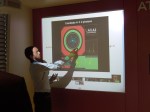
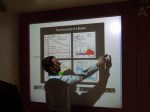
Liverpool University had a significant part in the building of this experiment. Their participation is described here.
CERN And Liverpool University
We were then treated to a lecture, about how Liverpool University fitted into the CERN firmament. Here’s some pictures that I took.

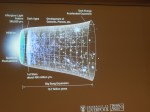
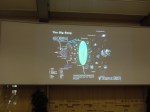
I think I should have made a video.
I can’t find a decent tome about how CERN and Liverpool University started their collaboration, so if anybody has one, send me a link, as the history of science fascinates me. That has led me to two of my heroes being Lise Meitner and Rosalind Franklin.
Nuclear physics at Liverpool dates back to the 1930s, when James Chadwick, who discovered the neutron, was appointed professor. The story of his research at Liverpool and the building of the cyclotron there is described here.
One phrase stands out from the talk. I think it was Sir Howard Newby, the University Vice-Chancellor, who said.
Research is global.
This is so true and it is why places like CERN must exist.
On My Way To CERN
CERN is reached from the centre of Geneva by a number 18 tram, which ends its journey at the site. You can either pick this up at the main station or as I did at Bel-Air, which is a major tram interchange at the foot of the old town.
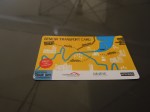
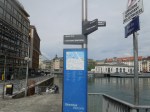

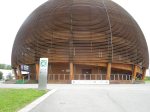


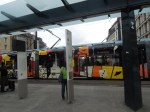

It was all very simple and civilised and took under thirty minutes.
A Visit To CERN
On Friday, I left the cold of London for hopefully better climes in Geneva.
The purpose of the visit was to go to CERN, the European Centre for Nuclear Research. The invite came from the Alumni Relations people at my old University of Liverpool. It was a full weekend, so I’m going to post things as they turn up. To give a taster of this visit, I’m posting this picture.

A Visit To CERN
This shows me in front of the CMS experiment. It is being rebuilt at the moment.
The picture was taken about a hundred metres underground the French countryside. That was a long climb back. But they did have a lift, which was cosy for the twenty-five or so in each party.
A Three Hour Eye Test
Yesterday, I went to Moorfields Eye Hospital for an eye test.
Not your average eye test, but one that was part of a study to test new diagnosis methods, rather more than my eyes. The eyes incidentally, seemed to be much the same as ever.
What I found interesting was how far the new equipment is moving down a patient-friendly route and the more things they could tell you.
As an example, with my eyes, I hate the standard ‘puff of air’ test, that checks the fluid pressure inside your eye. If you want to read more on what is called ocular tonometry, it’s here on Wikipedia. I had a test from a new instrument, that was much kinder to my sensitive eyes. So that one instrument, seems a big improvement.
I also had a visual field test on the state of the art perimeter. There’s more on perimetry here. This was to compare with the results found on some of the new methods they tried in another test.
I had the same test in Cambridge in 2010, soon after I had the stroke. Unfortunately, they didn’t send me the results. Surely, it’s about time, that we all had an NHS account, where we could access all of our notes, X-rays and tests. I shall be trying to get those field vision results from Addenbrooke’s, as it would be nice to know, if my eyes have got worse.
Even a chain of opticians like Vision Express can’t access results of tests performed in one shop from another. That is apparently down to the Data protection Act. How stupid is that?
This is the second University research project, in which I’ve collaborated. The other was respect to widowhood at Liverpool University.
I would like to get involved in more, as research is something, I feel will be the saviour of this world.
Perhaps we need a web site, where people could register, to say they would be prepared to take part in research, that universities could tap into for volunteers.
Both the research projects I’ve been involved in, have been non-invasive and the worst danger I’ve faced is probably crossing the road to get to Moorfields. I suspect too, that much of the medical research in the next few years, will be of this non-invasive nature. I recently had a request from Liverpool University, looking for gay men, who had suffered bereavement, for a study. This is the sort of project for which a national database of possible participants would be a great help.
It was interesting to see how yesterday, one instrument was virtually a laptop in a frame. The boundaries between specialist professions like doctors, vets and dentists, and those like engineers and computer scientists, are getting very porous.
Are We Getting Less Intelligent?
This story in the Daily Mail and other newspapers suggests we are. Here’s the first few sentences.
It was an era of glorious scientific discovery.
And the reason for the Victorians unprecedented success is simple – they were ‘substantially cleverer’ than us.
Researchers compared reaction times – a reliable indicator of general intelligence – since the late 1800s to the present day and found our fleetness of mind is diminishing.
They claim our slowing reflexes suggest we are less smart than our ancestors, with a loss of 1.23 IQ points per decade or 14 IQ points since Victorian times.
As the study was done, by three universities, I won’t argue with their findings.
But it does make you think!
There are now so many factors in our modern life and the way we bring up and educate children, that without decent research we won’t know why. and we can’t go back and do experiments on our Victorian ancestors.
Is Lack Of Sun One Of My Problems?
I don’t know, but I’ve read this article about research at Edinburgh University with a great deal of interest.
I am very pale skinned and used to burn easily in the sun, so I kept out of it for long periods of my life. Since being diagnosed as a coeliac, and going gluten-free, strangely, I’ve tended to burn less easily.
I had a very bad winter in 2010-2011 and again this one in 2012-2013. This year our lack of sun in London has been very marked. I’ve just looked atb the pictures, I took on this blog in 2011-2012 and there seems a lot more sun than this past winter. I know, it’s not very scientific.
In the last few years of her life, C and I always went away for a few weeks in January and I felt better. She would also drag me out for a walk on any day that the sun might come out.
Soon, after she died, my GP at the time, thought I might be suffering from SAD, so one of the actions I took, was to wear a thick coat and drive my Lotus with the top down. The extra sun seemed to help!
Let’s hope the sun kicks me back to life!
More From The Institute Of Economics and Peace
the web site of the The Institute Of Economics and Peace is fascinating.
Shown here, is a comparison of the various US States. As most would expect, Maine and Vermont are at the top, but to me, there are some surprising states in the bottom ten.
And here is a global terrorism index.
Both reports have very good interactive maps.
I think research like this is invaluable, when it comes to sorting out the world.
The Joy Of Global Warming
Bjorn Lomborg likes to provoke and this article in the Sunday Times certainly does. He starts the article like this.
As I fly into a snow-bound Britain, I realise that you might be asking where global warming has gone as you shiver in the coldest March for 50 years and wonder what you will do if gas has to be rationed. I have been involved in the climate debate for more than a decade, but I am still amazed at how wrong we get it. Let us try to restart our thinking on global warming.
Yes, global warming is real and mostly man-made, but our policies have failed predictably and spectacularly.
He then goes on to say that Kyoto has failed.
But he does produce a solution that could be a win-win situation for everyone.
He says that we should spend money on research!
He is right!
Just look what has happened to products like computers because money has been spent on research!
I have heard some wacky ideas to generate energy and cut carbon dioxide emissions over the last few years. Some of them might just be the things we do to save the planet.
But then engineers and scientists have a track record in digging us out of the holes that politicians and others have got us into.
Where for instance would Britain be today without the genius of Henry Royce, Lord Hives, RJ Mitchell, Alan Blumlein, Alan Turing and Sydney Camm. Under a Nazi jackboot perhaps?
But they and others answered Churchill’s plea and gave the country the tools to finish the job.
A similar massive effort today on a world-wide basis would I believe solve the problems of global warming and create a world fit for our descendents.
The same approach could be used on all of the major problems of the world like cancer, providing clean water, housing and food production.
 The Anonymous Widower