What Is Putin’s Attitude To Rail Baltica?
Rail Baltica is a railway that the EU is building between Warsaw in Poland and Helsinki in Finland.
This is the first paragraph of the railway’s Wikipedia entry, which gives an outline of the route.
Rail Baltica is an under-construction rail infrastructure project that is intended to integrate the Baltic states in the European rail network. The project envisages a continuous rail link for passenger and freight services with stations from Tallinn (Estonia) to Warsaw (Poland), via Pärnu (Estonia), Riga (Latvia) and Kaunas (Lithuania), with two branches extending from the main line towards Riga International Airport and Vilnius (Lithuania). Its total length in the Baltic states is 870 kilometres (540 mi), with 213 kilometres (132 mi) in Estonia, 265 kilometres (165 mi) in Latvia, and 392 kilometres (244 mi) in Lithuania.
The second paragraph explains the history of the railway gauge in the area
Rail Baltica will build the first large-scale mainline standard gauge railway in the region. Rail networks in Estonia, Latvia and Lithuania mainly use Russian gauge (1,520 mm). These countries’ first railways were built in the second half of the 19th century as part of the Russian Empire rail network. While some railways were built or converted to narrow or standard gauge in the Interwar period between World War I and World War II in the independent or German-occupied Baltic states, these were later converted back to Russian gauge under Soviet occupation rule after 1945.
The Russians do seem to be protective of their gauge.
The third paragraph gives the current status of the project.
As of 2025, the completion of the phase 1 single-track railway from Tallinn through Latvia (Riga) to the Lithuania-Poland border is scheduled for 2030, with completion of the double track railway to follow dependent on funding. Rail Baltica is one of the priority projects of the European Union (EU). It is part of the North Sea–Baltic Corridor of the Trans-European Transport Networks (TEN-T) and it is also intended as a catalyst for building the economic corridor in Northeastern Europe. It has also been proposed to extend Rail Baltica to include an undersea railway tunnel between Tallinn and Helsinki. By 2024, the estimated cost of the project had increased from €5.8 billion in 2017 to €23.8 billion (at 2023 prices).
These are some characteristics of the railway.
Terminals: Warsaw and Helsinki.
Countries Served: Poland, Lithuania, Latvia, Estonia and Finland
Intermediate Stations: 8.
Electrification: 25 kV 50 Hz AC overhead line.
Operating Speed: Passenger – 145 mph.
Freight – 75 mph.
Signalling: ERTMS – L2
Putin’s Attitude To Rail Baltica
Although, I can’t talk to Putin about this, I’m sure Google AI can give us a good idea.
I asked Google AI,”What Is Putin’s Attitude To Rail Baltica?” and received this answer.
Vladimir Putin’s attitude toward Rail Baltica is one of deep hostility, viewing the 500-mile high-speed railway as a strategic, military, and infrastructural threat to Russian influence in the region.
The project, which aims to integrate the Baltic States (Estonia, Latvia, and Lithuania) with the European rail network, is seen by Moscow as an effort to sever ties with the former Soviet bloc and solidify NATO’s presence on Russia’s border.
Key Aspects of Putin’s Opposition:
Military Threat Assessment: The Kremlin views Rail Baltica not just as a civilian project, but as a crucial logistical tool for NATO to swiftly transport troops and equipment to the Baltic region, strengthening the “eastern flank” that Russia challenges.
Destabilizing Russian Sphere of Influence: Moscow perceives the integration of the Baltic States into the European infrastructure system as a direct challenge to its influence and an “imperial project” aiming to detach them further from the post-Soviet space, which Putin seeks to keep within Russia’s sphere of influence.
“Putin-Proofing” the Baltics: The project is explicitly recognized by Baltic officials as a way to “Putin-proof” their countries against Russian aggression by reinforcing their security and economic autonomy, a move the Kremlin strongly opposes.
Infrastructure Isolation: The project enables the Baltic States to shift away from the Russian gauge track (1520mm) to the European standard (1435mm), decreasing their dependency on Russian logistical infrastructure.
While the Russian state has not issued daily commentary on the railway, its overarching aggressive posture toward the Baltics, including threats to Lithuania over transit to the exclave of Kaliningrad and the use of hybrid operations in the region, indicates a fundamental opposition to projects that deepen Western integration, such as Rail Baltica.
Mega Airport Costing £24billion In Europe To Rival Heathrow And Dubai
The title of this post is the same as that of this article in the Daily Express.
A new mega airport is being built in Europe, and it is set to rival the likes of Dubai and London Heathrow in terms of size and capacity for passengers and planes alike
These three paragraphs add more details.
A plush new airport could be touching down in Europe, set to rival London’s Heathrow and even the esteemed Dubai International, as it aims to link the entire continent in unprecedented ways.
The Centralny Port Komunikacyjny, a proposed $32.5 billion project, is a fresh aviation gateway in Warsaw that carries the burden of Poland’s ambitious mega airport aspirations. However, the concept is swiftly progressing, with the official approval and handover of the passenger terminal design marking a significant leap forward.
This suggests the colossal airport is officially moving into its next phase of development. The question remains, will this new progression challenge the supremacy of the Middle East, home to both the world’s largest airport, King Fahd International Airport in Saudi Arabia, and the busiest, Dubai International Airport?
Note.
- In English, Centralny Port Komunikacyjny means Central Communications Port.
- CPK’s forecasted passenger capacity makes it a formidable contender as the new hub for Europe.
- Dubai is on course to handle 100 million passengers by the end of next year, thanks to its strategic geographical position with other continents, while the Polish project will eventually accommodate up to 44 million.
- n 2024, Heathrow Airport welcomed a record 83.9 million passengers, a 6% increase from the previous year.
Even the busiest airports in Europe handle far fewer passengers than Dubai.
Central Communications Port has a Wikipedia entry, which has this first paragraph.
The Central Transport Hub is a planned major infrastructure project in Poland aimed at the construction of a new international airport and the development of a nationwide integrated transport network. The airport is planned to be located approximately 40 kilometres (25 mi) southwest of Warsaw, connected to a new high-speed rail network and controlled-access highway system linking it with much of the rest of the country.
Note.
- The airport will be designed by Foster + Partners in collaboration with Buro Happold.
- Initially the airport is planned to have two runways, but will eventually be expanded to four.
- The combined airport and railway station is planned to serve 40 million passengers per year, double the size of Berlin Brandenburg Airport.
- The long-term goal is about 100 million passengers per year.
These are my thoughts.
The Airport’s Location
The Wikipedia entry for the airport has a section called Location, which has this first paragraph.
The airport’s planned site is about 40 km west of Warsaw, next to the village Stanisławów which is part of Gmina Baranów in Grodzisk Mazowiecki County. The Baranow commune occupies a significant part of the Grodzisk County and, despite its rural character, has an extensive road infrastructure. The A2 autostrada and railway lines run in the immediate vicinity of the potential construction site, and Wrocław (Expressway S8) and Poznań (National road 92) is nearby.
It sounds to me, that a British equivalent airport, would be a four-runway airport at Birmingham Airport with connections to the M1, M6, HS2 and the West Coast Main Line.
Rail Connections
The Wikipedia entry says this about rail connections.
Planned train connections from the CPK will take 15 minutes to Warsaw Central railway station, 25 minutes to Łódź Fabryczna railway station, and 2 hours to most other major Polish cities, such as Kraków, Wrocław, Poznań and Gdańsk. The construction of a high-speed train to Frankfurt (Oder) is also planned, which is to shorten the travel time on the Berlin-CPK route to under 3.5 hours
I suspect that Rail Baltica’s trains between Berlin and Helsinki via Warsaw, Kaunus, Riga, Bialystok and Tallinn will also stop at the airport.
The Airport Will Become A Gateway To North-East Europe
I wouldn’t be surprised to see Central Communications Port become a low-cost gateway to the surrounding countries., like Belarus, Estonia, Finland, Latvia, Lithuania and hopefully Ukraine.
Polish Hospitality
Consider.
- Most Poles speak English better, than what I does!
- There are several large Polish cities that are worth a visit.
- The food is excellent, as the local basic ingredients are of high quality.
- I have spent about a month in Poland and I’ve stayed in all levels of accommodation from the lowest to the highest and have never felt need to complain.
- They handle my gluten-free diet with no problem.
My experience of Belarus was also similar.
Lithuania To Germany Intermodal Service To Launch In April
duiThe title of this post, is the same as that of this article on Railway Gazette.
These are the first two paragraphs.
Lithuanian national railway’s freight business LTG Cargo is to launch a service carrying containers and semi-trailers from the Kaunas Intermodal Terminal to Duisburg in Germany on April 4.
Trains with a capacity of up to 36 semi-trailers and containers will run thrice-weekly on the 1 500 km route. This will be LTG Cargo’s first westward service operating in three countries, with operations in Poland and Germany handled by its LTG Cargo Polska subsidiary.tail
These are more information and my thoughts.
The Route
The route appears to follow a route from Kaunas to Warsaw via
- Marijampolė
- Šeštokai
- Mockava
- Suwalki
- Buchwalowo
- Bialystok
Note.
- The links on the names are to the town’s Wikipedia entry.
- The border between Lithuania and Poland is between Mockava ans Suwalki.
- There are freight yards and change of gauge facilities at Šeštokai and Mockava.
Some of these towns are probably worth a visit, especially if like me, you have Jewish ancestors from the area.
My father’s great-great-grandfather possibly came from Konigsberg in East Prussia and arrived in the UK around 1800.
The Russian And Standard Gauge Solution
Consider.
- Estonia, Latvia and Lithuania have Russian gauge railways which is 1520 mm.
- Poland, Germany, France, Italy and the UK have standard gauge railways, which is 1435 mm.
The solution has been to build between Kaunus and Šeštokai, to build Russian gauge and standard gauge tracks side by side.
Kaunas Intermodal Terminal
This Google Map may show the Kaunas Intermodal Terminal.
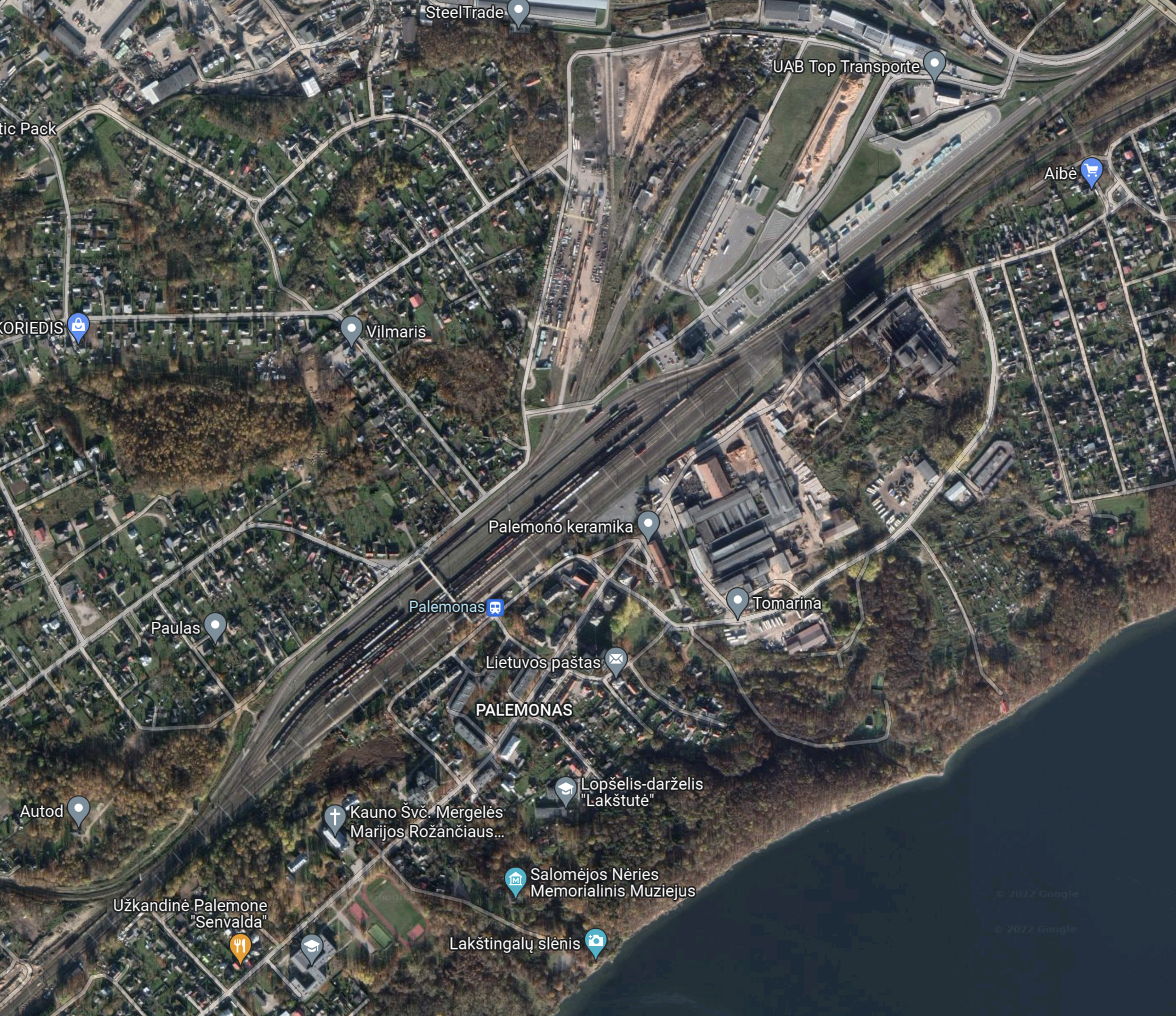
Note the rail yards in the middle of the map, have both Russian and standard gauge tracks.
Rail Baltica
The route taken is the standard gauge route of Rail Baltica, which is an EU project.
- It will run between Helsinki and Warsaw.
- Intermediate stops will be Pärnu, Riga, Riga International Airport, Panevėžys, Kaunas and Bialystok
- Vilnius will be served by a branch from Kaunus.
- The line will be double track.
- The line will be electrified with 25 KVAC overhead.
- Passenger trains will operate at up to 249 kph.
- Freight trains will operate at up to 120 kph.
- A tunnel will be built later between Helsinki and Tallinn.
Completion of the route between Warsaw and Tallinn is planned for 2026.
Rail Baltica I
Rail Baltica I is the first section of the route to be opened and is described like this in Wikipedia.
The name Rail Baltica is also sometimes used to mean the first phase of European gauge railway construction from the Poland-Lithuania border to Kaunas in Lithuania.
It opened in October 2016.
The new freight service will use this route to connect to Bialystok and Warsaw.
Conclusion
I have been on the roads in this area of Poland and rail freight services are needed to take the pressure off the roads.
 The Anonymous Widower