Desperate Times Call For Desperate Measures
The title for this post was inspired by this article on the BBC, which is entitled Water Scheme Kicks In To Boost Severn Amid Drought.
This is the sub-heading.
A groundwater scheme in Shropshire that pumps additional water into the River Severn has been switched on
These are the first three paragraphs, which add more detail.
It comes after the Environment Agency (EA) last month declared drought status for the West Midlands, following the driest spring in 132 years.
The scheme, owned and operated by the agency, pumps groundwater stored naturally in sandstone underneath much of north Shropshire, and delivers it through an underground network of pipes into the Severn.
The scheme pumps almost 40 Olympic-sized swimming pools of fresh water every day into the river, with a total of 49 pumps and 53km (32.9m) of underground pipes.
It looks a good scheme to me, but I suspect, those pumps and pipes didn’t come cheap.
These two further paragraphs, explain how it works.
Two reservoirs in Wales – Clywedog and Vyrnwy – are the first resources used to top up the river during dry weather.
The groundwater scheme is the last option to be brought into operation during dry conditions, because of how resource-intensive it is.
I suspect politicians like Trump and Farage would not have sanctioned a scheme like this, as it only protects a river.
This page on the Environment Agency blog gives more details of the scheme.
I looked up the title, that I’ve used for this post on Google AI and received this answer.
“Desperate times call for desperate measures” is an idiom suggesting that unusual problems or difficult circumstances may require unconventional or extreme solutions that would not normally be considered. The phrase originated from an ancient Greek physician, Hippocrates, who wrote about extreme diseases needing extreme methods of cure. The saying acknowledges that when faced with significant challenges, bold or drastic decisions may be necessary for survival or success.
As it seems the scheme is working well, I feel that the decision to build it, was the right one.
Newport To Swindon Via Gloucester – 14th June 2025
Because of engineering works, we came home from Newport via a diversion through Gloucester.
I took these pictures.













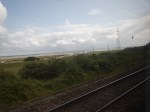



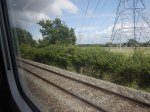

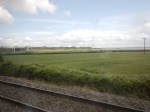

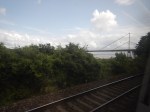


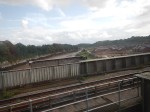
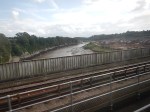
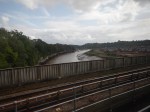


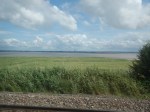

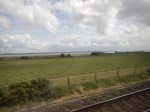
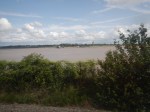
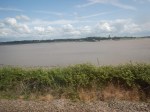
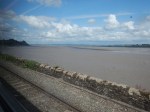
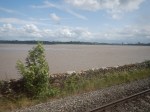
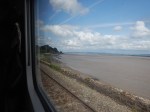








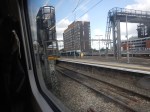

Note.
- I had sat on the right side of the train facing forward.
- We were accompanied my the thud, thud, thud of an underfloor diesel engine, as most of the route is not electrified.
- Newport and Gloucester is 44.8 miles.
- Gloucester and Swindon is 36.7 miles.
- Newport and Swindon is 81.5 miles.
- Newport and Swindon are fully-electrified stations.
- The first four pictures show Trains for Wales Premier Service.
- The Gloucester and Newport Line joins the South Wales Main Line at Severn Tunnel Junction station.
- As you travel towards Gloucester, the bridges over the Severn and the Wye can be clearly seen.
- There are two former nuclear power stations ;Berkeley and Oldbury, on the far bank of the River Severn.
- The large white wind turbine is close to Berkeley.
- Oldbury is further down the river.
As yesterday, the route is commonly used as a diversion route, when engineering works close the electrified main line through the Severn Tunnel.
I have some further thoughts.
Electrification Of Newport And Swindon
The distances involved are as follows.
- Newport and Gloucester is 44.8 miles.
- Gloucester and Swindon is 36.7 miles.
- Newport and Swindon is 81.5 miles.
As Hitachi’s Intercity Battery Trains are likely to have a range of around a hundred miles, they should be able to handle the diversion.
A short length of electrification could be erected in Gloucester station to charge any battery-electric trains, that needed a boost.
I believe full electrification is not needed.
 The Anonymous Widower