The M4 Is Open Again
So what?
After all this is supposed to be a Green Games, so shouldn’t athletes and official be using trains to get to Stratford. The original plans for the Heathrow Express called for the trains to go to St. Pancras as well as Paddington. So what happened to that? Here‘s a press release from Railtrack.
If the Heathrow Express to St. Pancras, had connected to ThamesLink, in say a simple cross platform interchange, that would have been the quick way to get between London’s two biggest airports.
The Rubbish Talked About HS2
I listened to some of the phone-in about HS2 on Radio 5 this morning, but gave up after most of those in the discussion, weren’t letting facts get in the way of a good selfish argument.
So here’s a few facts and my observations.
The West Coast Main Line is rather a nightmare. It is overloaded now and longer and bigger trains would probably only mop-up a small amount of the increase in passengers that will happen in the next few years. In my travels any Virgin train to or from Glasgow was severely overloaded and this section needs action now.
It was intended that the speed limit on the line would be increased, but because the line isn’t very straight, the cost would be high both in monetary terms and also in blockades whilst it was upgraded. Wikipedia says this about the reasons for the bad design of the line.
Because of opposition by landowners along the route, in places some railway lines were built so that they avoided large estates and rural towns, and to reduce construction costs the railways followed natural contours, resulting in many curves and bends. The WCML also passes through some hilly areas, such as the Chilterns (Tring cutting), the Watford Gap and Northampton uplands followed by the Trent Valley, the mountains of Cumbria with a summit at Shap, and Beattock Summit in southern Lanarkshire. This legacy of gradients and curves, and the fact that it was not originally conceived as a single trunk route, means the WCML was never ideal as a long-distance main line.
The East Coast Main Line is better, but it doesn’t solve the problem on the western side of the country.
So those who talk about increasing the capacity on the West Coast Main Line had better look at the engineering problems involved.
Christian Wolmar, a respected commentator on rail, said on television this morning, that the money for HS2 would be better spent on improving local tranport in cities and large towns, by providing trams and better bus services. He has a point, but there is one fault in his argument.
If we take Manchester as an example, where the tram system is being substantially developed, this will make it easier for long distance travellers to get to Manchester Piccadilly and the West Coast Main Line. If trams are frequent and have substantial car parking outside of the city, it may well persuade many more to take the train rather than driving.
So in fact, his plan will in the long term increase the long distance train traffic increasing the need for long distance services from Manchester and in a decade or so for HS2.
More passengers will also be brought to the line, by improvements to cross country and branch lines. Some of these like Manchester to Leeds are scheduled to be electrified and this can only attract more passengers to the fast London lines, where their local station has no connection.
One point on this is that Network Rail is investing in a special overhead line installation train, that can install a mile of overhead wiring every night with only minimal line closure. This will mean that some lines where only a marginal case exists now, will be electrified. An example is possibly from Felixstowe to Nuneaton via Peterborough, which would allow freight trains to be electric hauled all the way to the North of England and Scotland.
Another big problem is freight, which most would feel is better carried by rail to and from the ports to where it is needed. A few years ago, Felixstowe had just three freight trains a day out of the port. Now it’s a lot higher. Much of the freight will come and go through Felixstowe, Southampton and in the future the new London Gateway development and it will need to be either collected from and delivered all over the country. This would add greatly to the number of freight trains going everywhere. Many of course, will have to go up to Birmingham, the North West and Scotland.
So whatever we do we’ll have to find some way to take the freight north or alternatively free up the West Coast Main Line, by building HS2. Or do we put more trucks on the motorways and clog them up?
Those that propose upgrading the West Coast Main Line with longer and bigger trains, forget one problem, that under the current plans also applies to HS2. And that is what to do with the totally inadequate station at Euston. Of London’s main stations it is one of the worst, as I said here. It will have to be rebuilt whether we build HS2 or not. It really doesn’t have the good ongoing transport links that Kings Cross, Liverpool Street, London Bridge and Paddington have or in some cases will have after Crossrail.
In fact it could be argued that if HS2 has a station at Old Oak Common, this might be a better London terminus for that line, as it links to Crossrail, the Great Western Main Line and possibly Heathrow.
There are also a lot of technology that will make HS2 better from an engineering, environmental and passenger point of view.
For a start tunnelling technology has improved substantially in the last decade or so. If you look at the speed of building the Crossrail tunnels, I think that this shows a big increase to the similar tunnels bored for HS1. Having listened to Justine Greening’s statement in the House of Commons, this improvement is being used to put more of the line underground. We may actually be getting to the point, where tunnels are cheaper to build that lines on viaducts.
We also know a lot more about how to minimise problems when we build large projects. Crossrail for example seems to be causing a lot less problems with construction than HS1 did. Admittedly, it has caused a bit of a problem at some Central London station sites, but no more than say the average large building site or an office block.
Project management has also got a lot better over the last few decades and it is much more likely these days that a large contract is built on time and on budget. Provided the politicians and the civil servants don’t stick their oar in too much and change the specification, it will be all right in the end.
As the Sunday Times pointed out at the weekend design is getting better and the trains on HS2 could be a lot better than Eurostar. We might also see other technologies like anti-noise cutting the noise signature of the trains.
It has also been said that passengers won’t use HS2 because it will be too expensive and too much hassle. But here is where technology will help, in such things as buying tickets, where hopefully we’ll see a touch-in touch-out system like Oyster.
So the doom-mongers will continue to knock HS2, but it has a lot going for it.
The trouble with rail projects, is that if we had a referendum about spending £32 billion on rail or the same amount on roads, the public would vote for the roads. But within a few years they’d be just as gridlocked.
What We’re Good At!
I was very pleased when I read the third leader in The Times today, entitled Capital Idea.
This was the first paragraph.
After the on-time and underbudget Olympic Stadium, yesterday brought the opening of the Hindhead Tunnel on the A3, on the main route between London and Portsmouth, on time, on budget and garlanded with awards for its safety record. Britain is in danger of getting a reputation for being good at large infrastructure projects.
I could add another couple of projects like the London Overground, where the engineers delivered quality at a price well under the budget.
Bailing Out Barbara’s Folly
The Humber Bridge is one of those bridges that ;looked good on paper and to the politicians, but quite frankly it is now becoming an expensive folly. Wikipedia says this about its creation.
The Humber Bridge Act, promoted by Kingston Upon Hull Corporation, was passed in 1959. This established the Humber Bridge Board in order to manage and raise funds to build the bridge and buy the land required for the approach roadsHowever raising the necessary funding proved impossible until the 1966 Hull North by-election.
To save his government, Labour Prime Minister Harold Wilson prevailed upon his Minister of Transport Barbara Castle to sanction the building of the bridge.
I know quite a few people, who either lived or worked on both sides of the Humber and to a man and a woman, none of them ever use the bridge. I myself, have only used it a couple of times to get to Beverley horse races in the past, but on the last time I went, I took the M62 from Doncaster, which is an easier route.
I suppose too, that the bridge was used to try to unify the unwanted and short-lived county of Humberside, which was abolised in 1996.
I think that the telling statistic is that the Humber Bridge only carries about 120,000 vehicles every week, whereas the similar-sized Runcorn-Widnes bridge carries 80,000 vehicles every day.
Why should we bail out a bridge that no-one seems to want?
It would be better to spend the money in providing better services, where they are actually needed, rather than expect people to cross the bridge to say get advanced medical treatment.
There is a possible long-term solution to the bridge, that has been ducked for years and that is to create a road from the M11 up through Cambridge and Lincolnshire to join the bridge and create an alternative route north to by-pass the congested A1.
I suspect it will never be built, as container traffic is moving successfully to the railways and building roads is now something that no government feels they want to do. Correctly in my view!
What would happen today, if the Humber Bridge was being designed now?
It is interesting to look at the new designs for the new Forth Road bridge. Not only have they taken pressure off the crossing, by building a new bridge further upriver, they have gone for a much simpler and less grand design, if the pictures I saw in Scotland recently are anything to go by. But then the Forth Road bridge has been a success in terms of the traffic carried. This could not be said for the Humber bridge.
The Humber bridge was a badly planned bridge, built for political reasons and now it sits like a white elephant around everybody.
I suspect that the best solution at some point would hae been a modern ferry for local traffic, given that most long distance traffic into the area uses the good east-west roads.
But ferries aren’t sexy, are they? Given that those on the Mersey and the Thames still run and are much loved, I suspect that might have been the best solution.
But now it is too late!
So now we’re left with the problem of what to do with the bridge and its financing!
Looking at the map, I wouldn’t rule out that a new crossing is build to the north of Scunthorpe to improve northern connections to that town, which is suffering somewhat at the moment. After all, transport in the whole area needs improvement, with decent rail links to London, the Midlands and the North.
Perhaps the biggest mistake was not to make the Humber bridge, one that carried both road and rail! I do sometimes think, that someone wanted to design or build the longest bridge in the world. If they did, they created a white elephant.
Stoic Londoners
Last night, I had to go to the bus stop to pick up a friend, who was coming to dinner.
At the moment, the Balls Pond Road, is more like the Balls Pond Roadworks and as buses through Dalston appeared to be being diverted, buses were stacked up to get to the stop, where my friend was to alight.
But was it all fraught, with shouting and waving?
No! Everybody just got on with their travel, perhaps walked a bit if necessary and got off buses in the middle of the road, if that was all they could do.
Hopefully, it’ll all be better in a week or two, when the works finish.
You do sometimes think that stupidity makes it worse. Yesterday, as I walked back from Dalston Junction, the road was narrowed by the road works, so what did some idiot decorators do? Block the pavement with ladders, so they could paint a building. This meant mothers with buggies had to use the road and weave between buses, trucks and other vehicles. Hopefully, there wasn’t an accident.
Train Across the Mersey
Everybody knows about the Mersey Ferries, in part due to Gerry Marsden‘s song of the same name. The train though crosses the river at Runcorn on one of my favourite bridges, the Ethelfreda or Britannia Bridge, depending on your preference.
The bridge lies alongside the Runcorn-Widnes road bridge, which was built in the 1960s. I remember after a party once in Cheshire getting C to stop the car on the bridge as I was feeling unwell. I then proceeded to puke my guts into the river below. After that incident, she nearly didn’t marry me! I never went to another party, where ICI’s Petrochemicals and Polymer Laboratory, were responsible for the punch.
There is an interesting footnote to the design of the bridge and that is why it is not a suspension bridge. It is hinted at in the Wikipedia entry for the bridge.
The next idea was for a suspension bridge with a span of 1,030 feet (314 m) between the main towers with a 24 feet (7 m) single carriageway and a 6 feet (2 m) footpath. However aerodynamic tests on models of the bridge showed that, while the bridge itself would be stable, the presence of the adjacent railway bridge would cause severe oscillation.
But the true story is all about how good engineers know their subjects.
The designers of the bridge made a presentation before the design was finalised to the ICI Merseyside Scientific Society. One of those attending was Mond Division’s vibration expert, who supposedly had a fearsome knowledge of the subject, even if he was slightly eccentric. After the presentation, he rose to his feet and said that he’d done some quick calculations and because of the proximity of the two bridges, the proposed suspension bridge would shake itself to pieces at a particular windspeed.
The bridge designer was not amused.
But ICI’s vibration expert was proved to be right in wind tunnel tests and we now have the steel arch bridge. Here are some notes on the design from Wikipedia.
The design of the bridge is similar to that of Sydney Harbour Bridge but differs from it in that the side spans are continuous with the main span rather than being separate from them. This design feature was necessary to avoid the problem of oscillation due to the railway bridge.
So good design avoided creating another Galloping Girtie.
I took a video as the train crossed and you can see the road bridge and some of the details of the railway bridge, with the large Fiddlers Ferry power station in the distance.
The A11 Missing Link Goes Ahead
Or that’s what it looks like after the government’s cost cutting according to this report on the BBC.
I know you could have argued that in our current state all road projects should go, but this is one that will pay for itself in lives saved because of the dangerous Elveden village.
The upgrading of the A14 through Cambridge has been scrapped, but if the Felixstowe to Peterborough rail freight mprovements kick in as they should, then the congestion caused by heavy lorries may decrease. Remember too, that a lot of the cars on this section of the A14 are commuters working in the high-tech businesses in the Cambridge area and these are just the commuters that might use alternative technological alternatives.
So if it was the A14 or the A11, then the A11 is the more iportant. It’s just a pity though, that there appear to be no plans in place to improve the links between Great Yarmouth and the rest of the country. The A11 Missing Link will be a great help, but work on the Acle Straight would very much be welcomed.
Are There Fewer Container Trucks on the A14?
Today was the first time, I’d been along the A14 during the day and especially on a Saturday for some months. I may have been in a bus, but I couldn’t help thinking that there were very few container trucks on the road. It could either be the recession or perhaps more and more are going by rail to and from the Midlands and the North. After all the latteris what the work in Boxing Clever is all about. When I returned, between Bury St. Edmunds and Newmarket, we only saw three in pehaps twenty minutes!
The Two Forth Bridges
You shouldn’t go to Edinburgh on a trip like mine, that is looking at the engineering that has shaped this country, without going to see the two Forth bridges.
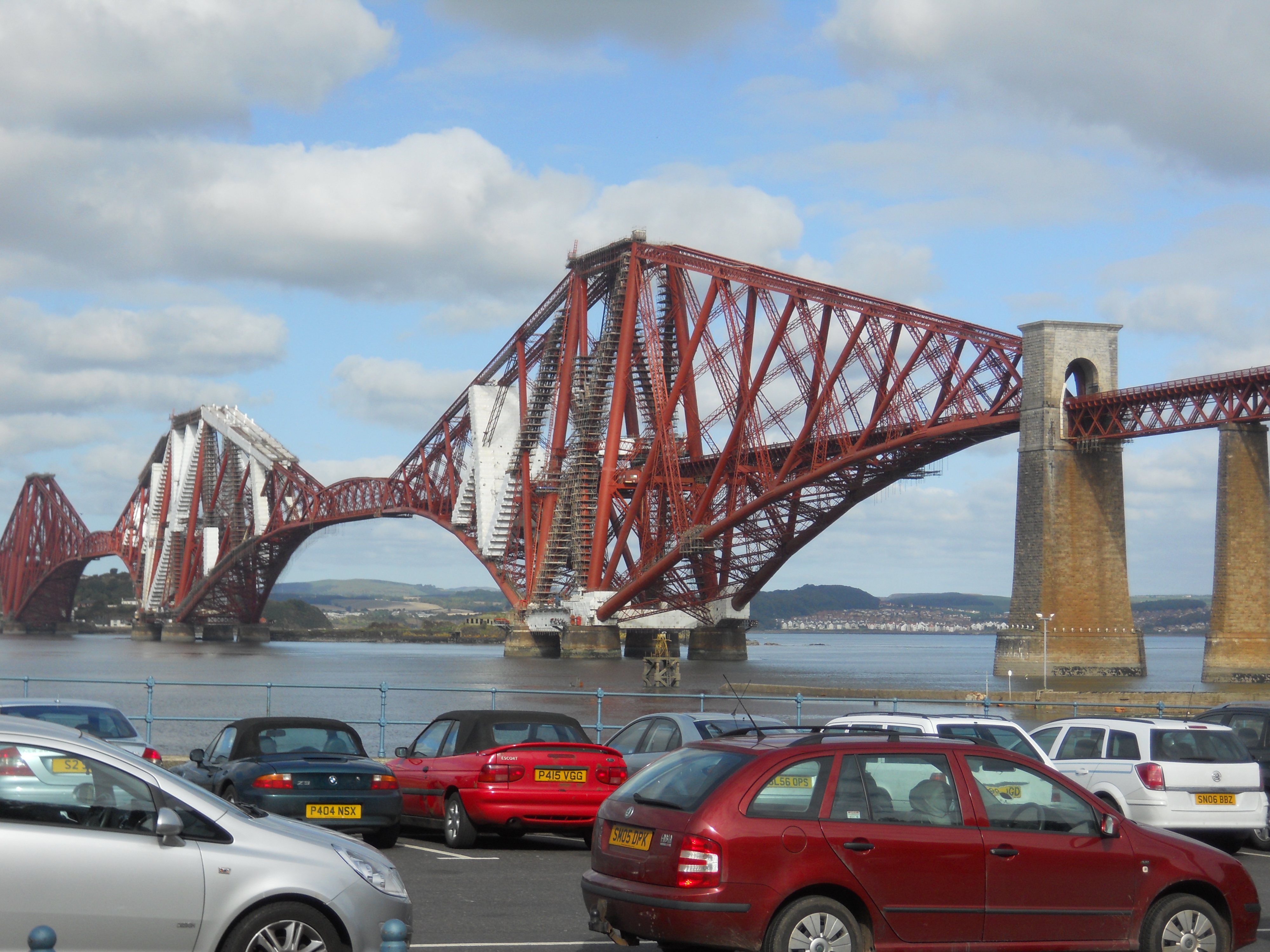
The Forth Rail Bridge
The rail bridge is probably the most recogniseable bridge in the world and despite being 120 years old it still carries upwards of ten trains per hour. Incidentally, as modern trains are lighter than steam ones, it is probably under less stress now than it was in the past. It’s been under less stree too in recent years as coal trains no longer use the bridge.
I do wonder that if can see this bridge in twenty years, whether the trains going across the top will be electric!
I’ve actually never been across the rail bridge and it’s been many years since I travelled across the road bridge. I think it was with my hosat in Edinburgh and my late wife, when we went to St. Andrews.
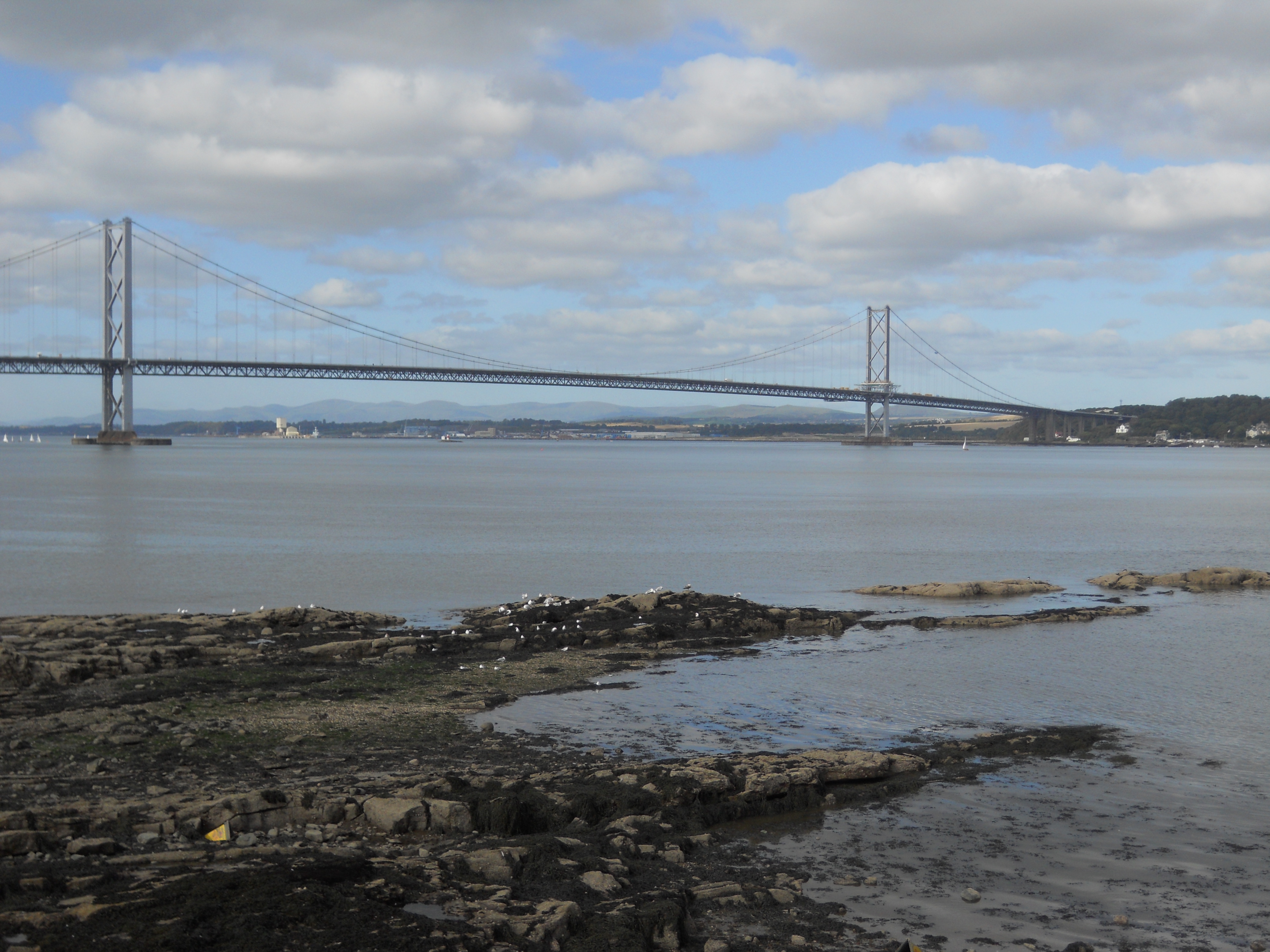
The Forth Road Bridge
It is rather ironic, that if I could return to this spot in 2100, it would be more likely that the older rail bridge would still be carrying traffic, whereas, it would appear that the road bridge will have to be closed by 2020.
So much for modern engineering!
Simon Calder on the M25
Simon Calder is one of my favourite writers and his piece on Saturday on the M25 in the free Independent, I got from East Coast was excellent.
I particularly liked this bit.
Time for coffee. No service station graces this stretch of the M25, but handily the coffee bar with the best view in the South-east is just a juggernaut’s shudder from Junction 14. The location is on the departures level of Heathrow Terminal 5. As you wander over from the car park, you can look west to Windsor Castle. And a window seat provides you with a view over one of the busiest runways in the world. On the apron below, Airbuses beetle about, while every minute or two a Boeing whizzes past the window, carrying hundreds of people with stories from afar – some of which would no doubt be told as the M25 guided them home with their meeters and greeters.
It sounds like a place to visit. But I suspect Simon’s publicity means it will be very busy!
 The Anonymous Widower