Minimum Age To Be A Train Driver Lowered To 18
The title of this post, is the same as that of this article on the BBC.
This is the sub-heading.
Eighteen-year-olds will be allowed to drive trains after the minimum age was lowered from 20 in a bid to tackle driver shortages.
These first three paragraphs add detail.
UK rail services are frequently disrupted due to a lack of drivers being available, and the problem is set to get worse with companies struggling to replace a growing number of people retiring with new recruits, the government said.
Transport Secretary Heidi Alexander announced the change as “bold action to improve train services and unlock thousands of jobs”.
Union Aslef said it would open up opportunities for school or college leavers, while the Rail Safety and Standards Board said its research found “18-year-olds are capable of safely becoming train drivers”.
This paragraph from Google AI, says you only have to be sixteen to join the British Army.
The minimum age to join the UK Army as a Regular Soldier is 16. However, you’ll be a Junior Soldier until you turn 18, at which point you can transition to a regular role. To join the Army Reserve, you need to be at least 18. The upper age limit for joining the Army Reserve as a soldier is the day before your 43rd birthday.
A similar age of sixteen, applies to the Royal Navy and the Royal Air Force, with eighteen applying for the Police.
How Does This Compare With Driving A Bus?
This paragraph from Google AI, gives the driving age for a bus.
The minimum age to become a bus driver in the UK is 18 years old. However, to drive a full-sized bus (Category D), you must be 24 years old, unless you are undergoing the Initial Driver CPC (Certificate of Professional Competence) qualification. For Category D1 (minibus), the minimum age is also 18.
Google AI gives this description of Category D1.
PSV (Public Service Vehicle) Class D1 licence, also known as a PCV (Passenger Carrying Vehicle) licence or a minibus licence, allows you to drive a minibus for hire or reward. This licence category applies to minibuses with up to 16 passenger seats and a maximum length of 8 meters, and can tow trailers up to 750kg. To obtain a D1 licence, you need to pass a medical check, a theory test, and a practical driving test.
I suspect that many eighteen-year-olds are capable enough to hold a PCV licence.
What sort of vehicle will someone with a PCV licence be able to drive?
Wrightbus subsidiary ; Rightech has just released a suitable vehicle.
- It is battery-electric powered.
- It can seat up to twelve passengers.
- It is six metres long.
- It has a range of 112 miles.
It has a high-specification, which includes air-conditioning.
This image is courtesy of Rightech.

I can see bus operating companies, creating a career structure, that starts drivers on a PCV licence and progresses them upwards to the full PSV licence at 24.
Conclusion
I feel this could be a very sensible decision and like the age and competence structure for bus drivers, it creates worthwhile jobs for 18-24 year olds.
SolarDuck, Green Arrow Capital And New Developments S.R.L. Sign Collaboration Agreement For A Grid-Scale Offshore Hybrid Wind-Solar Project In Italy
The title of this post, is the same as that of this press release from SolarDuck.
These three bullet points, act as sub-headings.
- 540 MW hybrid offshore wind-solar farm offshore Corigliano, Calabria
- Milestone project to accelerate scaling of Offshore Floating Solar Photovoltaic (OFPV)
- Strategic collaboration proves the potential of the technology in Italy and the wider
Mediterranean region
These three paragraphs outline the project.
SolarDuck, leader in OFPV technology, Green Arrow Capital, leading Italian Independent Asset
Manager in the alternative investment world, and New Developments s.r.l., one of Italy’s
most experienced developers, have agreed to collaborate on the development of a landmark
120MWp OFPV farm integrated with 420MW Floating Offshore Wind (FOW).The project will install SolarDuck’s unique elevated platform technology that allows PV panels
to be deployed in significant wave heights whilst maintaining a safe working environment for
access and maintenance and minimizing environmental impact. In addition, the collaboration
will also allow the harnessing of the complementarity of wind and solar energy resources.“With the current momentum, we believe this is a unique opportunity for the offshore
renewable energy industry to help shape a favorable regulatory framework and facilitate the
scaling of OFPV. This is not just important for Italy, but also for other countries in the
Mediterranean. Our collaboration with New Developments and Green Arrow Capital can also
serve as a catalyst for OFPV in Italy”, says SolarDuck CEO, Koen Burgers.
This Google Map shows the location of Corigliano at the foot of Italy.
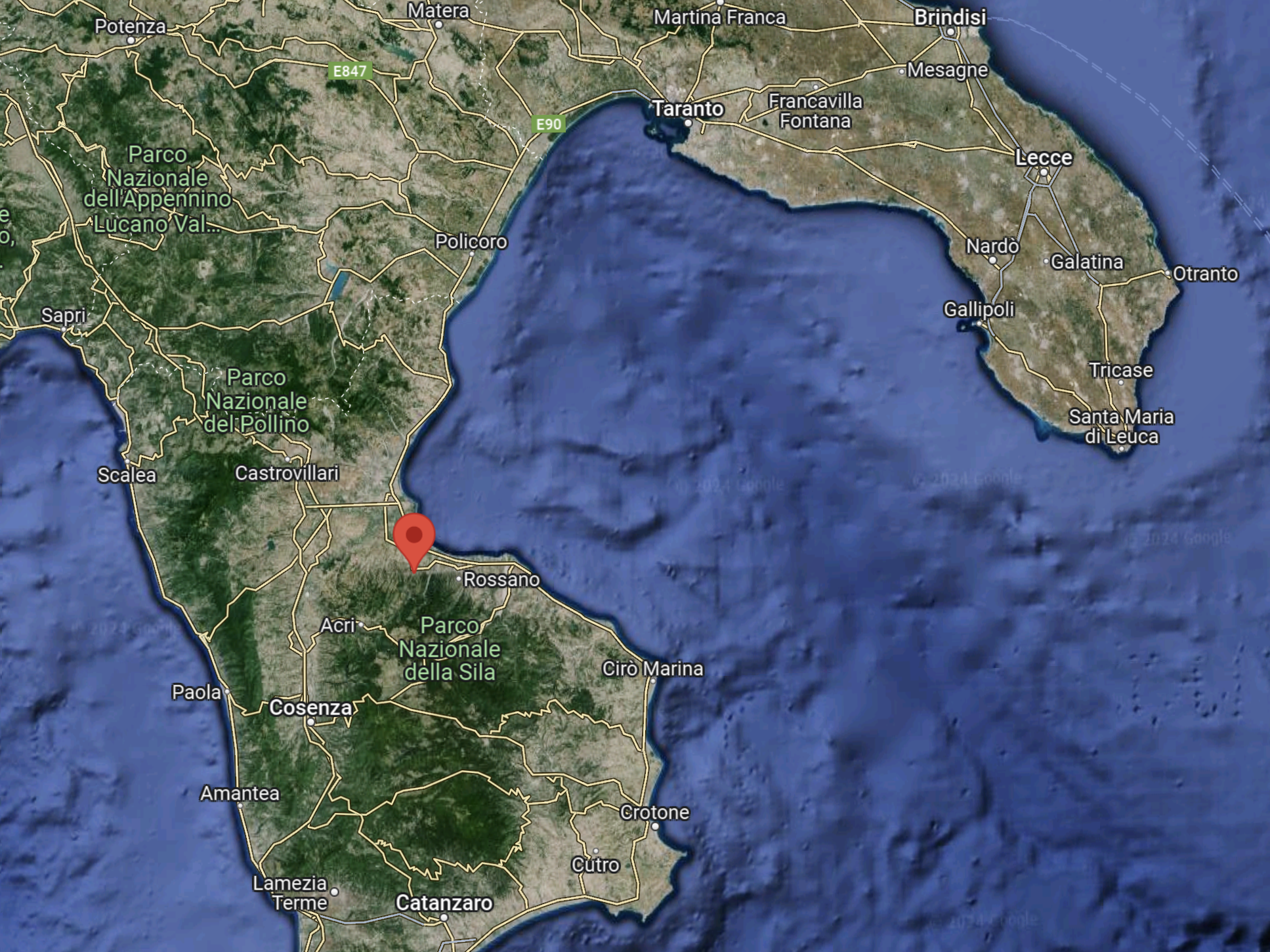
Note.
- Corigliano is indicated by the red arrow.
- There is an explanatory video of their technology on SolarDuck’s web site.
Opposite Corigliano on the other side of the can be seen the Italian Naval Base of Taranto, which was the scene of the Battle of Taranto, which was one of the most significant naval battles of Second World War, if not the most significant.
- This web page has the Fleet Air Arm’s account of the battle.
- I have a book, that shows the Japanese visiting Taranto after the battle.
- Did the Japanese use what they learned to plan their successful raid on Pearl Harbor?
- Without Pearl Harbor, would the Americans have stayed out of the Second World War?
I visited Taranto in the 1980s and stood on the Dockside. Perhaps, it is time to go again?
Conclusion
I have a feeling that a hybrid offshore wind-solar farm can generate more electricity in a given area, by making better use of the space available.
It will be interesting to see how this hybrid wind farm performs.
In an area with plenty of sun and wind, it could be a better solution.
Only the mathematics will tell.
The Painted Hall At Greenwich
The Painted Hall at Greenwich is now fully restored.
I went on Saturday and these are some of the pictures I took.















We had an excellent guide, who explained the imagery of the painting.
Much of it is aimed against the French and today, it can almost be considered to have a Brexit theme.
So has this philosophy about Europe and mainly the French been passed down the generations from the time of William and Mary?
The older I get, the more I realise that some of my personal philosophy on how I live and treat others has a Jewish slant.
Has it all come down from my sole Jewish ancestor, who arrived in this country from the Baltic in around 1800?
.
Memorials On The Liverpool Pier Head
Liverpool is proud of its maritime heritage and the Pier Head on the Mersey is part of a UNESCO World Heritage Site called the Liverpool Maritime Mercantile City.
When Celia and I met in Liverpool in the 1960s, it was a simpler place, where we would walk to take the ferry across the Mersey.
These pictures show the Pier Head today.
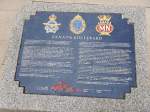



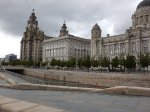



I’d never realised that the road across the Pier Head, had been named Canada Boulevard in honour of Canadians, who lost their lives in the Battle of the Atlantic or the war against German U-boats.
Shown in the pictures is the memorial to Captain Johnnie Walker, one of the leading British commanders in the battle.
The scale of the battle is shown by the fact that according to Wikipedia the Allies lost over 70,000 sailors, 3,500 merchant ships and 175 warships, whereas the Germans lost 30,000 sailors and 783 submarines.
One thing that wasn’t there in the 1960s is the canal that links the Leeds and Liverpool Canal to the Stanley Dock, so narrow-boats can visit the city centre.
My New All-Purpose Shopping Bag
I bought this stringbag for £2.95 and when I go out, it fits neatly in my shoulder bag or pocket.

My New All-Purpose Shopping Bag
Isn’t a stringbag the most useful of bags? After all it did lend its name to that most mighty of the Royal Navy’s attack aircraft; the Fairey Swordfish, which was called the stringbag on account of its ability to carry virtually anything to its target. Wikipedia has a full explanation.
The Swordfish is almost unique amongst military aircraft for two reasons.
Several aircraft types were built to replace it in service and it out-served them all.
In some attacks, it pressed the attack home successfully, because it flew slower than the low limit of the gun-aiming computer of the ship being attacked. The Germans hadn’t believed that an attacking aircraft would be as slow as a Swordfish.
But this unusual biplane did carry out one of the most unlikely battle successes of the Royal Navy, by attacking the Italian fleet at anchor in the Battle of Taranto. The lesson was not lost on the Japanese, who inspected the port after the attack. But the Americans, who must have known what happened at Taranto, did nothing to change their thinking.
The Battles Of Coronel And The Falkland Islands
Thebattles of Coronel and the Falkland Islamds were fought between the Royal and German Navies in the First World War. In 1927 a silent black and white drama/documentary was made telling the story of both battles called the Battles of Coronel and the Falkland Islands.
The British Film Institute have restored the film and on Friday, I went to see it at BFI Southbank.
It is a superb restoration to which has been added a modern score. Usually, when films of this age are restored you see the odd bit of blankness on the screen. But not with this film!
The film is also unusual in that no actors are given any credits, but the Royal Navy ships, who played the actual combatants in both navies are named.
It is a serious reconstruction of the battles, but it is not without dramatic and comic moments.
I thoroughly enjoyed it and it reminded me of when at about eleven or so, I saw the Powell and Pressburger film; The Battle of the River Plate, made about the battle in December 1939. I had seen the film in the Rex cinema in Station Road, Wood Green, which was close to my father’s print works.
It would be interesting to see that again to compare it with the earlier one. Both were made with real warships!
If you want to see the film, but can’t get to a screening it is available for download on the BFI Player.
A Day Out In Portsmouth
I’ve been to the Portsmouth Historic Dockyard before, but as my yearly ticket can be used as many times as I like for £24.25, I thought I had better go again. I chose today, as the weather looked it might by sunny in the afternoon. I got the weather wrong, as it was sunny from when I arrived in Portsmouth Harbour station at about 12:30, courtesy of South West Trains for £23.30 in ninety minutes.

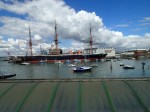




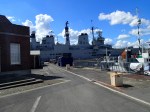
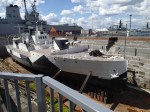
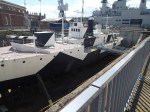
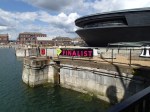
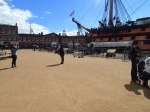
I walked to Carluccio’s in the Gunwharf Quays shopping centre by the station so I could have some lunch. But it would be much nicer if there was a direct connection between the station and the shopping centre.
Every time I visit Portsmouth there seems to be more to see, especially in the Dockyard.
The Tripe Talked About Building Warships In The UK
I have been listening and watching the debate about BAE ‘s decision to end warship building at Portsmouth and move this all to Glasgow.
Much of the argument has been based on emotional facts like Portsmouth has been building warships since the Mary Rose and political considerations of keeping Scotland happy. Little has got anything to do with having a Royal Navy that is fit for purpose.
This article on the BBC, gives a pretty good assessment of the political story. This section is the heart of the article.
So was this a sweetener to Scotland, to stave off a Yes vote? The Defence Secretary Philip Hammond was asked repeatedly in the Commons to say whether the Scottish poll had influenced his choice.
He made, broadly, three replies to the variety of ways in which he was posed that question. Firstly, he stressed that the decision to locate warship building solely in Glasgow was taken by BAE, with endorsement from the Ministry of Defence. It was, thereby, primarily an industrial rather than a political choice.
Secondly, he stressed the importance of cost. His entire statement was predicated upon the drive to contain rising costs in the aircraft carrier contract. The identification of a sole location was also, he suggested, driven by cost efficiency.
But, thirdly, he made a point with regard to the forthcoming orders for Type 26 ships. Mr Hammond’s core point in respect of the carriers was that a blunder had been made (by the predecessor government) in placing the contracts for these vessels before design was completed.
He would not repeat that error, he said, with the Type 26 contract. It would not be placed before design was “mature”. That would be at the end of 2014. He noted, twice, that would be after the Scottish referendum in September of that year.
So BAE, had to make a decision, before they know what orders are coming. They are a supposedly commercial organisation, so they will do what they see is best for the company. Given that costs are higher in Portsmouth than Glasgow for most things, I suspect that there was only two solutions; persuade the Government to buy lots of warships that we don’t need or close Portsmouth.
In the arguments I heard, no-one seemed to bring up the Falkland Islands. When Argentina invaded, as regards warships we were ill-prepared and had to scramble hard to get a task force together. But the rest as they say is history!
The one thing we can say with certainty, is that if we need to use the Navy in anger again, we’ll have the wrong ships, and they’ll be in the wrong place.
It was always thus!
I would suspect that the Navy goes through some of the most bizarre scenarios, and works out how they will handle them and that there will be a lot of improvisation in there.
Look at the operational history of HMS Ocean and you’ll find a lot of it, is in response to events. If you read the Wikipedia entry for HMS Ocean, you’ll find this gem.
While Swan Hunter viewed the ships as entirely military, “VSEL thought the design was basically a merchant ship with military hardware bolted on.” VSEL’s decision to sub-contract the build phase took advantage of lower overheads at a civilian yard as well as efficiency drives by its parent, Kværner. The cut-price build to commercial standards means that Ocean has a projected operational life of just 20 years, significantly less than that of other warships.
VSEL and Swan Hunter were completing for the work. But there was some serious innovation in the construction of this, in my view, successful warship. It’s certainly got us out of trouble a few times.
Innovation has been lacking over the years in the design of warships, which partly explains, why we and probably every other Navy has the wrong ships for a serious crisis.
One thing that should be thrown in, is if warship building is so important and BAE are so good at it, why aren’t we exporting ships to other friendly nations?
So are we subsidising warship building and BAE to an unsustainable high level?
HMS Victory
I hadn’t been over HMS Victory for many years.
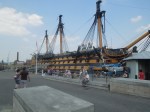
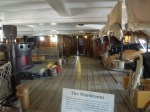

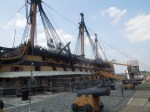
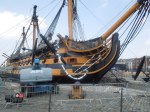
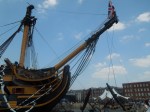

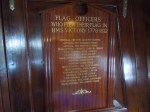
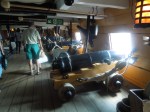

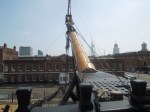
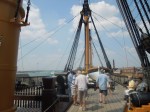
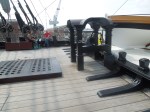
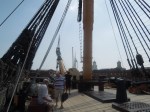
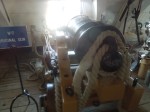
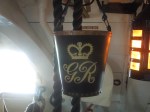



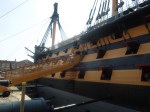
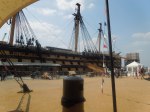
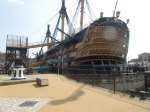
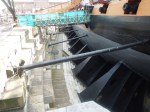
it is a bit stunted at the moment, as the masts have been taken away for some work, but they now give you free run right into the depths of the ship.
HMS Warrior
HMS Warrior was the first ship I visited.
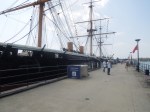
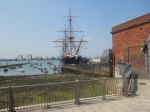
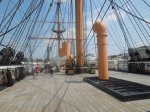
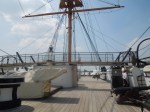
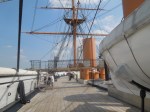
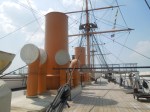
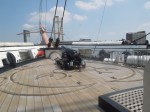
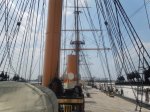
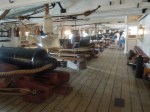
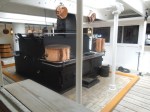
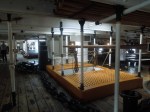
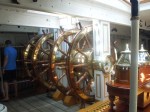



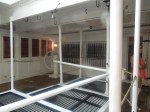
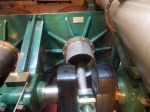
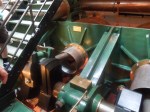
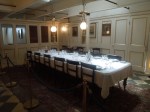
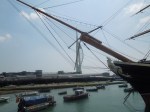
HMS Warrior was Britain’s first iron-hulled, armoured warship, when she was built in 1960 and she still floats in Portsmouth Harbour.
This site is her official web site.
 The Anonymous Widower