The Private Thoughts of Engineers and Scientists
Some years ago there was an attack on the Tokyo Metro using sarin gas. Although it killed a number of people and injured many more, it could easily have been a lot worse.
At the time, I knew a guy who was and hopefully still is a world class chemical engineer, who worked in the pharmaceutical industry. I asked him, just how easy it was to make Sarin gas. He said it was fairly easy, but in most cases, sarin will kill you before you use it, unless you can get the proper protection, which is the most difficult part.
He did however tell me a much more easy way to paralyse a city and cause a lot of damage. I will not repeat it here, but judging what I don’t see in London, other people have had the same thought and made the carrying out of such an attack impossible.
What worries me now, is if we had a jokey conversation in a chat room on the Internet about an attack similar to that in Tokyo, would our doors be kicked in?
Science as Entertainment
There is a science fair called The Big Bang on in East London at the moment.
It was talked about on BBC Breakfast this morning, but they didn’t think it worth saying where and when it was on, and how much it costs to enter.
They were just using the fair as an entertaining program filler.
I have just searched and found the web site, but it would appear that except for Saturday it is sold out. This should have been flagged up earlier in the month, but then most people in the media have no interest in science and believe that most viewers don’t have any either, unless they’re over forty or so!
Up With the Morning Star
Venus has very bright these last few days, as I hope this picture shows.
Venus, The Morning Star
The planet is just above the tree in the middle.
I’ve pointed Venus out to several people lately and they haven’t realised what they are seeing. Knowledge of the stars and planets is something that should be properly taught. At my school, Minchenden, there was an observatory that contained a beautiful telescope in both artistic and scientific terms, that had once belonged to Prince Albert. One night, someone broke in, smashed it all and stole the lens. It was no act of wanton vandalism, but a cold calculated crime. I at least hope that the thief dropped the lens, so got no pleasure from his act.
I always look up when I’m in unfamiliar lattitudes. I remember when C and myself were in a hotel in Alice Springs, a kid of about sixteen had set up his telescope and was showing the guests the night sky from an Australian perspective. We had perhaps an hour of his charming and informed company. I hope that somewhere in the world, he is still following his hobby. Perhaps as a career!
Sadly, we were the only people, who that night took advantage of his company. But how many read their horoscopes every day and act on them?
No wonder the world is in the state it is today, if that is the general view of science.
So what am I doing up at this hour?
I slept well as I usually do, but last night, I spent several hours clearing my loffice loft of my past life. So most of it was old magazines, books and software I no longer need, but the only way to clear it, was to drop everything into a wheelie bin and then transfer it to boxes, which I then threw in the skip.
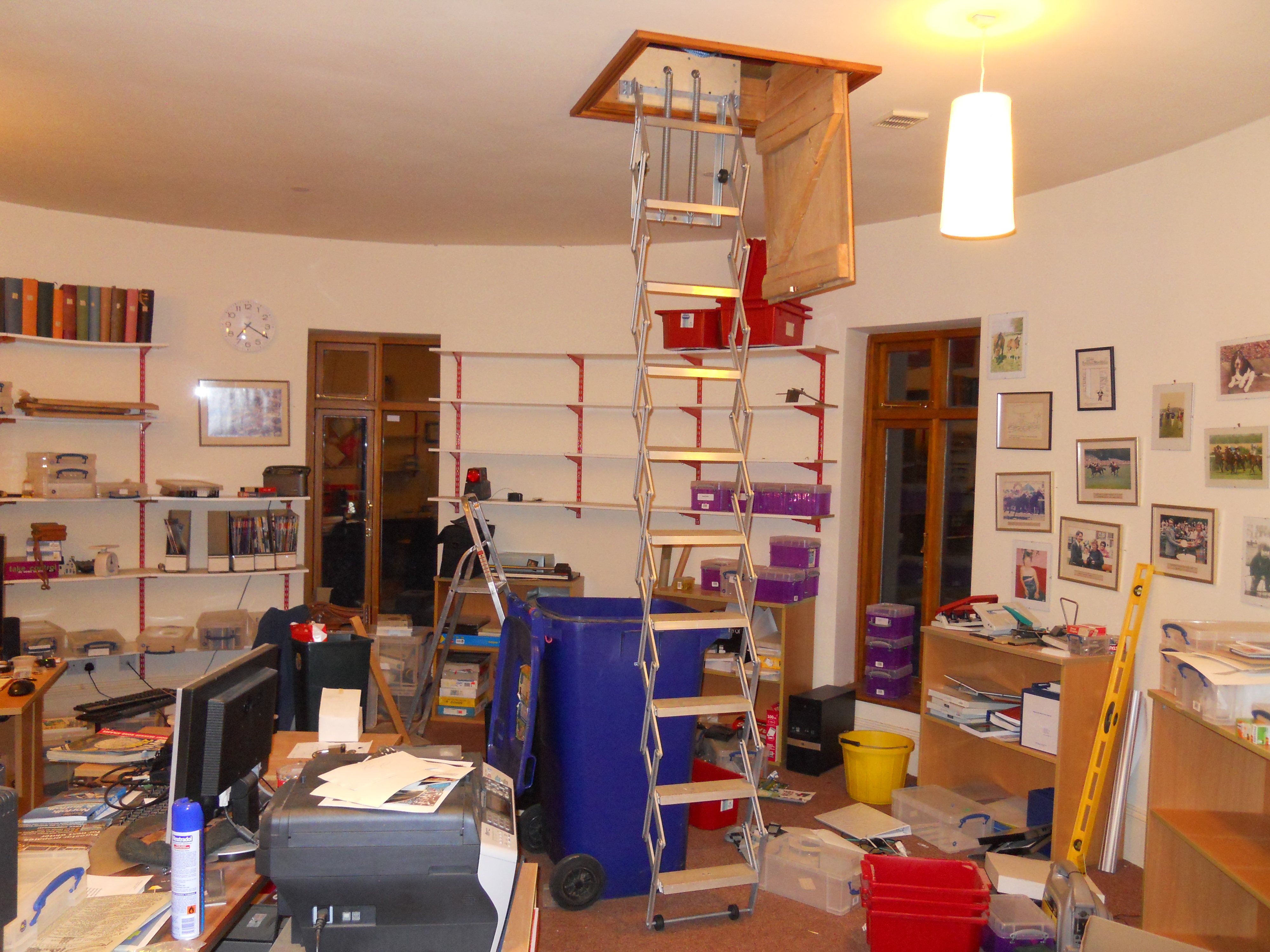
Clearing the Office Loft
It may have been a long-wnded process, but my shoulders aren’t strong enough to carry the boxes down the rather rickety loft ladder.
So perhaps the adrenaline is flowing through my body. I certainly feel pretty well today, although my left arm is tired.
Self-Repairing Solar Cells
I like this story. It just goes to show that if anything gets the world out of the mess, it will be scientists, engineers and other thinkers, who use science and technology correctly. It will be not be politicians, union leaders or those that believe God is always the solution. These people will just hold back those like the scientists in this story, who might be leading us to salvation from our lack of energy.
Decoding the Wheat Genome
In some ways I am pleased that scientists at mine and C’s old university, Liverpool, have led a team that has decoded the wheat genome.
I could make a sarcastic comment about what good is that to me as a coeliac, but it should help to ease the problems of feeding the world. Something that is needed even more given the problems in Russia and Pakistan, which may well be repeated elsewhere. Although new varieties will come too late for the current crisis.
I do suspect though, that science that works for wheat will also work for rice, maize and the other staple cereals. This is actually confirmed in the BBC Report, which says they are less complex and have already been done.
Fair Comment?
I have been following the progress of the action against Simon Singh by the British Chiropractic Association with interest. As a scientist, I believe strongly that in science we get progress by research, experiment, peer review and open debate, and not by resorting to the law. I’ve also always had a deep regard for Simon ever since he wrote Fermat’s Last Theorem: The story of a riddle that confounded the world’s greatest minds for 358 years

So perhaps I’m biased.
But I am rather pleased that he has obtained a judgement in the Court of Appeal, that allows fair comment as a defence in certain libel actions.
Scientifically-Correct – Raymond Tallis
I have used the term scientifically correct several times in this blog and you’ll find out a bit more about the history of the use of this term here.
Today, Raymond Tallis in The Times has written a comment entitled, “Test medicine in the lab, not the court”. Here’s the first two paragraphs.
A while back, I wrote a piece arguing that the retired, such as myself, had a responsibility to speak fearlessly about what we saw to be the truth and to take unpopular stands on difficult issues. After all, we no longer had any hope of advancement and the execration of ill-informed, unthinking or self-interested opponents could not touch us. Recent events have awoken my dormant cowardice to question this bravado. Speaking out on some things might mean that Mrs Tallis and I could end our days on the parish, cleaned out by a ruinous court battle with individuals or institutions with deeper pockets than us. The libel case brought against Simon Singh is one such event.
Singh is one of the most brilliant, accurate and thoughtful science writers of his generation. In 2008 he wrote a piece in The Guardian to coincide with Chiropractic Awareness Week challenging claims that spinal manipulation could be useful for treating childhood conditions such as asthma and ear infections. (Yes, ear infections — I kid you not!) The British Chiropractic Association (BCA) protested that he had defamed its reputation and threatened to sue for libel. The Guardian offered the BCA a 500-word response and an entry in its “Corrections and Clarifications” column. This was rejected, The Guardian chose not to engage in a potentially costly battle, and Singh was on his own. He courageously decided to fight on, because of the principles at stake.
Now I was married to a barrister, who did one of her pupilages in libel chambers. In those far-off days of the early 1980s, libel was all about people with massive egos and often bank balances, who felt they had been wronged in the tabloids. Now, it seems it is being used in a much more general way to protect commercial interests.
In the next few years, how many writers and scientists will challenge the established view, if they felt that what they said despite the overwhelming evidence was against the commercial interests of a large company or professional organisation?
Raymond Tallis finishes by asking us to become a signatory on the National Petition for Libel Reform. I have done what he asked and suggest that all those who want scientifically correct, rather than lawyer derived truth, should sign.
Magnetic Electricity
When I was studying Electrical Engineering at Liverpool University in the 1960s, one of the prize pieces of equipment was a laser. They had been invented only a few years before and the one in the University had cost several thousand pounds. Ideas were being researched for their use in commercial applications.
Now, we all own lots of lasers. Every CD player and computer has at least one and their cost is only a few pence. You see them in bar-code scanners at the supermarket and in many myriad applications from the mundane to the deadly.
So what will be the technology that now is just a scientific curiosity, but in forty years will be as commonplace as the laser is now?
Here’s one! Magnetic electricity.
Will it be the next great scientific advance? Who knows?
The Power of Magnets
It may be simple in essence, but it does look that it might not be so simple to make work. On the other hand, if it does it could be a spectacular breakthrough in the fight against cancer. Effectively, you induce ferrous nanoparticles to lodge in the cancerous cells and then you blast them with a strong magnetic field. This raises their temperature and kills them.
For a more detailed (and better) explanation see The Times.
I do rather have this belief that the big breakthroughs in medicine in the future will come by combining the best of medicine, with the best of engineering, physics, chemistry and many more disciplines.
 The Anonymous Widower