All Change On Thameslink
Wikipedia gives a Provisional Timetable for Thameslink.
- 4 trains per hour (tph) – Sutton to St. Albans (2 tph via Wimbledon, 2tph via Mitcham)
- 2tph – Brighton to Bedford
- 2 tph – Gatwick Airport to Bedford
- 2 tph – Brighton to Cambridge
- 2 tph – Horsham to Peterborough
- 2 tph – Tattenham Corner to Cambridge
- 2 tph – Sevenoaks to Kentish Town
- 2 tph – Caterham to Finsbury Park (stopping via Sydenham or semi-fast)
- 2 tph – Maidstone East to Luton
- 2 tph – East Grinstead to West Hampstead
- 2 tph – Littlehampton to West Hampstead
Some services are extended in the Peak to and from Bedford, Luton, Three Bridges and Welwyn Garden City.
According to Modern Railways for August 2016, the new proposal is.
- 4 trains per hour (tph) – Sutton to St. Albans (2 tph via Wimbledon, 2tph via Mitcham)
- 2tph – Brighton to Bedford
- 2 tph – Three Bridges/Gatwick Airport to Bedford
- 2 tph – Brighton to Cambridge North
- 2 tph – Horsham to Peterborough
- 2 tph – Maidstone East to Cambridge
- 2 tph – Sevenoaks to Blackfriars
- 2 tph -Orpington to Kentish Town/West Hampstead
- 2 tph – Rainham to Luton (via Dartford and Greenwich)
- 2 tph – East Grinstead to Bedford
- 2 tph – Littlehampton to Bedford
No information on Peak extensions is given.
I can make the following observations.
More Off Peak Trains Through The Core
According to Modern Railways for August 2016, there will be another 2 tph in the Off Peak, through the core from St. Pancras to London Bridge.
The core section of Thameslink, which effectively goes from West Hampstead/Kentish Town and Finsbury Park in the North to London Bridge and Elephant and Castle in the South.
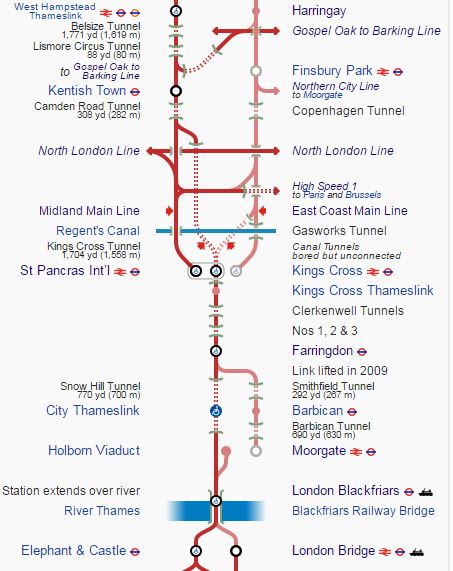
Thameslink Core
This section is getting to look more like a high-capacity Underground Line. The frequency is in the mid-twenty trains per hour, which is better than some Underground lines.
There is also a lot of connections.
- West Hampstead – Jubilee Line and North London Lines and possibly Chiltern and Metropolitan Lines.
- Kentish Town – Northern Line
- Finsbury Park – Great Northern, Piccadillyand Victoria Lines.
- St. Pancras – Circle, Metropolitan, Northern,Piccadilly and Victoria Lines, and Main Line services out of Kings Croiss and St. Pancras.
- Blackfriars – Circle and District Lines
- London Bridge – Northern and Jubilee Lines and Main Line services.
- Elephant and Castle – Northern and Bakerloo Lines
With this level of connections, it should surely be on the Underground Map.
Changing In The Core
Passengers will have to get more used to changing trains in the core section between St. Pancras and Blackfriars.
Passengers will get off one train at a station they like, wait for hopefully a few minutes, before getting a train to their preferred destination.
I think Thameslink could make this a lot easier, by providing kiosks and coffee shops on the platforms of the station, they would like people to change.
New Routes
Thameslink will open up new routes.
Until I was fifteen, I lived near Oakwood station and getting to and from Gatwick from there is not easy. But after Thameslink opens, the Piccadilly Line takes me to Finsbury Park for Thameslink, where I suspect I’ll be able to get a train to Gatwick.
All the fuss is about Crossrail, but the effect of a full Thameslink could be almost as great.
London Bridge Station
According to a platform layout diagram in Wikipedia of London Bridge station, Thameslink will use the following platforms.
- Platform 4 to go South.
- Platform 5 to go North.
Is the design of the island platform 4/5 in the new station, wide enough to have kiosks and/or coffee shops?
It’s certainly an island platform, that will enable passengers to change direction.
Sutton Loop Services
Sutton currently has 2 tph to St. Albans and 2 tph to Luton, so the new proposal might be seen as a cutback, as it doesn’t go all the way to Luton.
Will users of the Sutton Loop Line find this acceptable? According to the Political Developments section in the Wikipedia entry for the Thameslink Programme, this is said.
Network Rail had planned to terminate Sutton Loop Thameslink trains at Blackfriars station, rather than have them continue through central London as at present. This upset many residents in South London and their local politicians, who saw it as a reduction in services rather than an improvement. In response to pressure, government has ordered Network Rail to reverse the decision.
There are powerful interests!
Cambridge
Are some Cambridge services going to Cambridge North station, to give better connections between Thameslink and services to and from Kings Lynn, Norwich, Peterborough and the Midlands?
Cambridge North station is given in Wikipedia as a three platform station.
Is that enough? Especially, if trains arriving at Cambridge North station from the North were to be turned back.
Thameslink will also highlight a real problem at Cambridge.
After Thameslink opens, for many passengers, going to say Ipswich or Norwich via Cambridge could be a better option, than going via Liverpool Street.
At present trains from Cambridge to Ipswich, Norwich and Peterborough do not have enough capacity or frequency. At least a four-car train running every thirty minutes is needed now and, Thameslink will bring more passengers to the routes.
Hopefully, the new East Anglia Franchise will improve these important services across the region.
Midland Main Line
It would seem that services on the Midland Main Line branch of Thameslink, stop a few stations further in with perhaps fewer services going to Luton.
Given that the Midland Main Line is to be electrified and fast trains will be running from St. Pancras to Derby, Nottingham and Sheffield, the interface between the two lines needs to be well thought out.
Consider.
- The interchange between Thameslink and Midland Main Line services at St. Pancras is not the best.
- Will Bedford be upgraded to be a better interchange?
- Trains on the electrified Midland Main Line will probably be 200 kph trains, as opposed to the 160 kph of the Class 700 train‘s on Thameslink.
- The trains run on separate pairs of lines, with the slow lines to the East and the fast lines to the West.
In my view, there is a need for a cross platform interchange between Thameslink and long distance services, but on a brief look, this might be difficult, at anywhere other than Bedford station.
As Bedford will also become the Eastern terminus of the East West Rail Link, and there is space in the area of the station, could we see Bedford developed into an important and efficient interchange?
St. Pancras Station
A lot of this could have been much easier, if St. Pancras station had been designed as a working station, rather than to show off! It may have a fur coat, but it’s certainly got no knickers.
A simple illustration of the bad design of St. Pancras, is to imagine you’re coming from say Flitwick on Thameslink and want to go to anywhere on the Northern, Piccadilly and Victoria Lines.
- The Piccadilly and Victoria Lines are a long walk from Thameslink and the Midland Main Line platforms at St. Pancras.
- The Northern Line is better as sensible passengers will use Kentish Town or London Bridge to change.
At least there is a good interchange to the Circle, District and Metropolitan Lines at Farringdon and Blackfriars.
In some ways the easiest way to get from the Thameslink platforms at St. Pancras to the Victoria and Piccadilly Lines, especially if you’re going South, is to get off at Farringdon station and use the cross-platform interchange between the Southbound Thameslink and the Westbound Circle/Metropolitan, which I showed in A Space Too Good To Leave Empty, and then take one stop back to Kings Cross before walking up the stairs to take the escalators to the Northern, Piccadilly and Victoria Lines.
East Coast Main Line
Thameslink’s links to the East Coast Main Line hopefully will be much better, as there are stations, where interchange to local and long-distance services could be excellent.
- Finsbury Park (At least 6 tph) will hopefully give good interchange to Great Northern, Piccadilly and Victoria Lines and local services.
- Welwyn Garden City (At least 4 tph) will interchange with local services
- Stevenage (At least 4 tph) will interchange with local services and some long distance trains.
- Peterborough (2 tph) will interchange with local services and lots of long distance trains.
As the slow lines are on the outside of the fast lines on the East Coast Main Line, I suspect that there are several good opportunities to create cross- or same platform interchanges between local services, Thameslink and long distance services to the North and Scotland.
Northern City And Hertford Loop Lines
One set of services that will benefit from Thameslink are those on the Northern City Line out of Moorgate and the associated Hertford Loop Line.
- The service will be connected to Thameslink services at Finsbury Park, Welwyn Garden City, Stevenage and other stations.
- The lines recently went to seven-day-a-week operation.
- The lines are getting new Class 717 trains.
- The Hertford Loop Line is a double-track line with a 120 kph speed limit and stations for six-car trains.
- The current Southern terminus at Moorgate, is not the easiest to access.
In the future, don’t discount improvements to the Hertford Loop Line, to get more trains through the area.
Consider.
- The Hertford Loop Line is the only diversion past the bottleneck of the Digswell Viaduct.
- Both ends of the line are grade-separated.
- The fastest trains between Finsbury Park and Stevenage on the main line take 18 minutes with no stops and 31 minutes with five stops.
- A typical stopping train on the Hertford Loop Line takes around 41-50 minutes.
- The line can handle long trains and frequently does, when there are problems on the main line.
- Thameslink Class 700 trains could certainly run on the line, but couldn’t stop unless platforms were extended.
- After the Great Northern Class 717 trains are delivered, under normal operation only the most modern trains with the latest signalling will use the line.
- Stevenage station already has cross platform interchange between main line, Thameslink, local and Hertford Loop services.
I think we shouldn’t discount the possibility of some Thameslink services going via an uprated Hertford Loop Line to release paths on the congested part of the East Coast Main Line.
Suppose the Hertford Loop Line was updated to include.
- 160 kph speed limit.
- Perhaps longer platforms at Hertford North station.
- Cross-platform or same platform interchange at Finsbury Park and Stevenage and perhaps Alexandra Palace.
- Perhaps a new parkway station South of Stevenage which could accept 12-car Thameslink trains.
I suspect Network Rail are updating their book of cunning plans to get more capacity through and around the Digswell Viaduct.
More Routes To Kent
The headline of the article in the August 2016 article in Modern Railways is Thameslink To Medway In Revised Timetable.
So why is Thameslink increasing its presence in Kent?
I could be cynical and say it is to take traffic from their rival company; Southeastern, but I think it is all about managing resources.
Consider.
- The core section of Thameslink can handle 24 tph in both directions.
- North of the Thames, the increased capacity has been used to create a second route out of London to Welwyn Garden City, Cambridge and Peterborough.
- East Croydon is a bottleneck and can’t take any more trains.
- The Bermondsey Dive-Under and the new London Bridge station will create more capacity and better routes to South East London and Kent.
- Thameslink has always served Kent.
- Many Kent services go right across London to Victoria, whenb perhaps it would be easier if they served London Bridge or went through Thameslink.
So by switching some of the available services through London to Kent, this could be to relieve pressure at Victoria and East Croydon. So perhaps in the long term, this will allow more services from Victoria to Brighton via East Croydon and Gatwick Airport
But obviously, these changes wouldn’t be done if the passengers didn’t need to use the route.
I have to admit, that I hear regular complaints about the quality of the train service in South East London.
The 2 tph between Orpington and West Hampstead certainly looks like a measure to address South East London’s bad connectivity. I know one solicitor who’ll use it to get from home to her office.
The 2 tph between Rainham and Luton is the interesting service, as it goes via the Medway towns, Dartford and Greenwich.
- It gives the Medway towns an additional route and more capacity to London.
- It connects to Greenhithe for Bluewater.
- It connects to Crossrail at Abbey Wood.
- Could this route release capacity in Victoria?
One thing that surprises me, is that it duplicates the proposed Crossrail extension to Gravesend. Perhaps it is just a better idea.
The other Kent service which is the 2 tph between Cambridge and Maidstone East, which is extended to Ashford in the peaks, seems to be a replacement for an existing service, but it could be taking the pressure off Victoria services.
Obviously Thameslink have the detailed passenger figures and can plan accordingly.
But surely, if the East Coastway service is extended to Ashford, perhaps by the use of IPEMU-capable Class 377 trains, then does this create another high-class commuter route to the far South-East?
Connecting To East Croydon And Gatwick From East London
For those of us in East London, who live along the East London Line, this is one of the most important sections of Thameslink.
At present, we can get to and from Gatwick Airport and East Croydon stations, by changing at somewhere like New Cross Gate or Norwood Junction stations.
It had been hoped that the improved Thameslink would have laid down a simple rule for getting from the East London Line to Gatwick, but when I asked Thameslink about this, they referred me to Transport for London, who unsurprisingly referred me back to Thameslink. I wrote about it in detail in Searching For What Is Going To Happen On The East London Line After The Thameslink Programme Opens.
Obviously, when Crossrail opens, it will help, as it runs from Whitechapel to Farringdon, but it would still be ideal to be able to get to Gatwick with one change, without making several and going halfway round London.
London Bridge To Caterham And Tattenham Corner via Purley
These destinations were originally to be incorporated into Thameslink, but it now appears, that they will become a shared service from London Bridge that divides at Purley station.
The current service is 2 tph from London Bridge to both Caterham and Tattenham Corner. As each train stops at all stations between New Cross Gate and East Croydon stations, this could appear to be the service that the East London Line needs.
The current London Overground services on the East London Line through New Cross Gate are 4 tph to West Croydon and 4 tph to Crystal Palace. As I said in Increased Frequencies On The East London Line, from 2018 Crystal Palace will receive 6 tph from Dalston Junction station.
So this means that from 2018, every six minutes a London Overground train will travel in both directions between New Cross Gate and Sydenham stations,. The services would run on the slow lines well out of the way of Thameslink on the fast lines.
There would probably be paths on the fast line to run the London Bridge to Purley services, but because Thameslink is such a high-frequency service, I suspect that they would run on the slow lines.
This would of course create a local Metro service to feed passengers to London Bridge and especially East Croydon to access longer distance services.
Let’s hope that there is sufficient capacity on the slow lines between New Cross Gate and East Croydon to incorporate a London Bridge to Purley service of sufficient frequency, so that plebs like me in Dalston wanting to go to East Croydon, can just get the first train to Sydenham and wait for a few minutes for the arrival of an East Croydon train.
In a perfect world, there would be ten trains per hour from London Bridge to East Croydon to match the Overground service. This would mean that the two services would alternate.
But I doubt this will happen, as other trains use the slow lines, like the service from Victoria to Sutton via Crystal Palace and West Croydon.
However, if we have at least a 4 tph service between London Bridge and Purley via East Croydon, that would mean that a reasonable service with one same platform interchange would exist between the East London Line and East Croydon, with all its connections to the South. Thameslink would be providing at least the following services from East Croydon.
- 4 tph to Brighton
- 4 tph to Three Bridges
- 2 tph to Horsham
All 10 tph would serve Gatwick Airport.
I wonder if the London Bridge to Purley services would share the same platform or island platform at East Croydon with Thameslink services.
If they did, then going to and from Gatwick Airport and Brighton from anywhere on the East London Line, would involve a maximum of two same platform changes.
London Bridge To Uckfield
For several months, I’ve thought that London Bridge to Uckfield will be run by an IPEMU or a train with onboard energy storage. I wrote about this in The Uckfield Branch Is Almost Ready For Longer Trains.
At present this service uses the fast lines between London Bridge and East Croydon and is run by Class 171 trains. An ideal train would be a modified Class 377 train, running in anb 8-, 10- or 12-car formation.
Between London Bridge and South Croydon, it would run using the third rail electrification and could keep up to a Thameslink speed. Only South of Oxted would it use the energy from the onboard storage to power the train.
Will Thameslink really want this interloper on their train superhighway between London Bridge and East Croydon?
Probably not!
But surely, the service could share the slow lines with the London Bridge to Purley services and the London Overground.
The Extended East London Line
Summarising the services that use the East London Line and the slow lines of the Brighton Main Line North of New Cross Gate we get from 2018.
- 4 tph Dalston Junction to West Croydon (London Overground) – Uses route from New Cross Gate to Norwood Junction
- 6 tph Highbury and Islington to Crystal Palace (London Overground) – Uses route from New Cross Gate to Sydenham.
- ? tph London Bridge to Purley (Southern) – Uses route from New Cross Gate to East Croydon
- ? tph London Bridge to Uckfield (Southern) – Uses route from New Cross Gate to East Croydon
- 4 tph Crystal Palace to West Croydon (Southern) – Uses route through Norwood Junction.
If say we had 4 tph to Purley and and 2 tph to Uckfield, then that would mean.
- 16 tph between New Cross Gate and Sydenham
- 14 tph through Norwood Junction
- 8 tph through East Croydon
- 8 tph to West Croydon
I suspect, that people who know about train scheduling could squeeze up to about the same twenty trains per hour along the line, that London Overground will be running through the Thames Tunnel.
If something like this train pattern were to be implemented, it would effectively create an extended East London Line from Highbury and Islington and Dalston Junction in the North to Gatwick Airport, Brighton and Uckfield in the South via East Croydon. All passengers would probably do is change trains, but not platforms once or twice.
The Brighton Main Line 2
There are a lot of commuters and others, who press for a second main line to Brighton, It even has its own web site, which would seem to like to see.
- Another route to London created using the Uckfield Branch and a reinstated Wealden Line.
- Better access to the Canary Wharf area of London.
Having looked at what Thameslink are doing, I think I can say the following.
- The new 12-car Class 700 trains will bring extra seats.
- Brighton will get 4 tph Thameslink train service through London.
- Thameslink services will interchange with East London Line services in a more efficient manner to give better access to Canary Wharf, Shoreditch, Whitechapel and East London in general.
- If the Thameslink services do create capacity at Victoria and East Croydon, then we’ll see more services from Brighton to Victoria.
- 10- or 12-car services will run from Uckfield into London Bridge, at 2-4 tph.
Hopefully, it will put off the day, when serious money needs to be spent to build a second line from Brighton to London.
Conclusion
I obviously don’t know, if this logic is right!
But if the following is done.
- Move services from Surrey to Kent.
- Provide a new Metro route from London Bridge to Caterham and Tattenham Corner via Purley.
- Optimise service end-points.
- Look seriously at the Hertford Loop Line
- Have a good think about how to serve Cambridge.
The following will happen.
- Victoria will have some spare capacity.
- Pressure on East Croydon will be eased.
- A frequent service can be created between London Bridge and Uckfield.
- The East London Line gets connected to Gatwick and Brighton.
- South East London gets much needed connectivity.
But the biggest effect will be the ability to create more services between Victoria and Brighton via East Croydon and Gatwick Airport.
It all illustrates some of the possibilities created by the new Thameslink proposals.
And all without any new infrastructure, other than what is currently being constructed.
Government “not pursuing” HS1-HS2 Rail Link
This is the title of an article on Global Rail News.
The report entitled High Speed Two: East and West The next steps to Crewe and beyond considers it is just too difficult.
Section twelve of the report entitled Connecting to High Speed 1, goes into details.
They suggest an enhanced pedestrian link and say this for rail.
For rail, we considered a range of direct link options. It was, however, not possible to identify a viable rail option capable of meeting the strategic aspirations whilst successfully addressing stakeholder concerns. This was because the options were complex and expensive to construct and would have delivered infrequent, less attractive train services for HS2 passenger travelling to European destinations. As a result we do not intend to take forward proposals for a direct rail between HS2 and HS1 or include active or passive provision to support the construction of such a link in the future.
In my view, the only direct rail link possible, without demolishing half of Camden, would be a totally tunnelled double-tracked route from a few miles north of Euston to somewhere like Barking to connect with the Channel Tunnel Rail Link. It could also be used to get freight trains between the West Coast Main Line and the Channel Tunnel and the ports in the South East.
But it would have a cost of almost the level of the tunnels for Crossrail or Crossrail 2. Have we got a spare ten billion pounds?
The Pedestrian Link
From drawings of Euston station after HS2 is opened, it would appear that the HS2 platforms are on the western side of the station.
Does this make the pedestrian link difficult?
The Crossrail Alternative
When HS2 opens in2026, it will stop at Old Oak Common station, where it will interface with a myriad of lines including Crossrail.
Crossrail at present only goes as far as Abbey Wood, but the route is safeguarded to Gravesend. As I showed in Crossrail Extension To Gravesend, extending Crossrail to Ebbsfleet International station, would not be a multi-billion pound project.
As the HS2 station at Old Oak Common is not finalised yet, I do hope when it is, that it is simple interchange between HS2 and Crossrail.
With a simple interchange between Crossrail and HS1, the link between HS1 and HS2 via Crossrail would not be as simple as a direct link, but it could have other advantages, when you look at the using Crossrail as a preferred link.
Convenience For Passengers
If Crossrail served Ebbsfleet International, this would mean that passengers from many more places would have a direct or one-change link to Continental services.
But the biggest winners would be those wanting to go between Heathrow and the Continent. What the direct frequency would be between Heathrow and Ebbsfleet International would be up to the planners, but I can’t expect there would be less than four trains per hour
I live close to Dalston Junction and might prefer to use Crossrail from Whitechapel to Ebbsfleet, at certain times of the day, when my routes to St. Pancras are extremely busy!
I believe that Crossrail should go be exected to Ebbsfleet International as soon as is feasible!
St. Pancras Is Too Small
I believe that in a few years time, London to Paris and London to Brussels will be turn-up-and-go services.
Given too, that plans exist for direct services to Amsterdam/Rotterdam, Marseilles and Cologne, it strikes me that a four-platform St. Pancras station will be too small in perhaps ten years.
Also, what would happen if say easyRail or RyanRail wanted to run low-cost services to Europe, which is or will be allowed by European Union competition rules?
With Crossrail linked to Ebbsfleet International, where there is plenty of space for more platforms, it would be possible that services could terminate there and use Crossrail to and from Central London.
Customs And Immigration
Once Crossrail is a feasible route to Continental services and the travel statistics start to be reliable, it might be possible so sort out our archaic customs and immigration arrangements.
When I travel between say Brussels and Frankfurt, I just have to have a valid ticket, but how long before I need to show my passport and have my baggage scanned on a journey like this?
Incidentally, if you travel on some long-distance trains in Spain, your baggage is scanned.
I think that with all the problems of terrorism and illegal immigration, that cross-border trains within the Schengen area, will come under tighter security rules in the near future.
Will regulations like this mean, when I am travelling from say Cologne to London, that I would undergo the same checks as another passenger going from Cologne to Brussels?
I certainly hope so!
Modern Ticketing
Surely with e-passports and contactless bank cards, we should be able to do something a lot better than exists today.
Imagine turning up at any major station on either side of the Channel, where you can board a train for the other side.
You put your e-passport on the turn-up-and-go terminal, which checks you against the passport. You just indicate on a screen where you want to go, choose your train and, pay for it and then walk through to the waiting area.
If you have already bought your ticket, the terminal would recognise you and after checking the bar code on your ticket or your bank card, you would also be let through.
The only thing to do before boarding, who be the personal and baggage scan.
All the technology to create a ticketing system like this is available today.
On the other hand, I would hate to see a system that was so slow, that you had to spend an hour in a station before travelling.
Thoughts On The Camden HS1-HS2 Link
After writing the previous sections and reading this section on Wikipedia about the link, I had the following thoughts.
- Trains between the Continent and HS2 would not stop in Central London. This might cause logistical problems for groups of travellers.
- To call at St. Pancras, trains would need to reverse at St. Pancras. Would there be enough platforms?
- Would Customs and Immigration services have to be provided at every HS2 station?
I suspect others have had the same and other thoughts and have thus decided that a pedestrian route is the best way to change between Euston and St. Pancras.
Journey Times
I wouldn’t use Ebbsfleet if the total journey time was a lot longer.
The following assumptions and facts can be considered.
- Ticketing, boarding or disembarking at St. Pancras or Ebbsfleet shouldn’t take different times.
- From Eurostar’s timetable St. Pancras to Ebbsfleet takes twenty minutes.
- From Eurostar’s timetable St. Pancras to Paris by the fastest train takes two hours sixteen minutes.
- From Eurostar’s timetable Ebbsfleet to Paris by the fastest train takes two hours five minutes.
- From Crossrail’s predictions, Old Oak Common to Abbey Wood will take thirty two minutes.
- I estimate that Abbey Wood to Ebbsfleet International would take perhaps fifteen minutes.
- I estimate that Old Oak Common to |St. Pancras via a direct HS1-HS2 link would take perhaps fifteen minutes or a bit more, if the train had to reverse at St. Pancras.
This would give the following estimated times.
- Old Oak Common to Paris via St. Pancras would take two hours thirty-one minutes.
- Old Oak Common to Paris via Crossrail would take two hours fifty-two minutes.
So not building a direct link means that passengers using HS2 to get to Paris take another twenty-one minutes.
On the other hand, how many would book separate trains with a generous connection time and whilst crossing central London would have a relaxing meal?
Conclusion
I think that to save twenty-one minutes in a journey from HS2 to Paris, but completely rebuild the lines North of Euston and St. Pancras is a trade-off not worth making.
Walking Between St. Pancras And Euston Stations
In 2011, I wrote Getting Between Kings Cross/St. Pancras and Euston about how I walked between the stations.
This route has now been formalised with green signs.












I think when they finish the roadworks, it’ll be a good route. This is cut and modified from my original post.
So how would I make it better, so that in effect we had one super station for the north?
- Perhaps, it should be marked on the ground, as a Kings Cross/St. Pancras to Euston walking route.
- You might even provide some eco-friendly transport along the route, like an electric shuttle bus or bicycle rickshaws.
- A couple of suitably placed Boris bike stations would help too.
- Shops and cafes should be developed along the road. There are some already.
I was right that this would happen.
Will St.Pancras Cope With More Trains On Thameslink And Eurostar?
This lunchtime I walked through St. Pancras station from the entrance by Kings Cross station on Euston Road, through the Underground ticket hall and the shopping mall past the Eurostar Entrance and exit to get a train on Thameslink.
It is a long walk, but if you want to catch Thameslink after arriving in the area on a 30 bus, it’s the shortest way. When Thameslink had a station on the Pentonville Road it was just a short walk through the passages at the bus stop direct to the Thameslink platforms.
What made matters worse was that a Eurostar train had just arrived and the ticket hall and shopping mall were teeming with passengers and masses of luggage. After all it was Friday and the time was about that, where early morning trains from Paris and Brussels will arrive.
The Thameslink station wasn’t busy, but at this time there are only about half-a-dozen trains an hour each way through the station.
But in 2018, there will be twenty four trains an hour each way for a lot of the day.
As by then, Eurostar or other operators should be running to Amsterdam and Cologne, these will be delivering a whole lot more passengers into the station.
So I can’t help feeling that St. Pancras will be an incredibly crowded station.
I’m probably lucky in that I can pick up Thameslink at London Bridge by using a 141 bus or perhaps at Farringdon using a 56.
If the Thameslink station had been built as an island station with escalators at more than one place, the problems would have been mitigated, as I said in this post. I won’t withdraw my concluding paragraph in that post yet.
St. Pancras is very much a fur coat and no knickers station!
Show on top and draughty and lacking at the bottom!
It’s up to Thameslink and Network Rail to convince me to do so.
Could St. Pancras Thameslink Station Have Had An Island Platform?
St. Pancras Thameslink station is in a big box under the western side of St. Pancras station.
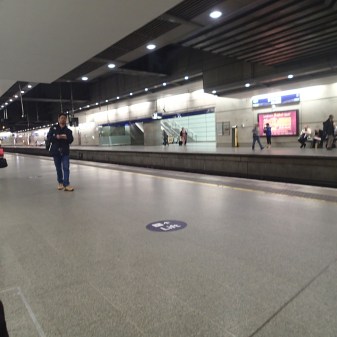
St. Pancras Thameslink Station
The picture shows the inside of the station with the two tracks running between wide platforms and the access by escalators at the side of the platforms. The escalators are joined by a bridge which has further escalators to the main station concourse.
Although step free it is not the nicest of interchanges.
Consider.
- Arriving Eurostar passengers must walk a hundred metres or so, then descend two escalators or lifts to get to a Thameslink platform.
- Departing Eurostar passengers at least have a shorter walk after they ascend to the concourse.
- Does the very independent Tante Dominique from Lille know whether she needs to go North or South on Thameslink to get to her nephew’s station of Sutton? This will get worse when the full Thameslink opens in 2018, as it will serve another 100 stations.
- Linking to the South Eastern High Speed and East Midlands services, involves a further ascent from or descent to the main concourse.
- To get to Kings Cross or the Underground, you have to walk across in one of two subways, which have steps and escalators at the St. Pancras end.
- The subteranean link from the Victoria Line to Thameslink must be the longest in London.
As the rebuilding of St. Pancras was only started a few years ago, it is a tragic case of old outdated thinking, getting in the way of modern design rules.
If you look at the design of the Crossrail station at Canary Wharf, you’ll see that the two rail lines are separated by a large island platform with escalators in the centre of that platform.
One picture in the link is a cross section of the station, which clearly shows the train lines and the stack of escalator connected floors above.
It would seem to me that St. Pancras Thameslink could have been created as a long island platform, with one set of escalators at the current location leading directly to the concourse.
The station would of course need to have platform edge doors, but London has had these for years on the Jubilee Line. As from 2018, Thameslink will be a totally Class 700 railway, the fitting of the doors could surely have waited until after the new trains had arrived. Remember that there are many busy stations in London, that work well without platform edge doors.
The central island layout gives several advantages.
- Several sets of escalators could be installed, as they will be at for instance at Canary Wharf. One could be at the Euston Road end and could speed passengers to and from that road, buses and the Metropolitan Line. Another could be in the centre to link directly to Eurostar and others might link across to the subways to Kings Cross.
- Passengers changing direction would just walk across the platform.
- It would be possible to add coffee stalls, toilets and other customer facilities as needs demanded.
- The biggest advantage would probably be the improvement in the passenger environment, by separating passengers and trains. So a rather draughty unwelcoming station would have been light and airy and much more customer-friendly.
In my view a wonderful opportunity has been missed to create the best station in the world.
All we’ve got is a second rate interchange, that means a lot of up and down, and walking down endless subterranean passageways.
St. Pancras is very much a fur coat and no knickers station!
Show on top and draughty and lacking at the bottom!
How We Use A Cross-City Railway
London has two main North-South cross-city railways; Thameslink and the East London Line, which are shortly to be joined by a third East-West line; Crossrail.
These three lines are characterised by a tunnelled central core, with branches fanning out on either side. This means that if the branch you live on is paired with another branch on the other side of the city, you will probably have to change trains in the centre if you want to go to an alternative branch.
It’s not just London, who use this sort of layout. Birmingham, Cardiff, Liverpool and Newcastle in this country have similar cross-city trains or metros, and I suspect that worldwide there are quite a large number.
I did a journey a few weeks ago, which illustrates how we use these lines. I’d been to my doctor’s surgery, which is close to Haggerston station and afterwards I needed to go to Norwood Junction, which is on the West Croydon branch of the East London Line.
As it was raining hard, instead of waiting for the next West Croydon train on an exposed platform, I took the first train. I then hopped-off this train at Canada Water and hopped-on my desired train, after waiting for a few minutes in a dry underground station.
This hop-off-hop-on behaviour at a convenient station in the core will get increasingly common, as more and more branches are added to these cross-city lines.
If you use National Rail’s Journey Planner for say Sutton to Luton, some routes offered, involve a change of train at either Blackfriars or St. Pancras using Thameslink. But in the current Thameslink, these changes are not same platform ones, like they are on the East London Line and hopefully will be on the upgraded Thameslink, when it opens in 2019.
Crossrail takes this concept to a whole new level!
Most if not all of the central core stations are island platforms, so that if you are on a train from Abbey Wood to Heathrow, but want to go to Maidenhead, you just hop-off and then hop-on the first train that calls at Maidenhead, using a convenient Central London station. But the island platform, also allow you to reverse direction on a hop-off-hop-on basis. So Abbey Wood to Shenfield becomes a simple step-free one-change journey.
Sadly, there is no central core island platform station on Thameslink and the East London Line. This is probably more to do with adapting existing stations, rather than a less than perfect design.
But imagine what a lovely station the below-ground Thameslink station at St. Pancras would be with a large light and airy, central island platform with trains behind platform edge doors! Perhaps it could have a welcoming coffee-shop, where you could refresh yourself and meet friends.
Which Idiot Obscured The Clock?
I was in St. Pancras recently and someone has put pointless stained glass in front of the clock.
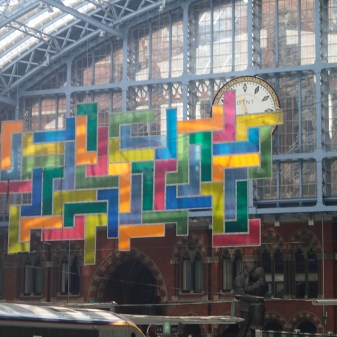
Which Idiot Obscured The Clock?
I suppose it’s art, but for those of us who don’t wear watches it’s a big annoyance.
The Back Passage At Kings Cross St. Pancras
A new passage has opened up on Kings Boulevard, which lets you by-pass the crowds going to and from Granary Square, by linking you directly to the subway that goes under Pancras Road


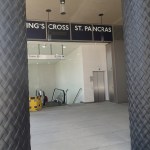
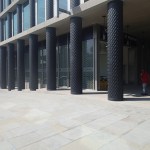
it is certainly magnitudes better than some subways on the Underground.
New Buses for London On The Euston Road
The route 390 from Archway to Notting Hill Gate from this morning is using New Buses for London.




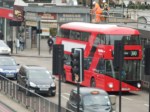


These pictures were taken on the Euston Road, in the vicinity of Kings Cross and St. Pancras stations, which now have a bus to compliment their own good design.
If you wan t to go in the Archway direction, you will just walk onto Kings Cross Square and pick up the bus along Euston Road. To go to Oxford Street and Notting Hill Gate, you need to cross the road.
I think that when they’ve finished the building work, it will be a lot better than it is at present.
A Day In Paris
As I wasn’t sure how long it would take to get home, before I left, I booked a ticket on the 21:10 Eurostar from Paris to London.
This effectively gave me nine hours in Paris, so I decided to go to the Louvre and then do some exploration.
Unfortunately, my camera ran out of juice, so there isn’t many pictures.
But I enjoyed myself otherwise!
I did even find a gluten-free creperie in Montmartre, but unfortunately it shuts on Mondays.
This wouldn’t have been a disaster, as I knew I’d get a good supper on Eurostar.
But unfortunately, I’d somehow mixed up getting my gluten-free meal.
The staff however, rustled me up some very acceptable chicken with chick-peas.
I was in my bed in Hackney by just after eleven, after eight trains in seven days.
Being close to St. Pancras means that trains are a very good option, as I can always get a bus home if the train is a very late one.
The
 The Anonymous Widower
