UK To Fund Hydro Energy Storage Projects
The title of this post, is the same as that of this article on The Times.
This is the sub-heading.
New infrastructure aims to help balance the electricity system after the rapid growth in renewables
These three paragraphs infrastructure the article.
Projects that use water to store and release energy are to be given government support, in an attempt to help manage the volatility in supply and demand as more green power enters the grid.
From next year, pumped hydro storage projects will be able to apply for government subsidies, which will be provided via a “cap and floor” mechanism. These would guarantee revenues if prices drop below a certain floor but prevent providers from charging above a ceiling when power prices are high.
Like other government support schemes, any cost will be levied on energy bills, while consumers will be paid back any money generated above the cap. It is yet to be decided precisely how the cap and floor will be set.
I feel it is reasonable to expect the system to be a success, as a similar system is used for interconnectors and this article on Offshore Energy is entitled Over $86 million To Be Split Between UK and Belgium Consumers As 1 GW Subsea Interconnector’s ‘Remarkable’ Revenues Exceed Ofgem’s Cap.
It looks like Ofgem played this right for interconnectors and the Nemo Link is making a substantial payment.
It will be interesting to see what happens when “cap and floor” contracts are assigned.
This move by Ofgem will probably have effects in two areas.
- SSE, Statera and Statkraft, who are typically developing systems at the high end with a size of about 1.5 GW/25 GWh could find money is easier to come by.
- At the lower end, companies like Highview Power, who have systems of 50 MW/300 MWh and 200 MW/2.5 GWh under development, will also benefit.
My Control Engineering thoughts are leaning towards the 200 MW/2.5 GWh systems being the popular ones. Especially as they would appear to be close to the right size to support a 1 GW wind farm for two hours.
A Highview Power Two-Hour Liquid Air Battery could fit nearly with a fleet of Two-Hour BESS.
It should be noted that CAF use a little-and-large approach to theit battery-electric trams in the West Midlands.
A large lithium-ion battery is the main storage device.
A supercapacitor handles the high-frequency response and keeps the power steady.
Pairing a Highview Power Two-Hour Liquid Air Battery and a Two-Hour BESS could achieve the same performance and possibly result in some cost savings.
Fifth Hydro Project Proposed At Loch Ness
The title of this post. is the same as that of this article on the BBC.
This is the sub-heading.
The local community is to be asked for its views next week on plans for a new hydro-electric scheme at Loch Ness.
These three paragraphs introduce the new scheme.
Glen Earrach Energy’s, external (GEE) pumped storage hydro project is the fifth hydro scheme proposed for the Loch Ness area.
The company said its project on Balmacaan Estate would create clean energy while protecting the environment, and create 600 on-site jobs.
But concerns have been raised about the number of planned schemes, with Ness District Salmon Fishery Board worried about the effect on wild fish.
The project has a web site, which has a section entitled About The Project, where this is said.
Glen Earrach Energy, which means “Valley of Spring” in Gaelic, stands at the forefront of energy innovation. The Pumped Storage Hydro (PSH) project, located at Balmacaan Estate, Scotland, is a critical component for achieving a net-zero grid by 2030.
The project prioritises environmental preservation and biodiversity enhancement while achieving outstanding efficiency in energy storage and generation.
This ensures a healthier and more sustainable balance between harnessing natural energy resources and the maintenance and reinforcement of the surrounding ecosystem.
Note.
- It doesn’t say, but it looks like Glen Earrach Energy aim to complete the project by 2030.
- Glen Earrach Energy also seem to be playing a strong environmental card.
But nothing is said about the size of the project.
This article on Business Insider, which is entitled £3 billion Loch Ness Hydro Project Plans Unveiled, does give some details.
- Potential Investment – More than £2 billion
- Output – 2 GW
- Storage Capacity – 30 GWh
- The project could create at least 600 on-site construction jobs in Scotland over a six-year period, plus many thousands more locally in the supply chain.
It is larger, than SSE’s flagship Coire Glas pumped storage hydroelectric power station, which is planned to be a 1.5 GW/30 GWh station, at the other end of the Great Glen.
I have some thoughts.
The Existing Hydro Schemes On Loch Ness
According to the BBC article, there are two existing hydro schemes on Loch Ness.
- Foyers is described on this web site and is a reasonably modern 305 MW/6.3 GWh pumped storage hydroelectric power station, that was built by SSE Renewables in the last fifty years.
- Glendoe is described on this web site and is a modern 106.5 MW conventional hydroelectric power station, that was built by SSE Renewables in the last twenty years.
Foyers and Glendoe may not be the biggest hydroelectric power stations, but they’re up there in size with most solar and onshore wind farms. Perhaps we should look for sites to develop 100 MW hydroelectric power stations?
The Proposed Hydro Schemes On Loch Ness
According to the BBC article, there are four proposed hydro schemes on Loch Ness.
- Coire Glas is described on this web site and will be a 1.5GW/30 GWh pumped storage hydroelectric power station, that is being developed by SSE Renewables.
- Fearna is described on this web site and will be a 1.8GW/37 GWh pumped storage hydroelectric power station, that is being developed by Gilkes Energy.
- Loch Kemp is described on this web site and will be a 600MW/9 GWh pumped storage hydroelectric power station, that is being developed by Statera.
- Loch Na Cathrach is described on this web site and will be a 450MW/2.8 GWh pumped storage hydroelectric power station, that is being developed by Statktaft.
In addition there is, there is the recently announced Glen Earrach.
- Glen Earrach is described on this web site and will be a 2GW/30 GWh pumped storage hydroelectric power station, that is being developed by Glen Earrach Energy.
Note.
- The total power of the seven pumped storage hydroelectric power stations is 4.76 GW.
- The total storage capacity is 85.1 GWh.
The storage capacity is enough to run all turbines flat out for nearly five hours.
Could Glendoe Be Updated To Pumped Storage?
The Wikipedia entry for the Glendoe Hydro Scheme mentions pumped storage several times.
In Glendoe Hydro Power Station, I estimate that a Glendoe pumped storage scheme could be perhaps 50 % bigger than the system at Foyers.
I feel that if more storage capacity is needed in the Highlands, then Glendoe could be converted to pumped storage.
Green Hydrogen Roundup: Statera Eyes ‘Critical’ 3GW Project In Scotland; UK Government Provides Support To Carlton Power And Octopus Hydrogen
The title of this post, is the same as that of this article on Current News.
This is the first heading.
Statera to develop ‘critical’ 3GW green hydrogen project in Scotland
These two paragraphs outline the project.
Energy generation and storage company Statera has released plans to develop a 3GW green hydrogen project in Scotland capable of supplying the UK with up to 30% of its 10GW by 2030 hydrogen target.
The major green hydrogen project is set to harness surplus Scottish wind power to power an electrolyser facility. The green hydrogen is expected to supply Statera’s power generating facilities and the UK’s carbon intensive industrial clusters via existing gas transmission pipelines.
This project will be built in Kintore.
This Google Map shows Kintore sub station.
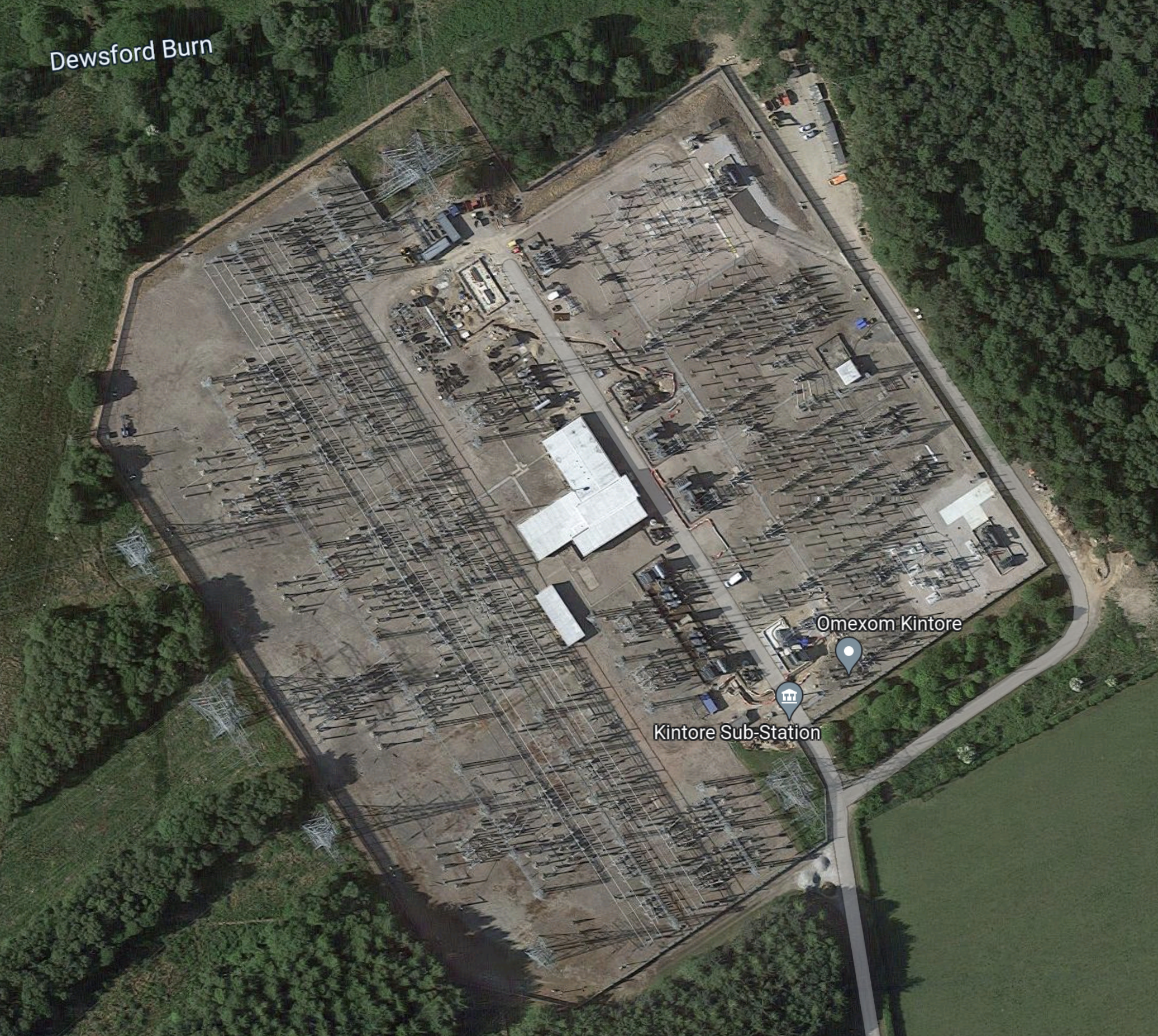
As this substation features on the home page of Kintore Hydrogen’s informative web site, I would assume, the electrolyser will be built nearby.
Statera’s web site is also informative.
This is the second heading.
Carlton Power receives UK government backing for three green hydrogen projects
These two paragraphs outline the projects.
Energy infrastructure development company Carlton Power has received UK government backing for three green hydrogen projects in Greater Manchester, Cumbria and Devon.
The backing has been received via the first round of the government’s Hydrogen Business Model (HBM)/Net Zero Hydrogen Fund process, which is worth up to £240 million. Around 15 projects in total will receive financial backing via this allocation.
The three projects will have a total capacity of 240 MW.
This article is very much one to read fully and thoroughly.
These are my thoughts.
Hydrogen Will Be Used To Bring Energy South From Scotland
This is part of a quote from Statera’s Managing Director.
The use of green hydrogen in the project has various perks. Firstly, it will utilise excess green energy that is generated from the vast Scottish wind sector and thus provide an additional basis to decarbonise sectors.
In doing so, Statera has said this will reduce the need for more costly transmission grid reinforcements to convey excess electricity in Scotland to other parts of the UK – in particular large industrial clusters.
Extracting Hydrogen From The Hydrogen/National Gas Blend
It’s all very well bringing the hydrogen South from Scotland blended with natural gas in the existing gas network, but how do you deliver pure hydrogen to those that need it?
In New Device Separates Hydrogen From Natural Gas When The Two Gases Are Blended In Pipelines, I wrote about such a device that has been developed by HyET Hydrogen in the Netherlands.
It is claimed to be silent and to create 99.9 % pure hydrogen.
Conclusion
This is an important milestone in cutting the UK’s carbon emissions.
 The Anonymous Widower