Something New And Very Green In The Laundry
I’ve read about a company called Xeros in The Times today. Their washing machines use 80% less water, 50% less energy and 50% less detergent.
The technology has been spun (?) out of Leeds University and uses special beads to clean the washing. They’re also talking about a washing machine with no programmes ( i.e. a man button!)
They’re not available for domestic use! Yet!
But if all machines in the UK were this efficient, then the water saved would fill twenty million swimming pools!
The Energy Bill Of The Future?
I saw this advert on the Tube yesterday.

The Energy Bill Of The Future?
After checking Mobile Energy’s web site, there are some nice features, but they don’t talk about a smart meter, which is what we all need.
This Will Be Great Fun!
I’ve just seen this Panono camera ball demonstrated on the Click segment of BBC Breakfast for today. You can probably find it on this page.
At the moment, it’s only a prototype, but my devious mind has already thought of several useful applications of the technology. At the moment the price looks to be several hundred euros, but one that was the size of a cricket ball, that is say just £200 would be wonderful toy for people of all ages.
A Development We Don’t Need
The BBC has just shown non-working images of a stun-gun amart phone case. There’s more here. This is the first bit.
Add-ons that turn smartphones into Star Trek-like tricorder medical diagnostic kits, Predator-style thermal vision cameras and even electric “stun guns” are being promoted at the Consumer Electronics Show.
They did say that these stun-gun smart phone cases would be illegal in the UK! But tell that to the gangs! It’ll become a must have accessory!
This development of the humble phone, is one of the sickest and pointless things, I’ve seen in some time. But of course, it appears to be legal in the United States.
I have found the company on the Internet. How long before you can buy a smart-phone case like this from their web site and have it shipped across the Atlantic?
The Daily Mail has te full story and gives a lot more detail than I would, in this report.
Where Now For The New Bus for London?
This post was prompted, when I found this post on Leon Daniel’s blog. It was this paragraph that caught my eye.
The buses have also been busy promoting British technology at home and abroad. After leaving the USA, LT1 journeyed to Bogota after which it will head to the Far East. Another vehicle is already doing similar duties in Europe and a third vehicle is likely to be added to the tour. Wherever they go they attract huge attention and continue to promote Britain and British industry.
It’s an interesting itinerary!
Couple this sort of story with the news last week about LT100 appearing in Ipswich and it does appear there is a strong move to sell the buses more widely.
Remember though that WrightBus have sold a lot of buses to the Far East in places like Hong Kong and Singapore.
The New Bus for London is also not built like most other buses and coaches, which makes it easy to assemble from a kit of parts with most of the body made locally. Hong Kong and Singapore have got their previous Wright buses this way. I speculated on a New Bus for Hong Kong in May 2012.
These buses are almost like a kit of parts, that can be assembled in many ways.
But surely, one of the biggest selling points of the bus, is that each operator can rebrand them as they want. Will we see a New Bus for Ipswich?
And don’t forget that London’s red buses have always been fashionable and extremely cool. Were bendy buses ever that?
I do think we’ll see one big change on New Buses for London in a few years. Hybrid buses, like the New Bus for London, use a lot of batteries, that need to be changed every few years. I suspect these will be replaced by some form of mechanical energy storage device like a flywheel. There’s something about the testing of this type of technology here.
To my untrained brain, I think that the distributed nature of the power train on the New Bus for London, where the various parts are positioned around the bus, lends itself to the replacement of the batteries by a flywheel. The batteries are under the front stairs and the engine is under the back stairs, with the electric motors in the rear wheel hubs.
Speeding Between Silicon Roundabout And Cambridge Science Park
There is an article in the Sunday Times that says that Ministers want to improve the links between Silicon Roundabout and the Cambridge Science Park. Here’s the guts of the story.
The aim is to slash travelling time between them and accelerate growth in Britain’s hi-tech industries.
The trip between London and Cambridge has long been considered a stumbling block to greater collaboration between the two tech hubs.
A station is already being built at the Cambridge Science Park, which should open before 2014, although the report in the Sunday Times says this is only being considered.
The article also talks about a Shoreditch stop on a fast train from Liverpool Street station to Cambridge.
It strikes me though that if you look at the proposals for Crossrail 2, which are slated to possibly go via Dalston Junction and the Angel, then this could be eventually an integral part of the new rail route, especially if Crossrail 2 links to the West Anglia Main Line.
I say eventually, as Crossrail 2, will be unlikely to open in the next thirty years.
Alternatively, there is the option of running the fast Cambridge trains into Old Street and Moorgate stations on the Northern City line. They would then use the Great Northern route to Cambridge.The stations would need to be enlarged, but the tunnels could probably take the full-size, Class 365, trains currently used on Kings Cross to Cambridge services. Remember that Old Street station is actually under Silicon Roundabout.
There are a lot of possibilities.
The NHS And Disruptive Innovation
I’m a great fan of disruptive innovation. It summed up in Wikipedia as follows.
A disruptive innovation is an innovation that helps create a new market and value network, and eventually goes on to disrupt an existing market and value network (over a few years or decades), displacing an earlier technology.
In some ways the classic disruptive innovation is iTunes, where Apple changed the music industry totally.
I, of course, would be a fan, because my first great success was Artemis, which took the project management industry out of the domain of large mainframe computers and cumbersome management structures into a computer that fitted under a desk.
But I have given this post, the title I have, as the NHS and other health systems is coming under pressure from disruptive innovation.
My other big innvation success was also disruptive innovation.
I was one of the backers of the technology that led to Respimat, a metered-dose inhaler.
That device seems to be too disruptive, as despite many years of development, I don’t think it is in general use.
It doesn’t use any batteries, compressed gases, nasty chemicals and is affordable to be throwaway. But despite their HCFC propellants, the incumbents in the healthcare industry, have not given market share.
But I have the satisfaction, that because of my scientific knowledge and practical experience, I spotted that the guys I backed could do something special. At least too, when I sold my share, I was well rewarded.
I do feel though that the NHS doesn’t do things in the same way as perhaps John Lewis would, when it comes to handling new methods of working.
As an example I was talking to my excellent GP about how having my cholesterol results on my blog, helped the doctors in Hong Kong when I had my stroke. I said it would be great if all our medical records were searchable on line. We were also discussing a small operation I had on my nose ten years ago and wondering if it should be done again to stop the nose bleeds I sometimes get.
We then both said that computerisation had been an expensive farce, but we were both agreed it would be a good thing, especially if like me you travel a lot. He did say Google launched something called Google Health, but that has now been discontinued. Read about it here.
So did the general conservatism of health professionals and a lot of the general public kill the project. Google don’t have many failures.
Reading about it, it seems that it would have been something I would have used.
If I look too at my Coaguchek, that is classic disruptive innovation. I don’t know how many use the device in the UK, but I suspect it’s not a large proportion of those who could benefit from such a device.
I suspect though that in a few years this device and its probably simpler successors will be as accepted as the monitors used by diabetics.
Small personal patient used technology like this will become more common. After all, we now have a population, who love their gadgets and what better gadget is there, than one that helps you improve your health.
The NHS is going to have to get used to new technology and especially where that technology shows substantial cost savings. But a lot of it, will mean changes in methods and management structures.
Disruptive innovation will improve the NHS, but it will be an NHS with a different number and type of hospitals, and staff not always deployed as they are now.
The First Shoots Of Electrification
Huyton lies on the original route of the Liverpool and Manchester Railway and you pass through Rainhill, where the trials were synonymous with the Stephenson’s Rocket, on your way to Manchester. As you travel you notice the pylons for the electrification of the line by the trackside.




It reminds me of watching as a child, as the pylons started to be added to the Great Eastern Main Line electrification was extended to Chelmsford and Colchester in the 1950s and 1960s.
There is one big difference. The modern pylons are much stronger than those of the past. Hopefully, these will cure some of the overhead wiring problems encountered on some of the lines electrified in the last century.
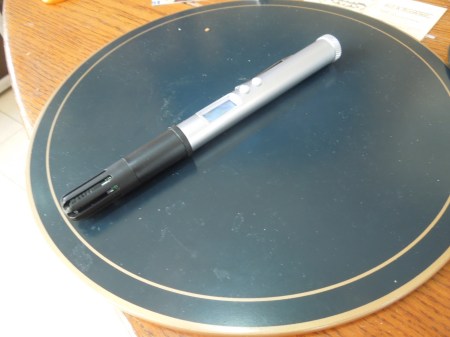
My New Thermometer and Hygrometer
I like to carry one around with me and I bought this new one from Maplins.
My New Thermometer and Hygrometer
I took it to Wigan on Sunday and it measured the temperature and humidity in the Pendelino as 23°C and 49% respectively.
Letterpress Rules OK
This is an older post, that I have re-dated and brought up to date.
My father was a printer. And he was all letterpress. He would have used machines like this Original Heidelberg, although his two were probably older.
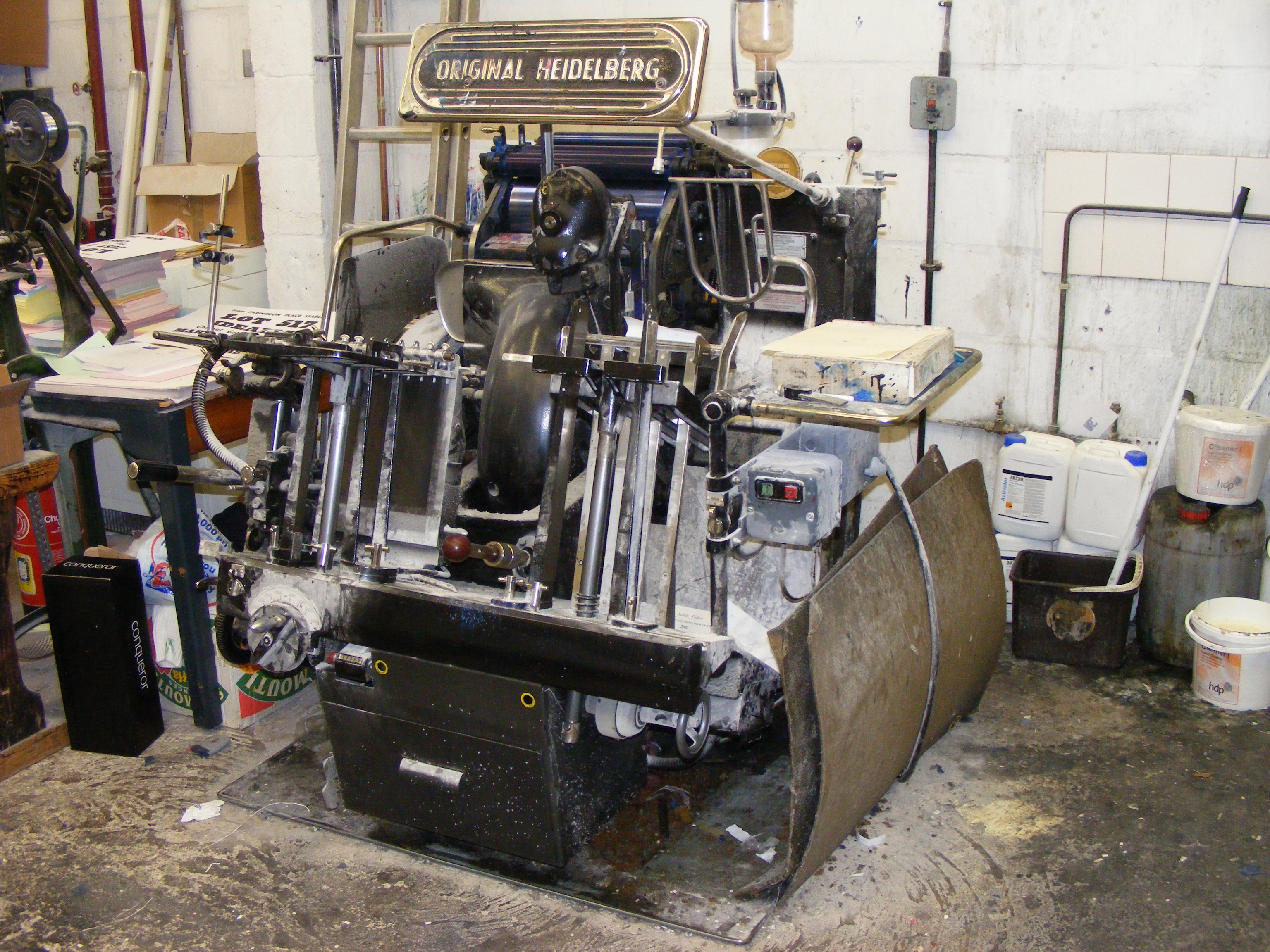
Original Heidelberg
Letterpress printing with movable type is one of the classic technologies that was invented in the Middle Ages by Johannes Gutenberg.
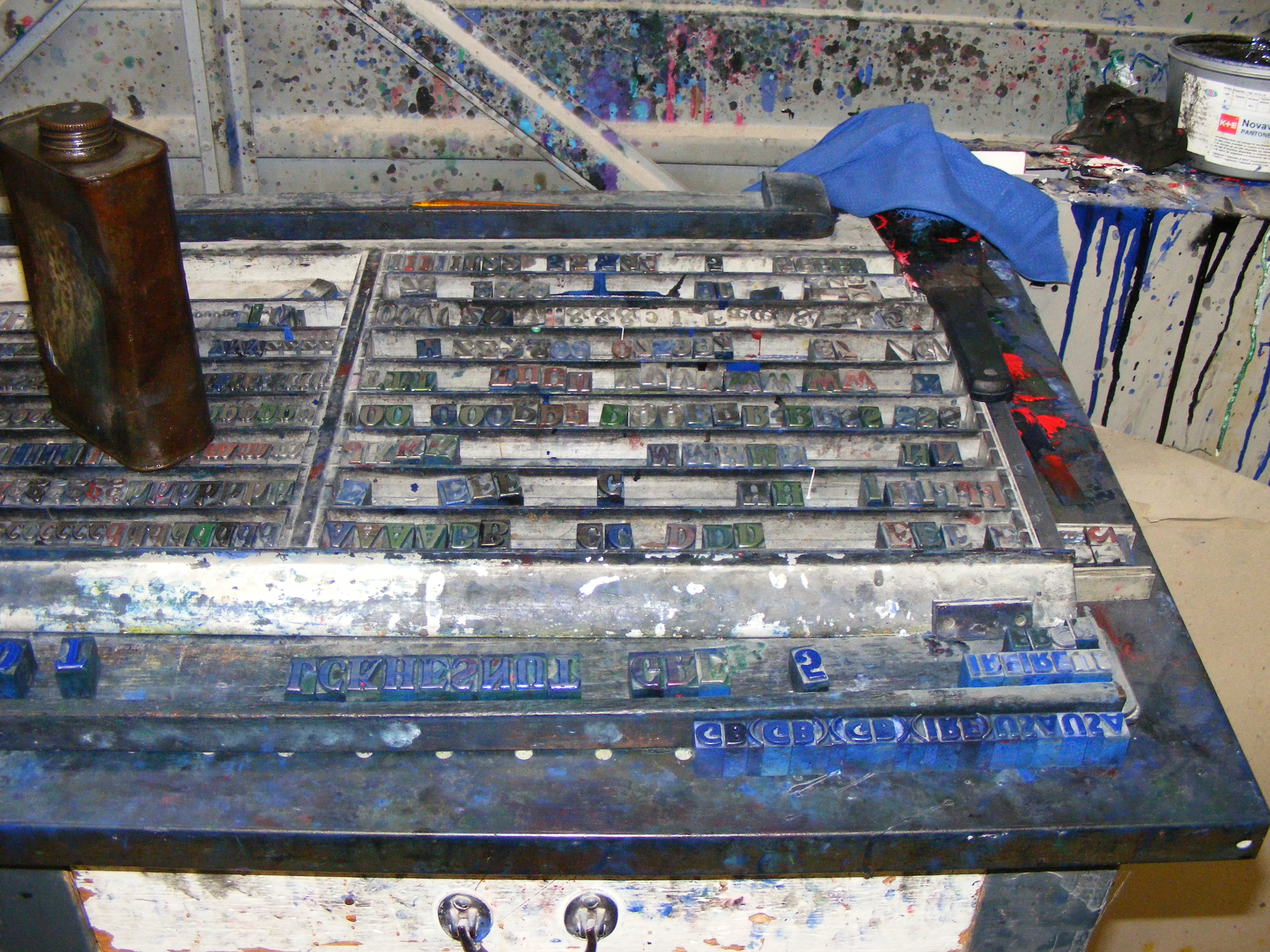
Movable Type
I spent most of my childhood in that printing works in Wood Green. I used to set the type for all sorts of letterheads, posters and brochures, but perhaps my biggest claim to fame, is that I used to do all of the handbills for the Dunlop tennis tournaments, that were held all over the UK in the 1950s and early 1960s.
Sadly, I do not have one of those handbills. If anybody has one, I’d love a photocopy. I’ve searched for years for one, but none exist. Even the archivist, who wrote the history of Dunlop, knows nothing about the tournaments and couldn’t find any reference to them.
I also learned to read and write with poster letters. These are of course backwards and you’d think that it would have caused me to have some sort of reading and writing problem. I suppose it may be one of the reasons for my atrocious handwriting in that I learned that printing, computers or typing is much better from an early age, but it did give me a strong mental alacrity in turning images through 180 degrees.
This involvement in letterpress also left me with some habits and pedantic actions.
For instance, I always refer to exclamation marks as shrieks, which I have inherited from my father.
I’m also very pedantic about spelling and some aspect of structure like apostrophes and plurals. I spell words with the proper use of ae and oe for instance. I spell archaeology with the diphthong and not as archeology. The difference is explained here.
The one thing I don’t seem to have inherited is my father’s good handwriting.
My father also had one of the oldest proofing presses, I’ve ever seen, but sadly there are no images of it. Mpst old ones you see tend to be Columbias made in the UNited States.
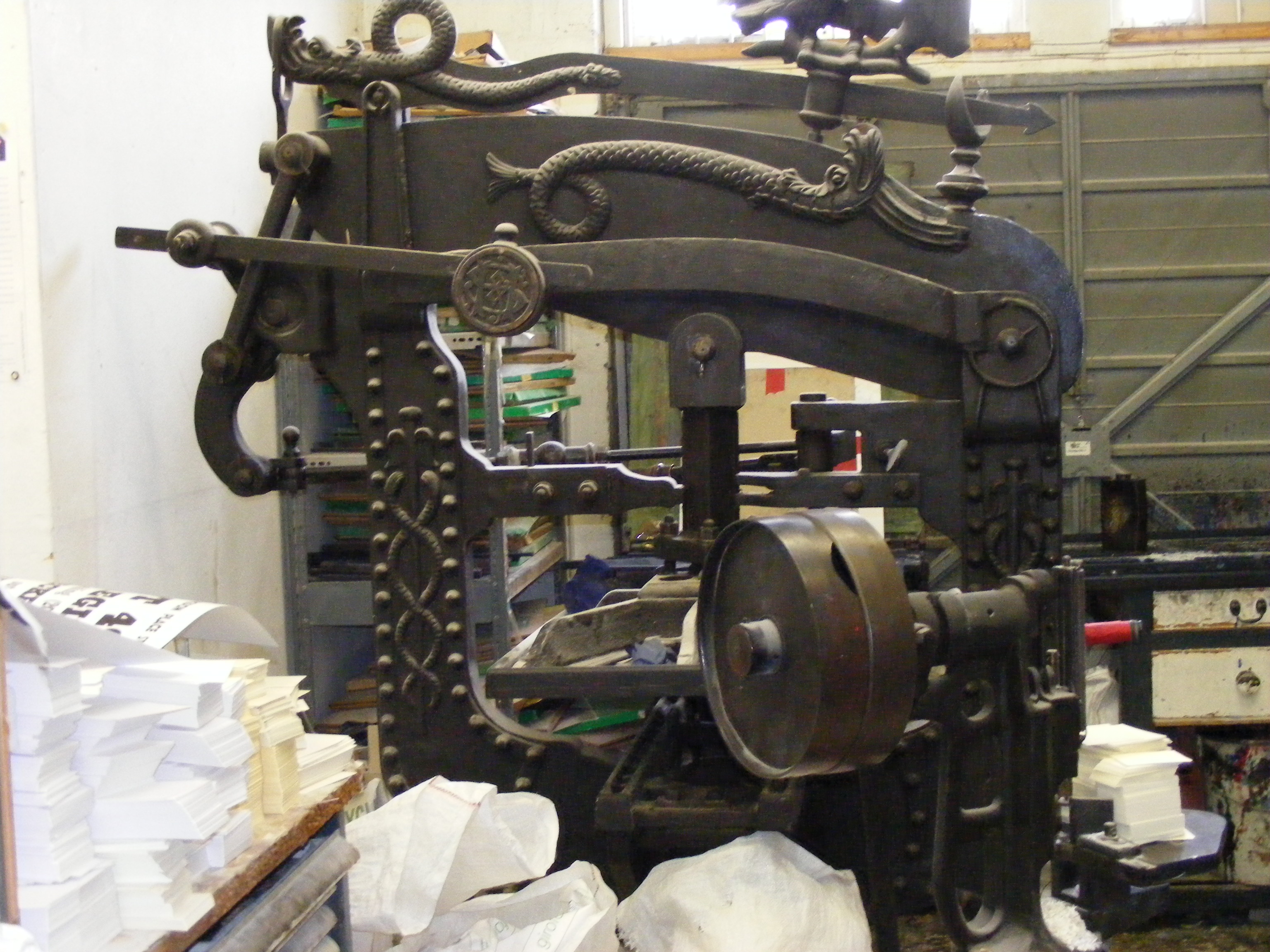
Proofing Press
This one is from about 1850 and was at least fifty years younger than my father’s. His probably ended up in a scrapyard, when a museum would have been a better bet. Printing museums are rather thin on the ground and there isn’t even one in Heidelberg! Although I did find a whole section in a museum in Belarus.
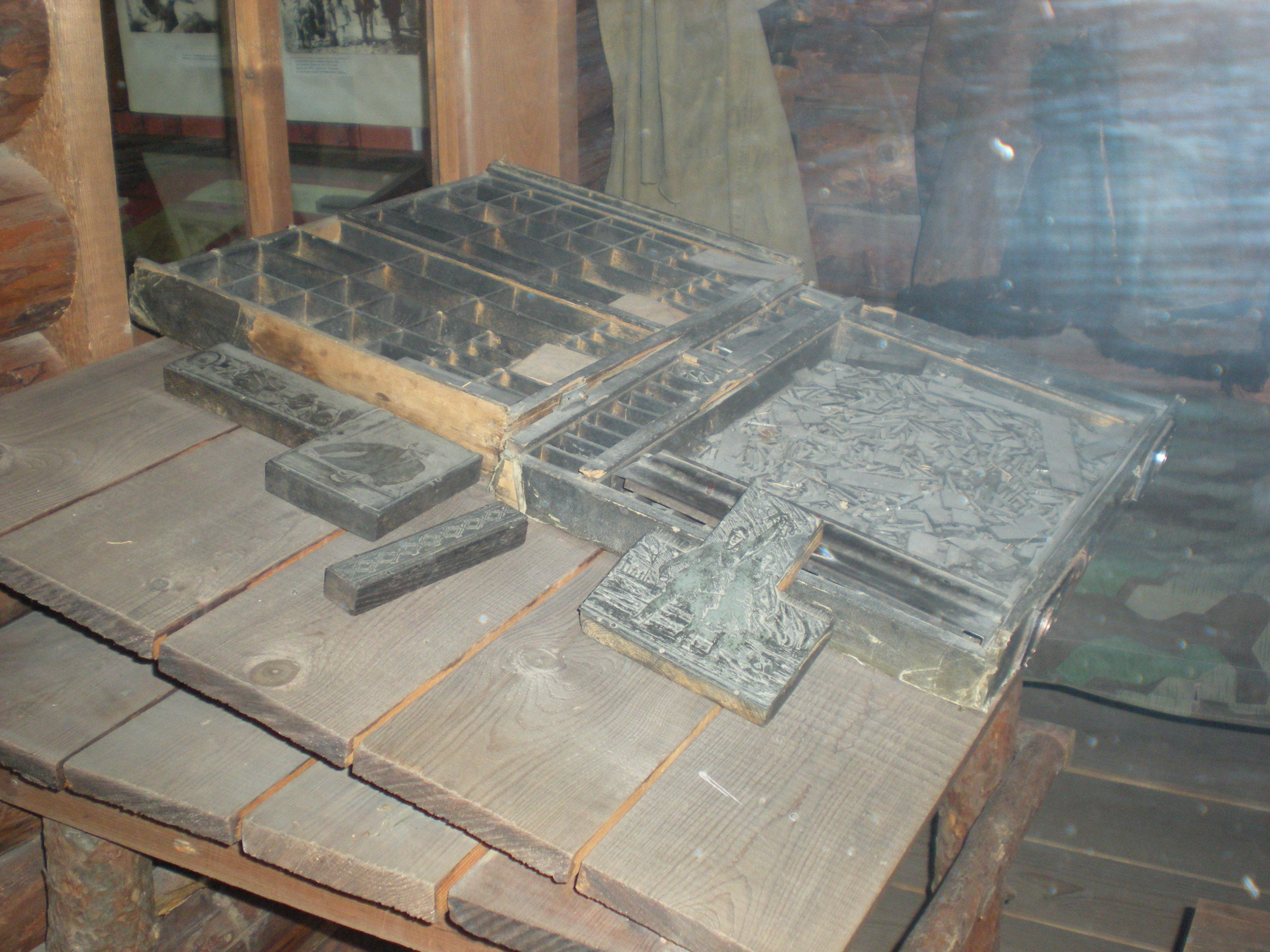
Wartime Printing in Belarus
My father’s letterpress business died.
Offset litho technology was coming in and because of the bizarre purchase tax system in operation in the 1950s and 1960s, it was cheaper for companies to do their own printing. Tax on plain paper was zero, but if it was printed it was 66%, so work it out for yourself. VAT would have solved the problem.
But now letterpress is coming back and like the printer who provided the pictures in this note, it is doing well.
There is nothing like the feel of a properly printed card or letterhead! And you can do so many clever things with a proper printing machine, like score, number, decolate and perforate.
A few years ago, I met one of people my father used to deal with at Enfield Rolling Mills. He explained how my father would use his skills to create production control documents and cards, to smooth the flow of work through the factory. That was the pinnacle of production control and workflow of its times.
It is a strange irony, that I made my money by writing software for project management. Is it in the genes?
 The Anonymous Widower