Glasgow Crossrail
I saw this bus at Glasgow Central station, whilst I was awaiting a friend to go to the Games.
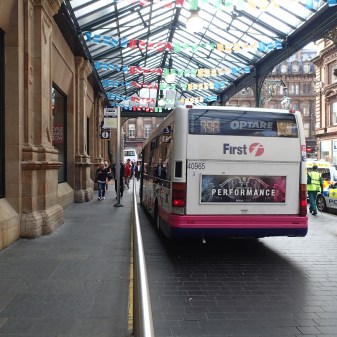
The Bus Connection Between The Two Stations
It connects the station to the other main one at Glasgow Queen Street.
It may work well, but it is needed in that Glasgow has effectively two rail networks; one going south and west from Central and another going east and north from Queen Street. This is illustrated, if you book a train from say Carlisle to the North of Scotland, where you either go via Edinburgh or use the bus to get across Glasgow.
London is adding the east-west cross city Crossrail to go with the current north-south Thameslink, which is being augmented and extended. Cross city routes have one big advantage in addition to the obvious one of linking places on either side of the city together, and that is that terminal platforms in city centres can be released for other purposes. Effectively in London, about half of the Midland Main Line platforms in St. Pancras, were released for Eurostar and High Speed services to Kent, by moving many services to Thameslink, where they effectively terminated at places like Brighton.
But it’s not just in London, that this technique of using a cross-city link to improve services and increase capacity is used.
- Liverpool has linked the Northern and Wirral lines to those going south through a tunnel, which also allowed the old Liverpool Central station to be redeveloped on its prime site as Central Village.
- Manchester is linking Piccadilly and Victoria stations, by means of new track and a bridge to create the Northern Hub.
- Cardiff, Bristol, Birmingham and Leeds don’t really have the two station problem, but many of them pair up services to save terminal platforms. The Valley and Local Cardiff routes are extensive and many services are end-to-end, stopping at Cardiff in the centre.
Obviously, as there are a lot of buildings in the way between Glasgow’s two station, a direct rail link would have to be tunnelled.
As I walked around Glasgow, I couldn’t help noticing two impressive structures. The first was the City Union Bridge.
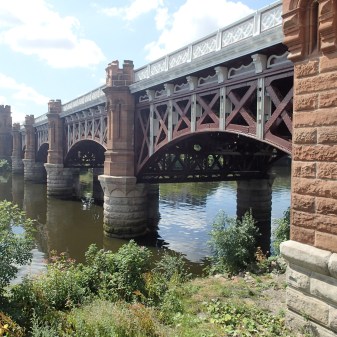
And the second was this viaduct across the centre of the city.

They were both part of the original City Union Line, which is now used for freight and empty stock movements. But it does appear to me to go from east to south across the city.
I had read about Glasgow Crossrail before, but I hadn’t realised that the missing link was so impressive and well-maintained. The Wikipedia article says this about the link.
Since the 1970s, it has been widely recognised that one of the main weaknesses of the railway network in Greater Glasgow is that rail services from the South (which would normally terminate at Central main line station) cannot bypass Glasgow city centre and join the northern railway network which terminates at Glasgow Queen Street station – and vice-versa for trains coming from the North. At present rail users who wish to travel across Glasgow have to disembark at either Central or Queen Street and traverse the city centre by foot, or by road.
Looking at the proposed project, it does seem that it might solve a few obvious problems with the rail system in Glasgow.
The proposal also includes the reopening of Cumberland Street railway station in the Gorbals, opening the area up to the passenger railway network for the first time since the 1960s and a link to the Glasgow subway at West Street station.
Amongst other developments the ability to go between the West Coast Main Line and the North of Scotland was listed.
I would be interesting to see the costs and benefits for Glasgow Crossrail.
On the first night at the Games, I went to the athletics and afterwards I needed to get to back to Edinburgh. The trains were totally overloaded and in a bit of chaos. Surely, Glasgow Crossrail might have allowed direct trains from the Hampden area to Edinburgh, which would have eased the problem, even if it meant a change of train at Central.
Reasons To Go Virgin Or East Coast
I went up to the Commonwealth Games on the 08:30 Virgin out of Euston arriving on time at 13:01 give or take a minute or so.
The best thing about going Virgin before 09:00, is that you get a proper breakfast, which includes a gluten-free option. I had plenty of tea, some delicious scrambled egg and smoked salmon and a glass of juice.
I didn’t get my gluten-free roll though!
As I was meeting someone in Glasgow, who’d come through from Edinburgh, I could have gone up with East Coast and then across to Glasgow with her.
But it would have meant an earlier start and I had to see the builders.
I think it’s true to say that if you’re going to Glasgow or Edinburgh from London, it’s probably better to go direct. But even so, the distance between the two big Scottish cities isn’t great, with the fastest trains taking between fifty minutes and an hour.
So as Virgin run twenty trains a day up the West Coast and East Coast run eighteen and the fastest trains take about the same four hours sand a bit, it’s very much a case of you pays your money and takes your choice.
The trains are different with Virgin running tilting Class 390 trains and non-tiliting diesel InterCity 125 and electric Inter City 225 trains. My preference is for the non-tilting trains.
The only certain thing is that in the next few years, train routes between England and Glasgow and Edinburgh will gain more capacity and will get faster.
As an example, over the last year, Transpennine Express has introduced new faster Class 350 electric trains to and from Manchester. I thought I heard several northern families in Glasgow, who looked like day trippers up for the Games.
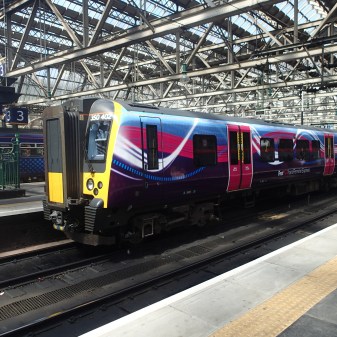
A Transpennine Class 350 In Glasgow
So is this illustrative of how fast, comfortable, high-capacity railways change our lives?
The biggest changed will be Network Rail moving to in-cab signalling, which will allow running over 200 kph on both the West and East Coast Main Lines. This could bring the journey time from London to Scotland much closer to the magic four hours, using the current trains.
When I went to Edinburgh recently by easyJet, security problems meant that I took five and a half hour from my home to Edinburgh city centre. So a four hour journey will be fast enough to give the planes a run for their money. But not everybody goes between London and the major Scottish cities and possibly the biggest beneficiaries of a faster service will be those who have easy access to intermediate stations like York, Peterborough, Preston and Carlisle.
The biggest problem will be track and train capacity on the East and West Coast routes. On the West Coast, there will probably be a further increase in the Class 390 fleet and on the East Coast the Class 800 and 801 are coming.
As with so much on Britain’s railways, the elephant-in-the-room is freight, which is increasing substantially. So will we see extra routes and tracks opened up to held the freight through, just like we have with the GNGE between Doncaster and Peterborough via Lincoln. Of course, we will!
Perhaps, in Scotland, we might even see the return of freight to a Waverley line extended to Carlisle.
Then there is the Edinburgh Glasgow Improvement Program, a project that seems to have lost its way a bit recently. But the main aim of getting about a dozen services every hour between Edinburgh and Glasgow, with some taking just over half-an-hour must be a goal for Scotland.
The Crossrail Portal At Royal Victoria From The Bridge
I was on the bridge at Royal Victoria DLR station this morning and took this picture of the works creating the Crossrail tunnel portal at Royal Victoria.
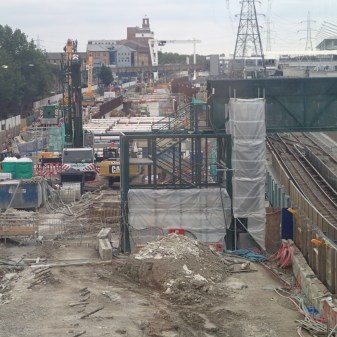
The Crossrail Portal At Royal Victoria From The Bridge
When completed the tunnels will go under where I took the picture to the next station, which is Canary Wharf. Custom House station and the crane used to put the pieces together is in the distance to the left of the electricity pylons.
According to the documentary on Crossrail, it was a tight squeeze at Tottenham Court Road, but this shows it’s as tight as a duck’s arse, virtually everywhere.
Rude words are allowed when talking about Crossrail, as one of the female project managers used the F-word in the documentary.
East Suffolk Gets A Community Rail Partnership
The two East Suffolk Lines out of Ipswich to Felixstowe and Lowestoft are being proposed for a Community Rail Partnership. It’s reported in Modern Railways, but strangely not in the East Anglian Daily Times.
I have travelled these lines occasionally over the last few years and still go to my long-suffering dentist in Felixstowe. I have only been to Felixstowe once since the opening of the Bacon Factory Curve, but it does appear that this development has made trains on the East Suffolk Lines more reliable and better to time.
The Ipswich to Felixstowe branch, must have one of the simplest schedules anywhere on the UK rail network. A single Class 153, just trundles up and down the line every hour over a dozen times a day.
A Community Rail Partnership can only benefit the line.
So what enhancements would I like to see on the Felixstowe branch.
A two coach train should probably be used, as at times the line gets busy and increasingly there are passengers with bicycles.
But the line doesn’t necessarily need a train with a toilet, as Ipswich and Felixstowe stations both have excellent facilities.
One thing I’d like to see is better interfaces with the buses at Felixstowe, but as ever the information is as visitor-unfriendly as you will find. It should at least have a town circular that goes to all the important places in the small town, arriving and leaving at the station convenient for the trains.
It should also have bike hire.
So let’s hope the Community Rail Partnership improves the line.
One possibility that might happen is electrification to Felixstowe Port, which would completely transform this line, Then an old electric multiple unit with perhaps three coaches, could be saved from the scrapyard and given a well-deserved sprucing up and retirement on the Suffolk coast.
I don’t know the Lowestoft line as well, but properly looked after by a Community Rail Partnership, it could be a serious asset to the towns on the route.
One thing is missing from the services back to London from Lowestoft and Felixstowe is the lack of a late train to get back to Ipswich and on to London.
The last train from Lowestoft leaves after nine on most days and at 20:05 on Sundays, whereas the last train from Felixstowe leaves just before half past nine all the week.
It’ll be good to see how the rail services develop in this proud part of Suffolk.
The Fifteen Billion Pound Railway
I’ve just watched the latest episode of the BBC documentary on Crossrail call the Fifteen Billion Pound Railway.
Part of this episode told a history of tunneling through the last fifty years, through old film and the eyes of one of the tunnellers, who’s been digging for fifty years, starting with manual methods on the Victoria line.
It is fascinating to see how techniques have improved even over the last couple of decades.
Just as with North Sea Oil exploration, where projects got easier, as cranes got bigger, it looks like tunnelling will get easier, as tunnel boring machines get bigger, more powerful and better designed.
So when they build Crossrail 2 will it be a quick and more financially efficient project? Having spoken to some of the planners of the project on Friday at Dalston Library, I suspect it will be. Especially, as they are cutting out one of the Hackney stations to save a billion and moving one terminus from Alexandra Park to New Southgate stations.
The lessons learned on Crossrail will also effect HS2, where I suspect we’l see even more tunnels, in the final design.
Redesigning The Ugly
There are lots of everyday common blots on the landscape, that are just downright ugly.
Take the electricity pylon. In all my years of travelling, I’ve never seen any that could be described as beautiful. If we didn’t want them to spoil the landscape, we’d bury them, as happens in most towns and cities.
However, there was a competition a few years ago with a £5,000 prize to find a better pylon. It’s all described in this report.
I’ve not seen any better ones yet!
So now it is time for the designers to look at the overhead lines used on railway lines. The thoughts and ideas are detailed here.
How many everyday objects can be improved by better design and materials?
What Will A Reopened March And Wisbech Railway Mean?
It was mentioned in the blog on Rail News, that a study will look at the reopening of the route from March through Wisbech.
The main reason is that it will allow freight trains between Felixstowe and the North to totally bypass the East Coast Main Line by using the upgraded GNGE.
But will it create better opportunities for passenger services around East Anglia and the Fens?
Getting between Ipswich, Norwich and Cambridge and the North of England and Scotland is not easy, as it means a slow train across East Anglia to Peterborough or a long detour via London.
As an example, going from Ipswich to Manchester takes over four hours and routing is via London. I know a lot of keen Ipswich fans use that route to get to away matches, as the cross country routes are totally inadequate and very crowded.
In a few years time, the TransPennine routes will be electrified, so to get to Liverpool and Manchester from Ipswich, it might be quicker to travel via Doncaster, perhaps changing at Peterborough.
Opening up the route from March to the GNGE would allow direct passenger trains from Ipswich and Norwich to go via Ely and Lincoln to Doncaster.
Lincoln is getting better connections to Nottingham according to the blog in Rail News, so these direct trains might give East Anglia better connections to the East Midlands as well.
But of course, all of this thinking is pie-in-the-sky, as where is the money for shiny new trains?
On the other hand, there might be a glut of hand-me-down InterCity 125s from the Great Western and East Coast Main Lines, as they get replaced by Class 800/801 trains.
So will we see these trains working cross country routes and giving much needed extra capacity out of East Anglia and the Fens?
It’ll be a bit like your mini-cab company saying we couldn’t send the new Nissan, so we sent this immaculate 1970s Jaguar instead. Although the lines wouldn’t be high speed ones, they wouldn’t be slow and mountainous ones, like those through the North of Scotland, where these trains show how good they are.
Repening the line through Wisbech could be unlocking a real box of delights for the East.
Full Steam Ahead On The Railways
As they say the devil is in the detail and this blog post on Rail News has pulled together all of the announcement about rail projects over the last few weeks and especially those concerned with the Local Growth Fund. Here’s the introduction.
Rail and Metro developments in several parts of England are among the principal beneficiaries of Local Growth Fund deals announced by the government on 7 July, it has emerged.
Note that this post only deals with England, so Scotland, Wales and Northern Ireland could have extra projects to add, like this one for Glasgow.
Britain has seen nothing like this since the Railway Mania of the 1840s.
So what are the key points detailed by Rail News?
1. Birmingham gets extensions to the Midland Metro to link it to Curzon Street station for HS2, Adderley Park station and Edgbaston.
2. Wolverhampton gets a transport interchange.
3. There are further extensions and upgrades to stations and lines in the West Midland.
4. Freight interchange and distribution is to be improved at Daventry and near Cannock.
5.Manchester will get more trams and a busway in Bolton.
6. The article includes the improvements in Cornwall and Blackpool that I’ve already noted.
7. There is money for station and transport improvements in the Thames Valley to link to Crossrail.
8. There has been a commitment to link Reading to Heathrow directly by 2021 and also to look at southern rail access to Heathrow.
9. Reading will get improvements as the line to Basingstoke get electrified, including a park-and-ride station at Green Park.
10. Worcester, Bristol, Nottingham to Lincoln will get serious improvements.
11. The last one in the article is one I wholeheartedly support. It is suggested that the March and Wisbech route might be reopened. This would help freight between Felixstowe and Doncaster completely ignore the East Coast Main Line. I talked about it in this article.
If you look at the projects most are about providing better connections to outlying and forgotten parts of England to the present and future main rail network.
It looks like the Local Growth Fund awards total about £6billion.
Places And Spaces At The Building Centre
I went to this exhibition this morning, which shows how the various stations on Crossrail will look.
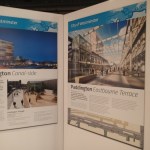



It was certainly a good free exhibition and whetted my appetite for what is to come.
Do We Need Double-Deck Trains In The UK?
You regularly see articles like this one in the Guardian extolling the virtues of double-deck trains. Here’s an extract.
Consultants have drawn up blueprints for double-deckers up to 400 metres long, carrying more than 1,000 passengers, on the network. Supporters of high speed rail say tackling the limited capacity offered by existing lines is crucial.
Greening told the Sunday Times she was excited by the idea of “continental-style double-decker trains that immediately give you more seats and more space”. The trains could have glass viewing ceilings and meeting areas.
Have any of these advocates of double-deck trains ever travelled on one?
They may work on the Continent, but UK railways are different to the rest of the Continent and probably the rest of the world, in that we’re increasingly going for walk-in step-free access to our trains, whereas everybody else has low platforms and several steps up into the train, as I pointed out in this article. In the article I quoted from the specification issued by Crossrail for their Class 345 trains.
Wide through gangways between carriages, and ample space in the passenger saloons and around the doors, will reduce passenger congestion while allowing room for those with heavy luggage or pushchairs.
From what I have read here on First Capital Connect’s web site, the Class 700 might be very similar.
If you’ve ever tried to get in and out of a French, German or Italian express train in a hurry, you will realise that they’re designed to different principles. And they are a total nightmare with a heavy case, in a wheelchair or pushing a buggy. And I’m generally tslking about single-deck trains.
You must also consider the Health and Safety aspects of double-deck trains. If the British public felt they were dangerous and didn’t like the climbing up and down, they would get angry and Disgusted from Tunbridge Wells would get his computer out.
But the biggest problem of double-deck trains is that they need infrastructure clearance everywhere they might go. So if say you might want to run say one of the trains to an important event off its usual haunts, you would have to make sure that line was cleared to accept it.
With normal height trains, like the Class 800, they are designed as go-anywhere trains, that can accept the far corners of the network.
You could argue that the double-deck trains would only stay on high speed or high-density commuter lines, but then for reasons of efficiency trains they must also be able to run on other lines.
Double-deck trains are one of these ideas that look good to politicians, but create more problems than they solve.
 The Anonymous Widower