New Life For Old Trains
We have a shortage of self-powered multiple units in this country, which means that dreadful Pacers like these are still soldiering on!
In the long term, more lines will be electrified, which will release some modern diesel multiple units, like these Class 172 trains on the London Overground.
There is also the new Aventra IPEMUs that might be used to run branch lines off major electrified lines.would be nice to fill the gap.
But some new diesel multiple units would be very nice to fill the gap.
One possibility to fill the gap is the Vivarail D-Train, which is being developed from second-hand London Underground D78-Stock.
This article on the RailStaff web site entitled New Life For Old Trains, gives more details.
It is an interesting concept and I look forward to my first ride in a new Vivarail D-train.
The D-Train doesn’t have the high quality el-cheapo market to itself, as Porterbrook, which is a ROSCO, has converted a Class 144 train from a dreadful Pacer to a modern Class 144 Evolution.
Ian Walmsley in Modern Railways has said this, with respect to the new Class 144e.
Would I lease this in preference to a new DMU? No.
Would I lease this in preference to D78 stock? Probably, but I’ll let you know.
Would the Pacer Death Warrant have been signed if Pacers looked like this a year ago? No.
At present Vivarail say they can produce seventy-six D-trains and there are twenty-three Class 144 trains that could be upgraded.
May the best train win!
Rail’s Forgotten City In The West Midlands
Whilst I was looking at the problems at Coventry Arena station, I came across this document entitled Coventry Rail Story – A Rail Investment Strategy for Coventry.
The report starts like this.
Coventry is the 13th largest City in the UK, with a population of 317,000. Following the loss of its primary manufacturing role in the 1970s, the City has significantly developed its service, health, technology and knowledge economy and 2 universities. However, Coventry has higher unemployment and lower economic output than the UK average.
By 2021 Coventry’s population will grow by 15%, nearly 50,000 people, faster than any other part of the West Midlands, with 33,000 new jobs required by 2028. Its key strategy is growth via employment rather than housing, avoiding becoming an unsustainable dormitory city.
It then goes on to describes the problems and opportunities in various areas.
- How will HS2 affect the City
- It’s lack of connectivity on Cross-Country rail routes, especially to the North East
- Getting To And From Birmingham
- Better Local and Regional Connectivity
- The Tired Coventry Station
It is well researched document and should be read.
Welcome To Coventry
It is interesting to compare the developments that have happened in Nottingham to what should happen in Coventry.
Arriving by train in the two cities couldn’t be more different.
Nottingham welcomes you with a rebuilt station with style and character and in minutes you can be on a tram to the city centre or other parts of the city. You can also get several local trains to suburbs and the surrounding area.
Coventry welcomes you with a tired (the report’s word!) 1960s box station, where the onward connections to the city centre are either walking or a taxi. A sadist built the bus station on the opposite side of the city centre to the rail station. Hadn’t they heard of designing a proper Interchange? This Google Map shows the location of Coventry station with respect to the city centre and its surrounding ring-road.
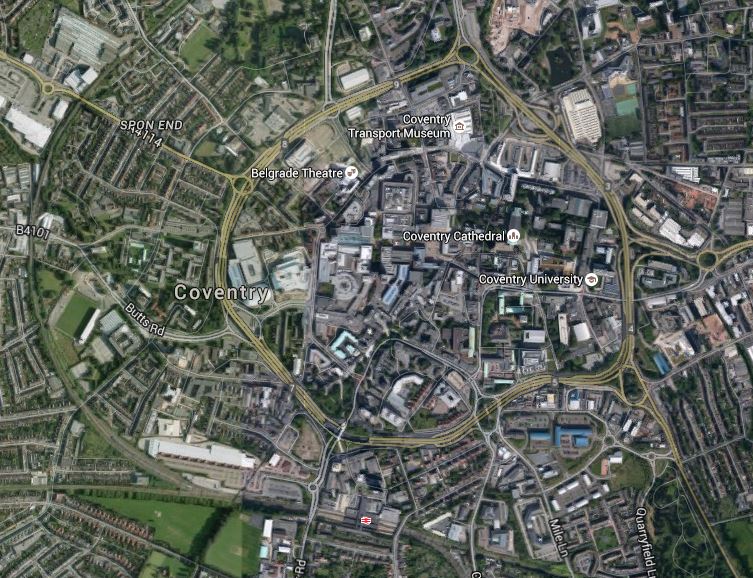
Coventry Station And City Centre
When you consider the new station at Birmingham, Coventry station doesn’t match up to the opposition and probably contributes negatively to visitors view of the city.
How many jobs does the station cost Coventry?
NUCKLE
NUCKLE is a project to improve the rail services between Coventry and Nuneaton and Leamington.
Phase 1 is described on this page of the Warwickshire County Council website. This is said.
The Coventry to Nuneaton rail upgrade, known locally as NUCKLE Phase 1, will improve the existing rail line between Coventry and Nuneaton. It will deliver two new stations – one at Coventry (Ricoh) Arena and one at Bermuda Park in Warwickshire. It will also see the extensions of the existing platforms at Bedworth station and a new bay platform at Coventry station.
The related phase 2 includes the new station at Kenilworth.
As part of the Electric Spine, the Coventry to Leamington Line is going to be electrified and doubled. The Coventry Rail Story says that Coventry to Nuneaton Line will also be electrified.
I suspect this will happen, as NUCKLE is in the West Midlands and they seem to get electrification done. So there will be approximately twenty miles of electrified line passing North-South through Coventry.
So would this open up the possibility of an electric service from Oxford to Leicester via Kenilworth, using Aventra IPEMUs, which could bridge the gaps in the electrification between Leamington Spa and Oxford and Nuneaton to Leicester.
This would fit the aspiration in the Coventry Rail Story of an improved train service between Coventry and Leicester via Nuneaton.
The Coventry to Nuneaton Line used to have other stations. So the question has to be asked if other stations can be built between Leamington Spa and Nuneaton to improve commuting into Coventry,
Extending The Midland Metro To Coventry
Extending the Midland Metro to Coventry is being considered in the Line Two Eastside Extension.
This may happen, but I have a feeling that new technology might offer better solutions to improving connections between Birmingham, the Airport, HS2 and Coventry
Has Sir Peter Hendy Had An Effect At Network Rail?
Sir Peter Hendy joined Network Rail in July 2015.
Is it just a coincidence, but there seems to be a lot more progress on getting the infrastructure sorted over the last couple of months?
Two stations I am following; Lea Bridge and Ilkeston seem to have finally got started.
Sir Peter may not be responsible, but just because he’s there, companies and people have decided that doing something is better than freewheeling.
Lea Bridge Station – 13th September 2015
The progress at Lea Bridge station seems to be mainly clearing the site.


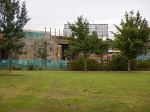


They were even working today, which is a Sunday.
But then the railway through the site had been closed off, as the pictures show.
The Railways East Of Nottingham
As an engineer, I’m always of the view that a lot of engineers, do the jobs they do because they like creating things on the one hand and because it’s great fun on the other.
Although, I’ve been much more in a support role to engineers in many varied industries, I’ve loved the solving of problems and the creating of products all my working life. It might have been stressful at times, but it has been tremendous fun!
It strikes me that the rail projects centred on Nottingham in the last few years, have been done well and with a great deal of style and innovation.
There has been a lot of them in recent years.
- Passenger services on the Robin Hood Line in the 1990s.
- Refurbishment and reorganisation of Nottingham station in the 2010s.
- Phase 2 of the Nottingham Express Transit in 2015.
- The Tram Viaduct Over Nottingham Station in 2015.
- Remodelling of track, signalling and platforms around Nottingham Station in 2013.
- Sorting the footbridge and public path at Nottingham Station in 2013.
- Improvement at Long Eaton Station in 2012.
- Improvement of the Erewash Valley Line in 2007.
Network Rail are following these with other projects in the area.
- Ilkeston Station
- Creation of the Ollerton Branch on the Robin Hood Line.
- Creation of a new route from Derby to Kirkby-in-Ashfield via Long Eaton and Ilkeston
Only the Ilkeston station project has started, although not much trackwork needs to be done for the two new routes.
There would appear to be little work either done or proposed to the East of Nottingham.
But that would ignore the big project about thirty miles to the East – the updating of the Great Northern and Great Eastern Joint Railway (GNGE). I wrote about that project in Project Managers Having Fun In The East.
Effectively, £230million has been spent to create a high-quality line for freight between Doncaster and Peterborough, so that there is a higher capacity for passenger services on the East Coast Main Line.
So what could happen in the area?
Poor Lincoln – Level Crossings
I say poor Lincoln, as the city has suffered for years because there is a busy level crossing used by very large numbers of people, vehicles and trains, right in the centre of the City on the High Street. This article from the Lincolnite talks about the start of a £12m project to create two footbridges over the railway. Reading the comments to the article is an informative exercise.
If you want to read more about this project, there are more details on this page on Network Rail’s web site.
This Google Map shows the two level crossings to the West of Lincoln Central station.
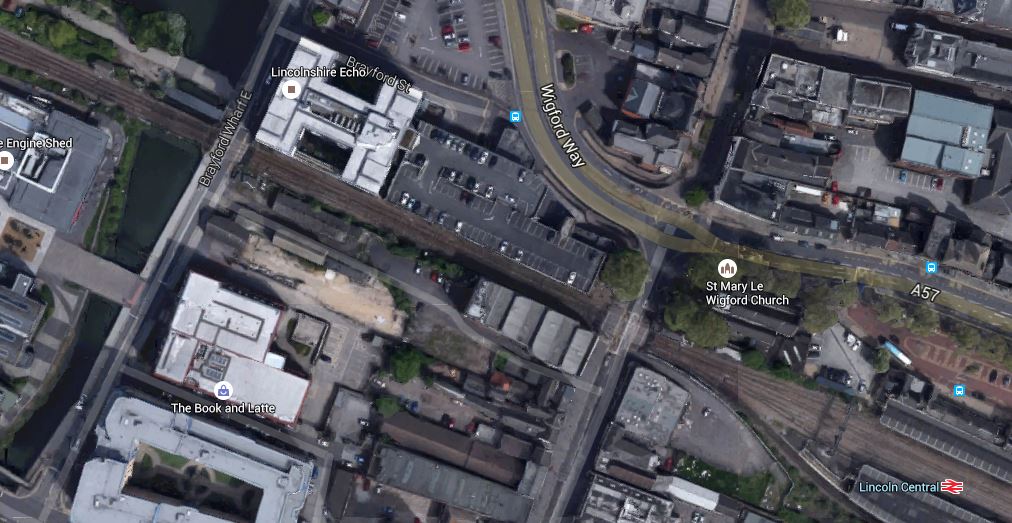
Lincoln Level Crossings
As an East West relief road is also being built, according to this article in the Linconite, the two projects might improve the problems in the City centre for a few years.
Before I leave the level crossings at Lincoln, take a look at this article from Rail Magazine. This is said about the level crossings.
Early Network Rail figures suggest that by 2030, with all freight paths being used and all East Anglian ports running at maximum capacity, the barriers in Lincoln could potentially be down for 40 minutes in every hour. The resulting road traffic problems are likely to increase local discontent.
So something serious must be planned for the future.
Poor Lincoln – Passenger Services
Lincoln also deserves sympathy for the poor passenger service that the City has to connect it with the rest of the UK. By comparison, Norwich is perhaps fifty percent bigger than Lincoln, but has a half-hourly service to Ipswich and London, and an hourly service to Cambridge.
Lincoln has an hourly shuttle to Newark and a few direct trains to London. There is also an irregularly-timed shuttle to Newark for London trains.
I think a city with the population and status of Lincoln deserves better.
North and South Through Lincoln
I have read the Route Utilisation Strategy (RUS) for the East Midlands and searched it for references to Lincoln. Two sections are of note. This is said in the RUS.
In addition, the interaction between passenger services terminating at Lincoln and freight trains passing through the station area has been identified by the RUS as a constraint to future growth. The RUS recommends that the great Northern/Great Eastern (GN/GE) Joint Line scheme, which will provide additional capacity between Peterborough and Doncaster (via Spalding) in CP4, considers whether or not combining terminating services at Lincoln (to create more through services and reduce congestion in the station area) would free up sufficient capacity to accommodate growth.
With my scheduling hat on, I think this simple matter of joining services together could give some needed additional paths to improve passenger services. In many places in the UK, like Birmingham, Cardiff, Edinburgh and London, this has been done to provide cross-city services, that release platform space in the station.
This was also said about improving services between Lincoln and Peterborough.
Peterborough and Lincoln by providing an improved service using existing resources once the upgrade of the GN/GE Joint Line has been completed.
After the upgrade of the GNGE, I wonder if any changes have been made to the passenger services between Peterborough, Lincoln and Doncaster.
I think not!
From my travels in Germany, the Peterborough to Doncaster and/or Sheffield/Meadowhall via Lincoln, is just the sort of route on which the Germans would run a regional service.
I think the RUS is hoping that someone will do this, but it would seem it’s just the same old slow service.
There may have been an improvement between Lincoln and Peterborough, as the service is roughly hourly and takes eighty minutes with four stops. There may be an improvement to come, when Werrington Junction, where the GNGE joins the East Coast Main Line, is improved. I wrote about this junction in To Dive Or Fly At Werrington.
But if you look at the services from Lincoln and Doncaster, some go direct in forty seven minutes and others go to everywhere in Yorkshire and take over two hours.
Lincoln To Nottingham via Newark
To improve services between Lincoln and Nottingham, the RUS recommends doing something about the notorious flat junction at Newark, which is best described as a cross roads, where a B-road crosses a motorway. This is said.
Of the remainder, the RUS recommends that the provision of a flyover at Newark is further developed in CP4 to refine the infrastructure costs and potential benefits. It is recognised that the development of the East Coast Main Line Intercity Express Programme service requirements beyond those proposed for LDHS services from May 2011, combined with freight growth beyond 18 freight trains per day on the east – west corridor, may drive the requirement for the flyover in CP5.
I have now looked at this Victorian railway relic in The Newark Crossing
Local Services Between Nottingham And The East
As I said earlier, Network Rail and the various local councils have done a lot of work to give Nottingham a first class tram systems and Nottingham station has been upgraded to accept extra services. They are now starting to improve services to the West and North.
So what will happen to services to the East of the city?
There are rumours about tram-trains being introduced in Nottingham and this is said in the section on Future Routes in the Wikipedia entry for the Nottingham Express Transit.
The document raised the possibility of tram-train lines from Nottingham to Gedling and/or Bingham, and to Ilkeston.
Gedling is on the line to Newark and Bingham is on the line to Grantham.
So one option would be to use tram-trains on the routes to Newark and Grantham, where the services run into the city as far as Bingham and Gedling as trains and then run as trams, to join the main tram network at either Nottingham station or some other convenient point.
One interesting observation is that as tram-trains can take much tighter curves than trains, is that a Nottingham to Newark tram-train might be able to call at Newark Castle, then cross the East Coast Main Line and then do a tight turn to call in the bay platform at Newark North Gate station before reversing and going on to Lincoln. This Google Map shows the Newark Crossing in detail.

Newark Crossing Close-Up
It is a very crowded place, but there may just be space for a tram-train coming from Nottingham to turn and go to Newark North Gate. It would appear to be no tighter than the Tinsley curve that will be used by Sheffield’s tram-trains to Rotherham.
Going the other way from the spur to Nottingham, might be more difficult, but I think it would be possible.
So could using tram-trains to Lincoln, give that city a much better service to and from Nottingham, but also take some pressure off the design of any solution at Newark?
I would suspect that if tram-trains went to Newark/Lincoln and Grantham, there would be a half-hourly service to and from Nottingham.
The Class 399 tram-train would also provide a faster service than the current trains.
Conclusion On The Newark Crossing
I only come to one conclusion about the solution to the Newark Crossing. Everybody should prepare for the unexpected.
Reading Station Just Gets Better!
Reading station is one of the best in the UK and rivals any second level station in Europe.
It first impressed me, when it opened and I wrote Is It Architecture, Engineering Or Art?
I took these pictures when I went to the Reading Ipswich match.

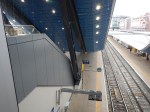

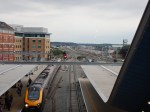
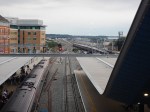
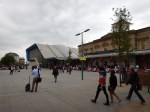
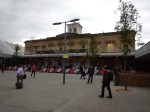

These changes were noted.
- The football buses are now parked by the station
- The Reading flyover is clearly visible from the massive footbridge over the station.
- The area in front of the station is now a plaza and not a building site.
The only problem I had was when returning after the match, It was difficult to find the first fast train to Paddington and I ended up on a stopping train to everywhere.
I did look around the station when I arrived, to see if there was any clue as to which will be the Crossrail platforms. The local services are currently served by Platforms 12 to 15 on the North side of the station. So it would probably be safe to assume that one island platform would be for Crossrail and the other is for services to places like Oxford, Newbury and Bedwyn.
It would appear that Rediung will not be served by Crossrail under December 2019.
Expanding The Robin Hood Line
The Robin Hood Line, runs between Nottingham and Worksop. It had been closed to passenger trains in the 1960s and reopened to passengers in the 1990s. I used to use it regularly to see a client in Mansfield in the years soon after it opened.
In my investigations into Ilkeston station, the Robin Hood Line kept cropping up and especially talk of a branch from the line to Ollerton.
Search Google News for Robin Hood Line and articles with titles like Chancellor backs Robin Hood line passenger plans are found in the Mansfield and Ashfield Chad. This is the start to the article.
The Chancellor George Osborne, has confirmed his backing for plans to open a passenger service on the Robin Hood line, from Shirebrook to Ollerton, including passenger stations at Ollerton and Edwinstowe.
Other Government figures like David Cameron and Patrick McLoughlin and important local councillors are also quoted saying similar things.
What is not said is that the line will serve the CentreParcs Sherwood Forest and that the rail line needed is currently fully maintained for driver training. This Google Map shows the area.
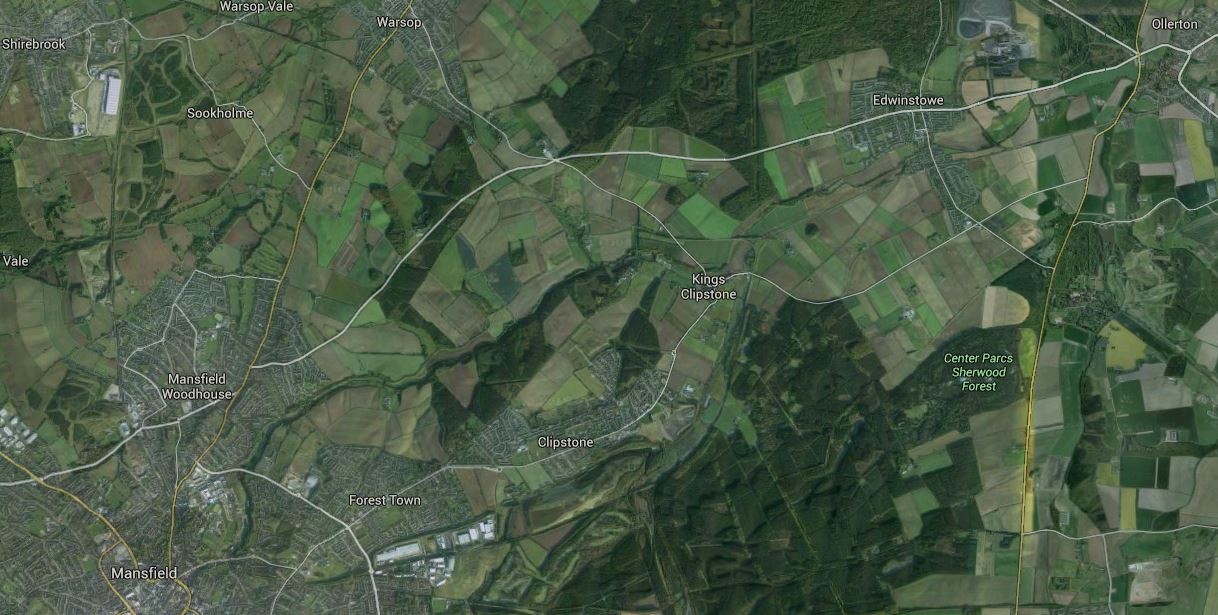
Proposed Ollerton Branch
The branch turns off from the Robin Hood Line just North of Shirebrook station in the top left hand corner of the map and then makes it way to Ollerton by way of the South of Warsop and Edwinstowe and North of the CentreParcs Sherwood Forest .
The line probably illustrates the only environmentally-friendly use for coal, which is to keep rail lines open and in good condition, until we can find a better use for them.
There is an interesting section called Branch Lines in the Wikipedia entry for Shirebrook station. This is said.
Two branch lines are plainly visible veering off north of the bridge at the north end of Shirebrook station.
The double tracks branching off eastwards (i.e. to the right as viewed from the station) to the side of the signalbox joined the LD&ECR’s one-time main line to Lincoln, next stop Warsop. The branch only ever carried a regular passenger service for a few years in Edwardian times. It did, however, carry Summer holiday trains such as the Summer Saturdays Radford to Skegness in at least 1963. The branch’s main purpose was always freight traffic, with coal being overwhelmingly dominant.
In 2013 the line gives access to Thoresby Colliery and to the High Marnham Test Track.
There is some hope of reopening the line as a branch off the Robin Hood Line and reopening Warsop, Edwinstowe and Ollerton stations, providing an hourly service to Mansfield and Nottingham.
This Google Map shows Shirebrook station and the railway lines around it.
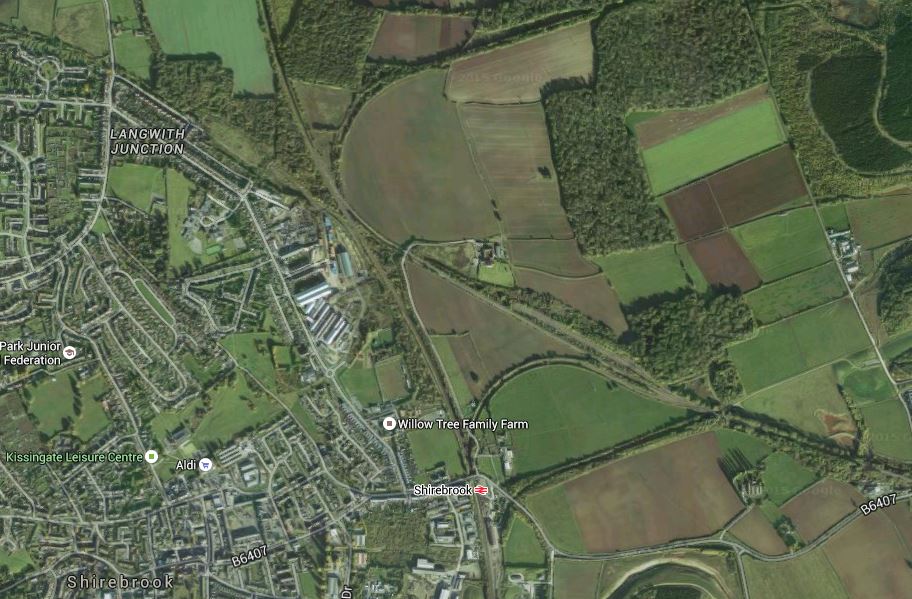
Shirebrook Station
The junction of the Ollerton branch would appear to allow access to trains from or to either Nottingham and Mansfield in the South and Worksop in the North
So there could be three stations; Warsop, Edwinstowe and Ollerton on a double-track branch.
From Ollerton To Lincoln
Interestingly, after Ollerton the line goes all the way to Lincoln. But I doubt that it would ever be part of the plans for passenger trains in the area.
But who knows?
The area between Chesterfield, Mansfield and Nottingham is not very well connected to Derby.
If you want to go from Mansfield or Kirkby-in-Ashfield on the Robin Hood Line to Derby, you always have to change at Nottingham, with sometimes an extra change at East Midlands Parkway.
The Erewash Valley Line runs North-South a few miles to the West of the Robin Hood Line.
Despite being partially in Derbyshire, getting from stations like Alfreton, Langley Mill and the soon-to-be-opened Ilkeston stations to Derby, you have to change at either Nottingham or Chesterfield.
Look at this Google Map of the area
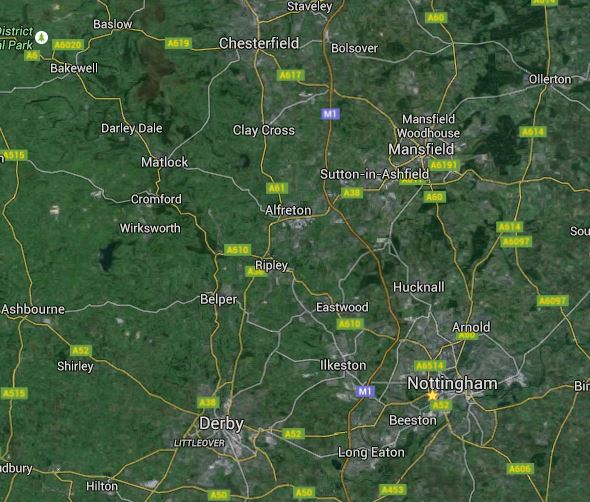
Between Derby, Nottingham, Mansfield And Chesterfield
There must be a better way of getting to Derby, than by changing trains in Nottingham or Chesterfield.
But what?
There are four main North-South routes in the area.
- The Robin Hood Line between Nottingham and Worksop
- The Erewash Valley Line between Long Eaton and Chesterfield
- The Midland Main Line between Derby and Chesterfield
- The M1 Motorway
What seems to be missing is high-capacity East-West routes for both rail and road.
The Erewash Valley Line goes South to Long Eaton, which has several trains per hour direct to Derby, so this could be the key to getting to Derby.
In a Notes on Current Station section on the Wikipedia entry for Long Eaton station, this is said.
It is planned that both platforms will be extended by up to 10 metres by no later than 2012.
It is anticipated that developments along the Erewash line will result in changes for Long Eaton station. A plan drawn up in 2011 recommended a new Derby to Mansfield service via new stations at Breaston & Draycott, Long Eaton West (renamed from Long Eaton), Long Eaton Central, Stapleford & Sandiacre, Ilkeston, Eastwood & Langley Mill (renamed from Langley Mill), Selston & Somercotes and then to Pinxton via new trackbed connecting with the Mansfield line from Nottingham at Kirkby in Ashfield.
It strikes me that work at Long Eaton, the several new stations and improvements north of Langley Mill would enable direct services from Alfreton, Ilkeston and Langley Mill to both Derby and Mansfield. This service would also improve services from stations stations North of Mansfield to Derby.
A trackbed from Langley Mill to Kirkby in Ashfield is shown on Google Maps.

Langley Mill to Kirkby-in-Ashfield
Alfreton is the station at the top left and Kirkby-in-Ashfield is at the top right. The Erewash Valley Line from Langley Mill, enters at the bottom and splits with one branch going to Alfreton and the other going East to cross the M1 and join the Robin Hood Line south of Kirkby-in-Ashfield.
On an Ordnance Survey map, dated 2009, the railway is shown as a multiple track line, probably serving collieries and open cast coalfields.
It all sounds very feasible too! Especially, as the Erewash Valley is an area of high unemployment, low car ownership and a dependence on public transport.
The Future Of Railways In North Nottingham And South Yorkshire
Look at any map of the area between Nottingham and Derby in the South to Sheffield, Doncaster and Barnsley in the North and you will see rail lines criss-crossing everywhere. Many are now disused and show up as green scars on the landscape.
Also on the maps, you will see quite a few large power stations. Most were originally coal-fired and merry-go-round trains transported the coal from the mines to the power stations.
So most of the rail lines in the area, were built to take the coal away from the mines to where it was needed. Passengers were almost an afterthought. The railway companies even built the Great Northern Great Eastern Joint Line from Doncaster to East Anglia to take coal to where it could profitably be used.
After the Second World War, the railways contracted and cut passenger services. As an example, the Robin Hood Line closed in the 1960s.
The passenger services were suffering because of car ownership, so most were withdrawn, except on the main routes. Mansfield before the Robin Hood Line reopened, was one of the largest towns in England without a rail station, an honour now held by Ilkeston a few miles away.
In recent years, coal use has in my view rightly declined. Everybody knows the poor environmental record of coal, with its creation of CO2 and other pollutants. On the other hand, I have met people whose fathers worked in the mines and the general advice they received is don’t go underground!
So as the need to move coal by rail has declined, many of these railway lines have ceased to carry much freight traffic and have fallen into disuse.
But some are coal’s last legacy, in that until comparatively recently, they were still used to get coal to the power stations. Like the line from Shirebrook to Ollerton, they are in good condition and only need stations to bring them back into use as passenger lines. Just as the Robin Hood Line was reused twenty years ago!
Because these lines serves the coalfields and the mines, they also serve the mining communities and the small towns, that need improved public transport links.
Network Rail’s plans seem to be going some way to be addressing some of the problems in the area.
I don’t think that the reopening of the Ollerton Branch and the connection between the vErewash Valley and Robin Hood Lines, will be the last lines to reopen in the area.
Work Will Start On Ilkeston Railway Station This Month
This article in the Ilkeston Advertiser has announced that work on the station will start soon. This is said.
Works in the coming months will include building the platforms, removing and installing a new and wider footbridge – making it easier for cyclists and pedestrians to pass – and building two car parks.
I would think that this could be the start of better times for Ilkeston.
Although someone has commented that it is a waste of money!
Faster London Trains Could Make Your Commute Even Longer
I have spent much of my working life calculating the dynamics of systems, be they complex sets of calculations for a Bank, the solving of massive sets of differential equations or calculating how many days, hours and minutes a project will take and how many pounds, groats or donkeys it will consume.
So when I saw an article in New Scientist with the title of this post, I had to read it.
You should!
In my modelling of complex systems, nearly fifty years ago, I used state-of-the-art, digital and analogue computers to model complex interactions in chemical reactions and plants. In more than one case the answer that was obtained was unexpected.
But then you can’t argue your feelings against thoroughly correct mathematical equations!
The same is happening in this transport example. Your feelings may say faster trains will get you there quicker, but properly modelled it would appear that the reverse may be true.
One thing that may be true in some places, is that adding new stations to a line reduces the time taken to commute.
So sometimes residents wanting a new station near their houses, may just be right!
Only a rigorous mathematical model will tell the truth!
Leeds seems to have an ambitious station building program, whereas only one new station;Lea Bridge, is being built in London.
And intriguingly in London, Crossrail is being built with only one new station; Woolwich, although some are being substantially rebuilt!
I hope they’ve done their modelling extensively enough!
Where Now For The Borders Railway?
On Monday I took a trip down the new Borders Railway to Tweedbank station.
It has been put together with care and no-one can say it will be falling apart in a couple of years.
Criticism
According to Wikipedia, there have been three major criticisms of the new line.
- Infrastructure Capability – It’s just a basic railway.
- Timetabling – Critics think they can do it better.
- Failure to continue to Melrose – New lines always have the wrong route.
I think though that you have to allow the line to bed down and allow the operator to overcome any problems that might be thrown up.
My thoughts on the three areas will now be given.
Infrastructure Capability
It is a railway that is designed to handle two trains an hour in each direction taking just under the hour for the whole journey.
Critics have said, that it should be double-tracked and electrified. But if it was, this would probably double the capacity of the line and will there be enough passengers to fill an enhanced service?
If in the future, the line suffers from overcrowded trains, to which new lines in the UK seem to be prone, there is a simple way to increase the capacity of the line. And that is to run longer trains!
I suspect that as the line has been built to take steam specials, the line will have the capability of taking diesel multiple units of four carriages.
Hopefully, there’s enough platform capacity at Waverley. But I do have a feeling that Waverley will need to be given some extra capacity, as more and more trains go to the Scottish capital, of which the Borders Railway is just one of several planned new services.
Timetabling
In a few years time, the timetable will be very different, as the current one is only an initial estimate of what is needed.
Failure To Continue To Melrose
In my view they have done something much better by creating an integrated train-bus interchange at Galashiels, which serves the whole Border region.
It may be in the future, they need to extend the line to Melrose, but if any bus route from Galashiels gets overcrowded, it is a lot easier to add a few more buses, than build a new railway line. At least if you catch the bus from Galashiels you wait in a nice comfortable bus station, rather than on top of the North Bridge in the wind and rain.
Possible Improvements
Much of the improvement to the line will be organic and small.
- Shops and kiosks will appear in and around stations, driven by the needs of passengers creating business opportunities.
- If passenger numbers increase, then the trains will gain extra carriages. Electrification of other routes in the UK, may help this, as it will release some longer trains.
- Operational problems may show up limitations in the track and signalling and small changes may improve reliability, time-keeping and may even reduce the journey time.
I am basing these conclusions on what I have seen on other new and much improved lines in the country.
But bigger improvements will be possible.
Extension To Melrose
This will only happen, if indications are positive that the service will pay for itself. But it could be an expensive line to rebuild, as the Melrose by-pass has been built over part of the line.
A positive could be that any extension to Melrose, might serve the Borders General Hospital,
Extension To Carlisle
Strangely, I think this will be more likely than an extension to just Melrose, as it will be an English project as well as it opens up a new route up the West Coast to Edinburgh, which could be used by freight trains in addition to passenger ones.
When the equivalent rail lines in the North of England are modernised, a Borders Railway to Carlisle, would open up a large area bordered by Edinburgh, Carlisle and Newcastle for rail-based tourism, with excellent links to the large centres of population in the UK.
But until we see how successful, the Borders Railway will be, extension to Carlisle is a remote possibility.
Extension To Penicuik
The creation of a branch to Penicuik is raised in Proposed Extensions in the Wikipedia entry for the Borders Railway.
At present Heriot-Watt University is looking into the proposal for Midlothian Council.
Changes At Edinburgh
There could be changes to the line at the Waverley end of the line, as Network Rail and Scotrail improve services in the capital.
At present services from Dunbar and North Berwick go across the city to destinations in the West. There must be a very small chance that services on the Borders Railway might be extended past Waverley to at least Haymarket.
Trains or trams might also run on the Edinburgh Suburban and Southside Junction Railway in a loop across the South of the City. Although this will not directly affect the Borders Railway, train times may be adjusted so they connect better.
New Stations On the Current Route
Passenger numbers and patterns of use, property development, jobs and other factors will create a need for new stations on the route.
These could be totally new or opened up at places where stations used to exist in the past. If you look at the diagram of the old Waverley Route, there are several places, where stations have not been rebuilt.
If built these will add to the passenger numbers on the line and this could create the need for other improvements, like longer trains.
Remember too, that this line was designed down to a price in the mid-2000s, based on the assumptions of the time. Since then, there has been a big change in our attitude to railways with big projects like the London Overground being created from terrible lines and being tremendous successes and smaller ones in Birmingham, Lancashire and Scotland showing good returns, Government is much more likely to fund a properly costed rail project.
So I wouldnt be surprised to see a couple of new stations in the next few years on the Borders Railway.
Electric Trains
For the last few years, electric trains don’t necessarily mean those taking current continuously from overhead lines. Bombardier’s new Aventra electric multiple unit, has a battery variant called an IPEMU. Provided it can charge the battery on a convenient overhead line, it can then run for sixty miles on the battery.
As Edinburgh to Tweedbank is about thirty-five miles, I would suspect that an IPEMU would be able to manage the journey, charging the battery on the short section of the East Coast Main Line at Edinburgh, before the train turns off onto the Borders Railway.
These IPEMU trains are modern, environmentally-friendly four-car trains, that can run on lines that are partially electrified without any modification to the lines, if they can handle diesel multiple units, like those currently running on the Borders Railway.
They may be the best way of providing a higher-capacity service, that run the route slightly faster, due to their faster acceleration.
Knock-On Effects On Other Lines
If the Borders Railway is a rip-roaring success, this will add to pressure to reopen or substantially improve rail lines all over the country.
Don’t Underestimate Engineers!
Because of the unique status of Scotland in the UK and the good publicity the new Borders Railway has received, I have a feeling that as the ultimate objective of the Scottish Government to connect to Carlisle will be fulfilled, as so many other parties like Councils in the North of England, freight companies and Network Rail will give their support for all sorts of reasons,
And a lot of engineers, architects, engineering companies and train manufacturers will come up with innovative solutions for those dreams.
After all what better showcase is there for your new construction technique, train or rail-related product?

