Vestas Unveils Plans For V236-15.0 MW Nacelle Factory In Scotland
The title of this post, is the same as that of this article on offshoreWIND.biz.
This is the sub-heading.
Vestas plans to build a nacelle and hub assembly facility in Scotland to support offshore wind projects in the UK and across Europe.
These four paragraphs give what looks to be a full outline of a more or less comprehensive plan.
The proposed factory would require a capital investment of more than EUR 250 million and is planned to manufacture nacelles and hubs for the company’s V236-15.0 MW offshore wind turbine. The new facility is expected to create up to 500 direct jobs, with additional employment across the supply chain.
According to Vestas, the plan to set up the factory follows the results of the Contracts for Difference Allocation Round 7 (AR7) in January 2026, the company’s growing offshore wind order book in the UK, and strategic discussions with the UK and Scottish governments on the next steps to develop and co-invest in the facility.
The plan also includes the potential co-location of suppliers producing other major turbine components, as part of a broader manufacturing setup.
The final investment decision (FID) on the new factory will depend on Vestas securing sufficient UK-based orders for the AR7 projects and those from the upcoming AR8. Subject to the timing of those results and the planning process, the facility could begin production by 2029 or 2030, Vestas said on 25 March.
- V236-15.0 turbines are 15 MW turbines, for which Vestas have 256 orders in the UK for Inchcape, Norfolk Vanguard East and Norfolk Vanguard West.
- In addition to new wind farms, will these large turbines be used for refitting to older wind farms?
- If other manufacturers or components could be involved, this would surely be sensible.
The picture in the original article shows the large size of these nacelles, which would suggest a site with good access to water might be good to ease transport.
Did The Help For Steel, Six Days Ago Help?
On the 19th March, I wrote UK Steel Industry Backed By Major New Trade Measure And Strategy. Did this help for steel to formulate Vestas’s plans? I wouldn’t be surprised, if the steel can be taken to the site Vesta chooses by rail or water.
RWE Orders 2.76 GW Of Offshore Wind Turbines At Vestas
The title of this post, is the same as that of this article on offshoreWIND.biz.
This is the sub-heading.
RWE has placed a firm wind turbine order with Vestas for its 1,380 MW Vanguard East offshore wind project in the UK, shortly after confirming a firm order for Vanguard West, which will have the same installed capacity.
These three paragraphs add more details.
For Vanguard East, Vestas will supply, deliver, and commission 92 of its V236-15.0 MW wind turbines, and will also be in charge of servicing them under a five-year service agreement, followed by a long-term operational support agreement.
RWE expects to make a final investment decision (FID) for both Vanguard East and Vanguard West in the summer of 2026, with wind turbine deliveries for Vanguard East to begin in the fourth quarter of 2028.
The commissioning of Vanguard West is expected in 2029, with Vanguard East following suit in 2030.
Note.
- On the 23rd of February, 2026, RWE placed a similar order for Vanguard West with Vestas.
- In Global Investor Joining RWE On Two Norfolk Vanguard Offshore Wind Projects, FID Expected in Summer, I describe how KKR are taking a stake in the two of the Norfolk Vanguard Offshore Wind Projects.
Things are looking good for RWE, Norfolk and wind power.
Site Investigations Underway At RWE’s Three Norfolk Offshore Wind Project Sites
The title of this post, is the same as that of this article on offshoreWIND.biz.
This is the sub-heading.
RWE has kicked off geophysical and geotechnical site investigations at the Norfolk Boreas, Norfolk Vanguard East, and Norfolk Vanguard West offshore wind project sites in the UK, rights to which the German company acquired from Vattenfall earlier this year.
All three projects in RWE’s 4.14 GW wind farm off the Norfolk coast, at last seem to be making progress.
According to the Wikipedia entry for the List Of Offshore Wind Farms In The United Kingdom, this is the last status.
Norfolk Boreas
Owner: RWE
Turbines: Vestas
Status: Contract for Difference – Round 4
Commissioning Date: 2027
Norfolk Vanguard East
Owner: RWE
Turbines: Vestas
Status: Early Planning
Commissioning Date: Before 2030
Norfolk Vanguard West
Owner: RWE
Turbines: Vestas V236-15.0 MW
Status: Early Planning
Commissioning Date: Before 2030
Note.
- All three Norfolk wind arms, will be using Vestas turbines.
- The data for Norfolk Vanguard West shows that Vestas V236-15.0 MW turbines will be used.
- In SeAH To Deliver Monopiles For Vattenfall’s 2.8 GW Norfolk Vanguard Offshore Wind Project, I discussed the monopiles for the Norfolk wind farms. Will these be standardised across the Norfolk wind farms?
- In RWE Orders 15 MW Nordseecluster Offshore Wind Turbines At Vestas, I speculated that RWE had standardised on these large turbines for their North Sea wind farms, which would surely be a sensible action to take.
Using the same large turbines and monopiles for a number of wind farms, will surely give advantages in manufacture, installation, operation and and servicing for RWE, SeAH Wind and Vestas.
The finances should also be more beneficial.
These are my thoughts.
Will The Norfolk Wind Farms Produce Hydrogen For Germany?
Consider.
- As Hornsea 4 wind farm makes landfall in Norfolk, Norfolk should have enough renewable electricity.
- The Norfolk Nimbies will object to more electricity transmission lines across Norfolk.
- H2ercules, which is the large German hydrogen network will need lots of green hydrogen.
- Wilhelmshaven, which will be the main hydrogen feed point for H2ercules, is just across the North Sea at Wilhelmshaven.
- There are no Houthis roaming the North Sea.
- Hydrogen could be transported from the Norfolk wind farms to Wilhelmshaven by pipeline or coastal tanker.
- German companies are building the Norfolk wind farms.
I believe that there is a good chance, that the Norfolk wind farms will produce hydrogen for Germany.
This will have the following benefits.
- Germany will get the hydrogen it needs.
- The hydrogen link will improve energy security in Europe.
- The UK government will receive a nice cash flow.
The only losers will be the dictators, who supply Europe with energy.
Vestas’s 15 MW Wind Turbine Up At Danish Port of Thyborøn
The title of this post, is the same as that of this article on offshoreWIND.biz.
This is the sub-heading.
Vestas has completed the installation of its V236-15.0 MW offshore wind turbine in the Port of Thyborøn in Denmark, only three months after the port ordered the company’s flagship model.
This is the first paragraph.
On 8 June, the wind turbine produced its first kWh of power, a crucial step in the final verification campaign, Vestas said in a social media post.
I suspect that soon, Vestas will be accepting orders for these large turbines.
RWE Orders 15 MW Nordseecluster Offshore Wind Turbines At Vestas
The title of this post, is the same as that of this article on offshoreWIND.biz.
This is the sub-heading.
Vestas has now revealed the name of the project and the client for a conditional contract the company signed in May as an unconditional order came in from RWE for the first phase of its 1.6 GW Nordseecluster offshore wind development in Germany.
This is the first paragraph.
The Denmark-based wind turbine OEM has received a firm order for 44 of its V236-15.0 MW offshore wind turbines for the 660 MW Nordseecluster A, the first phase of RWE’s two-phased Nordseecluster project in Germany.
Note.
- The V236-15.0 MW offshore wind turbine would appear to be Vesta’s largest turbine.
- On the Internet RWE’s Norfolk Vanguard West wind farm is shown as using the same turbine.
Does this mean that the Vestas V236-15.0 MW offshore wind turbine, is now RWE’s standard offshore turbine? This would surely have manufacturing, installation, operation and maintenance advantages.
These wind farms in the UK could use the V236-15.0 MW offshore wind turbines.
- Norfolk Boreas – 1380 MW – 92 turbines
- Norfolk Vanguard East – 1380 MW – 92 turbines
- Norfolk Vanguard West – 1380 MW – 92 turbines
- Dogger Bank South – 3000 MW – 200 turbines
- Awel y Môr – Up to 1100 MW – 73 turbines
- Five Estuaries – up to 1185 MW – 79 turbines
- North Falls – up to 504 MW – 34 turbines
Notes.
- The capacity us as sown on the RWE web site for each wind farm.
- The turbine numbers assume 15 MW turbines.
- The total capacity is 9929 MW.
- The number of turbines is 662.
The Nordseecluster will generate 1600 MW from 107 turbines.
Conclusion
I don’t see any reason, why all these wind farms couldn’t use the V236-15.0 MW offshore wind turbines.
Do RWE Have A Comprehensive Hydrogen Plan For Germany?
What is interesting me, is what Germany company; RWE is up to. They are one of the largest UK electricity producers.
In December 2023, they probably paid a low price, for the rights for 3 x 1.4 GW wind farms about 50 km off North-East Norfolk from in-trouble Swedish company; Vattenfall and have signed contracts to build them fairly fast.
In March 2024, wrote about the purchase in RWE And Vattenfall Complete Multi-Gigawatt Offshore Wind Transaction In UK.
Over the last couple of years, I have written several posts about these three wind farms.
March 2023 – Vattenfall Selects Norfolk Offshore Wind Zone O&M Base
November 2023 – Aker Solutions Gets Vattenfall Nod To Start Norfolk Vanguard West Offshore Platform
December 2023 – SeAH To Deliver Monopiles For Vattenfall’s 2.8 GW Norfolk Vanguard Offshore Wind Project
Then in July 2023, I wrote Vattenfall Stops Developing Major Wind Farm Offshore UK, Will Review Entire 4.2 GW Zone
Note.
- There does appear to be a bit of a mix-up at Vattenfall, judging by the dates of the reports.Only, one wind farm has a Contract for Difference.
- It is expected that the other two will be awarded contracts in Round 6, which should be by Summer 2024.
In December 2023, I then wrote RWE Acquires 4.2-Gigawatt UK Offshore Wind Development Portfolio From Vattenfall.
It appears that RWE paid £963 million for the three wind farms.
I suspect too, they paid for all the work Vattenfall had done.
This transaction will give RWE 4.2 GW of electricity in an area with very bad connections to the National Grid and the Norfolk Nimbies will fight the building of more pylons.
So have the Germans bought a pup?
I don’t think so!
Where Is Wilhemshaven?
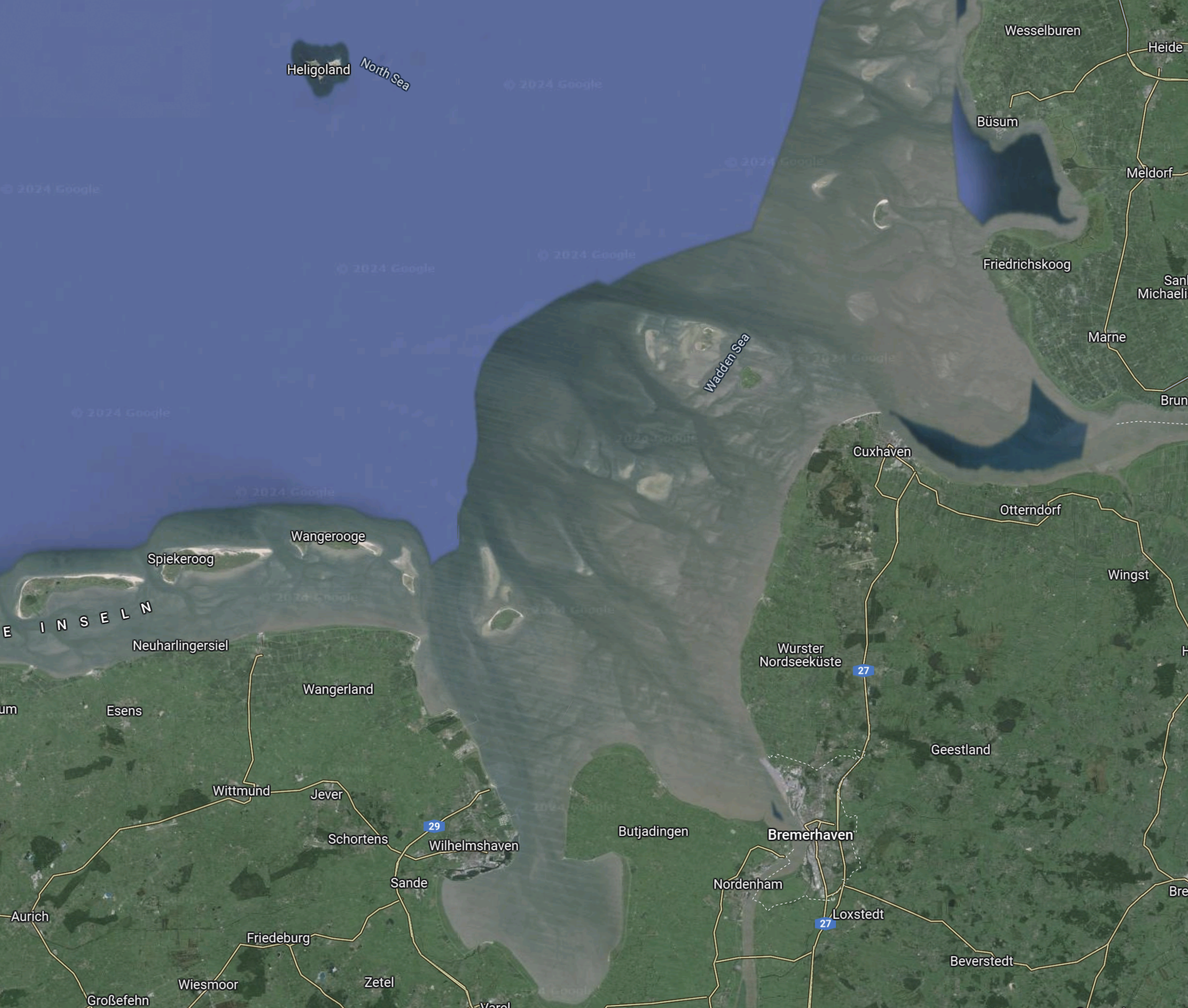
This Google Map shows the location of Wilhemshaven.
Note.
- Heligoland is the island at the top of the map.
- The Germans call this area the Wdden Sea.
- The estuaries lead to Wilhelmshaven and Bremerhaven.
- Cuxhaven is the port for Heligoland, which is connected to Hamburg by hydrogen trains.
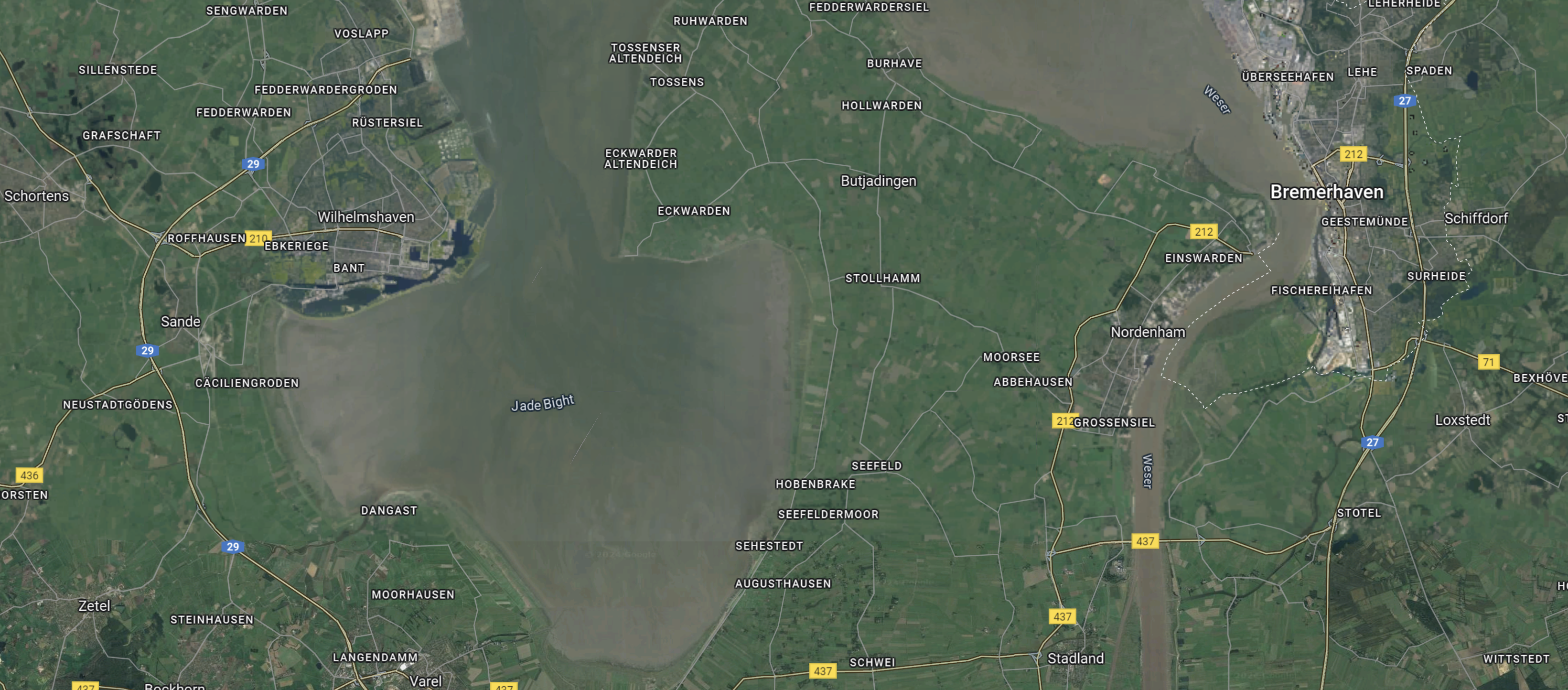
This second map shows between Bremerhaven and Wilhelmshaven.
Note.
- Wilhelmshaven is to the West.
- Bremerhaven is in the East.
- The River Weser runs North-South past Bremerhaven.
I’ve explored the area by both car and train and it is certainly worth a visit.
The Wilhemshaven Hydrogen Import Terminal
German energy company; Uniper is building a hydrogen import terminal at Wilhemshaven to feed German industry with hydrogen from places like Australia, Namibia and the Middle East. I wrote about this hydrogen import terminal in Uniper To Make Wilhelmshaven German Hub For Green Hydrogen; Green Ammonia Import Terminal.
I suspect RWE could build a giant offshore electrolyser close to the Norfolk wind farms and the hydrogen will be exported by tanker or pipeline to Germany or to anybody else who pays the right price.
All this infrastructure will be installed and serviced from Great Yarmouth, so we’re not out of the deal.
Dogger Bank South Wind Farm
To make matters better, RWE have also signed to develop the 3 GW Dogger Bank South wind farm.
This could have another giant electrolyser to feed German companies. The wind farm will not need an electricity connection to the shore.
The Germans appear to be taking the hydrogen route to bringing electricity ashore.
Energy Security
Surely, a short trip across the North Sea, rather than a long trip from Australia will be much more secure and on my many trips between the Haven Ports and The Netherlands, I haven’t yet seen any armed Houthi pirates.
RWE And Hydrogen
On this page on their web site, RWE has a lot on hydrogen.
Very Interesting!
H2ercules
This web site describes H2ercules.
The goal of the H2ercules initiative is to create the heart of a super-sized hydrogen infrastructure for Germany by 2030. To make this happen, RWE, OGE and, prospectively, other partners are working across various steps of the value chain to enable a swift supply of hydrogen from the north of Germany to consumers in the southern and western areas of the country. In addition to producing hydrogen at a gigawatt scale, the plan is also to open up import routes for green hydrogen. The transport process will involve a pipeline network of about 1,500 km, most of which will consist of converted gas pipelines.
Where’s the UK’s H2ercules?
Conclusion
The Germans have got there first and will be buying up all of our hydrogen to feed H2ercules.
Vestas and Vattenfall Sign 1.4 GW Preferred Supplier Agreement For UK Offshore Wind Project And Exclusivity Agreements For 2.8 GW For Two Other UK Projects
The title of this post, is the same as that of this press release from Vestas.
These are the first two paragraphs.
Vattenfall, one of Europe’s largest producers and retailers of electricity and heat, and Vestas have signed agreements to elevate the partnership between the two companies and their offshore wind business towards 2030. The agreements are another step in the right direction for offshore wind energy in the UK and follow the UK Government’s recent announcement about the parameters for the next Contracts for Difference Auction round, which sent a very positive signal to renewable energy investors.
The agreements for the three projects include a preferred supplier agreement (PSA) for the 1,380 MW Norfolk Vanguard West project, comprising 92 of Vestas’ V236-15 MW offshore wind turbine. Vattenfall and Vestas have further signed exclusivity agreements for the Norfolk Vanguard East and Norfolk Boreas projects with a total installed capacity of 2,760 MW. The two latter projects will potentially feature up to 184 V236-15 MW turbines. Once installed, the agreements also include that Vestas will service the projects under long-term Operations and Maintenance (O&M) service contracts. The agreements are another step forward for what will be one of the largest offshore wind zones in the world, with a capacity to power over 4 million UK homes.
It looks like Norfolk Boreas is back on Vattenfall’s list of active projects.
Vattenfall’s Norfolk zone now includes the following.
- Norfolk Vanguard West – 92 x V236-15 MW – 1380 MW
- Norfolk Vanguard East – 92 x V236-15 MW – 1380 MW
- Norfolk Boreas – 92 x V236-15 MW – 1380 MW
Note.
- All turbines appear identical.
- The deal includes long-term Operations and Maintenance (O&M) service contracts.
- 276 identical turbines plus service contracts looks like a good deal for Vestas.
Since I wrote Vattenfall Stops Developing Major Wind Farm Offshore UK, Will Review Entire 4.2 GW Zone in July 2023, which has this sub-heading.
Vattenfall has stopped the development of the Norfolk Boreas offshore wind power project in the UK and will review the way forward for the entire 4.2 GW Norfolk Zone, the Swedish energy company revealed in its interim report.
I have written the following posts.
- November 2023 – Aker Solutions Gets Vattenfall Nod To Start Norfolk Vanguard West Offshore Platform
- November 2023 – Norfolk Boreas Windfarm Work Could Resume After Energy Price Rise
- December 2023 – SeAH To Deliver Monopiles For Vattenfall’s 2.8 GW Norfolk Vanguard Offshore Wind Project
- Earlier in March 2023, I wrote Vattenfall Selects Norfolk Offshore Wind Zone O&M Base
It appears that with the deal announced with Vestas, Vattenfall now have everything they need to develop 4.2 GW of offshore wind.
- The O & M base will be Great Yarmouth.
- SeAH will build the monopile foundations on Teesside. Will all monopiles be identical?
- An energy price rise could change the cash flow of the project.
- Aker Solutions will build the offshore substations.Will all sub-stations be identical?
- Vestas will build the wind turbines.Will all turbines be identical?
Nothing has been said since July 2023 about how the power will be brought ashore.
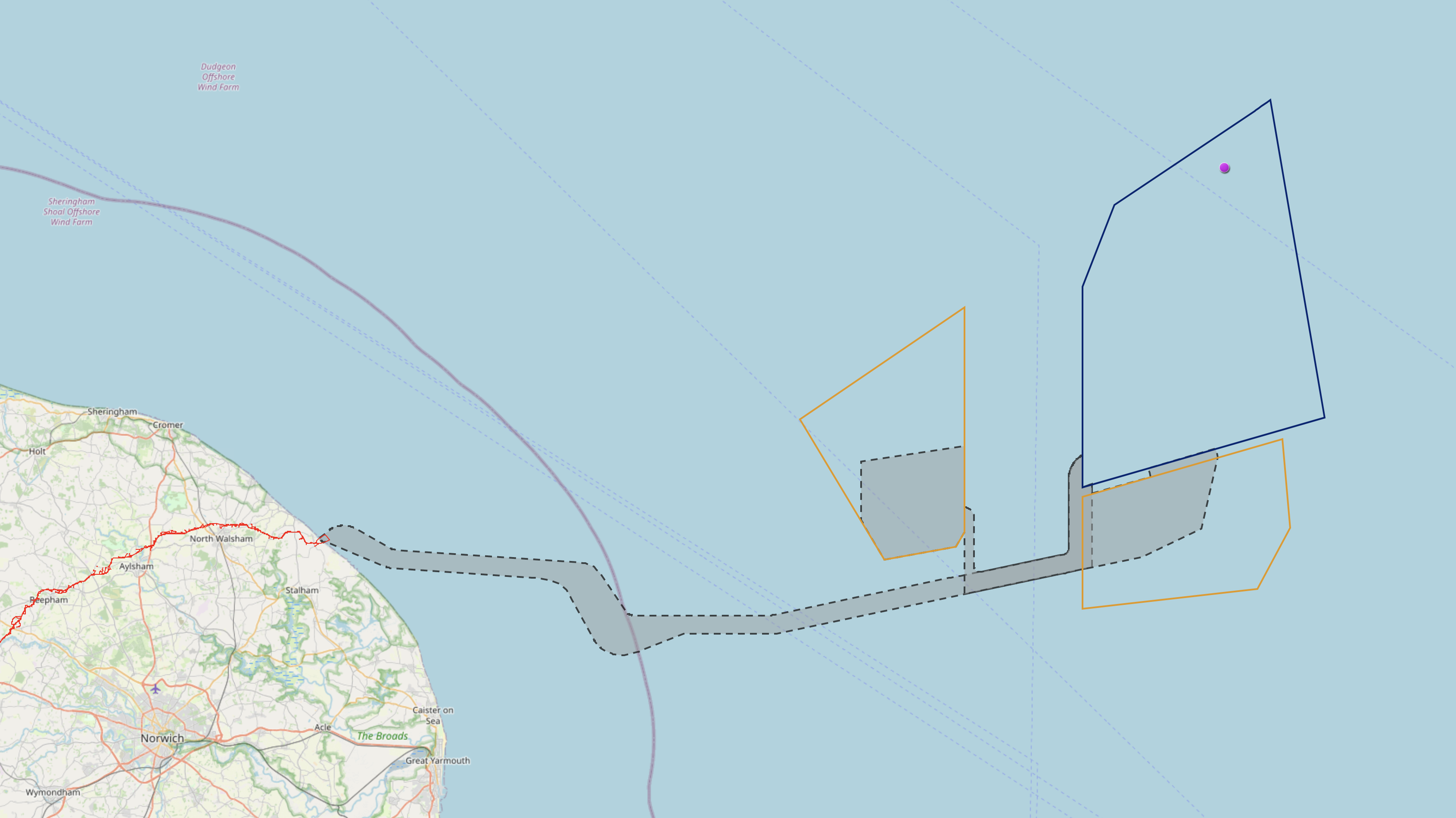
In February 2022, I wrote Norfolk Wind Farms Offer ‘Significant Benefit’ For Local Economy, where I published this map from Vattenfall, which shows the position of the farms and the route of the cable to the shore.
Note.
- The purple line appears to be the UK’s ten mile limit.
- Norfolk Boreas is outlined in blue.
- Norfolk Vanguard West and Norfolk Vanguard East are outlined in orange.
- Cables will be run in the grey areas.
- Cables to deliver 4.1 GW across Norfolk to the National Grid, will bring out the Nimbys in droves.
Landfall of the cables will be just a few miles to the South of the Bacton gas terminal.
In SeAH To Deliver Monopiles For Vattenfall’s 2.8 GW Norfolk Vanguard Offshore Wind Project, I asked if there could be an alternative approach.
Consider.
- If Vattenfall develop all three wind farms; Boreas, Vanguard East and Vanguard West, they will have 4.2 GW of capacity, when the wind co-operates.
- But East Norfolk is not noted for industries that need a large amount of electricity.
- I also feel, that the locals would object to a steelworks or an aluminium smelter, just like they object to electricity cables.
But would they object to a 4 GW electrolyser?
Could this be Vattenfall’s alternative approach?
- A giant electrolyser is built close to the landfall of the cable to the wind farms.
- The hydrogen could be piped to Bacton, where it could be blended with the UK’s natural gas.
- Bacton also has gas interconnectors to Balgzand in the Netherlands and Zeebrugge in Belgium. Could these interconnectors be used to export hydrogen to Europe?
- The hydrogen could be piped to Yarmouth, where it could be exported by tanker to Europe.
There would be only a small amount of onshore development and no overhead transmission lines to connect the wind farms to the National Grid.
There would be even less onshore development, if the electrolyser was offshore.
From their decisions, Vattenfall seem to have a new plan.
Siemens Gamesa And Vestas Collaborate To Standardise Equipment For Transportation Of Wind Turbine Towers
The title of this post, is the same as that of this article on offshoreWIND.biz.
This is the sub-heading.
Building on a previous collaboration focused on tower foundations and lifting guidelines, Siemens Gamesa and Vestas, facilitated by Energy Cluster Denmark, have signed a new partnership agreement to increase standardisation within the wind industry.
Surely standard sizes and similar designs will help any industry. Look at how containerisation has helped freight transportation.
These four paragraphs illustrate the problem and detail the solution.
Initially, the partners will standardise equipment for the transportation of wind turbine towers.
“Currently, whenever a wind turbine tower is shipped out for offshore installation, the manufacturer welds a box onto the installation vessel to which the tower is then clamped. The process is costly in terms of tons of iron and labour on the quayside. Once installation offshore is completed, all the equipment is removed from the vessel, which is again costly in terms of hours, money and the green transition,” said Jesper Møller, Chief Engineer in Offshore Execution at Siemens Gamesa.
The new partnership agreement comprises a series of projects involving equipment for and the storage of huge components produced by wind turbine manufacturers.
The first project focuses on sea fastening, involving securing towers, blades, and nacelles to installation vessels.
The article finished with statements about why standardisation is important.
Vestas 15 MW Prototype Now At Full Throttle
The title of this post, is the same as that of this article on offshoreWIND.biz.
This is the sub-heading.
Last week, three months after it was installed at the National Test Center for large wind turbines in Østerild, Denmark, Vestas’s V236-15.0 MW prototype wind turbine reached its nominal power rating of 15 MW.
On the 30th December 2022, I wrote Vestas 15 MW Prototype Turbine Produces First Power.
It appears to me, that going from startup to full power in a few days over three months indicates that testing has gone well.
I suspect too, that this apparently successful first test indicates that 15 MW will quickly become a standard size for wind turbines.
Full certification is expected from the third quarter of this year.
Vestas 15 MW Prototype Turbine Produces First Power
The title of this post, is the same as that of this article on offshoreWIND.biz.
This is the introductory paragraph.
Vestas’ V236-15.0 MW prototype wind turbine has produced its first kWh after being fully assembled at the Østerild National test centre for large wind turbines in Western Jutland, Denmark.
The first of the four wind farms in the Hornsea wind farm complex to be developed is Hornsea One.
- It has a capacity of 1218 MW.
- It is comprised of 174 Siemens SWT-7.0-154, which each have a generating capacity of 7 MW.
If 15 MW turbines could have been used on Hornsea One, it would have more than doubled the generating capacity to 2625 MW.
But obviously, larger turbines have longer blades, so they may need to be placed further apart.
In Vattenfall Boosts Capacity For Norfolk Offshore Wind Zone, I write about how Vattenfall are increasing the size of their Norfolk wind farms, by proposing to use larger turbines.
Conclusion
Turbines will get larger and 15 MW turbines will be commonplace.
A possible advantage is that you only need sixty-seven turbines for a GW, as opposed to a hundred 10 MW turbines, so there are possibilities to optimise the most profitable way to build a wind farm.
 The Anonymous Widower