Will Walthamstow Central Station On The Victoria Line Be Expanded?
This post is prompted by this article on London Reconnections, which looks at Transport for London’s World Class Capacity Upgrades for the Victoria, Jubilee and Northern Lines.
After the upgrade of the crossing at Walthamstow last summer, the Victoria Line now has a capacity of 33 trains per hour and most trains run all the way between Walthamstow Central and Brixton stations.
Sometime this year the limit will be further increased to 36 tph, which will be a very high limit considering the design of the line.
The London Reconnections article says this about future upgrades.
With the Victoria line pushing towards what must be the theoretical limit for a line with that amount of rolling stock and – more importantly – two-platform termini, there are no plans to further improve the service. Indeed the challenge of procuring more trains and finding the depot space for them would probably discourage any such plans on its own. This does not mean that the line will be forgotten, as both Oxford Circus and Walthamstow Central are on TfL’s top ten hit list of stations in need of a major capacity upgrade. Simply that the days of pushing more trains through the same stations more quickly have passed. In the case of Walthamstow Central it is highly likely that the next step will be making the station double-ended, with an entrance near or in the shopping centre.
Certainly with just two escalators, Walthamstow Central station can be busy with both working. At the moment it is on my list of stations to avoid, as one of the escalators is being replaced.
Is the idea of creating a double-ended station at Walthamstow Central worth pursuing?
Look at this map from carto.metro.free.fr, which shows the lines at the station.
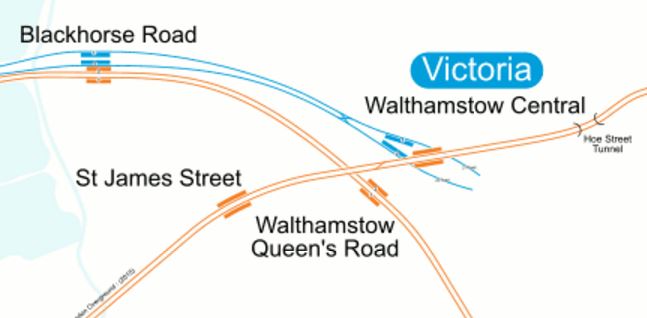
Walthamstow Central Lines
So it would appear that the Victoria Line platforms could be somewhere under the bus station and the shopping centre.
It certainly isn’t an impossible dream to create a second entrance to the Victoria Line platforms.
Walthamstow Central station was one of London Transport’s economy stations. Wikipedia says this.
The underground station, like many stations on the Victoria line, was never completely finished. White ceiling panels were never fixed to the ceilings above the platforms; instead the steel tunnel segments were painted black and used to support the fixtures and fittings. This has had a detrimental effect on the lighting levels. There is a concrete stairway between the two escalators instead of a third escalator; this caused a hugely disruptive station closure for several weeks in 2004 when both escalators went out of service.
It would be hoped that any upgrade of the station finishes the 1960s era construction.
But surely creating a double-ended station is the way to go.
- It would take the pressure off the passageways in the existing station.
- The existing station is not step-free and there is no deep lift.
- If the second entrance had two escalators and lifts, it would give a lot of redundancy in platform access.
- There is plenty of space in the shopping centre for a new entrance.
Passengers interchanging with the Chgingford Brancxh Line and those interchanging with buses or going shopping, could possibly be persuaded by good design to use appropriate and different entrances.
Conclusion
It’s feasible.
But the biggest advantage is surely that by planning carefully, the second entrance can be built around the current station, without disrupting passenger entrance and exit.
Related Posts
Improving The Chingford Branch Line
Could Electrification Be Removed From The Chingford Branch Line?
Could Reversing Sidings Be Used On The Chingford Branch Line?
Could The Hall Farm Curve Be Built Without Electrification?
Crossrail 2 And The Chingford Branch Line
New Stations On The Chingford Branch Line
Connectivity Around Clapham
I’ve talked a lot lately about improving the rail lines and especially their connectivity in South London in quite a few posts lately.
So I extracted this map from carto.metro.free.fr
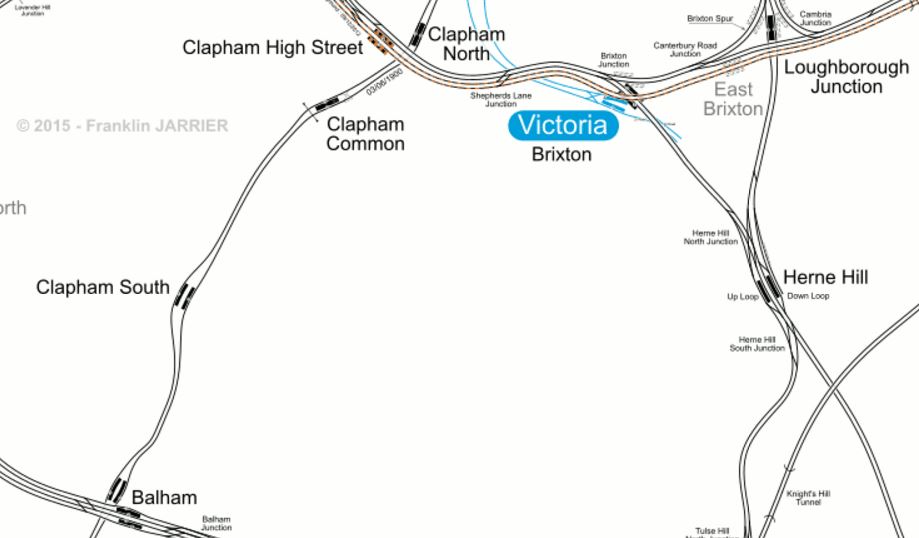
Clapham Lines
I think we have to congratulate the French behind these accurate metro maps.
Note the following.
- In a few years time, there will be two high-capacity North-South routes through the area; Thameslink and the Northern Line, which meet with the Bakerloo Line at Elephant and Castle station.
- Thameslink at Farringdon station and the Northern Line at Moorgate and Tottenham Court Road will have excellent connections to Crossrail.
- Thameslink goes through Herne Hill and Loughborough Junction and will have at least six eight-car trains all day, with extra services in the peak.
- Herne Hill is a big railway bottleneck, with as yet no sensible proposal to solve it.
- The Northern Line will have at least twenty trains per hour all day, between Morden and Kennington stations.
- The Victoria Line is also important to the area, as it will provide a thirty trains per hour service to from Brixton to Walthamstow Central via Stockwell on the Northern Line.
- The East London Line connects Clapham Junction in the west via Clapham High Street and Surrey Quays to Highbury and Islington in the north-east.
- The East London Line is getting crowded and increased frequencies will happen in 2019.
- The Law of New Routes, Stations and Trains will mean that Thameslink will attract traffic and the trains will quickly get busy.
- In the future Balham station could be served by Crossrail 2.
I believe that expecting Crossrail 2 to solve South London’s transport problems, is a bit like waiting for the United States to help the beleaguered good guys out in the First and Second World Wars.
Like the Americans, Crossrail 2 will arrive, but we have to make the best of what we’ve got in the meantime.
Perhaps these projects will help.
More And Better Designed Stations
Transport for London (TfL) have very sophisticated train and passenger modelling systems, which enable them to propose where improvements to stations should be made.
Sometimes this type of analysis, gives surprising results, that are counter-intuitive.
For example, I pointed out in Faster London Trains Could Make Your Commute Even Longer, how French research had shown this premise, to sometimes be true.
But the research also showed that in certain cases, extra stations could make journeys faster.
From my personal observations at Angel station, I sometimes think that trains arrive and depart faster on the wider southbound platform, rather than the narrow northbound one.
Camberwell Station On Thameslink
A couple of miles north of Loughborough Junction station is the disused Camberwell station, which Transport for London are proposing to reopen.
In their report on the Bakerloo Line Extension, TfL give this concise summary on reopening Camberwell station.
A new station at Camberwell would be a significantly lower cost option to a Tube extension, whilst serving the same catchment area. Investigations show significant journey time improvements could accrue to Camberwell passengers and that operationally there may be scope to integrate re-opening of the station into the launch of the completed Thameslink programme.
We will therefore undertake further planning work with Network Rail and the London Borough of Southwark to assess the proposal.
From their statement, it would appear that TfL have done an extensive analysis.
I would not be surprised, if this enthusiastic statement wasn’t followed through.
Northern Line Stations
Several of the Northern Line stations are relics of the line’s Victorian past and stations are slated for major improvements over the next few years.
- Bank – A big development has just been announced.
- Camden Town – I wrote about the proposed development of Camden Town station in The Camden Town Upgrade Exhibition.
- Elephant and Castle – A big property development is planned, which incorporates a new Northern Line station.
- Moorgate – Crossrail will improve the station.
- Old Street – Developments are planned in the area, which could result in an improved station.
These developments will probably mean that after the Northern Line Extension to Battersea is completed, most major stations between Camden Town and Kennington will have been upgraded.
Only the two Northern branches and the Morden branch will have not received a substantial number of upgraded stations with complete step-free access, wide safe platforms and escalators.
I think we’ll see other improvements to stations, especially an upgrading of the two island platform stations at Clapham North and Clapham Common.
The Herne Hill Loop On The Victoria Line
One constraint on the efficiency of the Victoria Line, is reversing the trains at Brixton station. There have been proposals in the past to crete a reversing loop with another station on the loop at Herne Hill station. I wrote about it in detail in Will The Victoria Line Go To Herne Hill?
This extension will only be built, if it is value-for-money in improving the Victoria line, despite the positive secondary effects it might have in the Herne Hill area!
An Interchange Hub At Streatham Common Station
Transport for London has recently proposed a interchange hub at Streatham Common, which I wrote about in Puzzled Over Streatham Common Station.
In my article, I showed that a well-designed hub could connect the following lines.
- The Sutton Loop Line Of Thameslink – Linking To Wimbledon and Sutton
- The Brighton Main Line
- Tramlink – With the possible use of tram-trains.
- East London Line – Linking to East London, Kent and Essex
- West London Line – Linking to Old Oak Common for HS2 and the West Coast Main Line
I very much think that the idea of an interchange hub at Streatham Common is a masterstroke.
Especially, as it will take the pressure off Wimbledon and East Croydon!
Another Branch Of The East London Line
The East London Line currently has four trains per hour in both directions across South London to and from Clapham Junction station.
This branch is getting very busy and from 2019, an extra two trains per hour will use this route.
But will Clapham Junction be able to cope with the extra services?
If it can’t, a possible alternative would be to run some trains from Peckham Rye via Tulse Hill to a terminus at Streatham Common.
Clapham High Street, Brixton And Brockley Interchanges
These are three possible interchanges with the Easst London Line in South London.
- Clapham High Street and Clapham North stations could be connected, if it was decided to improve the Northern Line through Clapham.
- Interchange between all the lines at Brixton station has been mentioned by TfL and I wrote about it in Could The Various Lines At Brixton Be Connected?
- TfL have also suggested that Brockley station could be a potential interchange hub and I wrote about it in A Report On The Bakerloo Line Extension
Each will have advantages and disadvantages.
Conclusion
There are a lot of possible projecs to improve the train services in the Clapham area.
What TfL have in their traffic database will decide the pattern of trains the area.
Herne Hill Station
I visited Herne Hill Station and took these pictures.



It is a bit of an odd station, in that although it is fully step-free and has a ticket office, it is a station without ticket gates.
It was also surprisingly short on information about buses, as due to a train being cancelled, I thought I might get a bus to Loughborough Junction station.
But there was no map!
This is a Google Map of the station

Herne Hill Station
It clearly shows how the four lines through the station divide both North and South of the station, into two pairs of lines.
It is noteworthy that where the lines split in the North, the area is a Network Rail depot, so it would be ideal to create a shaft to a Victoria Line tunnel.
I have seen or found nothing to definitely answer the question I posed in Will The Victoria Line Go To Herne Hil?
Will The Victoria Line Go To Herne Hill?
The Wikipedia entry for the Victoria Line has a section entitled Possible Future Projects. This is said.
For many years there have been proposals to extend the line one stop southwards from Brixton to Herne Hill. Herne Hill station would be on a large reversing loop with one platform. This would remove a critical capacity restriction by eliminating the need for trains to reverse at Brixton. The Mayor of London’s 2020 Vision, published in 2013, proposed extending the Victoria line “out beyond Brixton” by 2030.
Now that the dodgy crossover on the approach to Walthamstow Central station has been replaced, this extension to Herne Hill station must be higher up Transport for London’s list of priorities, as they try to squeeze more capacity out of London’s railways.
This metro map from carto.metro.fr, shows the lines around Herne Hill.

Victoria Line And Herne Hill
Note the blue lines of the Victoria Line going a short distance past the terminal platforms at Brixton tube station.
The plan calls for these stubs to be extended in a wide loop under Herne Hill station, where there would be a single platform beneath the current platforms.
I think that this was a project that should have some years ago, as it would surely have taken some of the pressure off Victoria tube station, during the current rebuilding.
In the London Transport Infrastructure Plan for 2050, under New Links and/or stations for Strategic Interchange, there is a mention of Brixton High Level, which I wrote about in Could The Various Lines At Brixton Be Connected?. I finished with.
So it would appear that substantial improvement at Brixton could be achieved by creating a High Level station linking the various lines together and perhaps using an iconic lift tower to the ground.
Brixton needs an iconic creation to go with the vibrancy of the area, that doesn’t destroy everything. This could be the High Level station. Having seen the way that the walkway was threaded through at Hackney, I think there are at least one set of engineers and architects up to the challenge.
But building an iconic station at Brixton would cause a lot of disruption.
However, it could be argued and the passenger figures might show it, that another station at Herne Hill might help in giving passengers another way to get on the Victoria Line.
This section is taken from the Transport Infrastructure Plan.
Some examples of the types of schemes to address these issues are an upgrade of the London Overground network to provide 6 car trains and new stationson existing lines, eg at Camberwell, that can plug connectivity gaps and act as development nodes.
Look at the map of the Victoria Line and Herne Hill and you’ll see the orange line of the London Overground passing across and going over the top of Loughborough Junction station. Surely a four-poster station could be built to improve the connectivity. For a start, it would give Dalstonistas like me, good access to Thameslink.
South London often gets overlooked in the development of London’s railways, but done in the right sequence, I think these projects would be a welcome addition to London transport network.
- Victoria Line Extension to Herne Hill
- Brixton High Level Station, which would connect the Overground to lines out of Victoria.
- Loughborough Junction High Level Station, which would connect the Overground to Thameslink.
I would start with the Victoria Line extension to Herne Hill. After all it would be a nice follow-on job to the Northern Line Extension to Battersea.
The Piccadilly And Victoria Lines, Manor House Station And Harringay Green Lanes Station
The planners and the politicians created a real dog’s breakfast here, when the Victoria Line was designed and built in the 1960s.
A Few Facts
I’ll start with a few facts, as far as we can trust Wikipedia.
From the Planning and construction section of the entry for the Victoria Line.
A test tunnel from Tottenham to Manor House under Seven Sisters Road had been bored in 1959 and was later incorporated into the running tunnels.
From the entry for Seven Sisters station.
The section of Victoria line between Seven Sisters and Finsbury Park stations is the longest between adjacent stations in deep level tunnels on the London Underground network.
From our own observations.
There is a ventilation station at the junction of Green Lanes and St. Ann’s Road. This was put in, as it’s a long way between Turnpike Lane and Manor House stations. The Cockfosters Extension section of the entry for the Piccadilly Line says this.
It was also planned to build a station between Manor House and Turnpike Lane at the junction of Green Lanes and St Ann’s Road in Harringay, but this was stopped by Frank Pick, who felt that the bus and tram service at this point was adequate. However, a ‘Ventilation station’, in similar architectural style to tube stations of the time was provided at the site, and is visible today. There was also some opposition from the London and North Eastern Railway to the line.
I think we underestimate the influence the LNER had on shaping London’s railways. Much was positive, but some was about protecting their interests.
I had a great uncle, who lived in Harringay and in the 1950s, we’d go and visit him on the 29 bus, as it was a long walk from Turnpike Lane.
What Might Have Been
Here again from various parts of Wikipedia.
From the Victoria Line section of the entry for the Piccadilly Line
During the planning stages of the Victoria line, a proposal was put forward to transfer Manor House station to the Victoria line, and also to build new “direct” tunnels from Finsbury Park to Turnpike Lane station, thereby cutting the journey time in and out of central London. This idea was eventually rejected due to the inconvenience to passengers that would have been caused during rebuilding, as well as the costs of the new tunnels.
From the entry for Seven Sisters station.
During the planning phase of the Victoria line, thought was given to converting Manor House into a Victoria line station and diverting the Piccadilly line in new tunnels directly from Finsbury Park to Turnpike Lane via Harringay Green Lanes, but the idea was abandoned because of the inconvenience this would cause, as well as the cost.
From fifty years and more after construction of the Victoria Line it might seem to be a feasible plan on a cursory look.
- It would speed trains on the Piccadilly Line to Kings Cross and Central London, as the route is shorter.
- There would be an extra station at Harringay Green Lanes on the Piccadilly Line, which would replace Manor House.
- It might also be feasible to turn the ventilation station at Green Lanes into a station.
- There would be an extra station at Manor House on the Victoria Line.
Also affecting these services will be this summer’s upgrade to the Victoria Line which will allow thirty-six trains per hour on that line.
So if you take the two improvements together passengers on both the Victoria and Piccadilly Line would get a better service with extra stations.
Enter Crossrail 2
Crossrail 2 will add another dimension to the planning in this area.
I’ll start with a personal observation from my childhood.
Many times, I travelled from Oakwood to Leicester Square or South Kensington and it’s a long way! It probably still is! And in trains that are a lot more crowded.
The opening of Crossrail 2 will affect the Piccadilly and Victoria Lines.
- Passengers on the Piccadilly Line from Wood Green northward may switch to Crossrail 2 at Turnpike Lane.
- Passengers on the Victoria Line from Walthamstow may switch to Crossrail 2 at Tottenham Hale.
- Many passengers from the London Boroughs of Barnet, Enfield, Harringey and Waltham Forest, will change their route to Central London with the arrival of Crossrail 2. And before that an upgraded Thameslink.
I think overall, we’ll see an easing of the lot of passengers on both the Piccadilly and Victoria Lines, by the end of the next decade. The Piccadilly Line should also have been upgraded with new and larger trains, running to an increased frequency. The Future Upgrades section for the Wikipedia entry for the Piccadilly Line says this.
On current plans, resignalling work on the Piccadilly line will begin in 2019 and new trains should be in service by 2022.
If the Piccadilly Line eases South of Turnpike Lane, then there may be scope for opening more stations on the line at perhaps the ventilation station on Green Lanes and Harringay Green Lanes.
And what about an interchange to the North London Line at Maiden Lane to serve the Kings Cross Central development?
How Could New Stations Be Built?
Doing anything at present to create any new stations on the Piccadilly Line is probably not feasible, as it would be impossible to shut the Piccadilly or Victoria Lines for long enough to do anything substantial. There’s been enough chaos caused by shutting the outer reaches of the Victoria Line this summer.
Transport for London have a similar problem about creating a link between the Central Line and the East London Line at Shoreditch High Street station. Transport for London feel that nothing can be done until Crossrail opens. I discussed that link in Will Shoreditch High Street Be Connected To The Central Line?.
Creating new stations on the Piccadilly Line probably can’t be done, until Crossrail 2 is opened, as how do the passengers get to work, rest and play?
I think that in a few years time actually creating the stations will not be as difficult as it would be today, from a construction point-of-view. The experience gained on building Whitechapel station on Crossrail, where a technique called uphill excavation has been used, might be applicable.
Conclusion On The Piccadilly Line In Harringay
My view is that a sort out of the Piccadilly Line and its stations in Harringay is possible and probably very worthwhile, but only after Crossrail 2 has been opened.
Planned Rail Development At Harringay Green Lanes Station
Over the next few years, there will be two major developments on the GOBlin through Harringay Green Lanes station.
The line is going to be electrified with 25 KVAC overhead lines, which will mean putting up structures to support the cables. The bridge across Green Lanes will probably be replaced, as it doesn’t look to be in the best of condition and to be safe, it will probably be replaced before the wires are erected.
The new electric trains will be four-car and this will probably mean the platforms have to be extended. I suspect that Transport for London may well future-proof the station and extend the platforms for perhaps six or even eight-car trains.
There is definitely space at the eastern end of the station to do the platform extension, but why not extend the platforms over the bridge and perhaps even use glass sides, as they’ve done at Deptford. Extending over the road will also mean that in future a western entrance or link to Harringay station could be created.
As no plans to replace the bridge have been published that I can find, could it be that Network Rail and their architects are working with property developers to design a proper flagship station?
I also think that designing a station to carry the overhead wires in its structure, as I’ve seen at Liege station, may simplify the design and save on the cost of the building.
Property Development And Harringay Green Lanes Station
If you want a profitable development, building car parking is a waste of money, so good access to public transport is essential.
For this reason and especially for housing, property development will be the force that drives the development of London’s transport system.
There is a lot of scope for property development in the area around Harringay Green Lanes station.
This document from the London Borough of Harringey entitled Harringay’s Local Plan lists a large number of development sites around the station.
On Page 92 the document details the St. Ann’s Hospital Site, which lies to the north of the GOBlin. It details how the South West corner of the hospital site will be connected to Green Lanes and the station.
On Page 94 the document goes on to talk about the Arena Retail Park, which adjoins the station.
Both sites have something that developers love. They are both in single ownership; one public and the other private.
So you can have control of the sites without the sort of problems that Tottenham Hotspur have had on building their new stadium, which has delayed the development for some years.
As it will be in the developers’ interest and profitability to have good public transport, I would be very surprised not to see a very good station built at Harringay Green Lanes to serve their developments and also to improve the transport opportunities for locals. This is said in the document.
Access to Harringay Green Lanes Station should be improved by creating a
new entrance on Portland Gardens.
Also, no sane developer would build this station without a secret place, where the escalators and lifts to the Piccadilly Line could be installed. As an example, Tottenham Court Road and perhaps Angel stations, are already ready to accept Crossrail 2.
I believe that given the amount of property development that will take place in the area, a new station at Harringay Green Lanes will be one of the first new buildings to be constructed.
Imagine the advertising potential for your development to see a shiny glass and steel station built over Green Lanes, as you drive or ride a bus through the area. Buiilding the station partly over the road would mean you need to use less valuable land and it would be easier to create a Hackney style link to Harringay station along the railway. If you want to see what can be done, go to Deptford station.
Tailpiece
If you have a flagship station at one end of Green Lanes in Harringay, why not have one at the other by converting the ventilation station into a real one?
I just wonder if that should and could be done before Turnpike Lane is rebuilt for Crossrail 2, so that there is an alternative station, if Turnpike Lane had to be closed.
Crossrail have shown that they like to be good neighbours and converting the ventilation station could be something they’d look at to cool the anger of diverted passengers and local residents. The superb new Pudding Mill station on the DLR was built by Crossrail, as the old station was in their way and had to be demolished. I was very surprised that the new station is so spectacular, but I suspect that through good design, clever use of space and leaving out expensive escalators and various utilities not needed if there are driverless trains and no booking office, that the station wasn’t as expensive as it looks. The property developers and West Ham United won’t be complaining.
Working Around The Victoria Line Closure
Today, I wanted to go to IKEA and a decent B & Q, so as both are close to Tottenham Hale station, it required a trip to that station or thereabouts.
The problem is that the Victoria Line is closed past Seven Sisters in August, so they can remove the bottleneck at Walthamstow Central that was part of the cheapskate design of the 1960s. Click here for the full story.
So I couldn’t take my usual route of an Undrground train to Tottenham Hale and a 192 bus.
I decided to go to IKEA first, which is just an easy trip all the way on a 341 bus from perhaps a hundred metres from my house. But as I got to the stop, the 341 whizzed past. Luckily it was followed by a 476 bus, which joins up with the 341 at Northumberland Park and hopefully because of the route it takes will get there first.
So I got the 476 and sat upstairs. I was watching to see if the 341 was behind us as we turned off Tottenham High Road and saw the 341 appear behind.
At the next stop I got off the bus to get the 341, only to see that bus go straight past. Luckily, I was able to get back on the 476, so in the end, I went all the way to Northumberland Park, a couple of stops short of IKEA. The bus information saif I’d haveto wait twenty minutes for a 341, so I walked over the level crossing to the Marigold Road stop for the 192. Again my luck was in, as a 192 had just turned up and they were changing drivers.
Coming back, I was carrying a full IKEA bag, and wanted to get to B & Q at Tottenham Hale for a couple of small bits, so I needed a 192 bus. Unfortunately, there was a bit of a gap in the service, but after about twenty minutes, I’d done my hopping and needed to get home.
So I walked back to Tottenham Hale station, hoping that there was a Hackney Downs train due.
Remarkably there was one in a couple of minutes and I just had time to climb over the bridge to catch it.
At Hackney Downs, the train dropped me on Platform 1, so I could either go down into Hackney Downs station and get a 56 or 38 bus, or use the new walkway to Hackney Central, from where I could get a more numerous 38 bus.
As it was a warm day and there was a lift in the walkway, I decided to take the newly-opened route.
I’m glad I did, as it turned out that due to the wire mesh at the top of the sides of the walkway, it was remarkably cool.

I’d surmised it would have been good in wet weather, but I’d never thought I’d be pleased to use it because of the heat.
According to one of the staff to whom I spoke, the walkway is staring to be increasingly well-used as passengers discover it.
I think that we’ll see this type of walkway in other places on the UK rail network.
One thing that helped this morning to get around the Victoria Line closure, which removes a bit chunk of my usual routes to Tottenham and Walthamstow, was London’s superb text message-based bus information system, which like any good system is designed to work on any device that can send and receive text messages.
And it does it all without using any dreaded app.
The Importance Of The Victoria Line
In an ideal world, Crossrail 2 would be a follow-on to Crossrail 1, but there is not enough money to do that.
So in the time before Crossrail 2 is built, we must make the most of other lines.
The Victoria Line is by some measures one of the most heavily used Underground lines in London and this summer a bottleneck is being removed at Walthamstow Central to increase the frequency of trains on the line.
After this wirk, the big constraint on frequency on the Victoria Line will be the reversing of trains at Brixton. Under Future Projects for the Victoria Line, Wikipedia says this.
For many years there have been proposals to extend the line one stop southwards from Brixton to Herne Hill. Herne Hill station would be on a large reversing loop with one platform. This would remove a critical capacity restriction by eliminating the need for trains to reverse at Brixton. The Mayor of London’s 2020 Vision, published in 2013, proposed extending the Victoria line “out beyond Brixton” by 2030.
I would suspect this will be done in the near future, as it both increases Victoria Line capacity and gives the line a new station at Herne Hill, which has good interchange possibilities.
Although the Victoria Line is important to London, I do find it strange, that it has no interchange with Crossrail.
Hopefully, during the wait for Crossrail 2, improvements to the Victoria Line will soothe some of the problems.
How They Dug The Victoria Line
I found this documentary from 1969 on the BBC iPlayer
http://www.bbc.co.uk/iplayer/episode/p00sc29t/how-they-dug-the-victoria-line
For those who enjoyed the BBC documentary about Crossrail, this is one they did earlier.
A Radical Idea For The Bakerloo Line Extension
I have spent forty years involved in project management, writing software for project managers and generally listening to some of the thoughts and experiences of some of the best engineers from all over the world.
One common thread, which is best illustrated by how the size of lift possible increased in the North Sea in the 1970s, is that as time has progressed machines have got bigger and more capable, and the techniques of using them has improved immeasurably.
The Crossrail tunnel boring machines (TBM) make those used on the Jubilee Line extension or the Channel Tunnel look like toys. But not only are the TBMs bigger and faster, they have all the precision and control to go through the eye of the smallest needle.
If we look at the proposals for the Bakerloo Line Extension, there have been several differing ideas. Some envisage going under Camberwell and in others the trains terminate on the Hayes line.
Transport for London (TfL), obviously know the traffic patterns, but do we really want to take the chance of say connecting the Hayes line to the Bakerloo and then finding that it’s not the best solution?
What we should do is augment the services in the area, by providing a good alternative transport mode, that links to some of the traditional rail lines to give even more flexibility. We certainly shouldn’t repeat the grave mistake that was made at Brixton in the 1960s by not connecting the Victoria line to the surface rail lines.
This is Transport for London’s indicative map of the extension.
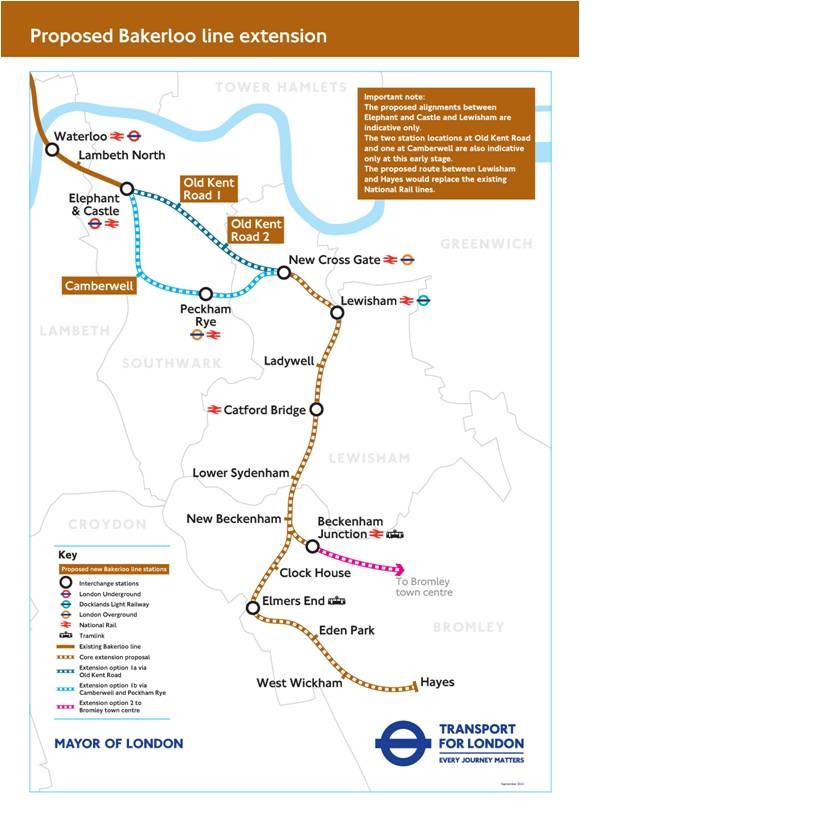
Bakerloo Line Extension Map
I have reason to believe that the Northern Line Extension may be being built as an extension to the Kennington Loop.
So could we design the Bakerloo Line Extension as a loop starting and finishing at Elephant and Castle calling at important stations?
A possible route could be.
- Elephant and Castle – Interchange with Northern Line and National Rail including Thameslink
- Old Kent Road 1 – Proposed on Map
- Old Kent Road 2 – Proposed on Map
- New Cross Gate – Interchange with London Overground and National Rail
- Lewisham – Interchange with Docklands Light Railway and National Rail including Hayes Line
- Catford Bridge – Interchange with Catford station and National Rail including Hayes Line and Thameslink
- Peckham Rye – Interchange with London Overground and National Rail
- Camberwell – Interchange with National Rail including Thameslink
- Elephant and Castle
The advantages of this simple design are.
- The tunnel would be excavated in one pass by a single TBM.
- The line could be deep under any existing infrastructure.
- Most stations would be simple one-platform affairs, with perhaps only large lifts and emergency stairs, to give unrivalled step-free access for all from the street to the train. Surely lifts exist, that are large and fast enough to dispense with escalators.
- For safety, passenger convenience and flows, and other reasons, the stations could have two entrances, at opposite ends of the platform.
- The simple station entrances would be much easier to position on the surface, as they wouldn’t need to be much bigger than the area demanded by the lifts.
- A single loop would only need half the number of platform edge doors.
- At stations like New Cross Gate, Lewisham, Catford and Peckham Rye the lifts would surface within the confines of the existing surface stations.
- The route has interchanges with the Brighton Main Line, East London Line, Hayes Link, Thameslink and other services, so this would give lots of travel possibilities.
- Trains do not need a terminal platform, as they just keep going on back to Elephant and Castle.
- The loop would be operationally very simple, with no points to go wrong. TfL have aspirations to run twenty-seven trains per hour on the Bakerloo and a simple reversing loop , which would mean the driver didn’t have to change ends, must certainly help this. It would probably be a lot more difficult to get this capacity at the northern end of the line,where Harrow and Wealdstone doesn’t have the required capacity and the only possibility for a reversing loop would be north of Stonebridge Park.
- Elephant and Castle would need little or no modification. Although it would be nice to have lifts to the Bakerloo Line.
- Somewhere over two billion pounds has been quoted for the extension. A single loop with simple stations must be more affordable.
The main disadvantage is that the loop is only one-way.
But making even part of the loop two-way would create all the operational difficulties of scheduling the trains. It would probably be better, less costly and easier to make the trains go round the loop faster and more frequently.
But if a passenger went round the loop the wrong way and changed direction at Elephant and Castle that would probably only take a dozen minutes or so.
Alternatively, I’m sure some New Routemasters would step up to the plate and provide service in the other direction between the stations.
Minding the Gap on the Victoria Line
The Victoria line is unusual in London’s Underground lines in that many of the stations are hump-backed. This means that the slope up into the station, slows the train and the descent out of the station, speeds it up. I took some pictures as I rode the line this morning.
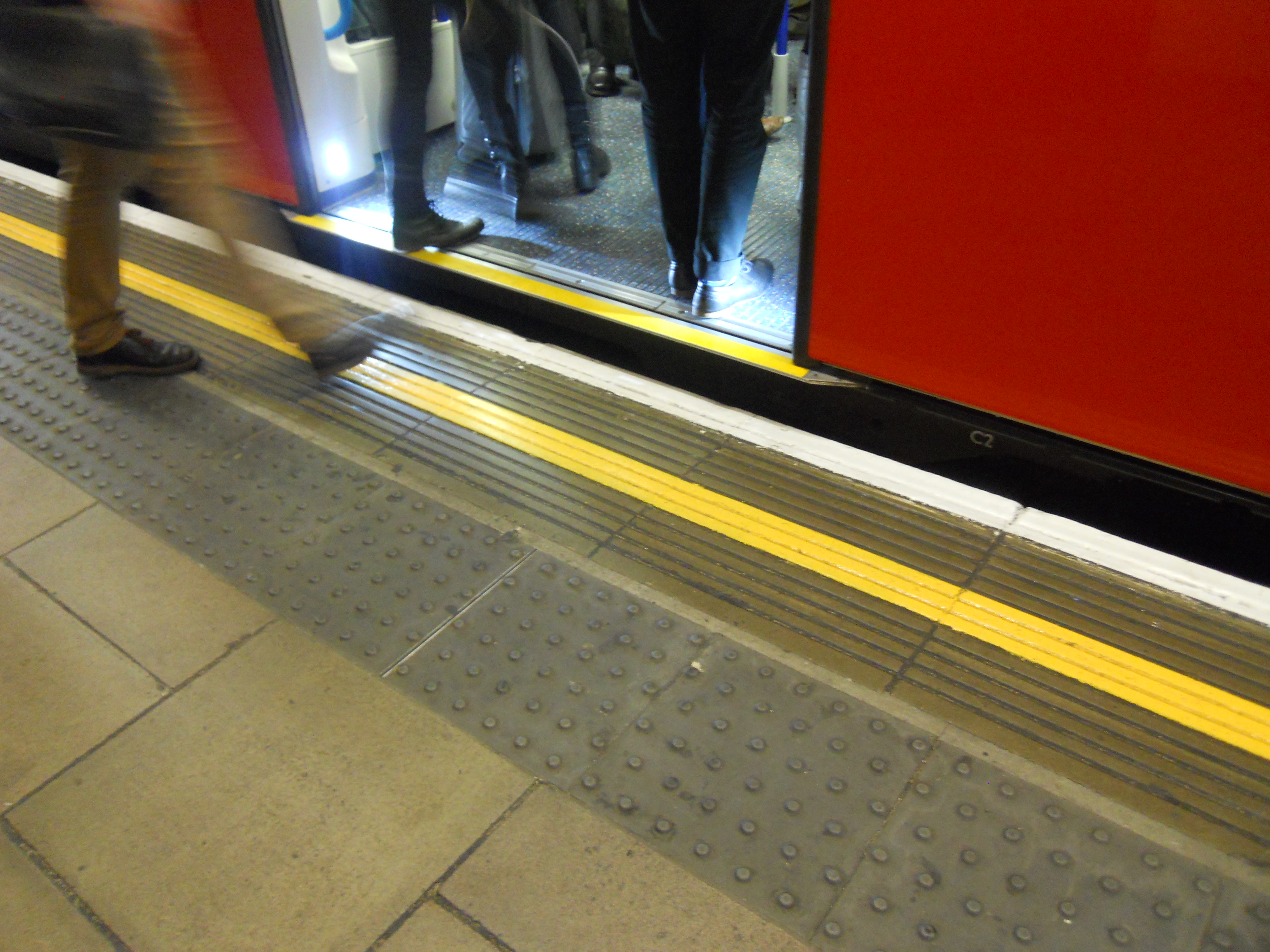
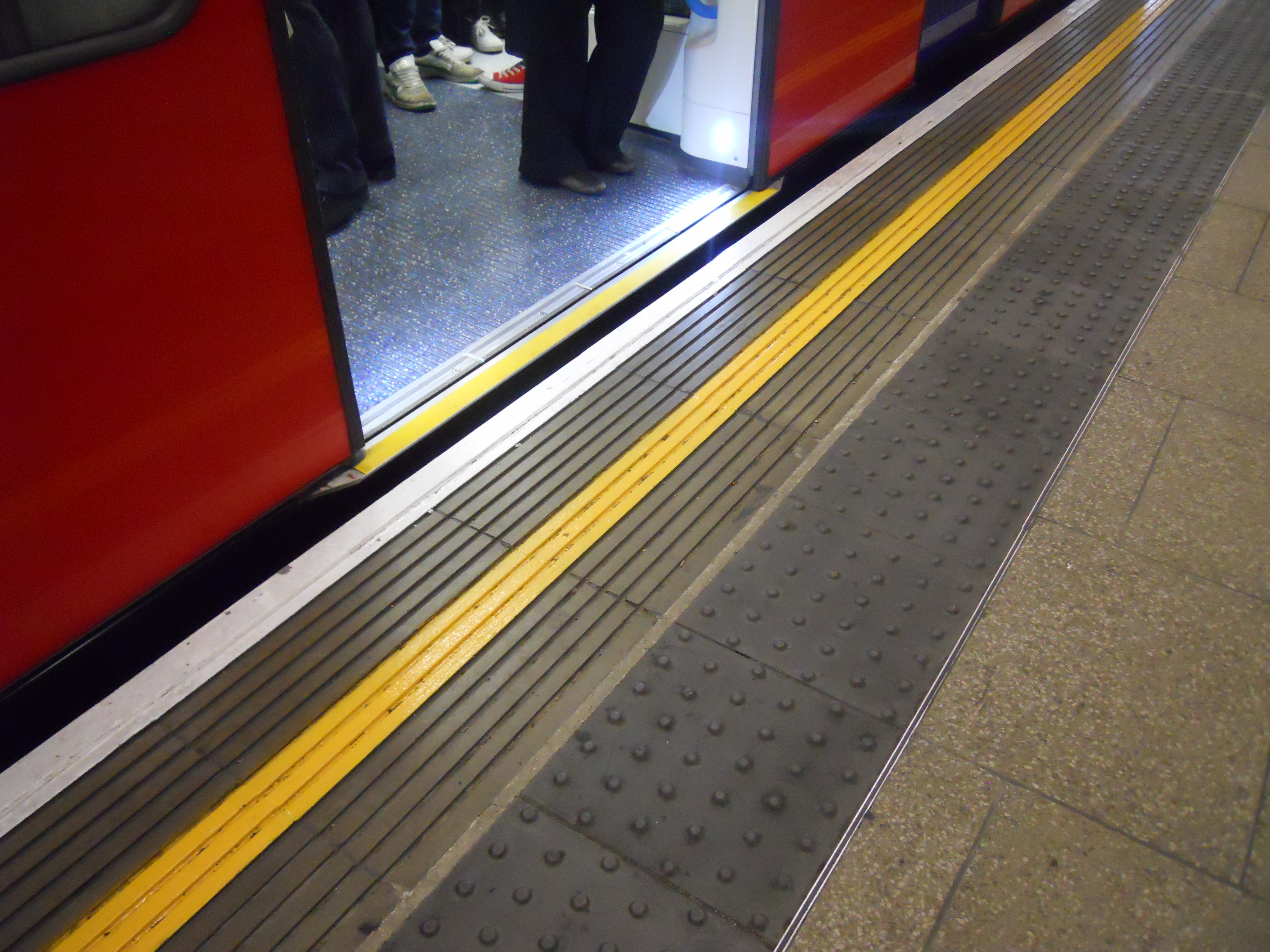
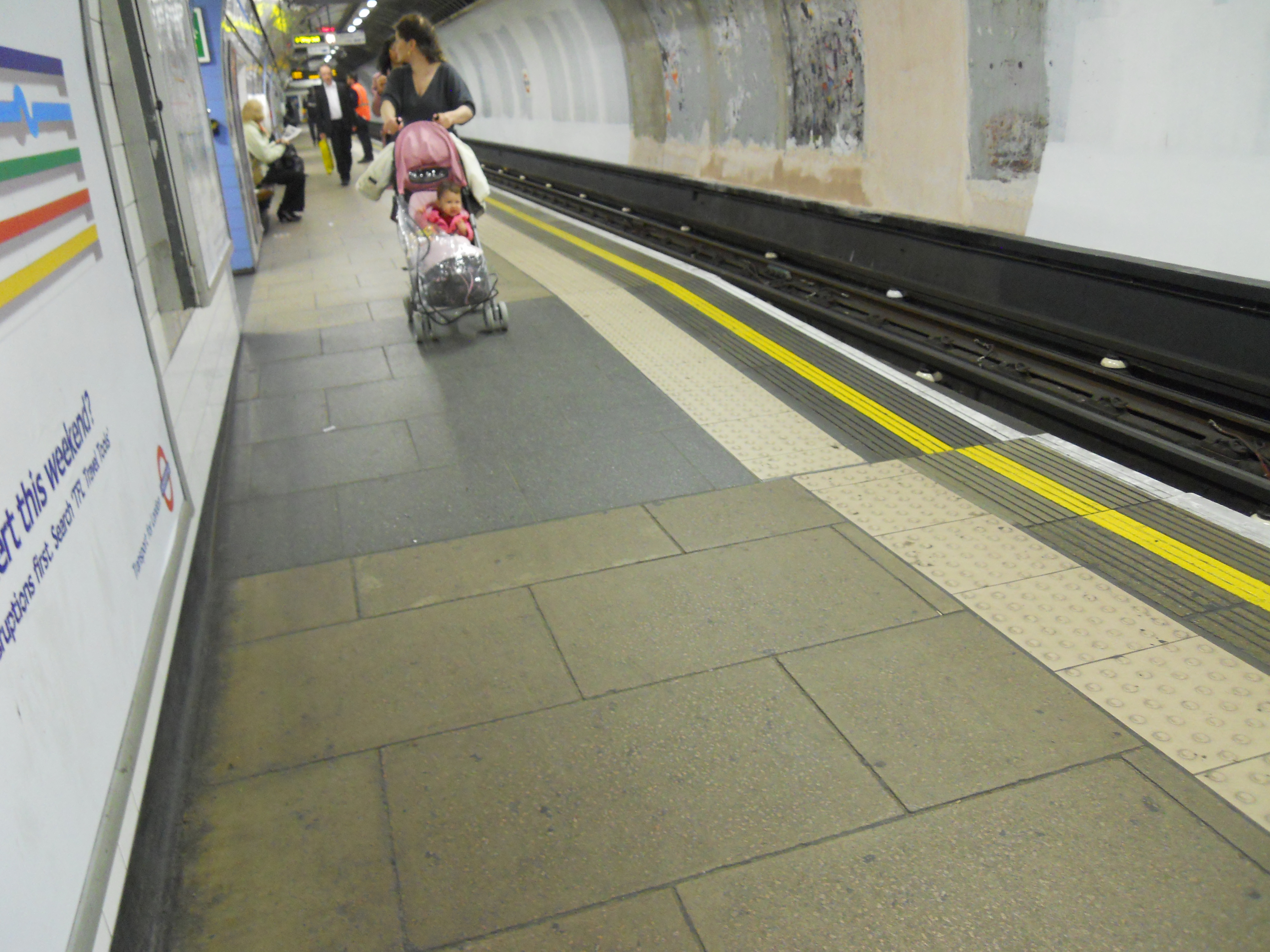
Note the variable step-up into the trains,which is also partly explained by the humped-backing of the platform, which was done a couple of years ago,to ease entry for wheelchair users and buggy pushers. All stations except Pimlico have these humps and they are at the middle of the station.
As to the hump-backed designs of the stations, this saves energy. In fact 5%, according to Wikipedia, which also says it makes the trains 9% faster. So why isn’t this simple idea used on other lines?
 The Anonymous Widower