Waterloo Upgrade August 2017 – Mid-Platform Entrance/Exit On Platforms 23/24 At Waterloo Station
These pictures show the mid-platform entrance/exit on Platforms 23/24 at Waterloo station.
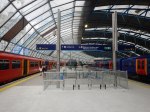

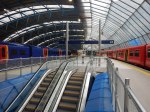
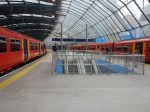
Note.
- This mid-platform entrance/exit must mean that Platforms 20 to 24 effectively have a double-deck gate line.
- Access is also to the Waterloo and City Line.
This article in Rail Engineer, which is entitled Waterloo and South West Route Upgrade, says this.
Improvements in access to the Bakerloo, Northern and Jubilee tube lines from platforms 1/2 and 3/4 and from the former International terminal.
These pictures were taken at 09:30 at the end of the Peak.

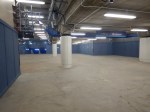


When finished it looks like it will be impressive.
Will the access on Platforms 1/2 and 3/4 be double-escalator like this access on the former International platforms?
As I indicated in Waterloo’s Wide Platforms, the design of the older platforms isn’t cramped, so it could be possible.
Incidentally, I couldn’t see any lifts on Platforms 23/24, but these structures behind the grey hoardings could be for lifts.
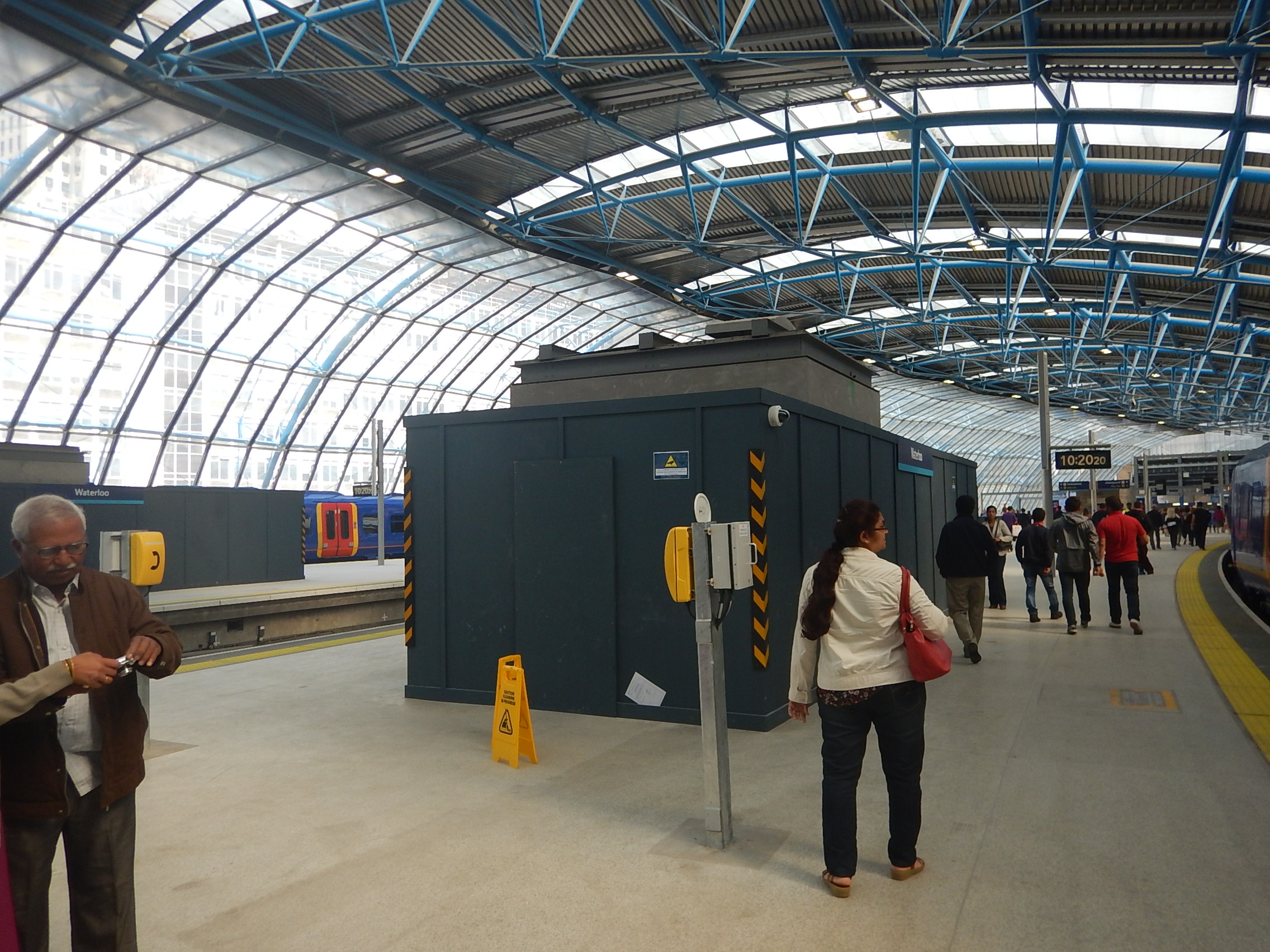
Will there be any platforms in the UK with better step-free access?
And it’s not as if the platforms are for an exotic destination like Cardiff, Huddersfield or Norwich, although I suspect services will go to the regal delights of Windsor! Will Liz be amused?
Waterloo Upgrade August 2017 – Waterloo’s Wide Platforms
These pictures compare the platforms at Waterloo station.
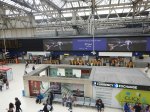
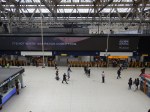
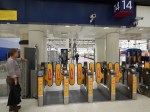
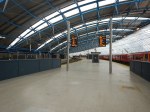
The pictures are shown in increasing platform number order.
Platforms 5 to 14 are in the old part of the station, which was opened in 1922, whilst Platforms 20 to 24 are in the former International station.
Surprisingly, the platforms in the old part of the station seem to be fairly generous in width compared to say those in other London terminals.
They are not much narrower than those built for Eurostar in 1994.
Note that it appears that the old platforms have around five to seven gates per platform, as the space allows, whereas the new ones have thirty gates for the five platforms.
As gates are reversible, that surely is enough to cope with the Peak, especially as there is a mid-platform entrance/exit on some platforms to the Underground.
I suspect the platforms can cope with a whole battalion of guardsmen complete with full kit, all arriving at the same time!
Waterloo Upgrade August 2017 – Was It Alright On The Day?
This article in the Standard had a headline of Waterloo station upgrade: Furious commuters hit out at ‘shambolic’ queues on first weekday of major works.
This article on the BBC had a headline of Waterloo station: Stations quiet after upgrade warnings.
This article on the Independent had a headline of Waterloo station upgrade: Passengers report trains better than normal despite predictions of ‘month of chaos’.
There certainly isn’t lots of interviews on the BBC this morning with irate passengers.
This was the first paragraph from the Independent.
Commuters reported easier journeys than normal on train lines into London Waterloo on Monday morning as some passengers apparently took alternative routes or worked from home to avoid a predicted “month of chaos”.
But I think that Network Rail and South West Trains must have got it more or less right.
London thought they would have a problem during the 2012 Olympics and Transport for London flooded the streets and stations with extra staff to help passengers.
And it worked!
Network Rail and South West Trains have done the same, at least at Waterloo.
And it seems to be working!
Waterloo Upgrade August 2017 – Feltham Station
I took these pictures at Feltham station.
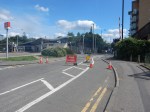


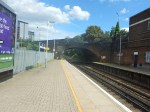
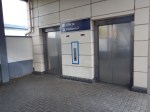

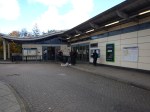
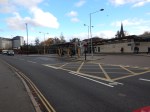
Feltham station is a particular problem, as the level crossing has to be closed.
At present it is closed for preliminary works to take place, so that it can be permanently closed.
This page on the Hounslow Council web site gives more details.
Waterloo Upgrade August 2017 – 5th August 2017
It’s all change at Waterloo station with Platforms 20 to 24 open for business.
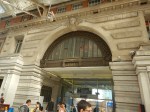

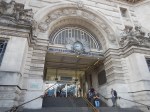

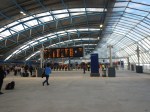
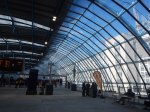
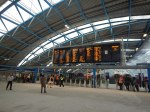

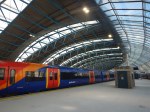


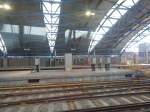
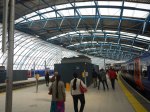

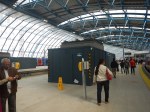
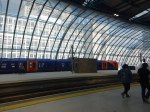
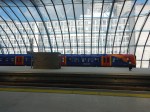
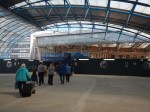
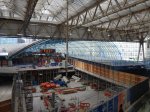
I think what has been revealed today is an excellent stop-gap to allow platforms 1 to 9 to be extended.
- Network Rail and South West Trains are also to be congratulated on putting a large number of informed staff on the platforms to answer passegers’ questions.
- With luck too, the vast open spaces around platform 20 to 24 will help to calm passengers.
- But they weren’t lucky in that everything was disrupted by a signal failure early in the day.
If I have any criticism it is over the length of time it has taken to get these platforms open.
The International platforms were closed about the time my wife died in December 2007.
That closure has just been too long.
Passenger And Train Capacity
From what I saw today, Network Rail have opened five new platforms numbered 20 to 24, with the following features.
- The ability to handle twelve-car trains.
- Wide platforms for large numbers of passengers.
- A new very wide gate line.
- Lots of natural light and fresh air.
Passengers will wish all stations could be this good.
Just imagine five packed commuter trains arriving at those new platforms at around the same time.
- Each pair of new five-car Class 707 train can hold just over sixteen hundred passengers.
- A ten-car Class 720 train, which must be similar to South Western Railway’s new trains can hold around fifteen hundred passengers.
So can the platforms, gates and concourse handle all those passengers?
As the flow of passengers seems straight down wide platforms and into the Underground or out of the station through the Victory Arch, I suspect that the station has been designed to handle the greatest number of passengers, the trains can deliver.
With Crossrail, the stations at Shenfield and Abbey Wood will be handling twelve trains per hour (tph) in a two platform layout or 6 tph at each platform.
I suspect that the signalling and track layout at platforms 20-24 at Waterloo station, is such that each platform can handle at least four tph and possibly the six, that will be achieved at Shenfield and Abbey Wood.
If they can handle six, that is an unbelievable thirty tph.
This figure is probably way in excess of other capacity constraints in the complex rail network out of Waterloo, but at least platform capacity won’t be a constraint on growth in the future.
But four tph on each platform, would give a theoretical capacity of twenty tph or around thirty thousand passengers per hour. That is a massive increase in the capacity of the station.
It has to be taken into account, that part of the Waterloo Upgrade for August 2017 is lengthening Platforms 1 to 4 at the station and improving the track layout for the lower-numbered platforms. Access to the Underground is also being improved at platforms 1 to 4.
Are Network Rail creating another high-capacity set of four platforms at the other end of the station?
What is happening at platforms 1 to 4 will be revealed at the end of the month.
Conclusion
The work has whetted my appetite as to what the station will eventually look like!
In An Analysis Of Waterloo Suburban Services Proposed To Move To Crossrail 2, I came to the following conclusion.
Crossrail 2’s proposals for the suburban branch lines from Waterloo to the four destinations of Chessington South, Epsom, Hampton Court and Shepperton stations, can be fulfilled using the following.
- More platform capacity at Waterloo.
- Modern high-performance 100 mph trains like Class 707 trains.
- Some improvements to track and signals between Waterloo and Wimbledon stations.
- Wimbledon station would only need minor modifications.
- A measure of ATO between Waterloo and Wimbledon stations.
What effect will this have on the design of Crossrail 2?
The Class 707 trains will not be arriving, but high performance Aventras will.
This August’s Upgrade will certainly make substantial increases in service frequencies and passenger capacity possible.
Waterloo Upgrade August 2017 – Virginia Water Station
I took these pictures at Virginia Water station.
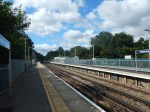
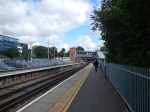

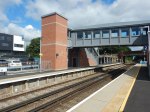

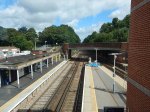
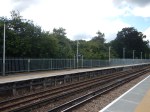
The station was updated a few years ago, but the platforms have been lengthened to twelve-car platforms, as part of the August 2017 upgrade.
If the station has a problem, it is that the Waterloo to Reading Line and the Chertsey Branch, split on the Waterloo side of the station, so it would be impossible to have a ten-car train formed of two five-car units arrive in the station, with one departing on each line.
I suppose they could always split at Egham station, which has recently been updated with twelve-car platforms.
These two half-hourly services.
- Waterloo to Guildford via Aldershot
- Waterloo to Chertsey
Could be run by five-car trains, which ran as a ten-car train to Egham.
- Both services would move from two to four trains per hour.
- No extra train paths would be needed.
If the Class 707 trains can’t run a service like this, they’re history.
This Google Map shows Virginia Water station
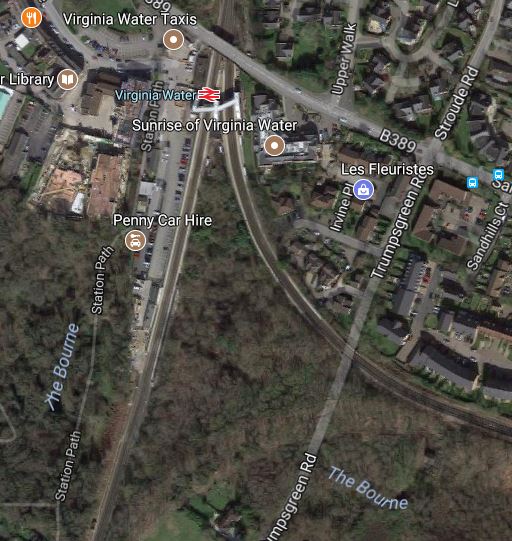
Note that the scar of a chord that used to connect the Reading and Cherstey Lines can be seen South of the station.
Would it have any possibilities?
Waterloo Upgrade August 2017 – 4th August 2017
These pictures show everything ready for the start of the first partial closure of Waterloo station from tomorrow.

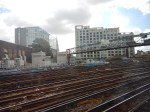
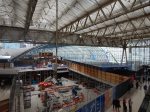
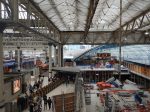
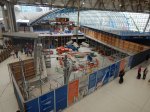
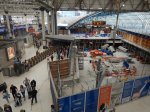


From tomorrow, the five platforms in the old International station will come into use until the 28th of August.
Note.
- The piles of track ready to be used to reorganise the lines into Platforms 1 to 9.
- The new destination board in front of Platforms 20 to 24.
- The lowered concourse in front of Platform to 24, which will become retail units.
I shall be there in the morning.
What Is Happening At Waterloo In August?
There have been various alarming headlines promising chaos at Waterloo sation for the whole of August.
This article in Rail Engineer, which is entitled Waterloo and South West Route Upgrade, gives a factual view of what should happen.
An Outline Of The Work To Be Done
This is a list from the article, which lays out the work being done.
- Redevelopment of the previous International terminal and platforms;
- Extension of Platforms 1-4 to accommodate 10-car trains in place of the present eight-car units;
- Platform extension at 10 outlying stations – Feltham, Chertsey, Camberley, Egham, Virginia Water, Sunningdale, Ascot, Martins Heron, Bracknell and Wokingham;
- Track and signalling alterations on the approaches to Waterloo to create longitudinal space for the platform alterations;
- Thirty new five-car Desiro class trains;
- Improvements in access to the Bakerloo, Northern and Jubilee tube lines from platforms 1/2 and 3/4 and from the former International terminal.
This Google Map shows the platform ends at Waterloo station.
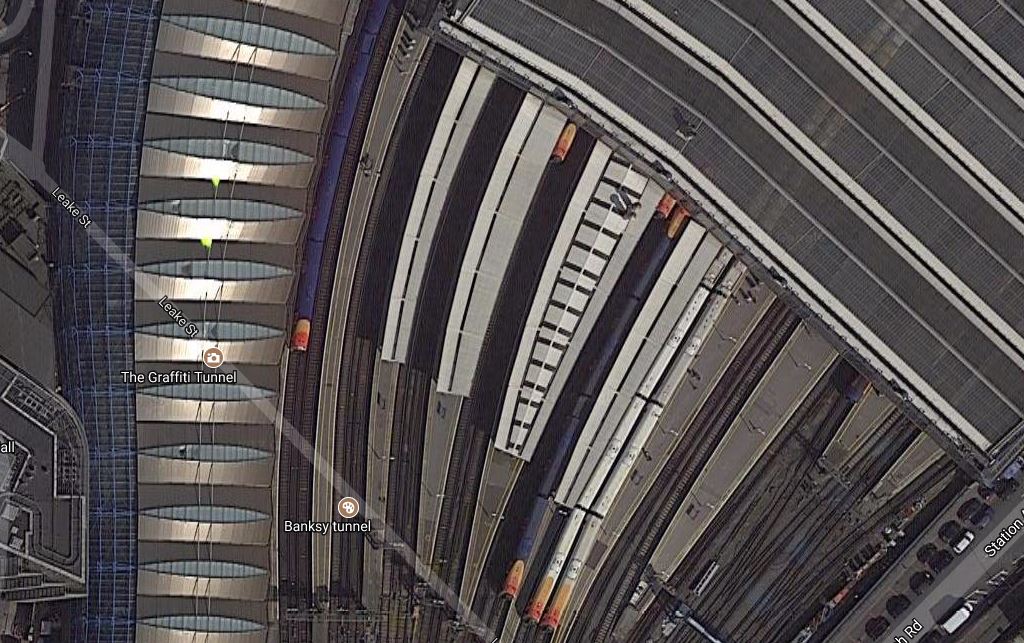
Note.
- The curved roof of the International station at the left
- The square roof of the main station, at the top right.
- Platforms are numbered from 1 to 24 from right-to-left.
- The five platforms in the International station are numbered 20-24.
- Platforms 1/2 and 3/4 are the shortest platforms to the right and will be lengthened to ten-cars.
- Platforms 5/6 and 7/8 are the medium length platforms. .
- Trains are visible in Platforms 8, 9 and 10.
- Platforms 11/12, 13/14, 15/16, 17/18 are all longer platforms.
- A train is visible in Platform 19, which lies alongside the International station.
This Google Map shows Platforms 1/2, 3/4 and 5/6.
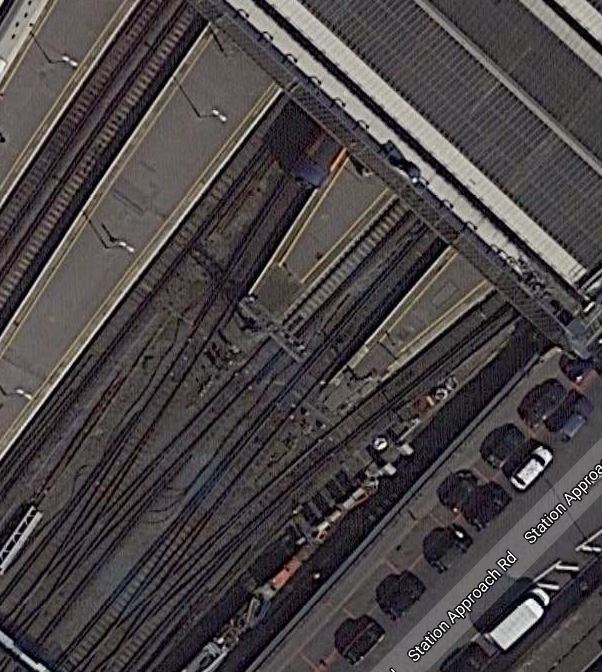
Note.
- The complicated track layout, linking the tracks out of Platforms 1 to 4 together.
- The nose of an eight-car train in Platform 4.
- Platforms 1-4 will probably need to be lengthened by something like forty metres.
- The black cabs and a white one alongside the station, which are 4.6 metres long.
It certainly isn’t a small and simple project.
The Work Schedule For August
This is a shortened extract from the article describing how the work will be done.
The overall programme commenced in 2016 with the initial redevelopment stages of the International platforms. They have been shortened at their far ends to take 12-car trains.
When these platforms are ready for use by Windsor line services on 5 August this year, Platforms 1 to 10 will be closed between then and 28 August. This closure will allow Platforms 1 to 4 to be extended to accommodate 10-car trains and Platforms 5 to 8 will be modified.
An even more severe closure, of Platforms 1-14, between 25 and 28 August, over the Bank Holiday weekend, is needed in order to complete the track and signalling alterations.
Extension of the platforms at the outlying stations is now complete apart from the work at Feltham, which is complicated by the proximity of a level crossing.
The end result of this, the largest investment for decades, will be an increase in peak time capacity into Waterloo of 30 per cent.
There is a lot more information in the full article.
What’s Wrong With The Class 707 Trains?
As I wrote earlier under point 5 in An Outline Of The Work To Be Done, thirty Desiro City Class 707 trains were to be bought for this capacity upgrade .
But the new operator; South Western Railway has decided that these trains are not wanted.
Why?
I’ve ridden both the Class 700 trains, which are the Thameslink version of the Class 707 train and Crossrail’s Class 345 train, which is a version of Bombardier’s new Aventra, which South Western Railway have ordered to replace their suburban fleet.
- In my view in terms of noise, vibration and harshness, the Bombardier product is better.
- The Class 345 train also gives a strong impression of space with its seating layout and large windows with slim pillars.
- The Class 345 train is a bit more spartan, but then it is effectively a large Underground train, rather than a long-distance commuter train.
- The Class 345 train has wi-fi and 4G connectivity, whereas the Class 700 trains have none.
Some of the trains being replaced by South Western Railway are refurbished Class 455 trains. They may be thirty-five years old, but after a high-class refurbishment, they do a good job and set a very high standard, that any new train must exceed.
If I was on a route across London , where I had a choice of one of these Class 455s or a new Class 700 train, I’d choose the older British Rail product, if there was no difference in time.
But it can’t just me passenger reaction to the two new trains, that have made South Western Railway ditch the trains. Although it is very important.
Bombardier have not disclosed all of the technical details of the Aventra and I think that these technical details are the key to the decision.
I have been suspicious for some time that Aventras are fitted with batteries to handle the regenerative braking and other issues.
In Do Class 800/801/802 Trains Use Batteries For Regenerative Braking?, I describe the electrical systems of Hitachi’s new trains and come to this conclusion.
I will be very surprised if Class 800/801/802 trains don’t have batteries.
Will the Class 385 trains for ScotRail have similar traction system?
So if Hitachi are using batteries, why shouldn’t Bombardier? In Is The Battery Electric Multiple Unit (BEMU) A Big Innovation In Train Design?, I write about my trip in Bombardier’s prototype battery train in February 2015.
So does an Aventra have a sophisticated battery system to handle the regenerative braking?
As an Electrical Engineer, I believe that using a battery to handle regenerative braking energy is much more efficient than returning the energy through the third rail or overhead wire, as another train needs to be close to use the energy.
Regenerative braking is quoted as saving up to twenty percent of the energy, but how much could be saved by an integrated train-track electrical system? Bombardier are understandably keeping their mouths shut.
But every Watt saved is less operating cost for the train operator!
Trains with onboard energy storage could give Health and Safety advantages, in places like stations and level crossings. If all trains using a level crossing were had onboard storage or were diesel, could the third rail be cut back to reduce the daanger to tresspassers?
There is also the facility for joining two five-car trains into a ten-car train automatically, which I’m sure is available on Aventras, just as it is with the Hitachi trains.
Splitting and joining at an intermediate station, as Sputheastern do at Ashford International, Great Northern do at Cambridge and Southern do at Gatwick, gives the following advantages.
- Only one train path is needed between London and the intermediate station.
- Between London and the intermediate station, capacity is maximised.
- The two split services have more appropriate capacity to their routes.
- Train companies probably spend less on track access charge and electricity.
- Train companies might even need less trains.
The only disadvantage is that passengers must get in the right portion of a train.
Is the major problem with the Class 707 train, that they don’t have the ability to couple and uncouple automatically?
 The Anonymous Widower