The Emirates Air-Line
This is the cable car over the Thames sponsored by Emirates.
Construction has started on the south bank of the river by the O2.
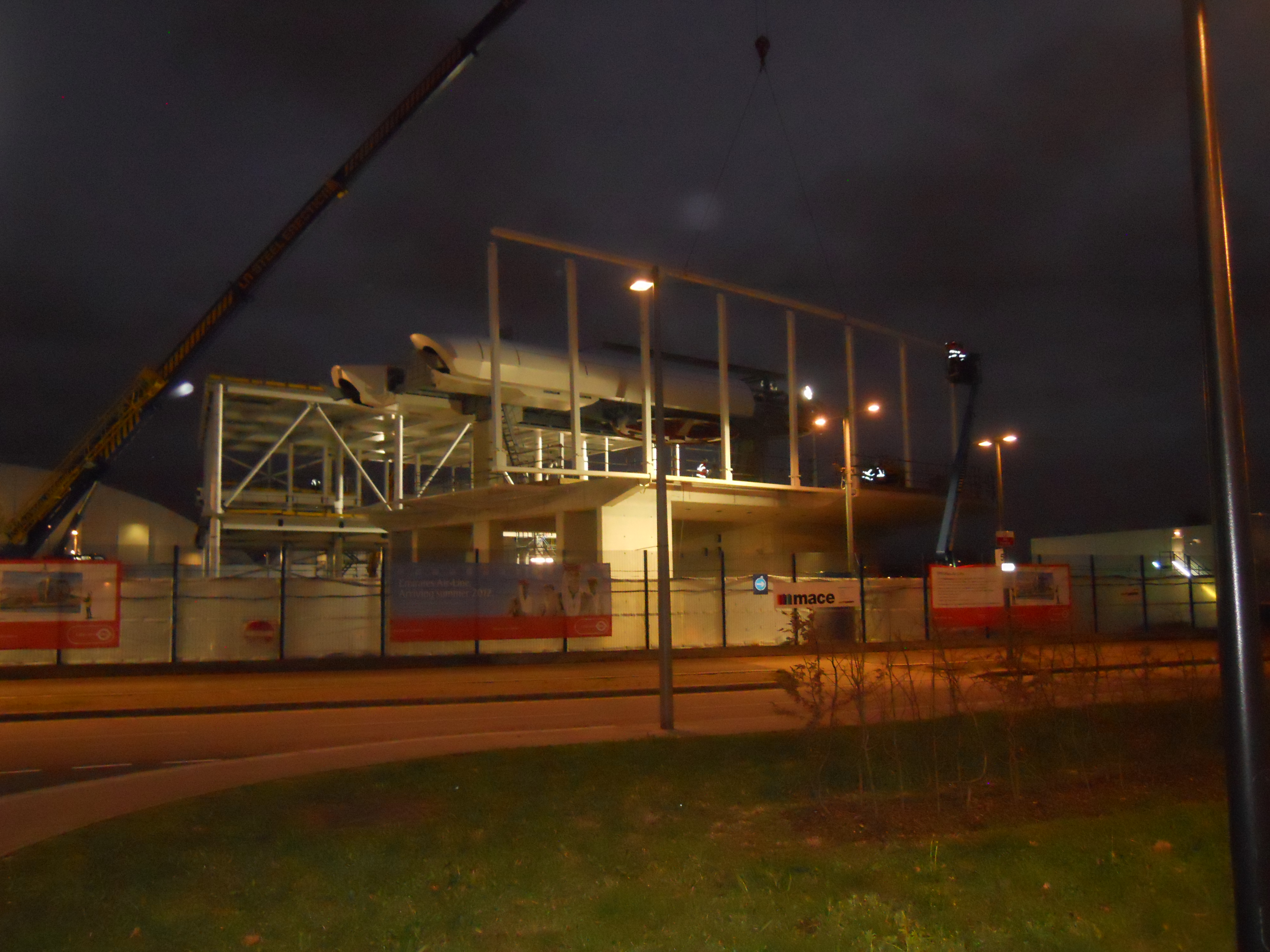
The Emirates Air-Line
This cable car has been talked about for many years and it looks like it will finally be built.
A Working One Hundred Year Old Power Station
You may think that it is a bit unusual that a power station commissioned in 1902 is still generating electricity.
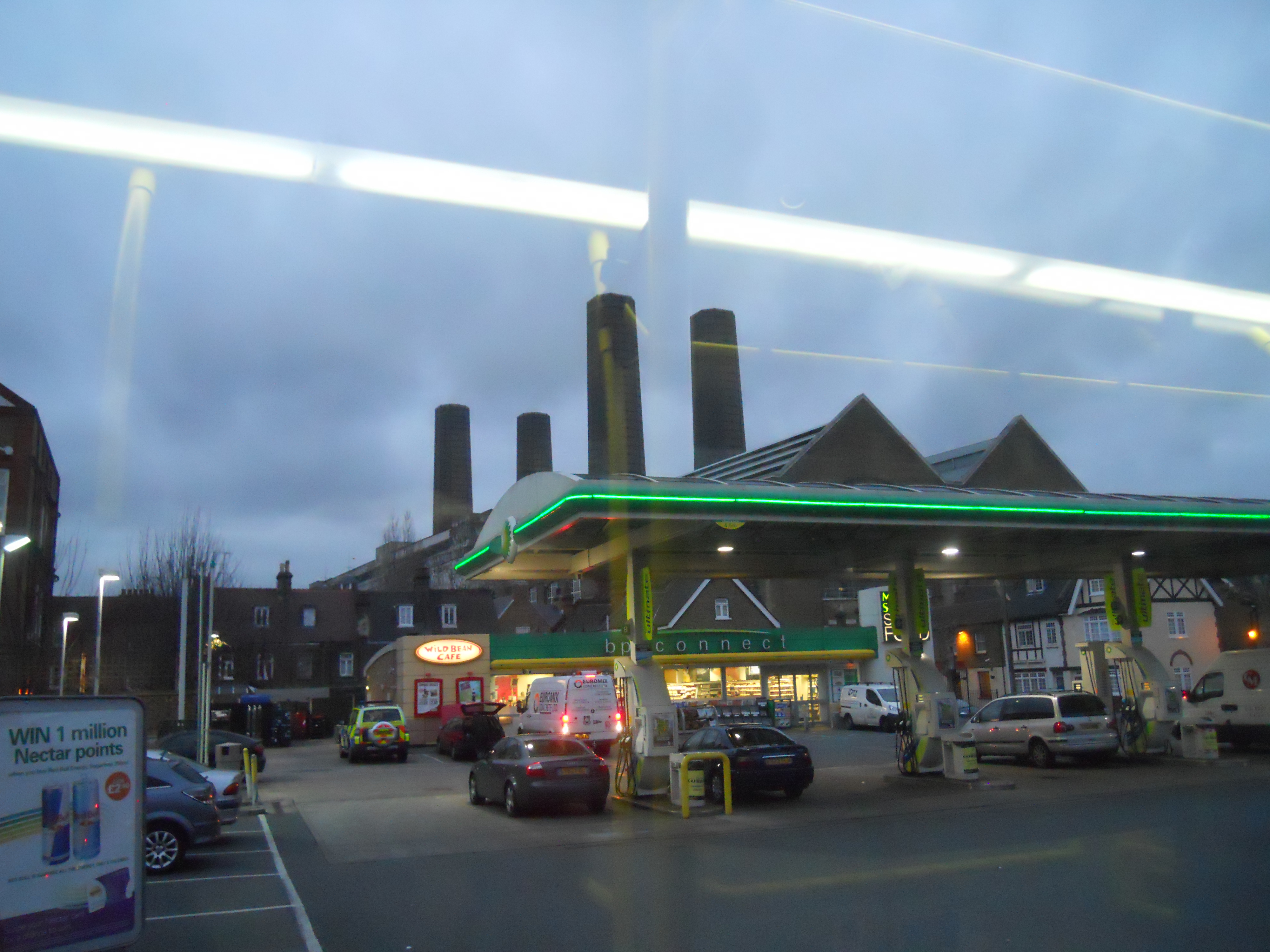
Greenwich Power Station
Greenwich Power Station is quite small with the chimneys just fifty-five metres high.
Admittedly, it is only a standby power station these days and uses modern gas turbines to generate the electricity rather than the original steam engines.
There’s some more information and pictures here.
The Success of the East London Line
I found this article on the web. It predicts that in 2011-2012 they’ll be a large increase in passengers on the East London Line.
Here’s the first couple of paragraphs.
The London Overground network has “grown faster than anticipated” with nearly three and a half times more journeys made per week in 2011 than in 2007, according to a TfL report on the train operator. Nearly two million journeys were made per week in September last year compared with 0.6 million in 2007.
But the increase has led to higher levels of crowding, and the local government body predicts that there will be 100 million journeys made on the service in 2011/12 as user demand proliferates this year due to predicted popular events including the Olympic Games and the Queen’s Jubilee.
I think it proves that building new rail lines or improving old ones encourages a lot of people to use trains.
The Rubbish Talked About HS2
I listened to some of the phone-in about HS2 on Radio 5 this morning, but gave up after most of those in the discussion, weren’t letting facts get in the way of a good selfish argument.
So here’s a few facts and my observations.
The West Coast Main Line is rather a nightmare. It is overloaded now and longer and bigger trains would probably only mop-up a small amount of the increase in passengers that will happen in the next few years. In my travels any Virgin train to or from Glasgow was severely overloaded and this section needs action now.
It was intended that the speed limit on the line would be increased, but because the line isn’t very straight, the cost would be high both in monetary terms and also in blockades whilst it was upgraded. Wikipedia says this about the reasons for the bad design of the line.
Because of opposition by landowners along the route, in places some railway lines were built so that they avoided large estates and rural towns, and to reduce construction costs the railways followed natural contours, resulting in many curves and bends. The WCML also passes through some hilly areas, such as the Chilterns (Tring cutting), the Watford Gap and Northampton uplands followed by the Trent Valley, the mountains of Cumbria with a summit at Shap, and Beattock Summit in southern Lanarkshire. This legacy of gradients and curves, and the fact that it was not originally conceived as a single trunk route, means the WCML was never ideal as a long-distance main line.
The East Coast Main Line is better, but it doesn’t solve the problem on the western side of the country.
So those who talk about increasing the capacity on the West Coast Main Line had better look at the engineering problems involved.
Christian Wolmar, a respected commentator on rail, said on television this morning, that the money for HS2 would be better spent on improving local tranport in cities and large towns, by providing trams and better bus services. He has a point, but there is one fault in his argument.
If we take Manchester as an example, where the tram system is being substantially developed, this will make it easier for long distance travellers to get to Manchester Piccadilly and the West Coast Main Line. If trams are frequent and have substantial car parking outside of the city, it may well persuade many more to take the train rather than driving.
So in fact, his plan will in the long term increase the long distance train traffic increasing the need for long distance services from Manchester and in a decade or so for HS2.
More passengers will also be brought to the line, by improvements to cross country and branch lines. Some of these like Manchester to Leeds are scheduled to be electrified and this can only attract more passengers to the fast London lines, where their local station has no connection.
One point on this is that Network Rail is investing in a special overhead line installation train, that can install a mile of overhead wiring every night with only minimal line closure. This will mean that some lines where only a marginal case exists now, will be electrified. An example is possibly from Felixstowe to Nuneaton via Peterborough, which would allow freight trains to be electric hauled all the way to the North of England and Scotland.
Another big problem is freight, which most would feel is better carried by rail to and from the ports to where it is needed. A few years ago, Felixstowe had just three freight trains a day out of the port. Now it’s a lot higher. Much of the freight will come and go through Felixstowe, Southampton and in the future the new London Gateway development and it will need to be either collected from and delivered all over the country. This would add greatly to the number of freight trains going everywhere. Many of course, will have to go up to Birmingham, the North West and Scotland.
So whatever we do we’ll have to find some way to take the freight north or alternatively free up the West Coast Main Line, by building HS2. Or do we put more trucks on the motorways and clog them up?
Those that propose upgrading the West Coast Main Line with longer and bigger trains, forget one problem, that under the current plans also applies to HS2. And that is what to do with the totally inadequate station at Euston. Of London’s main stations it is one of the worst, as I said here. It will have to be rebuilt whether we build HS2 or not. It really doesn’t have the good ongoing transport links that Kings Cross, Liverpool Street, London Bridge and Paddington have or in some cases will have after Crossrail.
In fact it could be argued that if HS2 has a station at Old Oak Common, this might be a better London terminus for that line, as it links to Crossrail, the Great Western Main Line and possibly Heathrow.
There are also a lot of technology that will make HS2 better from an engineering, environmental and passenger point of view.
For a start tunnelling technology has improved substantially in the last decade or so. If you look at the speed of building the Crossrail tunnels, I think that this shows a big increase to the similar tunnels bored for HS1. Having listened to Justine Greening’s statement in the House of Commons, this improvement is being used to put more of the line underground. We may actually be getting to the point, where tunnels are cheaper to build that lines on viaducts.
We also know a lot more about how to minimise problems when we build large projects. Crossrail for example seems to be causing a lot less problems with construction than HS1 did. Admittedly, it has caused a bit of a problem at some Central London station sites, but no more than say the average large building site or an office block.
Project management has also got a lot better over the last few decades and it is much more likely these days that a large contract is built on time and on budget. Provided the politicians and the civil servants don’t stick their oar in too much and change the specification, it will be all right in the end.
As the Sunday Times pointed out at the weekend design is getting better and the trains on HS2 could be a lot better than Eurostar. We might also see other technologies like anti-noise cutting the noise signature of the trains.
It has also been said that passengers won’t use HS2 because it will be too expensive and too much hassle. But here is where technology will help, in such things as buying tickets, where hopefully we’ll see a touch-in touch-out system like Oyster.
So the doom-mongers will continue to knock HS2, but it has a lot going for it.
The trouble with rail projects, is that if we had a referendum about spending £32 billion on rail or the same amount on roads, the public would vote for the roads. But within a few years they’d be just as gridlocked.
Lose Weight Or You Don’t Get the Operation
There has been a piece on the BBC about how doctors in Hertfordshire are saying overweight patients should lose weight before operations. Here’a more from an article in the St. Albans Review.
Overweight patients have been told to shift excess pounds before they are allowed operations such as hip and knee replacement, tonsil removal or gall bladder surgery.
It is hoped the new policy will result in patients being in a better state to recover following non-urgent procedures.
One doctor has recently told me, that obesity will bankrupt the NHS.
So I am all in favour of the policy of the doctors in Hertfordshire being replicated elsewhere.
HMRC Scams
I am very lucky in that I can afford an accountant to do my tax returns, so I know that if I get an e-mail from HMRC, it’s a scam.
I’ve had three in the last few days.
This page on the HMRC web site gives details on how to recognise them.
i forward all mine to phishing@hmrc.gsi.gov.uk. This is indicated on this page.
One of the interesting things about these e-mails, is that they were all to an old e-mail address that I don’t use now. I do monitor it, in case one of my old friends hasn’t got my new one.
For financial transactions, I always use a particular e-mail that is not used elsewhere. That means that if I get an e-mail to that address, I check it thoroughly and if say it’s selling me a holiday, I then know that my bank or other financial institution might have been compromised.
The Very Good Can Come Back
It is an old adage in sport, that sportsmen and women never make a successful comeback, was disproved last night by Thierry Henry.
But then he was something special.
Cantona For President
According to this article, one of Britain’s favourite Frenchman, wants to stand against Sarkozy to be French President.
 The Anonymous Widower