Leatherhead Station To Go Step-Free
This document on the Government web site is entitled Access for All: 73 Stations Set To Benefit From Additional Funding.
Leatherhead station is on the list.
These pictures show the station and the current subway,








This is one of those stations, where lifts could probably be put into the subway.
But this would probably mean closing the subway, which is the main access between the platforms.
Look at this Google Map of the Northern end of the station.
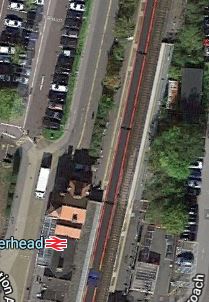
The map illustrates another problem. There is car parking by the London-bound platform and commuters will need to cross the tracks.
But the map does show there is a lot of space and a step-free bridge might be possible at this end of the station.
In Winner Announced In The Network Rail Footbridge Design Ideas Competition, I wrote how the competition was won by this bridge.
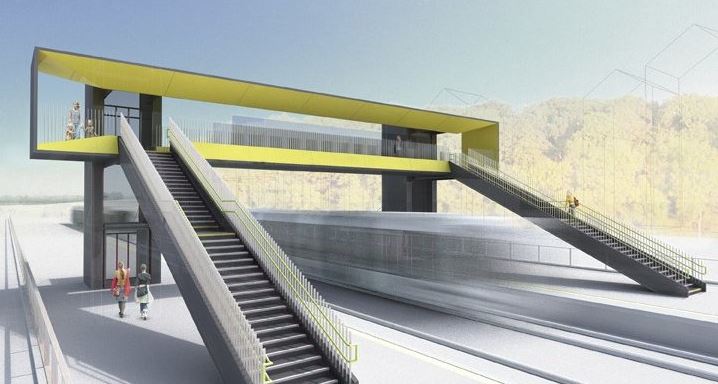
So could a factory-built bridge like this be installed be installed at Leatherhead station?
Queens Park Station To Go Step-Free
This document on the Government web site is entitled Access for All: 73 Stations Set To Benefit From Additional Funding.
Queens Park station is on the list.
These pictures show the station and the current access.


This is one station, where the Bakerloo Line and Watford DC Lines have fairly good step-free access between train and platform.
The following needs to be done.
- Provide lifts from both platforms to the booking hall and the gateline.
- Extra services to Blackpool may terminate at the station and this would mean adding step-free access to the main line platforms.
I feel the most difficult part of the project will be adding the step-free access, whilst keeping the station fully open.
A Different Energy Storage Technology
Recently, two articles on the web have been caught in my Google alerts.
- This article on Energy Storage News, which is entitled ‘Flow Machine’ Maker RedT Gets £3.2m Funding Needed To Power Projects
- This article on Mining Review Africa, which is entitled Bushveld Minerals: A Large-Scale Battery Storage Contender
Both articles are about energy storage using a Vanadium Redox Flow Battery.
This is a paragraph from the Bushveld article.
The project will be implemented in two phases for a total of 1 400 MWh of energy storage capacity – 800 MWh in Phase 1 and an additional 600 MWh in Phase 2.
When you consider that with lithium-ion technology battery capacity is normally talked about in kWH, these are impressive amounts of stored energy.
Reading the Wikipedia post shows that the batteries rely on toxic chemicals like sulphuric acid and vanadium oxide, which would probably rule out mobile applications.
Conclusion
Having read all the two articles and the Wikipedia entry, I wouldn’t be surprised to see some form of technology like this emerge for large scale energy storage to back up intermittent power sources like solar, wind and wave.
Now It’s Thieves On The Line As Crooks Target Railway Cables
The title of this post is the same as that of an article in The Times on Tuesday.
I was involved in a similar project with British Rail, where they were looking at patterns in signalling cable faults on the East Coast Main Line. My software Daisy was used to display the patterns.
I know in this case British Rail got a solution.
I even have their internal report somewhere!
Britain Hoes A Record Five Days Without Burning Coal
The title of this post came from an article in Tuesday’s Times!
It says it all!
Good isn’t it!
Although it’s probably not true, as there must be a few blacksmiths, who used coke to shoe a few horses.
 The Anonymous Widower