Is There An ERTMS-based Solution To The Digswell Viaduct?
Consider.
- Airliners have been flown automatically and safely from airport to airport for perhaps four decades.
- The Victoria Line has been running automatically and safely at over twenty tph for five decades.
- I worked with engineers developing a high-frequency sequence control system for a complicated chemical plant in 1970.
We also can’t deny that computers are getting better and more capable.
For these reasons, I believe there could be an ERTMS-based solution to the problem of the Digswell Viaduct, which could be something like this.
- All trains running on the two track section over the Digswell Viaduct and through Welwyn North station would be under computer control between Welwyn Garden City and Knebworth stations.
- Fast trains would be slowed as appropriate to create spaces to allow the slow trains to pass through the section.
- The driver would be monitoring the computer control, just as they do on the Victoria Line.
Much more complicated automated systems have been created in various applications.
The nearest rail application in the UK, is probably the application of digital signalling to London Underground’s Circle, District, Hammersmith & City and Metropolitan Lines.
This is known at the Four Lines Modernisation and it will be completed by 2023 and increase capacity by up to twenty-seven percent.
I don’t think it unreasonable to see the following numbers of services running over the Digswell Viaduct by 2030 in both directions in every hour.
- Sixteen fast trains
- Four slow trains
That is one train every three minutes.
Currently, it appears to be about ten fast and two slow.
As someone, who doesn’t like to be on a platform, when a fast train goes through, I believe that some form of advanced safety measures should be installed at Welwyn North station.
Conclusion
It will surely be more affordable to use clever signalling and train sequencing, than rebuilding the viaduct with four tracks.
Improving Trains Between London And Bradford
Current Services Between London And Bradford
LNER services run between Kings Cross and Bradford Forster Square stations.
- Two trains per day (tpd) run between Bradford and London in the early morning.
- Two tpd run between London and Bradford in the evening.
- Trains take two and three-quarter hours.
- Stops are at Shipley, Leeds, Wakefield Westgate, Doncaster, Retford Grantham and Stevenage.
- Trains seem to be generally a pair of five-car Class 801 trains.
Note.
- Trains reverse at Leeds.
- The timetable seems a bit lopsided, as there is no early morning train to Bradford or an evening one to London.
- Harrogate gets a one train per two hours (tp2h) service to and from London.
The timetable could do with an improvement.
Grand Central services run between Kings Cross and Bradford Interchange stations.
- Four tpd run between Bradford and London.
- Four tpd run between London and Bradford.
- Trains take three and a quarter hours.
- Stops are at Pontefract Monkhill, Wakefield Kirkgate, Mirfield, Brighouse, Halifax and Low Moor
- Trains are five-car Class 180 trains, which have seen better days.
Note.
- The timetable seems a bit lopsided, as there is no early morning train to Bradford or an evening one to London.
The timetable and the trains could do with an improvement.
LNER’s New Ticketing And Nine-Ten Car Trains
LNER have introduced the selling of Advanced Tickets from machines or the Booking Office as late as five minutes before the train leaves.
- My last three trips from Leeds to London cost me £33.55, £33.75 and £33.55 with my Senior Railcard.
- All were bought less than ten minutes before the train left.
- In two of the journeys, I spread out in two seats
- Trains were either a pair of five-car Class 801 trains or a nine-car InterCity 225.
I took these pictures after my last return from Leeds on Tuesday.
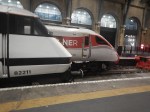

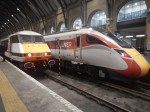
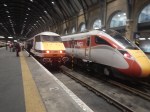
Note.
- Two of the three trains I’ve taken lately have arrived 3-4 minutes early.
- Not a great increase, but I do wonder if LNER are seeing what is possible with the new digital signalling.
- The British Rail era; InterCity 225 seems to hold its own against the new Hitachi train.
I wouldn’t be surprised that LNER intend to both run high-capacity trains between London and Leeds and fill them by competitive pricing.
A Grand Central Train Failure On Tuesday
This was my journey to Bradford on Tuesday,
- I was supposed to take the 1057 Grand Central service to Bradford Interchange, where it was timed to arrive at 1400.
- But the train didn’t run and we were all advised to get on the 1103 to Leeds and change at Doncaster.
- We arrived at Doncaster in Platform 4, a minute late at 1240 and got straight on a Grand Central train in the opposite Platform 6.
- We left Doncaster at 1251, which was sixteen minutes late.
- But we arrived in Bradford Interchange more or less on time at 1401.
Despite leaving six minutes late from Kings Cross and changing trains at Doncaster, we arrived at Bradford on time.
Battery-Electric Trains Between London and Bradford Interchange
I feel that my journey on Tuesday indicated.
- Electric trains between London and Doncaster can easily meet the current timetable.
- The Grand Central train went between Doncaster and Bradford Interchange was sixteen minutes faster than the timetable.
I wouldn’t be surprised that London and Bradford Interchange could be a few minutes under three hours.
Consider.
- It has been said that between Bradford Interchange and Leeds will be electrified.
- Bradford Interchange and Doncaster does not have electrification, but is only 52 miles.
- Electrification of Bradford Interchange station, will allow battery-electric trains to be charged in around 10-12 minutes.
- Most inter-city battery-electric trains have a battery range of at least eighty miles.
- Digital signalling is being installed between London and Doncaster to allow 140 mph running and more trains in the timetable.
I believe that a battery-electric train with sufficient range, charging South of Doncaster and at Bradford Interchange could go between London and Bradford Interchange in 5-10 minutes under three hours.
Bradford Interchange and all the other stations North of Doncaster on the route could probably also have a one tp2h service to and from London and the South.
Splitting And Joining Of Trains
Consider.
- Pairs of the Hitachi Class 801 trains have the ability to split and join en route, during a station stop extended by a few minutes.
- Platforms are long enough to handle splitting and joining at Doncaster, Leeds and York.
- Currently, three services to and from London go past Leeds; Bradford Forster Square, Harrogate and Skipton. All these services reverse in Leeds station, when they pass through.
- The reversing in Leeds station takes about 8-9 minutes.
- The track between Leeds and Bradford Forster Square is electrified.
- Leeds and Harrogate is not electrified and is 19.3 miles.
- The track between Leeds and Skipton is electrified.
- Bradford Forster Square has a service of two tpd.
- Harrogate has a service of one tp2h.
- Skipton has a service of one tpd.
In the Wikipedia entry for LNER, this is said.
From December 2019, LNER introduced a Harrogate to London service six times a day. LNER expected to introduce two-hourly services to Bradford and a daily service to Huddersfield by May 2020 when more Azuma trains had been introduced, however the latter has not yet been introduced.
Note.
- The Huddersfield service would have to reverse in Leeds station, like those to Bradford Forster Square, Harrogate and Skipton.
- Leeds and Huddersfield is not electrified and is 17.1 miles.
- Leeds and Huddersfield is being electrified.
Could LNER’s plan be to give Bradford Forster Square, Harrogate, Huddersfield and Skipton stations a two-hourly service , as the Wikipedia extract indicated, they intend to do for Bradford?
- All trains enter and leave Leeds to and from the West.
- Pairs of five-car trains would split and join at Leeds.
- Bradford Forster Square and Skipton services would be served by electric trains.
- Harrogate and Huddersfield services would be served by bi-mode or battery-electric trains.
- Horsforth, Keighley and Shipley could also get a one tp2h service to London.
It looks like services via Leeds could be much improved.
In a two-hour period the Leeds area will have the following trains to and from London Kings Cross.
- Two trains between London and Leeds via Peterborough, Doncaster and Wakefield Westgate
- One train between London and Bradford Forster Square via Stevenage, Grantham, Retford (Bradford-bound only), Doncaster, Wakefield Westgate, Leeds and Shipley.
- One train between London and Harrogate via Stevenage, Grantham, Doncaster, Wakefield Westgate, Leeds and Horsforth
- One train between London and Huddersfield via Stevenage, Grantham, Doncaster, Wakefield Westgate and Leeds
- One train between London and Skipton via Peterborough, Newark Northgate, Doncaster, Wakefield Westgate, Leeds, Shipley (London-bound only) and Keighley.
Note.
- Stops between London and Leeds would be adjusted to satisfy passenger numbers.
- Currently, there are a total of four trains in a two hour period.
- Six trains will be fitted in by having two London and Leeds trains and two pairs of five-car trains, that joined and split at Leeds.
There is still only four train paths needed in a two hour period between London and Leeds.
Digital Signalling Between London And Doncaster
The East Coast Digital Programme has its own web site, which gives this introduction to the programme.
The East Coast Digital Programme is delivering the next generation of train travel – creating a better performing East Coast Main Line for passengers and everyone else who uses and depends on it.
As part of the programme, traditional lineside signals will be removed and replaced with state-of the art digital signalling to improve the reliability of the train service.
The new technology continuously communicates with each train, providing signalling information directly to a computer screen in the driver’s cab. It boosts reliability, reduces carbon emissions and provides a more punctual service for customers.
In the first stage, digital signalling will be introduced on the Northern City Line, between Finsbury Park and Moorgate. It will then be progressively rolled out on the southern section of the East Coast Main Line (between London King’s Cross and the Stoke Tunnels, near Grantham).
It is expected that the first trains to operate on the East Coast Main Line using digital signalling technology will run in 2025, with all improvements expected to be completed by the end of the decade.
As a result of this programme, the East Coast Main Line will be GB’s first intercity mainline to be upgraded to digital. It lays the foundation for further improvements across the network, creating a more efficient railway fit for the future.
There is also a video.
Benefits of digital signalling will include.
- 140 mph running instead of 125 mph.
- An increase in the number of train paths.
- Trains will be able to be run closer together.
As a Graduate Control Engineer, I also believe that digital signalling will enable better control of trains through bottlenecks.
- Could ERTMS And ETCS Solve The Newark Crossing Problem?
- Is There An ERTMS-based Solution To The Digswell Viaduct?
A computer solution would surely be more affordable than some massive civil engineering.
What Will Be The Fastest Times Possible Between London King’s Cross And Leeds?
I put my thoughts in What Will Be The Fastest Times Possible Between London King’s Cross And Leeds?.
Conclusion
The original High Speed Two specification gave a time of one hour and twenty-one minutes between Euston and Leeds.
I suspect that time will be approached before 2040.
Derby Alstom Train Factory Jobs Fear As Orders Dry Up
The title of this post, is the same as that of this article on the BBC.
This is the sub-heading.
Derby City Council is seeking talks with train builder Alstom over reports it could be about to lay off workers.
These two paragraphs introduce the story.
The firm’s Litchurch Lane site is the only UK train factory able to design, build, engineer and test trains for domestic and export markets.
About 2,000 people work at the factory but the firm says its current order book only runs until early 2024.
This could be another serious problem for High Speed Two.
Could LNER Use High Speed Two Classic-Compatible Trains?
In LNER Seeks 10 More Bi-Modes, I discuss how LNER are needing ten more bi-mode trains to expand their services.
Consider.
- One of LNER’s predecessors used to run Eurostar trains between Kings Cross and Leeds
- A High Speed Two Classic-Compatible trains are 200 metres long, as against the 233.7 metres of a nine-car Class 801 train.
- High Speed Two Classic-Compatible trains will run on the East Coast Main Line, when High Speed Two fully opens.
- London to Doncaster, Edinburgh, Leeds, Newcastle and York are all fully electrified routes.
So if all these fully-electric routes, were to be run using High Speed Two Classic-Compatible trains, this would release a number of Class 800 and Class 801 trains, which could be converted to bi-modes or battery-electric variants.
London and Edinburgh In Three-And-A-Half Hours
This is a paragraph from the Wikipedia entry for the InterCity 225 train.
The InterCity 225 was designed to achieve a peak service speed of 140 mph (225 km/h); during a test run in 1989 on Stoke Bank between Peterborough and Grantham, an InterCity 225 was recorded at a speed of 162 mph (260.7 km/h). Its high speed capabilities were again demonstrated via a 3hr 29mins non-stop run between London and Edinburgh on 26 September 1991. British regulations have since required in-cab signalling on any train running at speeds above 125 mph (201 km/h) preventing such speeds from being legally attained in regular service. Thus, except on High Speed 1, which is equipped with cab signalling, British signalling does not allow any train, including the InterCity 225, to exceed 125 mph (201 km/h) in regular service, due to the impracticality of correctly observing lineside signals at high speed.
If in-cab digital signalling were to be installed between London and Edinburgh, I believe that the three-and-a-half hour timing can be regularly achieved by a High Speed Two Classic-Compatible train.
I also believe that at least one train per hour (tph) between London and Edinburgh could achieve the three-and-a-half hour timing.
High Speed Two are promising a 3:48 time between London and Edinburgh.
It could be a Lumo-squasher!
A one tph service would need eight trains, but would release eight nine-car Class 801 trains.
Euston and Glasgow
This might be another route, where High Speed Two Classic-Compatible trains could be used.
Conclusion
LNER gets some more trains and Derby gets more work.
But the biggest benefits would be that, the trains would get a thorough testing before High Speed Two opens and passengers would get a view of the shape of things to come.
 The Anonymous Widower