New Mobile Rail Charging Facility For Long Marston
The title of this post, is the same as that of this article from Rail Technology Magazine.
This is the sub-heading.
Porterbrook has signed a £1.7 million deal with Siemens Mobility to purchase an innovative Rail Charging Converter (RCC) for its Long Marston Rail Innovation Centre. The cutting-edge technology will make battery charging and 25kV power supply possible in areas of the UK railway where overhead line equipment is not currently available.
This first paragraph describes the system.
The RCC is a modular and containerised system that uses power electronics to provide a fully compliant, standard connection between the modern three-wire electricity grid and the single-wire railway. It essentially reduces the electrification infrastructure needed by being able to plug into existing power cables and deliver the ideal power supply for trains.
These two paragraphs describe how the RCC was designed and funded, and how it will be used in the future.
The original development of the RCC was supported by the Department for Transport through Innovate UK’s First of a Kind programme. The team will install the novel charging solution at Long Marston, enabling the charging of trains with batteries, fed from existing standard local power supply cables.
Compatible with all overhead line equipment powered trains, the small, low-cost design of the RCC enables the removal of diesel passenger train operation on routes without continuous electrification.
I suspect we’ll see other manufacturers like Hitachi ABB Power Grids and Furrer+Frey launch similar products.
This page gives full details of the award to Siemens Mobility.
Project Title: 25kV Battery Train Charging Station Demonstration
Lead Organisation: Siemens Mobility Ltd.
Project Grant: £59,910
Public Description:
The UK rail industry is committed to decarbonisation, including the removal of diesel trains by 2040.
Replacing diesel trains with electric, hydrogen or battery bi-mode rolling stock provides faster, smoother and more reliable journeys, as well as eliminating local pollution and greatly reducing carbon dioxide.
To enable clean, green electric bi-mode operation without continuous electrification requires enhancement of the power supply to existing electrification and novel charging facilities to support bi-mode trains.
No small, low-cost solution is currently available for charging facilities that are compatible with standard UK trains and locally available power supplies and space.
Siemens Mobility, working with ROSCO, TOCs and Network Rail, will deliver a novel AC charging solution enabling simple installation of small, low-cost rapid charging facilities fed from existing standard local power supply cables.
Compatible with all OLE-powered trains, the novel design enables the removal of diesel passenger train operation on non-electrified routes across the UK, while minimising land requirements and modifications required to existing station structures.
£59,910 seems to be good value for the helping with the design of a universal charging system for 25 KVAC battery-electric trains in the UK.
I have a few thoughts.
Will The Rail Charging Converter (RCC) Charge Third Rail Trains?
As new third-rail systems are effectively systems non grata, I suspect that third-rail trains will be charged by fitting a pantograph and the appropriate electrical gubbins.
Most modern third-rail electrical multiple units have a roof that is ready for a pantograph and can be converted into dual-voltage trains.
What Trains Will Be Able To Be Charged Using An RCC?
I suspect it will be any train with a battery, a pantograph and the appropriate electrical gubbins.
Battery-electric trains that could have a pantograph include.
- Alstom Electrostar and Aventra
- CAF Civity
- Hitachi Class 385 train
- Hitachi Class 800 train
- Siemens Desiro and Mireo
- Stadler Class 777 train
- Stadler Flirt and Akku
- Vivarail Class 230 train
I suspect it could charge all trains in the UK, where batteries have been proposed to be added.
What Is Meant By Mobile?
I suspect transportable and temporary would be a better description.
This gallery show Felixstowe station and a Class 755 train, which can be fitted with batteries.


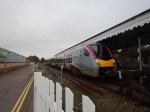

Suppose that testing was to be done at Felixstowe of a battery-electric Class 755 train.
- The containerised electrical system would be placed somewhere convenient.
- A short length of overhead wire would be erected in the platform.
- The system would then be connected together and to the electrical supply.
- After testing, it could be used to charge a train.
It would be very convenient for operation of the railway, if it could be installed and taken out overnight.
Conclusion
It looks a well-designed system.
RWE’s Welsh Offshore Wind Project Powers Ahead
The title of this post, is the same as that of this article on offshoreWIND.biz.
This is the sub-heading.
Natural Resources Wales has awarded marine licences for RWE’s Awel y Môr offshore wind project off the North Wales Coast.
These two paragraphs outline the project.
The offshore wind farm, which could power more than half of Wales’ homes, has secured all of its necessary planning approvals with the award of its marine licences from Natural Resources Wales, RWE said.
The marine licences have been awarded on behalf of Welsh Government ministers following the granting of a Development Consent Order in September.
With all the wind action in the East, we tend to forget that the Liverpool Bay area has a lot of wind.
- Awel y Môr – 500 MW – Before 2030
- Barrow – 90 MW – 2006
- Burbo Bank – 90 MW – 2007
- Burbo Bank Extension – 258 MW – 2017
- Gwynt y Môr – 576 MW – 2015
- Mona – 1500 MW – 2029
- Morecambe – 480 MW – 2028
- Morgan – 1500 MW – 2029
- North Hoyle – 60 MW – 2003
- Ormonde – 150 MW – 2012
- Rhyl Flats – 90 MW – 2009
- Walney – 367 MW – 2010
- Walney Extension – 659 MW – 2018
- West Of Duddon Sands – 389 MW – 2014
Note.
- This is a total of 6709 MW to be delivered before 2030.
- All the wind farms have fixed foundations.
- RWE have an interest in three of the Welsh wind farms.
The Times today has this article which is entitled Energy Minnow Sees Pathway To Irish Sea Gasfield Via London IPO, where these are the first three paragraphs.
An energy minnow that is seeking to develop a gasfield in the Irish Sea is planning to list on Aim, the junior London stock exchange, in an attempt to buck the downturn in initial public offerings.
EnergyPathways has announced its intention to float, seeking to raise at least £2 million.
It owns the rights to Marram, a small gasfield discovered in 1993 about 20 miles offshore from Blackpool. It is seeking permission from the government for its plan to develop the field in the Irish Sea quickly by connecting it with existing infrastructure that serves the already-producing gasfields in Morecambe Bay. It aims to be producing gas as soon as 2025.
This gasfield should produce enough gas until the large Liverpool Bay wind farms come on stream at the end of the decade.
Masdar To Invest In Iberdrola’s 1.4 GW East Anglia Offshore Wind Project
The title of this post, is the same as that of this article on offshoreWIND.biz.
This is the sub-heading.
Iberdrola and Masdar have signed a strategic partnership agreement to evaluate the joint development of offshore wind and green hydrogen projects in Germany, the UK, and the US, which also includes an investment in Iberdrola’s 1.4 GW East Anglia 3 offshore wind project in the UK.
These first two paragraphs outline the del.
After the parties’ successful co-investment in the Baltic Eagle offshore wind farm in Germany, the new milestone of this alliance will be to achieve a further co-investment concerning the 1.4 GW East Anglia 3 offshore wind project in the UK, said the companies.
According to the partners, the deal has been under negotiation for the last few months and could be signed by the end of the first quarter of 2024. Masdar’s stake in the wind farm could be 49 per cent.
This deal appears to be very similar to Masdar’s deal with RWE, that I wrote about in RWE Partners With Masdar For 3 GW Dogger Bank South Offshore Wind Projects.
- The Iberdrola deal involves the 1.4 GW East Anglia 3 wind farm, which has a Contract for Difference at £37.35 £/MWh and is scheduled to be completed by 2026.
- The RWE deal involves the 3 GW Dogger Bank South wind farm, which doesn’t have a Contract for Difference and is scheduled to be completed by 2031.
- Both deals are done with wind farm developers, who have a long track record.
- Both wind farms are the latest to be built in mature clusters of wind farms, so there is a lot of production and maintenance data available.
I suspect, that many capable engineers and accountants can give an accurate prediction of the cash flow from these wind farms.
I will expect that we’ll see more deals like this, where high quality wind farms are sold to foreign energy companies with lots of money.
Just over five years ago, I wrote World’s Largest Wind Farm Attracts Huge Backing From Insurance Giant, which described how and why Aviva were investing in the Hornsea 1 wind farm.
Conclusion
It appears that Masdar are doing the same as Aviva and usind wind farms as a safe investment for lots of money.
 The Anonymous Widower