Lumo In Discussions To Operate Glasgow Services
The title of this post, is the same as that of this press release from FirstGroup.
These four paragraphs give more details.
FirstGroup, the leading private sector transport operator, today announces that its popular open access rail service Lumo is in discussions with Transport Scotland and Network Rail to extend some of its London-Edinburgh trains to and from Glasgow.
Having identified opportunities to extend a number of daily journeys to and from Glasgow in the timetables for 2025 and beyond, work will now continue with Transport Scotland and track infrastructure manager Network Rail to agree final route options and timings ahead of an application for access rights to the Office of Rail and Road (‘ORR’), the industry regulator.
If successful, the new services could be in operation from next summer.
Lumo’s proposed new offering will improve links for customers travelling between Newcastle and Glasgow, giving people a choice of services without needing to change trains. In addition, a significant number of users of Lumo’s current London-Edinburgh trains go on to travel through to Glasgow via other connections, and through this move, Lumo aims to offer a direct through service for these customers.
I have a few thoughts.
There Appears To Be A Need For An Affordable London And Glasgow Service
This is the last sentence of my extract from the press release.
In addition, a significant number of users of Lumo’s current London-Edinburgh trains go on to travel through to Glasgow via other connections, and through this move, Lumo aims to offer a direct through service for these customers.
This looks to be a service, that has been suggested by an analysis of passengers’ tickets.
Which Station Will Lumo Use In Glasgow?
Consider.
- The current LNER service between London King’s Cross and Glasgow, uses Glasgow Central station and it takes 66 minutes between Edinburgh and Glasgow Central stations.
- LNER’s service also calls at Haymarket and Motherwell.
- ScotRail services between Edinburgh and Glasgow Queen Street take about 49-50 minutes.
I suspect, that Lumo will take the faster route.
Newcastle And Glasgow Is A New Route
Currently, all passengers between Glasgow and Newcastle have to change at Edinburgh.
This will be the first direct train in my memory, except for LNER’s single daily service between London and Glasgow Central, which stops at Newcastle.
What About The Football?
Glasgow is very much about football.
Would it be possible to use Lumo to see a match starting at 15:00 on a Saturday afternoon, if you lived in London?
- The 05:48 train from King’s Cross on a Saturday arrives in Edinburgh at 10:07.
- Trains between Edinburgh and Glasgow take fifty minutes, so I feel it would be reasonable to be able to get to Glasgow by 10:57.
This time would be more than early enough to have a few swift halves and see the match if it started at 15:00.
But would it be possible to get back to London after the match?
- The last train leaves Edinburgh at 17:55 and arrives in King’s Cross at 22:26.
- Applying the fifty minute journey time between Edinburgh and Glasgow means it will leave at 17:05.
- It appears that from Ibrox and Celtic Park to Glasgow Central or Glasgow Queen Street station is about twenty minutes.
On the current timetable, it would appear to be possible, but tight.
One alternative would be to take the Caledonian Sleeper back to London. But it doesn’t appear to run on a Saturday night.
Coaches do run and an overnight coach costs around twenty pounds.
It looks like if Lumo ran a service about 18:00 on a Saturday to London, it wouldn’t run empty.
Will Lumo Need More Trains?
In the press release, FirstGroup plc Chief Executive Officer Graham Sutherland, is quoted as saying.
Once preferred route options and timings have been agreed, discussions will continue with Network Rail and the ORR to secure the required approvals. The journeys would be operated within the existing Lumo fleet of all-electric trains and it is anticipated that the additional services could begin in summer 2025.
That looks to me, that they will not be obtaining more trains before next summer.
In Ten-Car Hull Trains, I noted that some of Hull Trains services were now running as ten-car trains.
If the passenger demand is there for ten-car trains to Hull, which is almost exactly half the distance of Edinburgh, I would expect that in the future, Lumo will be running some services as ten-car trains.
In Extra Luggage Racks For Lumo, which is based on an article in the November 2023 Edition of Modern Railways, an alternative view on more trains is taken.
The Modern Railways article finishes with this paragraph.
Lumo celebrated its second birthday in late October and was also set to mark the carriage of its two-millionth passenger. It is understood Lumo is interested in augmenting its fleet, such has been the success of the service; while many operators favour bi-mode units, Lumo is proud of its all-electric credentials so straight EMUs are still preferred, although the possibilities of including batteries which could power the trains may be pursued (the ‘803s’ have on-board batteries, but only to provide power to on-board systems if the electricity supply fails).
I find this development very interesting.
As London King’s Cross and Edinburgh and Glasgow are all electric routes, in normal service batteries should not be needed, but sometimes trains have to use the diversion via Lincoln, which I have estimated is 86.5 miles.
As an electrical engineer, I’ve always believed that the emergency batteries in the Class 803 trains are very similar to the traction batteries that Hitachi are developing for the Class 802 trains.
A traction battery, that was capable of handling the diversion would stop Lumo having to cancel occasional services.
Conclusion
An extension to Glasgow looks like it could be a simple and profitable way to extend the current Lumo service.
But it might need some extra trains in the future.
A Lumo service to Glasgow, might be helped by a seven-day service on the Caledonian Sleeper, so passenger could go North on Lumo and South on the Sleeper to get a full day in Glasgow.
London Overground Train Makes Rare Diversion To London Bridge Station
The title of this post, is the same as that of this article on Ian Visits.
This is the sub-heading.
On Sunday morning, a London Overground train paid a visit to London Bridge station — a station that the Overground doesn’t usually visit.
These were the first two paragraphs.
It was here for a test run ahead of a special service that will run on Easter Sunday, and the test was needed to ensure that what worked on paper also worked in practice.
The reason for the Easter Sunday special is weekend engineering works elsewhere which would mean no Southern trains between Victoria and London Bridge, while at the same time, the London Overground south of the river can’t go north.
Note.
- Judging by Ian’s pictures, it was a very thorough test of clearances and ramp functions.
- According to Real Time Trains, the two services used platform 5 at Crystal Palace and Platform 13 at London Bridge.
- The distance was 7.5 miles.
- Services took 23 minutes to London Bridge and 19 minutes for the return.
This image shows a London Overground train in Platform 5 at Crystal Palace station.
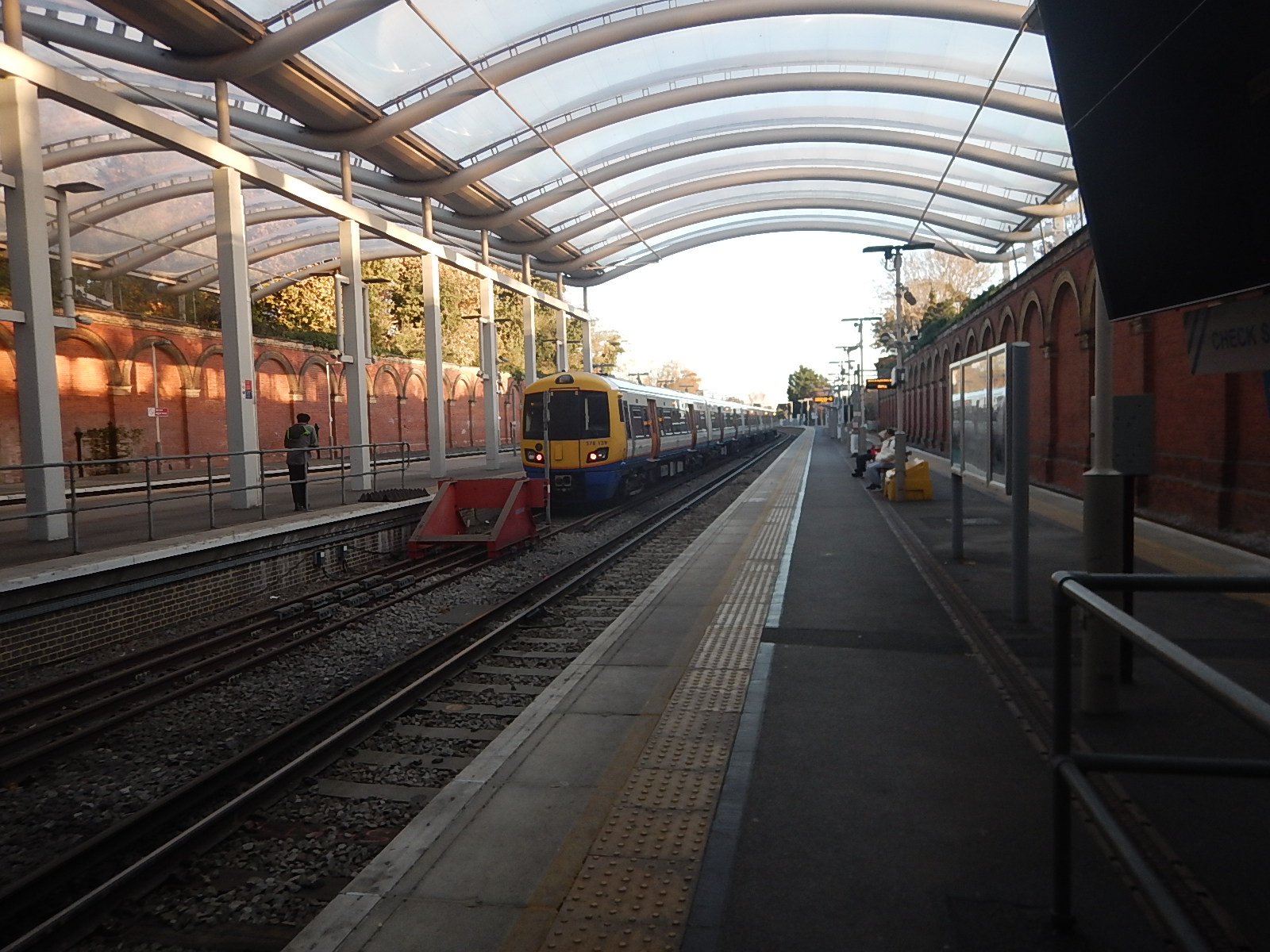
In Overground To London Bridge Under Consideration, I talked about how Transport for London were thinking about creating a new Overground service between London Bridge and Crystal Palace.
Sunday’s test also shows that if the paths are available, London Overground can run a service between London Bridge and Crystal Palace.
Given that the times for the out and return trips were 23 and 19 minutes on Sunday, it appears to me, that the following is possible.
- One train could run an hourly service.
- Two trains could run a two trains per hour (tph) service.
Trains could terminate in platform 3, which is on the right in the image and only has two trains per day.
There would be the following trains to London from Crystal Palace.
- London Overground – Four tph to Canada Water, Whitechapel and Highbury and Islington.
- London Overground – Two tph to London Bridge
- Southern – Two tph to London Bridge
- Southern – Four tph to London Victoria
These would total to.
- Canada Water – four tph for Jubilee Line
- Highbury & Islington – four tph for Victoria and North London Lines
- London Bridge – four tph for Thameslink, Jubilee and Northern Lines
- London Victoria – four tph for Victoria, Circle and District Lines
- Whitechapel – four tph for Elizabeth, Victoria, Circle, District and Hammersmith & City Lines
Note.
- The two extra tph to London Bridge even everything up to four tph.
- The London Bridge and Crystal Palace service could be run by any suitable train and I suspect it could be eight cars. What about using some of the spare Class 379 trains?
The London Bridge and Crystal Palace service wouldn’t need trains with a tunnel evacuation capability, so could use Class 378, 379, 387 or 710 trains.
Why Firms Are Racing To Produce Green Ammonia
The title of this post, is the same as that of this article on the BBC.
This is the sub-heading.
In the 19th Century, Europeans realised what the Inca had known long before. Bird droppings, or guano, made a fantastic fertiliser.
These are the first three paragraphs.
And so sprang up a gigantic industry dedicated to the harvesting of guano from Latin American bird colonies, where there were huge piles of the stuff.
It was so rich in ammonia, the key ingredient, that a mere whiff could induce coughing and sneezing. Not exactly a pleasant cargo to ferry across the world.
As demand for fertiliser rose in the early 1900s, someone began to think, “Perhaps there’s another way?” That someone was Fritz Haber, a German chemist who, along with Carl Bosch, developed the Haber-Bosch process for synthesising ammonia.
This Wikipedia entry describes the Haber-Bosch process.
This is the first paragraph.
The Haber process, also called the Haber–Bosch process, is the main industrial procedure for the production of ammonia. The German chemists Fritz Haber and Carl Bosch developed it in the first decade of the 20th century. The process converts atmospheric nitrogen (N2) to ammonia (NH3) by a reaction with hydrogen (H2) using an iron metal catalyst under high temperatures and pressures. This reaction is slightly exothermic (i.e. it releases energy), meaning that the reaction is favoured at lower temperatures and higher pressures. It decreases entropy, complicating the process. Hydrogen is produced via steam reforming, followed by an iterative closed cycle to react hydrogen with nitrogen to produce ammonia.
These companies are mentioned in the BBC article.
Starfire Energy
This is their web site.
Their home page has a title of Modular, Variable-Rate Ammonia (NH3) Production and this description of their technology.
We are scaling up technologies to make and use carbon-free ammonia fuel. Rapid Ramp is a variable-rate ammonia production process engineered into a modular plant design. Prometheus Fire is a lower temperature, high flow ammonia cracking process that allows ammonia to be used like natural gas, but with no CO2 emissions.
According to the co-founder of the company, Starfire’s process can use intermittent power, like wind and solar.
Could a farmer make their own fertiliser with a containerised system and say a 5MW wind turbine or a small solar farm?
Atmonia
This is their web site.
This description of their process is on their home page.
Atmonia is developing a nitrogen electrolyser with our patented catalyst. The technology uses only air, water and electricity for direct ammonia production. This enables zero carbon ammonia production, when applying renewable electricity.
Could a farmer make their own fertiliser with a containerised system and say a 5MW wind turbine or a small solar farm?
Jupiter Ionics
This is their web site.
Their home page has an endless video and this statement.
We’re commercialising carbon-neutral, electrochemical technology for sustainable agriculture, ammonia-fuelled transport and renewable energy exports.
These three paragraphs in the BBC article, say more about the process used by Jupiter Ionics.
Jupiter Ionics is currently planning to build an ammonia production module on the megawatt scale, which could produce a tonne per day.
Jupiter Ionics’ technology differs from Starfire Energy and Atmonia’s in that it uses lithium as a mediator to break apart nitrogen molecules, which naturally exist as strongly bonded pairs of nitrogen atoms, to form lithium nitride. This then reacts with hydrogen to make the ammonia.
Within the next 12-18 months, Jupiter Ionics aims to scale up its equipment so that it can produce a kilogram of ammonia per day. A grape farmer in the state of Victoria who has solar panels on his land is hoping to trial the system, says Prof MacFarlane.
It appears that Starfire Energy, Atmonia and Jupiter have containerised systems, that can take air, water and electricity and can create sizeable quantities of ammonia for fertiliser or a fuel.
This page on the Ammonia Energy Association web site is entitled Amogy: Ammonia-Powered Tractor, where this is said, alongside a picture of a standard John Deere tractor.
Earlier this month, Amogy demonstrated a new ammonia-powered tractor in Stony Brook, New York. A 100 kW ammonia-to-power system was successfully integrated into a John Deere mid-size standard tractor, which can operate on liquid ammonia fuel for a period of several hours. The tractor conversion demonstration was made possible by significant seed funding secured in late 2021.
The unique system is comprised of a standard liquid-storage tank and highly efficient ammonia-cracking modules integrated into a hybrid fuel cell system, which can provide consistent primary power for several hours per refueling. Therefore, the pioneering vehicle maintains the functionality and duration requirements operators rely on to support farming tasks, which has never been offered with other alternative energy solutions. The ammonia-powered tractor was driven for separate periods, with a refueling session in between. Refueling a tractor with liquid ammonia is fast and simple, similar to gas or diesel refueling.
This is Amogy’s web site.
I can also see a problem, if every farmer of a certain size wants to make their own ammonia for both fertiliser and fuel.
The NIMBYs will have a field day, but at least the countryside’s low-life won’t be nicking your diesel.
Nitricity
The BBC article also talks about Nitricity.
As Josh McEnaney, president and chief executive of Nitricity in the US, explains, spreading ammonia on fields results in greenhouse gas emissions that could be avoided if we took a more direct approach to applying nitrogen, the crucial element that promotes plant growth, to the soil.
His company is developing a system that uses solar-powered plasma cells to fix nitrogen from the air. This is then used to make nitric acid, which can be applied to the soil. Early experiments with tomato plants yielded success and the company is now trialling its technology with suppliers for the US fast food chain Chipotle.
“We don’t require any hydrogen production,” says Dr McEnaney. “We go straight for the fertiliser.”
This is the Nitricity web site.
Two Experts Give Their Views
The BBC article finishes with the views of two experts.
Bill David at the University of Oxford points out that, around the world, there is already lots of infrastructure designed to store and transport ammonia.
He praises large projects for manufacturing ammonia using renewable energy, such as the one in Uzbekistan that will reportedly spew out 454,000 tonnes of ammonia per year with the help of 2.4 gigawatts of wind energy.
While ammonia can be used as a fuel, it can also be cracked to release hydrogen, which may itself be burned as a fuel, points out Lindsey Motlow, senior research associate at Darcy Partners, a technology firm that works with the oil and gas industry.
“We’re seeing real progress in [the] development of ammonia cracking technology,” she says.
Conclusion
According to the BBC article, two percent of the carbon dioxide emitted on the planet comes from the creation of fertiliser.
So it looks like we can either fry or starve, if we don’t address the problem of zero-carbon fertiliser.
But the downside could be every farm having its own wind turbine.
The BBC article and the related web sites are a must-read.
 The Anonymous Widower