Hydrogen And Electric Propulsion Compared
Stadler have given us an interesting way of comparing the range and other properties of hydrogen-powered and battery-electric trains, as their Flirt H2 and Akku trains have both set Guinness World Records for distance travelled.
The Hydrogen-Powered Flirt-H2
In Stadler’s FLIRT H2 Sets World Record For Hydrogen Powered Train, I write about how a Stadler Flirt-H2 had set a record of 2803 kilometres, without refilling.
This page on the Stadler web site gives details of the Flirt-H2.
- Hydrogen Range – 460 km.
- Operating Speed – 127 kph
- Refuelling Time – < 30 minutes
- Seats – 116
This graphic clipped from the Stadler web site shows the Flirt-H2.

Like Greater Anglia’s Class 755 train, it has a PowerPack in the middle, which contains a fuel cell and the hydrogen tank, instead of the Class 755 train’s diesel engines.
The Battery-Electric Akku
In Flirt Akku And Class 755 Train Compared, I compare a Flirt Akku and Greater Anglia’s Class 755 train, after the battery-electric Akku had set a record of 224 kilometres, with recharging.
This page on the Stadler web site gives details of the Flirt Akku.
- Battery Range – 150 km
- Operating Speed – 160 kph
- Chrging Time – 15 minutes
- Seats – 120-180
This graphic clipped from the Stadler web site shows the Flirt Akku.
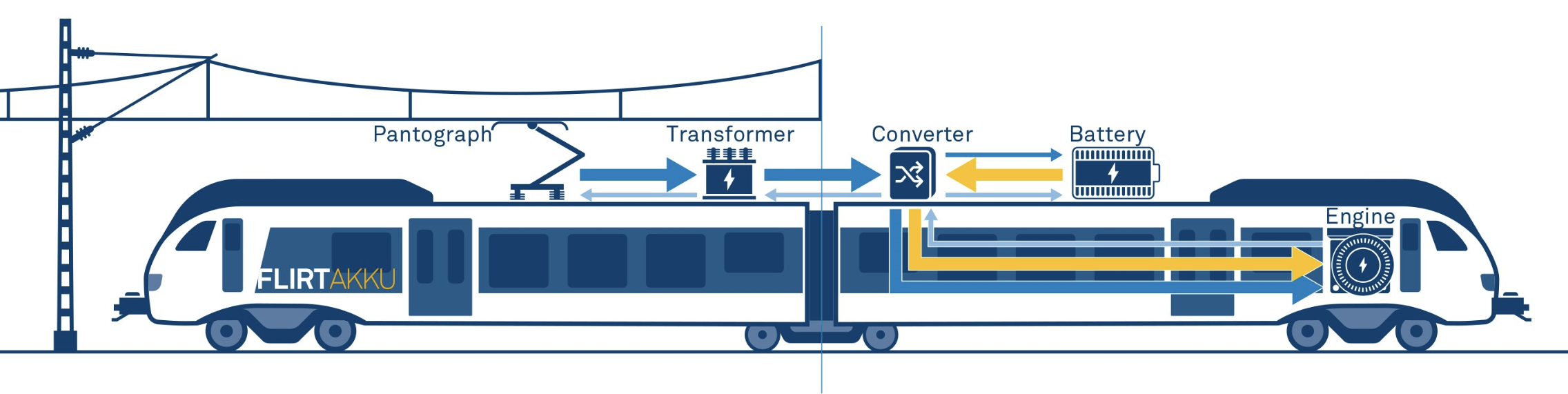
At a quick glance, the trains seem to be fairly similar, with the exception of the PowerPack.
- Both have regenerative braking.
- Both have the battery and the power converter on the roof.
- I would expect that the Flirt-H2 could be fitted with a pantograph and a transformer.
- Both trains have two passenger carriages.
I also suspect, both trains can be lengthened by adding extra coaches.
These are my thoughts.
Thoughts On The PowerPack In A Flirt-H2
This picture shows the PowerPark car of a Class 755 train.

Note.
- These PowerPacks have slots for up to four 480 Kw diesel engines.
- PowerPacks on a Class 788/4 train with four diesel engines weighs 27.9 tonnes.
- PowerPacks on a Class 788/3 train has two diesel engines.
- In the UK, trains with PowerPacks have up to four passenger cars.
- The PowerPack has a walkway from one end of the car to the other.
As customers, might like to replace their diesel PowerPacks, with something that was zero-carbon, I would expect, that the hydrogen PowerPack would have the following properties.
- Hydrogen and diesel PowerPacks would be interchangeable.
- The hydrogen PowerPack would come in two handy sizes of hydrogen fuel cell; 0ne and two MW.
- The weight of both hydrogen and diesel PowerPacks would be similar, as if power and weight were similar, then this could help certification.
- The Flirt-H2 for California, which would only have two passenger cars, would have the smaller hydrogen fuel cell.
I would expect that a conservative designer would use any spare space for hydrogen storage.
- Perhaps, there would be one tank either side of the walkway.
- The quoted range of 450 kilometres for the Flirt-H2 is just under 300 miles, so it would probably cover most regional round trips in Europe without refuelling.
- On many routes refuelling would only need to be done once-per-day.
- Refuelling can be some distance from operation.
- Large tanks would explain the thirty minutes refuelling time.
Obviously, large tanks have the collateral benefit of setting distance records.
The Kinetic Energy Of A Flirt-H2 Train
In My First Rides In A Class 755 Train, I calculated the kinetic energy of a Class 755/4 train.
I said this.
I will use my standard calculation.
The basic train weight is 114.3 tonnes.
If each of the 229 passengers weighs 90 kg with Baggage, bikes and buggies, this gives a passenger weight of 20.34 tonnes.
This gives a total weight of 134.64 tonnes.
Using Omni’s Kinetic Energy Calculator gives these figures for the Kinetic energy.
- 60 mph – 13.5 kWh
- 100 mph – 37.4 kWh
- 125 mph – 58.4 kWh
If we are talking about the Greater Anglia Class 755 train, which will be limited to 100 mph, this leads me to believe, that by replacing one diesel engine with a plug compatible battery of sufficient size, the following is possible.
- On all routes, regenerative braking will be available under both diesel and electric power.
- Some shorter routes could be run on battery power, with charging using existing electrification.
- Depot and other short movements could be performed under battery power.
The South Wales Metro has already ordered tri-mode Flirts, that look like Class 755 trains.
The calculation for a Flirt-H2 train is as follows.
Train Weight – 82.3 tonnes
Passenger Weight – 10.4 tonnes
Total Weight – 92.7 tonnes
This gives these kinetic energies
- 60 mph – 9.3 kWh
- 79 mph – 16.0 kWh
- 100 mph – 25.7 kWh
It looks like the 79 mph; Flirt-H2 would only need a 16 KWh battery.
It seems when a battery is not for traction and only handles the regenerative braking, it can be surprisingly small.
Mathematical Advantages Of Hydrogen
I do wonder that on balance, there may be mathematical advantages to hydrogen; long range, less frequent refuelling and small batteries.
But as I indicated in Zillertalbahn Hydrogen Plan Dropped In Favour Of Battery Traction, the decision doesn’t always go hydrogen’s way!
Conclusion
I feel Stadler have the right approach of a modular concept that incorporates both hydrogen-powered and battery-electric trains.
I also think, if you have a route, you want to decarbonise, Stadler have the train for you.
Zillertalbahn Hydrogen Plan Dropped In Favour Of Battery Traction
The title of this post, is the same as that of this article on Railway Gazette.
I wrote about this order in Zillertalbahn Orders Stadler Hydrogen-Powered Trains.
I didn’t blog about it but I remembered an article a few years ago about Stadler getting an order from the Zillertalbahn.
It appears the change is down to improvements in battery technology.
Narrow-gauge battery-electric multiple units must be right up Stadler’s street, as they built the new trains for the narrow gauge Glasgow Subway.
Waterbeach Station To Be Relocated
The title of this post, is the same as that of this article on Railway Gazette.
These three paragraphs, outline the project.
Cambridgeshire County Council has called tenders for an estimated £35m design and build contract for the relocation of Waterbeach station to a new site further to the north.
This would support the Waterbeach New Town development of 4 500 homes. Opening is now envisaged for 2026.
The replacement station would have two platforms, an accessible footbridge, a 200-space car park, taxi and bus drop-off, cycle storage and a new access road from Cody Road. The 24-month scheme would include the demolition of the existing station.
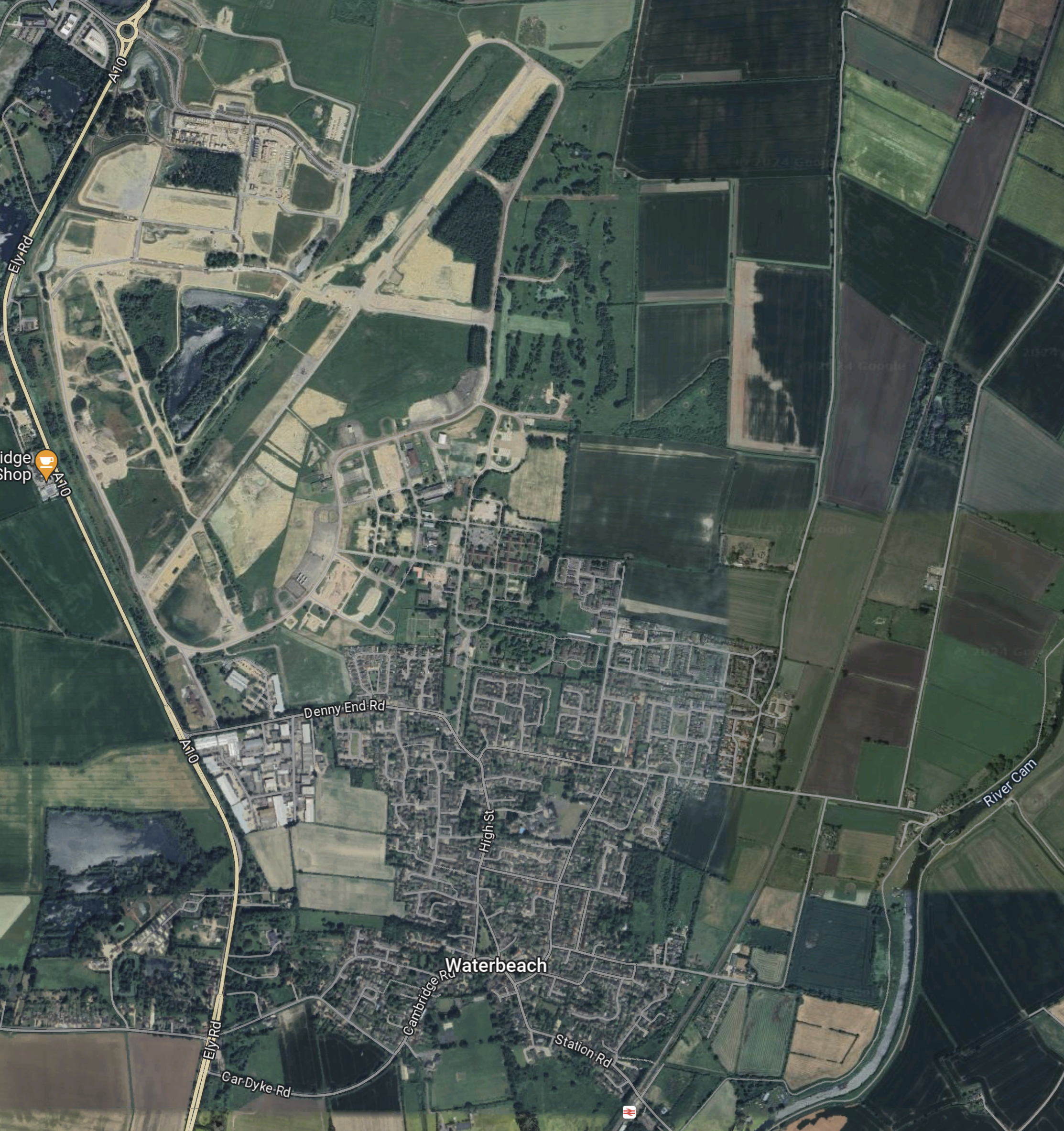
This Google Map shows the current station and the location of Waterbeach New Town.
Note.
Waterbeach station is at the bottom of the map, just to the right of centre.
- The station is on the Breckland Line between Cambridge and Norwich via Ely.
- The Breckland Line continues North-East to the North-East corner of the map.
- The village of Waterbeach is to the North of the station.
- North of Waterbeach is the old Waterbeach Airfield, which will be covered in the housing of the New Town.
Moving the station nearer the New Town would seem to be a sensible action.
I have some further thoughts.
The Remodelling Of Ely
Ely station is a railway bottleneck and in Are The Trains In Ely Finally To Be Sorted?, I discussed what needed to be done.
Would it help, if Waterbeach station were to be rebuilt first?
A Cambridge Metro
Once Waterbeach station has been rebuilt and Cambridge South station has been built, there will be a run of stations through Cambridge.
- Ely
- Waterbeach
- Cambridge North
- Cambridge
- Cambridge South
Perhaps, extra trains could be added to create a frequent rail route across Cambridge.
East West Railway
Will the trains of the East West Railway stop at Waterbeach station?
Conclusion
Waterbeach could be a very useful and busy station.
I Was Kathleened At The Weekend
Saturday
At 0200 on Saturday morning, I couldn’t sleep.
So in the end, I got up, made myself a mug of tea and did Saturday’s puzzles in The Times.
I had no trouble doing them, so my brain function was normal.
But my left hand wasn’t working that well.
I had breakfast in Leon and had a bit of trouble with their sauce containers, but otherwise I was fine.
I did a bit of shopping in M & S on Moorgate and came home.
I wasn’t having any problems.
For the rest of the day, I watched television and listened to the radio.
Sunday
I got up late, as I was probably catching up the sleep from the night before.
I had lunch in Gordon Ramsey’s Street Burger about one.
My left hand wasn’t working that well and I was making a bit of a mess.
After, I got home, I watched television and listened to the radio.
Monday
I slept in late, but as my left hand wasn’t being very co-operative, I had a small bit of trouble dressing, due to an uncooperative left hand.
My INR was 2.0, so I took 5 mg. of Warfarin.
I had breakfast in Leon, where I made a mess with the sauce container.
I then went looking for a book, which I couldn’t find.
Tuesday
Everything seems better today.
My INR was 2.1, so I took 5 mg. of Warfarin.
I did my usual Monday morning trip, of visit to Marks & Spencer for about three days of food and then had breakfast in Leon.
Conclusion
This seems to be a pattern.
- A storm goes through, I can’t sleep and after some drinks of tea or zero alcohol beer, I feel a bit better.
- My left hand often stops co-operating and won’t do simple things.
- But it does seem to clear up, when the storm passes.
This is probably the third time, that it’s happened.
Note.
- My left humerus was broken by the school bully.
- I had a stroke in 2011, which affected my left arm.
- If I carry shopping in my left hand, the pulling action on my humerus seems to help.
Any ideas will be gratefully received.
 The Anonymous Widower