Very Light Rail Trial For Heathfield Branch?
The title of this post, is the same as that of an article in the May 2024 Edition of Modern Railways.
This is the first four paragraphs.
Investigations are ongoing as to whether the disused Heathfield branch line in Devon could be used as a test route for the Revolution Very Light Rail (RVLR) vehicle.
Heathfield Rail Link Association (HRLA) says a survey has been completed along the four-mile line from Newton Abbot, which was last used by timber trains in 2017 and hasn’t seen a regular passenger service since 1959.
The work, by Lampitt Rail, has been completed for Eversholt Rail, one of the firms behind RVLR, a hybrid vehicle, which aims to help reduce costs on existing branch lines and those earmarked for reopening.
A spokesman for Eversholt said the line is one of more than 200 potential opportunities for RVLR ahead for 2026, when it’s hoped tests will start on branch lines around the country using three new battery prototypes.
These are my thoughts and observations.
The Heathfield Branch
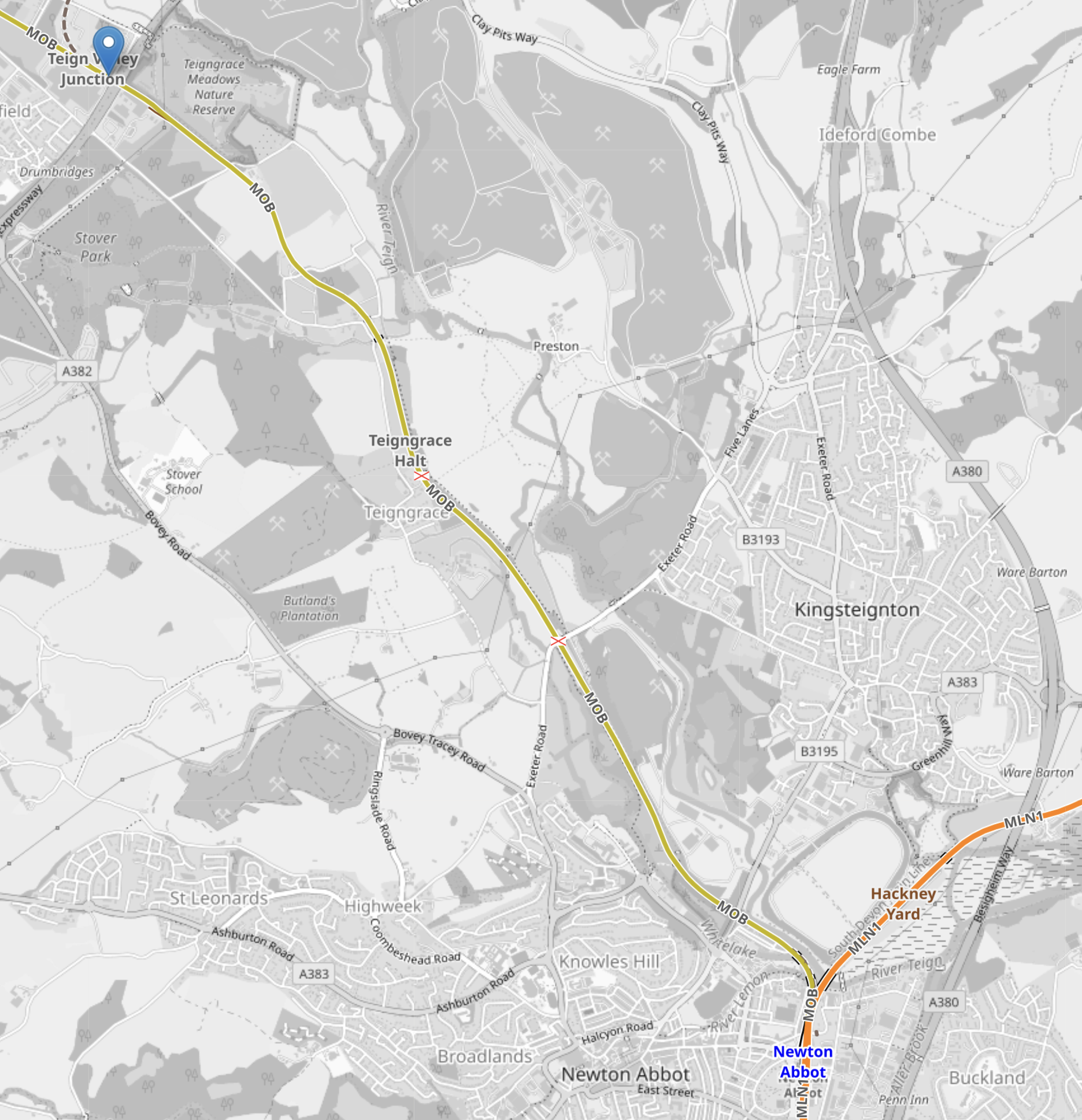
This OpenRailwayMap shows the Heathfield branch.
Note.
- The former site of Heathfield station is indicated by the blue arrow.
- The yellow track is the Heathfield branch.
- The orange track is the Cornwall Main Line, that goes through Newton Abbot station to Plymouth and Penzance stations.
This second OpenRailwayMap shows the track layout Newton Abbot station.
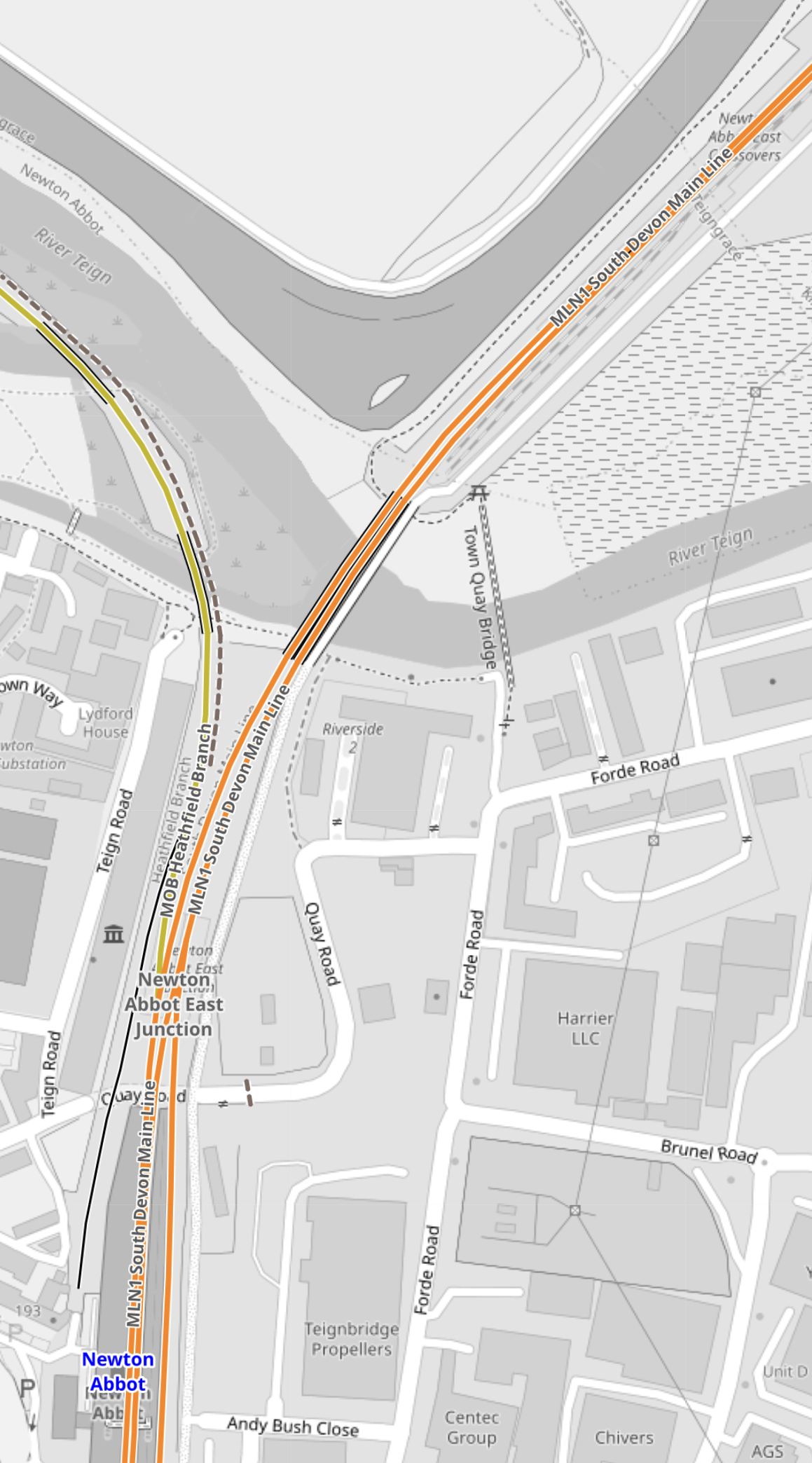
As there are three platforms, I suspect that matters can be arranged to turn an occasional train from the branch.
How Will The Revolution VLR Be Charged?
The Modern Railways article says this about charging.
Eversholt Rail and partner firm Transport Design International have stated they will build three new battery-powered vehicles for the 2026 tests, which will need rapid charging points, made up of two rails in-between the running lines which would contact a shoe hanging from the train. HRLA is working with UK Power Networks to find locations for these chargers, including at Newton Abbot.
It sounds very much like the Vivarail/GWR Fast Charge equipment.
What Will Be The Range Of The Revolution VLR?
The range of the Revolution VLR has not been stated.
But this is stated in the Modern Railways article.
Heathfield Rail Link Association (HRLA) says a survey has been completed along the four-mile line from Newton Abbot.
So will the train be able to do a round trip on one charge or just a single journey?
Or could this route be a strong possibility, as the Revolution VLR has the range to do a round trip on one charge?
Study Highlights Increased Risk Of Second Cancers Among Breast Cancer Survivors
The title of this post, is the same as that of this news story from the Cambridge University.
This is the sub-heading.
Survivors of breast cancer are at significantly higher risk of developing second cancers, including endometrial and ovarian cancer for women and prostate cancer for men, according to new research studying data from almost 600,000 patients in England.
These are the first three paragraphs of the story.
For the first time, the research has shown that this risk is higher in people living in areas of greater socioeconomic deprivation.
Breast cancer is the most commonly diagnosed cancer in the UK. Around 56,000 people in the UK are diagnosed each year, the vast majority (over 99%) of whom are women. Improvements in earlier diagnosis and in treatments mean that five year survival rates have been increasing over time, reaching 87% by 2017 in England.
People who survive breast cancer are at risk of second primary cancer, but until now the exact risk has been unclear. Previously published research suggested that women and men who survive breast cancer are at a 24% and 27% greater risk of a non-breast second primary cancer than the wider population respectively. There have been also suggestions that second primary cancer risks differ by the age at breast cancer diagnosis.
I have a few thoughts.
The Data
The story says this about the data.
To provide more accurate estimates, a team led by researchers at the University of Cambridge analysed data from over 580,000 female and over 3,500 male breast cancer survivors diagnosed between 1995 and 2019 using the National Cancer Registration Dataset. The results of their analysis are published today in Lancet Regional Health – Europe.
A large number of cases were analysed and with these types of analysis, more is definitely better.
I would hope that this study will be repeated in a few years, when more data is available.
The Death Of My Wife
This happened to my late wife.
At about 55 in 2004, my wife developed breast cancer. Strangely, it was in the same position, where a car air-bag had bruised her breast, when it went off in an accident, a few years before.
Chemotherapy was recommended and she tried one round at home, but she couldn’t get on with it.
So she eventually had a long course of radiotherapy in Harley Street going up every day on the train. She was also doing as many court cases as she could to pay for it all.
It appeared everything had worked well and in the Autumn of 2007, she was given the all clear for the breast cancer.
But in October 2007, she was diagnosed with a squamous cell carcinoma of the heart.
She died in December 2007 at just 59.
My wife’s second cancer and her death seems to fit the pattern of the patients in the news story.
My Wife’s Genetic Background
This is rather bare, as she was adopted. Although, I do have her plaits from, when the cut them off at 18, as she’d kept them and I found them after she died.
But she didn’t come from a deprived background.
I Am Coeliac
If I have one regret, it’s that I didn’t encourage her to go gluten-free after the first cancer.
It might have boosted her immune system to help.
Conclusion
Anybody, who has breast cancer must beware a second attack of cancer.
Uf it can kill my fit 59-year-old wife, it can kill anyone.
BW Ideol Unveils Mass Production-Ready Floating Wind Foundation
The title of this post, is the same as that of this article on offshoreWIND.biz.
This is the sub-heading.
France-based BW Ideol has unveiled its standardised floating foundation product and a blueprint for mass production that could drive costs down across projects.
This is the first paragraph.
With over 22 GW already awarded in Scotland, around 8 GW in the US, and several GW currently being awarded or in the tendering phase elsewhere in the world, the floating wind is now entering an industrialization phase, said BW Ideol.
It looks like the French have come up with a solution that’s needed.
These are previous posts about BW Ideol.
- BW Ideol And Holcim To Explore Use of Low-Carbon Concrete In Floating Offshore Wind
- BW Ideol, ABP To Explore Serial Production Of Floating Wind Foundations At Port Talbot
There is also this video of proposed serial production of BW Ideol floaters at the Port of Ardersier.
This Google Map show the area of Scotland to the North-East of Inverness Airport.

Note.
- Inverness Airport indicated by the red arrow.
- Ardersier village in the middle of the map on the bay.
- Fort George is at the North end of the bay.
The Port of Ardersier is the large slab of concrete in the North-East corner of the map, the Carse of Ardersier marked below it.
BW Ideol are claimining they can build one floater a week or one GW a year.
Wrightbus Secures Further German Order For 46 Hydrogen Buses
The title of this post, is the same as that of this press release from Wrightbus.
These paragraphs outline the deal.
World-beating zero-emission bus manufacturer Wrightbus today announced a milestone deal to provide 46 hydrogen buses to Germany – taking a demo bus from Belfast to showcase its reliability and range.
The buses ordered by Cottbusverkehr GmbH will serve the city of Cottbus, the second largest city in the state of Brandenburg, and and in the western part of the district of Spree-Neiße.
It follows a landmark announcement by the German government to implement a €350 million scheme to support the production of renewable hydrogen.
Wrightbus is Europe’s fastest-growing bus manufacturer and follows the company’s rapid rise since it was bought out of administration in 2019. It was named Northern Ireland’s fastest-growing company by Growth Index this week – employing 1,650 people and producing 22 buses a week.
The Cottbus order for the Kite Hydroliner buses follow deals in Germany with West Verkehr, Regionalverkehr Köln GmbH (RVK), and Saarbahn GmbH, with more European orders in the pipeline.
If Northern Irish hydrogen buses are selling well to the Germans, why are there so few in the UK.
These pictures show the UK version of the German buses in Crawley.





They are excellent buses.
 The Anonymous Widower