Redevelopment Of Scottish Port Begins As Owner Secures GBP 400 Million For Offshore Wind Upgrade
The title of this post, is the same as that of this article on offshoreWIND.biz.
This is the sub-heading.
Haventus, the owner of the Ardersier Port in the Moray Firth, Scotland, has taken a final investment decision and kicked off construction work on redeveloping the port to serve both fixed-bottom and floating offshore wind projects. The revamped port is expected to open in the second half of 2025.
These are the first two paragraphs.
This month, Haventus was granted a GBP 100 million (approximately 117 million) joint credit facility from the Scottish National Investment Bank and UK Infrastructure Bank with GBP 50 million (approx. EUR 58.5 million) investment from each.
This follows a GBP 300 million (approx. 351 million) investment commitment by the energy investment firm Quantum Capital Group in 2023 when Haventus began the redevelopment of Ardersier Port.
This page on the Haventus web site, gives more details of the Port of Ardersier.
Included are.
- Access channel width – 160 m.
- Access channel depth – 12.4 m.
- Landside area – 350 acres.
- 420m main quay.
- 80 m Ro/Ro capable berth.
- People-friendly midges
- Green Freeport tax site designation
- More space is available if required.
There is also an informative video.
Haventus say they are delivering a world-leading energy transition facility. I can go along with that!
These are my thoughts.
The Location Of The Port of Ardersier
This Google Map shows the location of the Port of Ardersier.
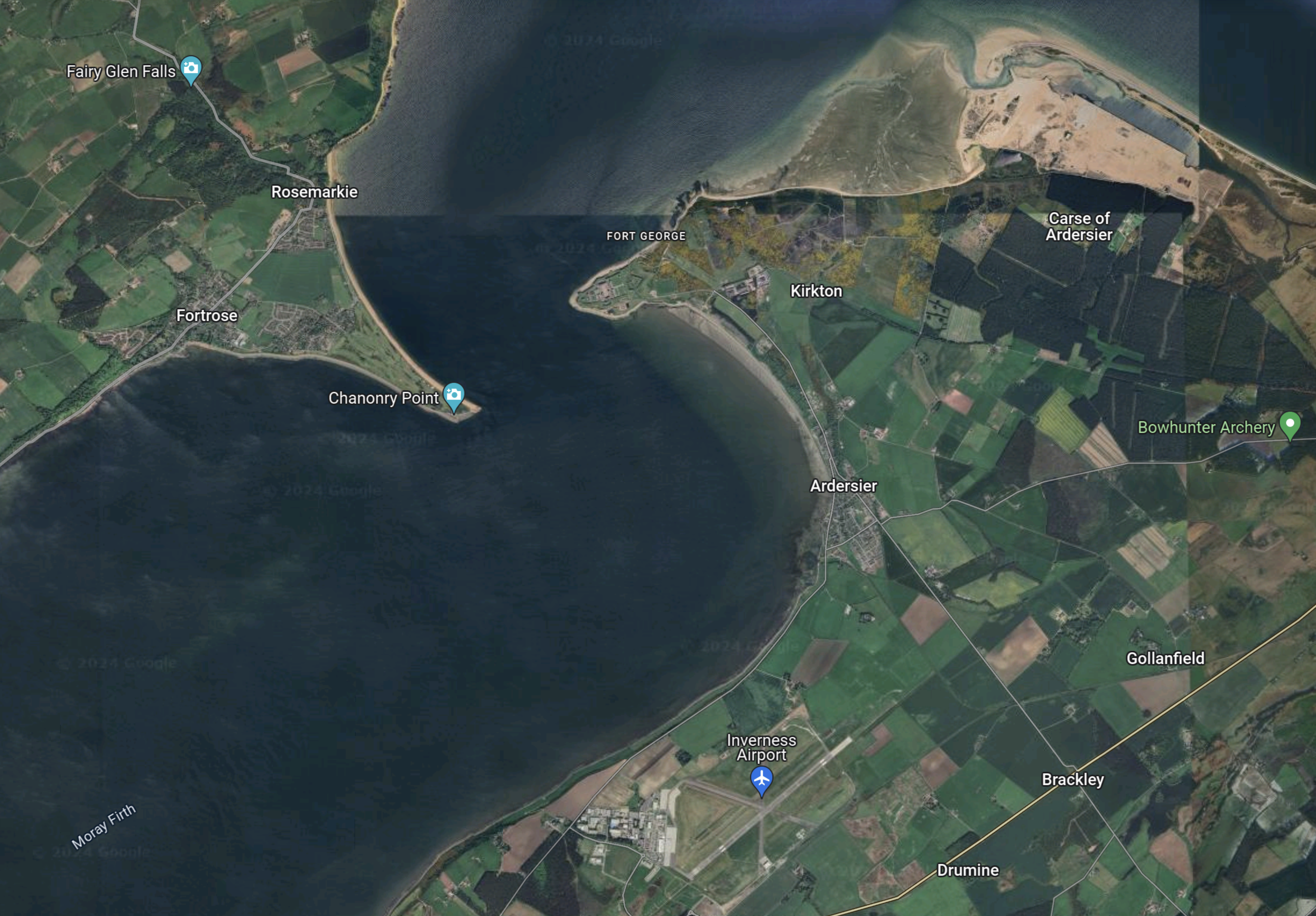
Note.
- The large expanse of water in the middle of the map is Moray Firth.
- The blue arrow at the bottom of the map indicates Inverness Airport.
- Inverness Airport, has a railway station on the Aberdeen and Inverness Line.
- The village of Ardersier is on the the Eastern bank of the Moray Firth
- The Port of Ardersier is in the North-East corner of the map.
The city of Inverness, with a population of around 48,000, is a few miles South-West of the South-West corner of the map.
Which Windfarms Will Be Built And Serviced From The Port Of Ardersier?
This map shows the various ScotWind leases, around the North of Scotland.

The numbers are Scotwind’s lease number in their documents.
These are the Scotwind wind farms to the North-East of Scotland, that could reasonably be assumed to be built and served from the Port of Ardersier.
- 7 – DEME Concessions Wind – 200 km² – 1.0 GW – Floating
- 8 – Falck Renewables Wind – 256 km² – 1.0 GW – Floating
- 9 – Ocean Winds – 429 km² – 1.0 GW – Fixed
- 10 – Falck Renewables Wind – 134 km² – 0.5 GW – Floating
- 11 – Scottish Power Renewables – 684 km² – 3.0 GW – Floating
- 12 – BayWa r.e. UK – 330 km² – 1.0 GW – Floating
These are the Scotwind wind farms to the North-West of Scotland, that could reasonably be assumed to be built and served from the Port of Ardersier.
- 13 – Offshore Wind Power – 657 km² – 2.0 GW – Fixed or Floating
- 14 – Northland Power – 390 km² – 1.5 GW – Floating
- 15 – Magnora – 103 km² – 0.5 GW – Floating
- 16 – Northland Power – 161 km² – 0.8 GW – Floating
These ten wind farms add up to 12.3 GW.
Transport
Consider.
- Obviously, heavy components will be brought in by sea, using the Ro/Ro capable berth or using a crane to unload a barge.
- Personnel will be able to fly in for the day.
- Will some visitors rom London use the Caledonian Sleeper to and from Inverness station to get a full day on site and a good night’s sleep, whilst travelling.
But I do see a problem with local traffic to and from the site.
Hydrogen Buses
This page on the Sizewell C web site, discusses how they will use hydrogen buses.
I could see the Port of Ardersier taking a leaf out of Sizewell C’s book and run hydrogen buses to Inverness, Inverness Airport and other nearby towns.
The North of Scotland certainly won’t be short of green hydrogen to power the buses.
Hydrogen
Conclusion
If you thought that the only useful wind-driven thing to come out of Scotland was bagpipes, you had better think again.
The Port of Ardersier will be the factory and operation and maintenance port for one of the largest offshore wind industries in the world.
Dr. David Owen And The NHS Infected Blood Scandal
I am writing this post, mainly using Dr. David Owen’s Wikipedia entry.
This paragraph describes Dr. Owen’s early days as a minister in Harold Wilson’s first government and the early days of Harold Wilson’s second government
From 1968 to 1970, Owen served as Parliamentary Under Secretary of State for the Navy in Harold Wilson’s first government. After Labour’s defeat in the 1970 general election, he became the party’s Junior Defence Spokesman until 1972 when he resigned with Roy Jenkins over Labour’s opposition to the European Community. On Labour’s return to government in March 1974, he became Parliamentary Under-Secretary for Health before being promoted to Minister of State for Health in July 1974.
There is also this paragraph describing his involvement as Minister of State for Health in the NHS Infected Blood Scandal.
As Minister of State for Health he encouraged Britain to become “self-sufficient” in blood products such as Factor VIII, a recommendation also promoted by the World Health Organisation. This was principally due to the risk of Hepatitis infection from high-risk blood donors overseas who were often paid and from “skid-row” locations. David Owen has been outspoken that his policy of “Self-Sufficiency” was not put into place (although he was, himself, Minister of Health) and gave rise to the Tainted Blood Scandal which saw 5,000 British Haemophiliacs infected with Hepatitis C, 1,200 of those were also infected with HIV. It was later described in the House of Lords as “the worst treatment disaster in the history of the National Health Service”.
So why did Dr. Owen’s and the World Health Organisation’s view of making the UK “self-sufficient” in blood products such as Factor VIII not prevail?
Did Sir Brian Langstaff and his team go through minutes of cabinet meetings, when Dr. David Owen was Minister of State for Health?
Did Harold Wilson or the Chancellor; Denis Healey overrule David Owen’s view, as they needed what little money we had for other purposes?
I must admit, that if I had been in Dr. Owen’s position in 1974 and the Government were proposing to something against, my engineering experience, I would have resigned. Note that Dr. Owen did resign in 1972, over Labour’s opposition to the European Community.
If any doctors are reading this, who were qualified at the time, I’d like to hear their views.
Conclusion
One way to ascertain the truth, would be to charge Dr. Owen with something serious and led the Law decide.
 The Anonymous Widower