Zenobē Lands Financing For 400MW Eccles Project
The title of this post, is the same as that of this article on Solar Power Portal.
This is the sub-heading.
Battery energy storage system (BESS) developer/operator Zenobē has announced that it has successfully financed its Eccles BESS project in Scotland, in one of the biggest finance rounds in European history.
These two paragraphs add more details.
The total debt raised for the 400MW/800MWh project was £220 million, which the company says is one of the largest finance raises for a standalone BESS project ever made in Europe. The funding was provided by a group of lenders organised by National Westminster Bank and KKR Capital Markets Partners LLP. Additionally, Zenobē has announced that construction on the Eccles BESS—the company’s largest battery project to date—has begun.
The Eccles BESS is the final part of the firm’s £750 million investment in Scotland. Zenobē’s Blackhillock BESS, a 200MW/400MWh project located near Inverness, recently began commercial operations, and is set to expand to 300MW/600MWh later this year.
Zenobe seem to be able to finance these projects, without too much difficulty.
Construction seems to have started. But then, I suspect there are wind turbines in the vScottish Borders already lined up to use the batteries.
This Google Map shows an Eccles substation.
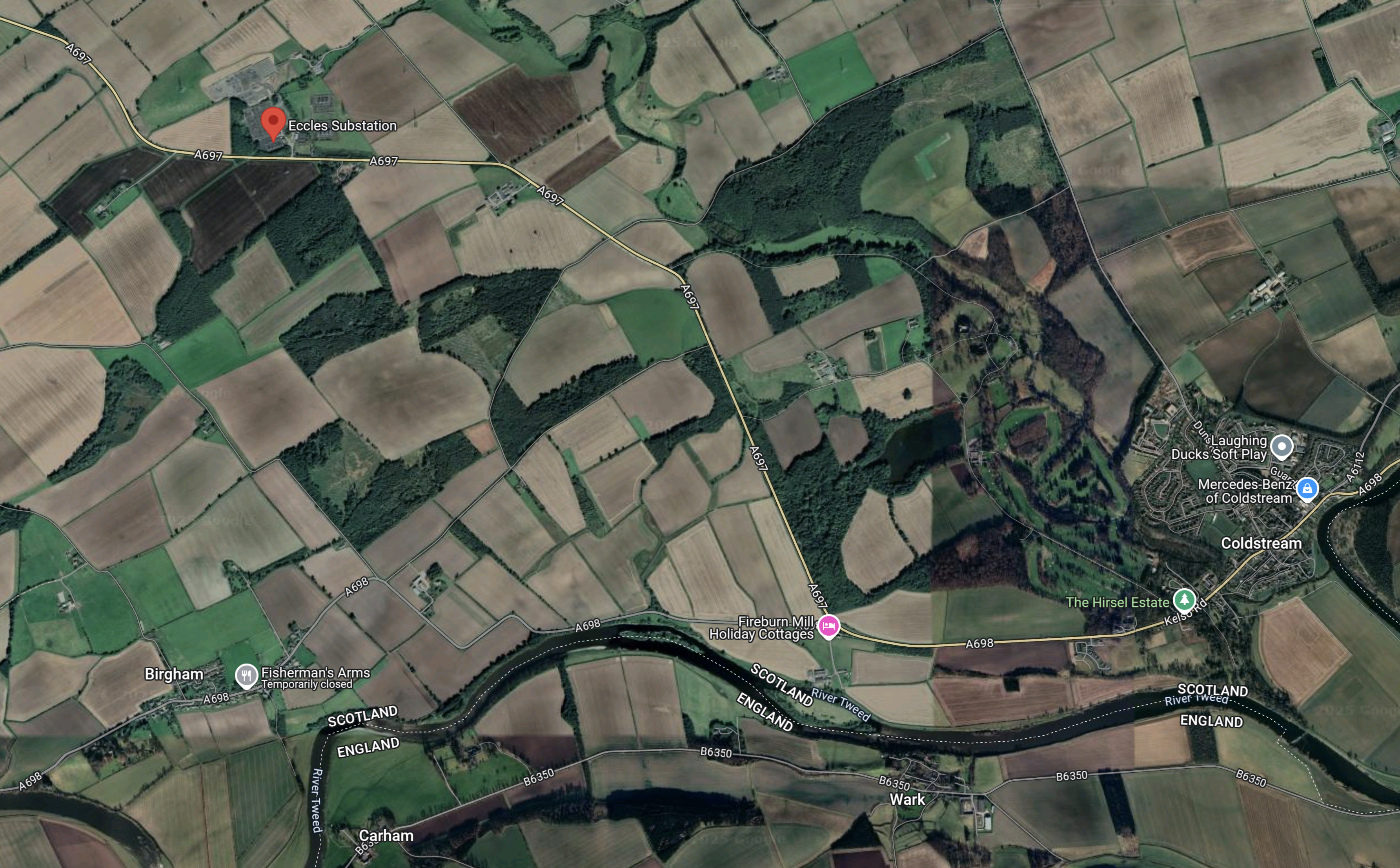
Note.
- The Eccles substation is marked by the red arrow.
- The town at the East edge of the map is Coldstream.
- The England-Scotland border is clearly marked.
This second Google Map shows a closer view of the Eccles substation.
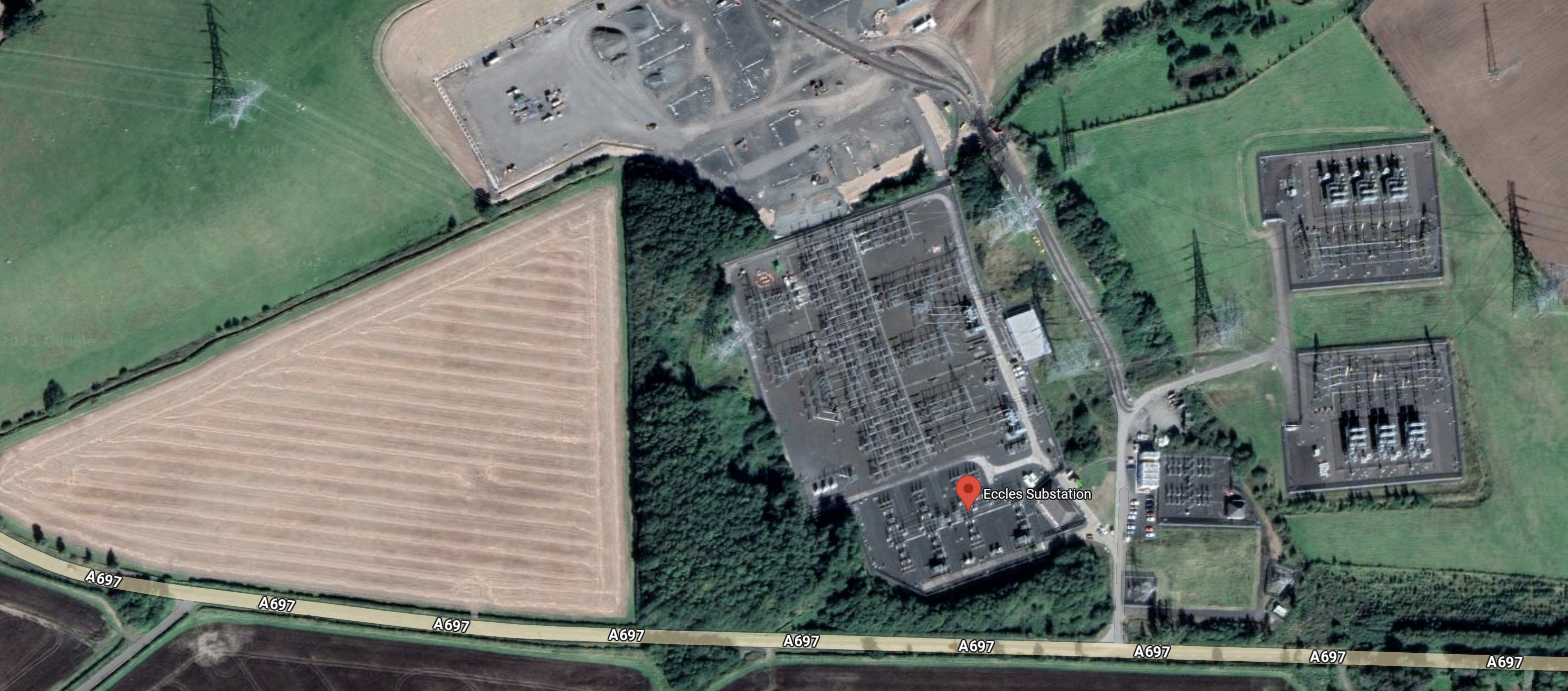
Note.
- t looks to be a substantial substation.
- There would appear to be plenty of space for a large battery.
- It is close to the A 597 road for the delivery of heavy equipment.
I suspect this substation could be the location of the battery.
It’s also right in the heart of Scottish onshore wind territory.
It is also according to the Solar Power Portal a £220 million project.
A project of this size will deliver substantial benefits in terms of work to the local community.
It will likely have a community benefit fund or something similar.
So you would expect the project would be welcomed into the local area.
But you would be wrong, if this article on the BBC, which is entitled Village ‘Heart Ripped Out’ By Battery Site Plans, is typical of the feeling about the batteries.
This is the sub-heading.
A rural community in the Borders is warning that Scotland’s renewable energy revolution is coming at a cost.
These three paragraphs add more detail.
Residents of Leitholm – a village between Coldstream and Greenlaw – claim the heart is being ripped out of their community with the arrival of battery storage facilities.
If all six proposed facilities are approved, more than 200 acres of farmland will be turned over to concreted compounds within a three-kilometre radius of their village.
Retired nursery owner Seonaid Blackie said: “This is not the place it used to be – people are worried sick.”
The residents view is balanced by industry expert Professor John Irvine, from St Andrew’s University, believes energy storage has a vital role to play in reaching net-zero targets.
My view is what is needed is an energy storage system, that can be built substantially underground.
If you look at large Battery Energy Storage Systems (BESS), they are best described as container parks.
We need energy storage systems, that fit in a single tennis court, rather than thirty football pitches.
Gravitricity is one possibility, who are also Scottish, who store energy using weights in disused mine shafts.
The French system; DELPHY is also a vertical system for storing hydrogen in a custom-built hole.
Practically, I believe the solution adopted will be to spread the batteries out and spend money on surrounding them with trees and other camouflage.
SSE And Gilkes Energy Submit Plans For Pumped Hydro Storage Project
The title of this post, is the same of this article in Solar Power Portal.
This is the sub-heading.
SSE Renewables and Gilkes energy have submitted a planning consent application to Scottish Ministers for a proposed Pumped Storage Hydro (PSH) project.
These two paragraphs add more detail.
The Fearna PSH project is proposed as a 50:50 joint venture project between SSE and Gilkes Energy, with Gilkes Energy leading the development under a developer services agreement with SSE Renewables. The scheme will have an installed capacity of 1.8GW and a stored capacity of up to 36GWh, providing 20 hours of storage. If approved, the project would be the largest pumped hydro scheme in the UK.
The proposed site is located around 25km from Invergarry in the Scottish Highlands and adjoins SSE Renewables’ existing Loch Quoich reservoir, which forms part of the Great Glen hydro scheme. The development will include the construction of tunnels and a new power station that will connect the existing Loch Quoich reservoir to an upper reservoir at Loch Fearna.
This Google Map shows the location of Invergarry and Loch Quoich.

Note.
Loch Quoich is the dolphin-shaped loch at the West of the image.
Invergarry is indicated by the red dot at the East of the image.
This second Google Map shows the location of Loch Fearna to the North-East of Loch Quoich.
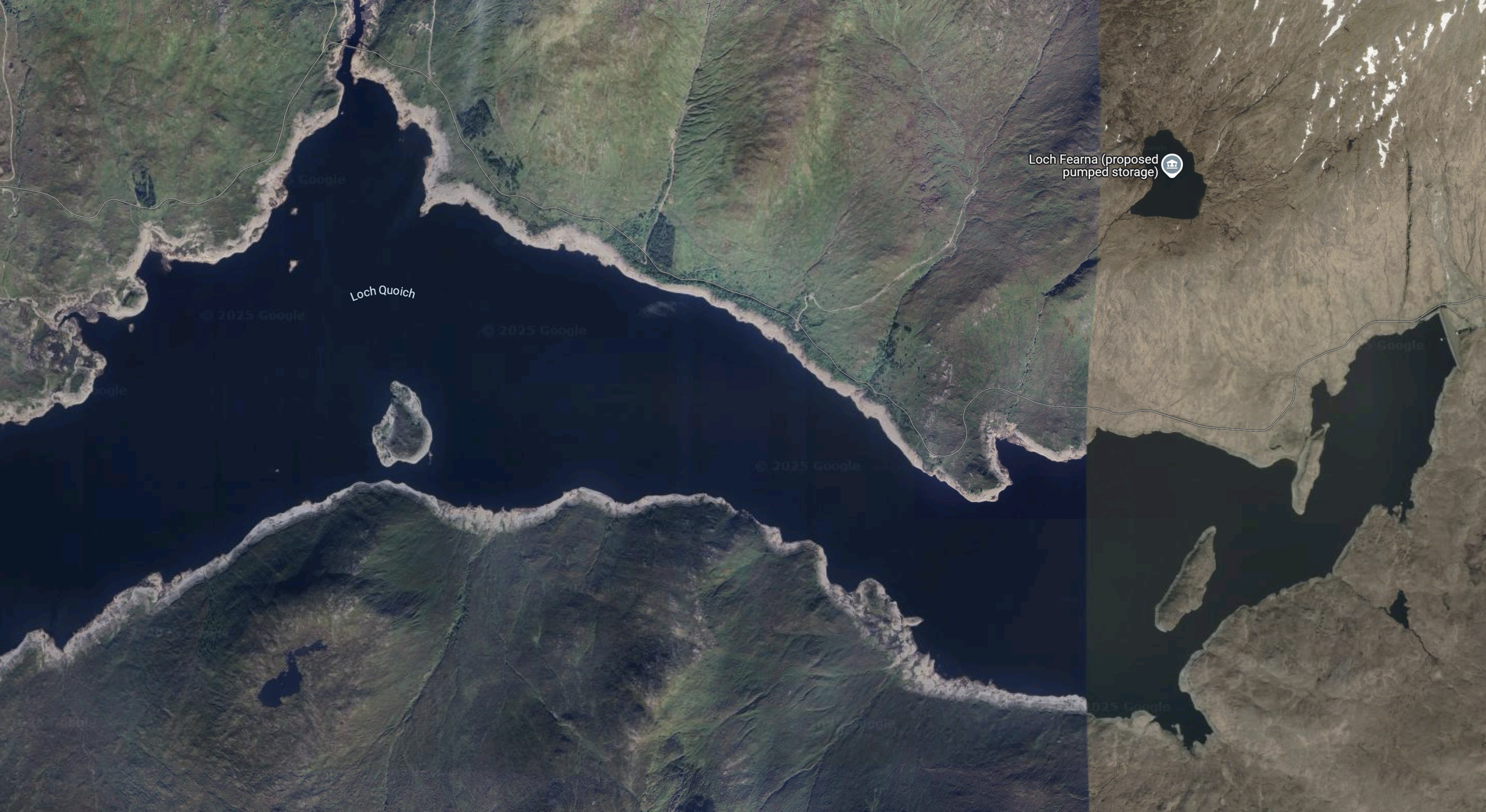
These are my thoughts.
It Will Be A Large Scheme
With an installed capacity of 1.8GW and a stored capacity of up to 36GWh, providing 20 hours of storage, this is not a small scheme.
Wikipedia’s Description Of Loch Quoich
This is the first two paragraphs of the Wikipedia entry for Loch Quoich.
Loch Quoich (Scottish Gaelic: Loch Chuaich) is a loch and reservoir situated west of Loch Garry approximately 40 km northwest of Fort William, Lochaber, Scotland. The name means “loch of the quaich”. In 1896, it was listed as six miles long and three-quarters of a mile in width, belonging to Mrs. Ellice of Glenquoich, within the parish of Kilmonivaig.
Both lochs form part of the Glen Garry hydroelectricity project commissioned by the North of Scotland Hydro-Electric Board in the 1950s.
So is the Loch Fearna scheme, a massive repurposing of the existing Glen Garry hydroelectricity project?
I wrote about this before in Repurposing The Great Glen Hydro-Electric Scheme?
This map from the SSE Renewables web site shows the layout of the dams and power stations between Loch Quoich and Invergarry..
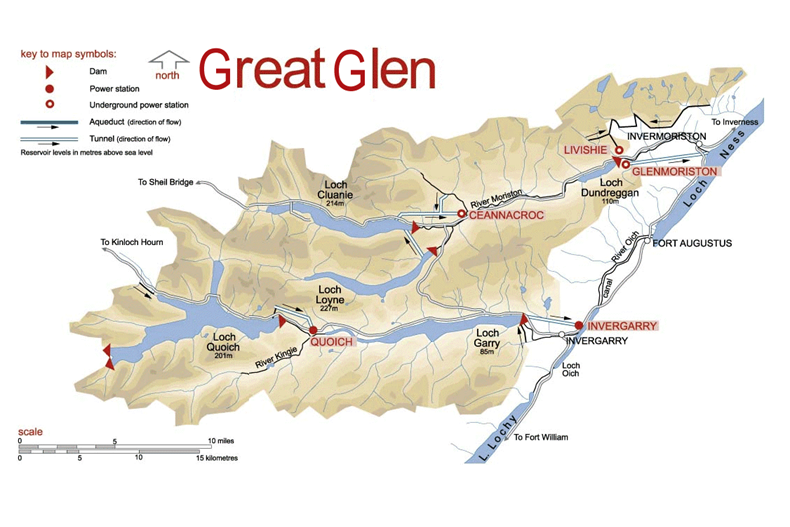
The sizes of the power stations in the scheme are as follows.
- Ceannacroc – 20 MW
- Livishie – 15 MW
- Glenmoriston- 37 MW
- Quoich – 18 MW
- Invergarry – 20 MW
- Mucomir – 1.7 MW
This gives a total power of 112.7 MW.
112.7 MW to 1.8 GW (1800 MW) is a colossal increase in power.
It should be noted that 1.8 GW is half the power of Hinckley Point C nuclear power station.
 The Anonymous Widower