Government Pauses Midland Main Line Electrification
This is the first paragraph of this article on Modern Railways.
The Government has paused the third phase of Midland main line electrification to Sheffield and Nottingham, plus the final phase of the South West Rail Resilience Programme (SWRRP), which involves strengthening cliffs at Holcombe.
Currently, the Midland Main Line electrification appears to have been installed between London St. Pancras and Wigston, where there is a triangular junction.
This article on Modern Railways is entitled MML Wires To Wigston energised, says this in the first paragraph.
A major milestones on the Midland Main Line has been achieved with the energisation of the newly installed overhead wires between Kettering and Wigston and the first trip for a new East Midlands Railway Aurora bi-mode unit to St Pancras.
This OpenRailwayMap shows the Midland Main Line between Leicester station and Wigston junction.
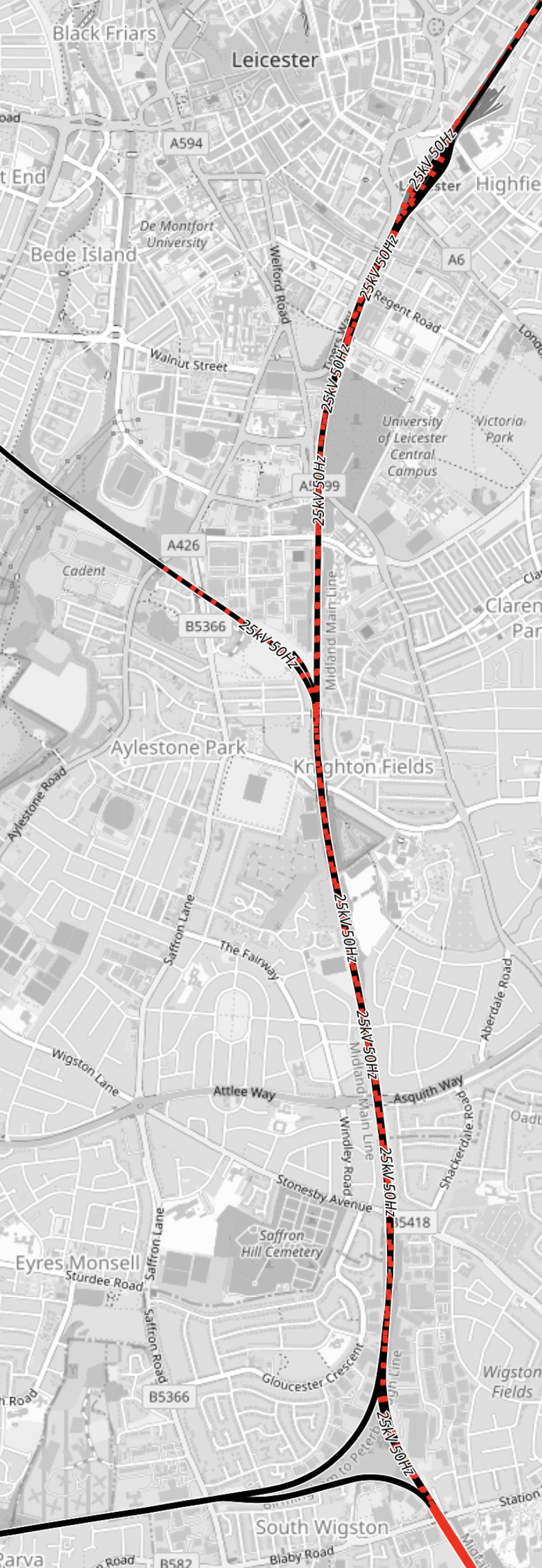
Note.
- Red tracks are electrified.
- Black tracks are not electrified.
- Black/red dashed tracked are being electrified.
- Wigston junction is at the bottom of the map.
- The red track indicates that the South of the junction is electrified.
- The North of the junction is now electrified according to the Modern Railways article.
- The West of the junction is not electrified and leads to the electrified Trent Valley Line at Nuneaton.
- The junction in the middle of the map is Knighton junction, that leads to Burton-on-Trent station.
- In the North-East corner of the map is Leicester station.
Distances from the electrified part of Wigston junction are as follows.
- Derby – 32.5 miles
- Leeds – 107.8 miles
- Leicester – 13.1 miles
- Nottingham – 30.5 miles
- Nuneaton – 15.6 miles
- Sheffield – 68.9 miles
I asked Google AI how far one of Hitachi’s Class 802 trains had gone during tests and got this reply.
A Class 802 train, when operating solely on battery power, can achieve a range of approximately 44 miles (70 km). This was demonstrated in a trial where a five-car Class 802/2 train reached a maximum speed of 87 mph using battery power alone, covering non-electrified sections. Hitachi Rail and Angel Trains are conducting trials to assess the viability of battery technology for longer distances and to reduce reliance on diesel power on non-electrified sections of routes.
Hitachi’s tests were performed with just one diesel engine replaced by a battery pack and it should be born in mind, that the Class 810 trains, that will be used on the Midland Main Line have four diesel engines.
As an electrical engineer, I feel battery range should be additive, so a three-battery train could have a range as much as 120 miles.
- This range would do nicely for a London and Leeds service, as Leeds station is fully-electrified to charge a train for return.
- As London and Sheffield return would be 137.8 miles, a charge at Sheffield would probably be needed to top-up the batteries.
On the other hand a two-battery and two-diesel unit, would have a battery range sufficient for the following services.
- London and Derby and return.
- London and Nottingham and return.
- London and Sheffield with return after a charge.
- London and Leeds with an intermediate charge at Sheffield.
We live in very electrifying times.
I am sure, that Hitachi and their battery-makers will find a solution to run all-electric services to the North of Wigston junction, without full electrification, but with just a charger at Sheffield.
The Electrification Problem At Leicester
Some years ago I came back to London from Leicester with a group of drivers. At one point, the conversation turned to electrification and they said that they had met a Network Rail engineer, who had told them, that the bridge was rather low for electrification and the track couldn’t be lowered because Leicester’s main sewer was underneath the railway.
In Leicester Station – 4th Jan 2022, I show a selection of pictures of Leicester station’s Grade II Listed frontage.
I doubt it would be possible to seriously alter Leicester station to electrify it, as the Heritage Taliban would have a field day.
But if I’m right that all services will be run North of Wigston on batteries, there will be no need to electrify through Leicester station.
Not only would using batter-electric trains probably be more affordable than electrification, but also because of the Leicester problem, it would be less inconvenient for passengers.
Could London and Leicester Be Run In An Hour Or Even Less?
Consider.
- The London and Sheffield services, which go non-stop between London and Leicester take around 64-66 minutes.
- The London and Nottingham services, which stop at Market Harborough take about 5-6 minutes longer.
- London and Leicester is 98.9 miles.
- The fastest trains average 93 mph between London and Leicester.
- Much of the route between London and Leicester has a maximum speed of 100 mph or more, with some sections of 125 mph running.
- Regenerative braking should reduce the time for the Market Harborough stop.
I can certainly see the non-stop Sheffield services being timed at under an hour between London and Leicester.
But I wouldn’t rule out all services between London and Leicester being timed at under an hour.
Could London and Sheffield Be Run In Two Hours Or Even Less?
Given that most services between London and Sheffield take two hours and four minutes and I reckon six minutes could be saved between London and Leicester, I suspect two hours or less is a very attainable target for London and Sheffield services.
Why Not Fit Four Batteries And Be Done With it?
I suspect it will be down to reliability and whether running the diesels on hydrotreated vegeatble oil is acceptable to some politicians.
Would This Be The World’s First Battery-Electric Main Line With 200 kph Running?
Quite possibly!
Conclusion
I can see no disadvantage in not electrifying North of Wigston junction and using battery-electric trains.
It could even be a lot more affordable.
New Rail Station For Mid Devon
The title of this post, is the same as that of this article on Exeter Today.
These are the first two paragraphs.
Devon is set to benefit from a major transport funding boost as the Government today confirmed plans for a new railway station in Cullompton and approved a long-awaited upgrade to the A382 between Drumbridges and Newton Abbot.
The announcement, part of a £92 billion national transport investment programme, includes over £47 million to reinstate passenger services between Portishead and Bristol — and, crucially for Devon, two brand-new stations along the Exeter to Taunton line, one of which will be in Cullompton.
It does appear, that according to its Wikipedia entry, Collumpton station has been a bit on-and-off.
In the October 2021 budget, development funding of £5m was allocated for the reopening of Wellington and Cullompton stations. However, in 2024 the Minister of State for Rail, Peter Hendy, stated that the proposed reopening of Cullompton station would no longer be funded by the UK government. Following the government’s spending review in June 2025, funding was confirmed for the station.
But now it appears to be definitely on.
This Google Map shows, the railway and the M5 passing Collumpton.
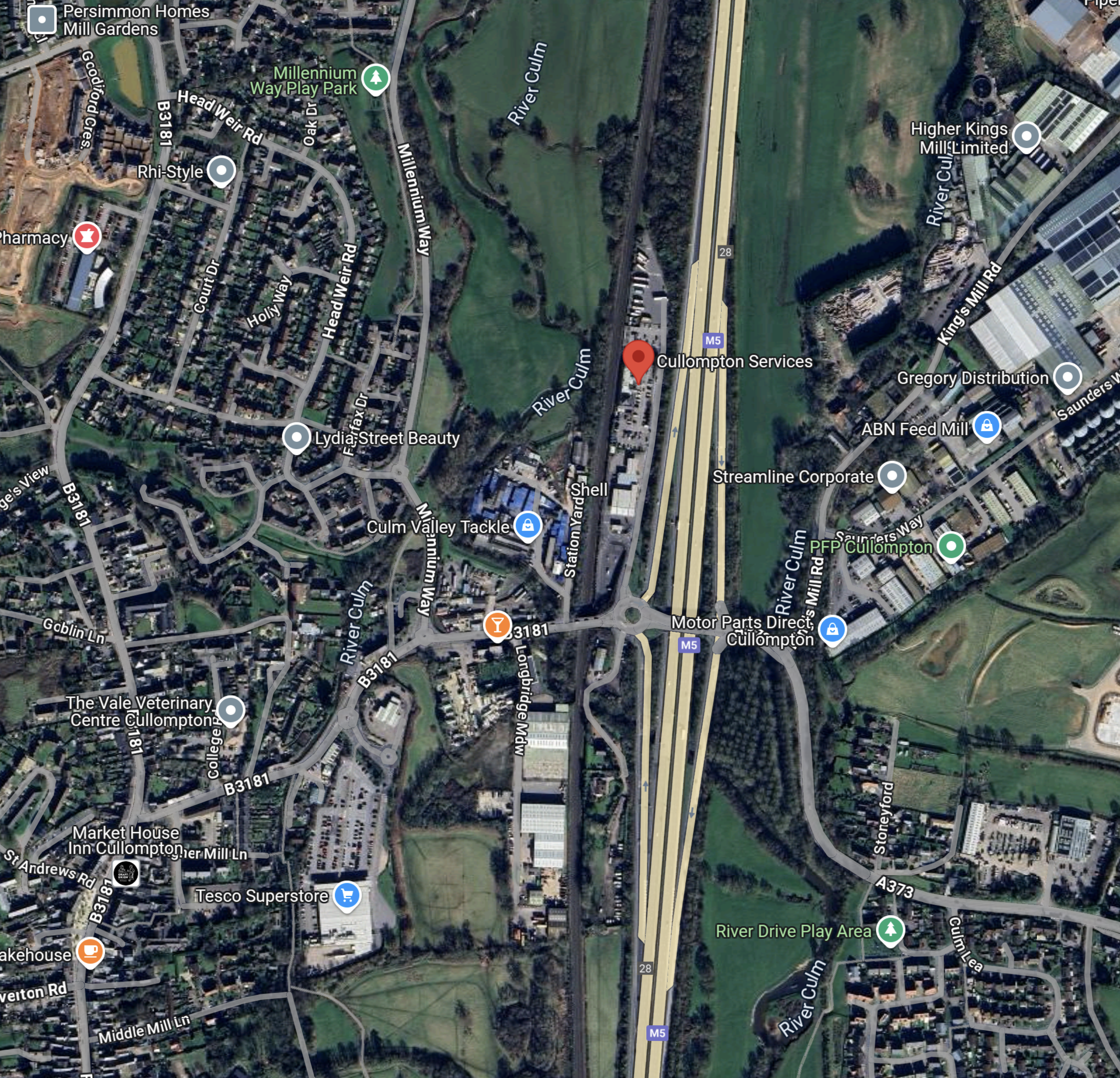
Note.
- The M5 runs North-South across the map, with Junction 28 about half-way.
- North-west of the junction are Collumpton Motorway Services.
- The Bristol-Exeter Line runs North-South to the West of the services.
This second Google Map shows the Northern end of the services.
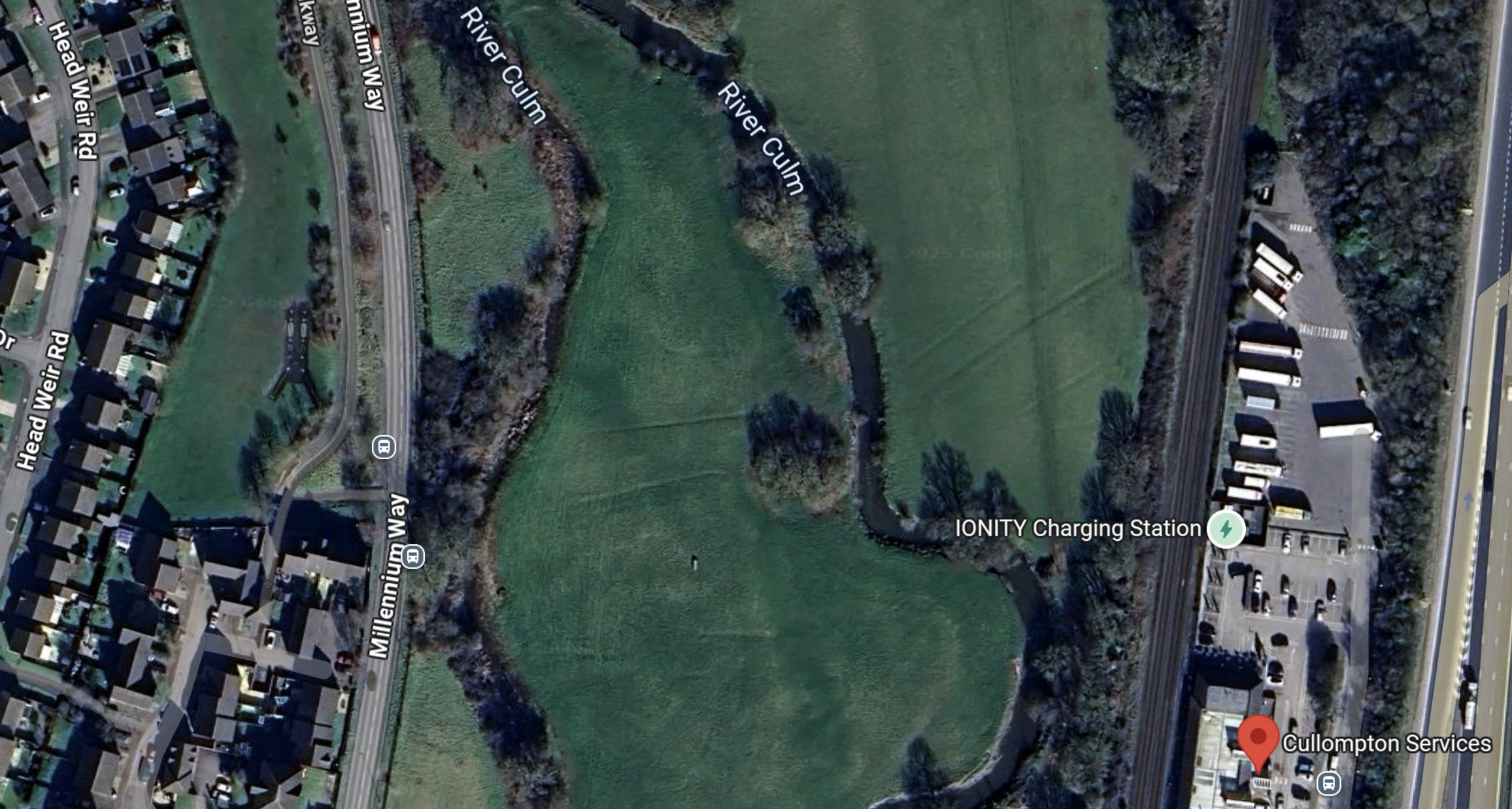
Note.
- Parking at the services appears rather limited.
- Trucks seem to be parked at the Northern end of the services.
- I feel there would be space to put a platform on either side of the rail lines.
- I doubt a bridge with lifts would be a problem.
- The station could share the facilities of the services.
- Could some of the fields to the West of the railway be used to create parking?
- The station could be built to accept nine-car Class 802 trains.
Collumpton station could be built to have a high capacity and direct access to the town and the M5.
I have some thoughts.
Could Collumpton Station Function As A Parkway Station?
I believe it certainly could for Exeter, Bristol and even London.
In Darlington Station – 26th June 2025, I showed how Network Rail are creating a 650-place car park at the station, which could be a major draw for travellers.
Could a large car park be provided here to attract travellers?
South West Rail Resilience Programme
This is the first paragraph of this article on Modern Railways.
The Government has paused the third phase of Midland main line electrification to Sheffield and Nottingham, plus the final phase of the South West Rail Resilience Programme (SWRRP), which involves strengthening cliffs at Holcombe.
If the final phase of the South West Rail Resilience Programme is paused, what happens if God decides to block the line through Teignmouth.
I have thought for some time, that one of the purposes of Okehampton Interchange station is to provide an alternative route to the South-West.
If the sea should destroy the coastal railway, as it did a few years ago, then passengers for the South-West could be ferried to and from Okehampton Interchange station by high-speed hydrogen-powered coaches along the A30, to catch trains to Exeter and London.
So, I would build a hydrogen filling station at Collumpton services, so that if the sea destroys the coastal railway again, the alternative of hydrogen coaches is ready.
If Okehampton Interchange station can also be used as an alternative, two alternatives might just ensure that the alternative routes never need to be used.
 The Anonymous Widower