Could Paddington And Minehead Be Within Range Of Hitachi Battery-Electric Intercity Trains?
I am prompted to ask this question, by an article in today’s Telegraph, which is entitled The New British Rail Services Reversing The Damage Of Beeching’s Axe.
Line 8. is given as the West Somerset Railway between London and Minehead?
This paragraph describes the idea.
As with the Severn Valley Railway (SVR) to Bewdley, the West Somerset Railway (WSR) looks like it could one day host mainline trains and connect communities along the route with destinations such as Taunton and Bristol. Like the SVR, the WSR is a very long and well-staffed heritage line with a long history (50 years, in fact, and it was one of Britain’s first heritage lines following its Beeching closure). Running to Minehead and Dunster, you don’t need me to tell you that this is a beautiful part of the world with numerous castles and beaches, and Exmoor National Park next door.
Note.
- The author doesn’t mention London services in the text.
- Batteries are not mentioned either.
- Minehead will be only about twenty miles from Hinckley Point C nuclear power station.
Is it feasible?
What Is The Battery Range Of An Hitachi Intercity Tri-Mode Battery Train?
In The Data Sheet For Hitachi Battery Electric Trains, I came to these conclusions.
- The battery pack has a capacity of 750 kWh.
- A five-car train needs three battery-packs to travel 100 miles.
- A nine-car train needs five battery-packs to travel 100 miles.
- The maximum range of a five-car train with three batteries is 117 miles.
- The maximum range of a nine-car train with five batteries is 121 miles.
As battery technology gets better, these distances will increase.
What Is The Distance Between Minehead And Taunton?
I shall be using 24.8 miles, which I have calculated from figures given in the Wikipedia entry for the West Somerset Railway.
What is The Distance Between Paddington And Taunton Via Newbury?
I shall be using 142.6 miles, which I have calculated from figures given in RealTimeTrains.
What Is The Maximum Range From Paddington Via Newbury Of An Hitachi Intercity Tri-Mode Battery Train?
Consider.
- The electrification runs between Paddington and Newbury.
- The distance between Paddington and Newbury is 53 miles, according to RealTimeTrains.
- Paddington and Taunton is almost 30 miles shorter by Newbury, than via Bath.
This Google Map shows Taunton station.
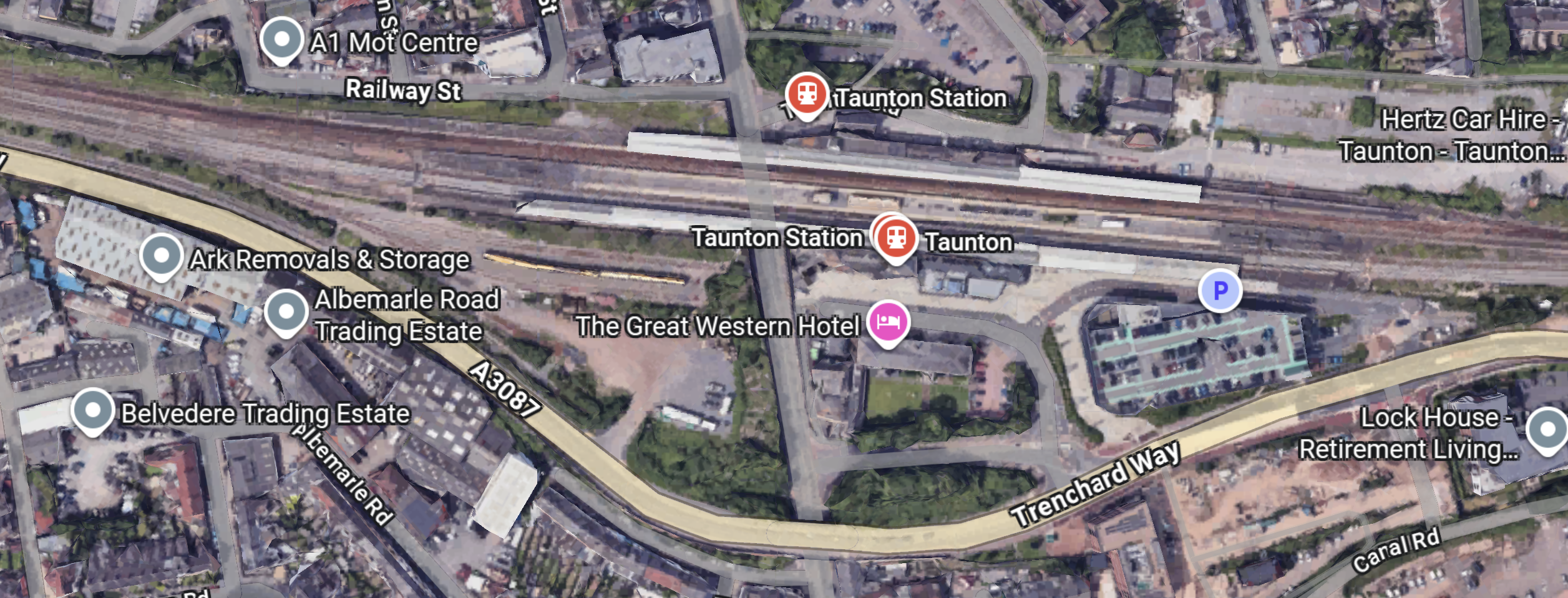
Taunton station looks spacious with numerous platforms and a hotel.
I believe that a five-car Hitachi Intercity train leaving Newbury with three full batteries could travel as far as 53+117 or 170 miles from Paddington.
Could A Hitachi Intercity Five-Car Train Reach Taunton?
This would mean that Taunton would be in range as it is only 142.6 miles.
The train would need to be recharged before returning to London.
Could A Hitachi Intercity Five-Car Train Reach Minehead?
But it could also have enough power in the batteries to reach Minehead, which is only a further 24.8 miles or 167.4 miles in total.
As with Taunton, the train would need to be recharged before returning to London.
Options For Charging Trains That Are Returning To London
This OpenRailwayMap shows the tracks through Taunton.
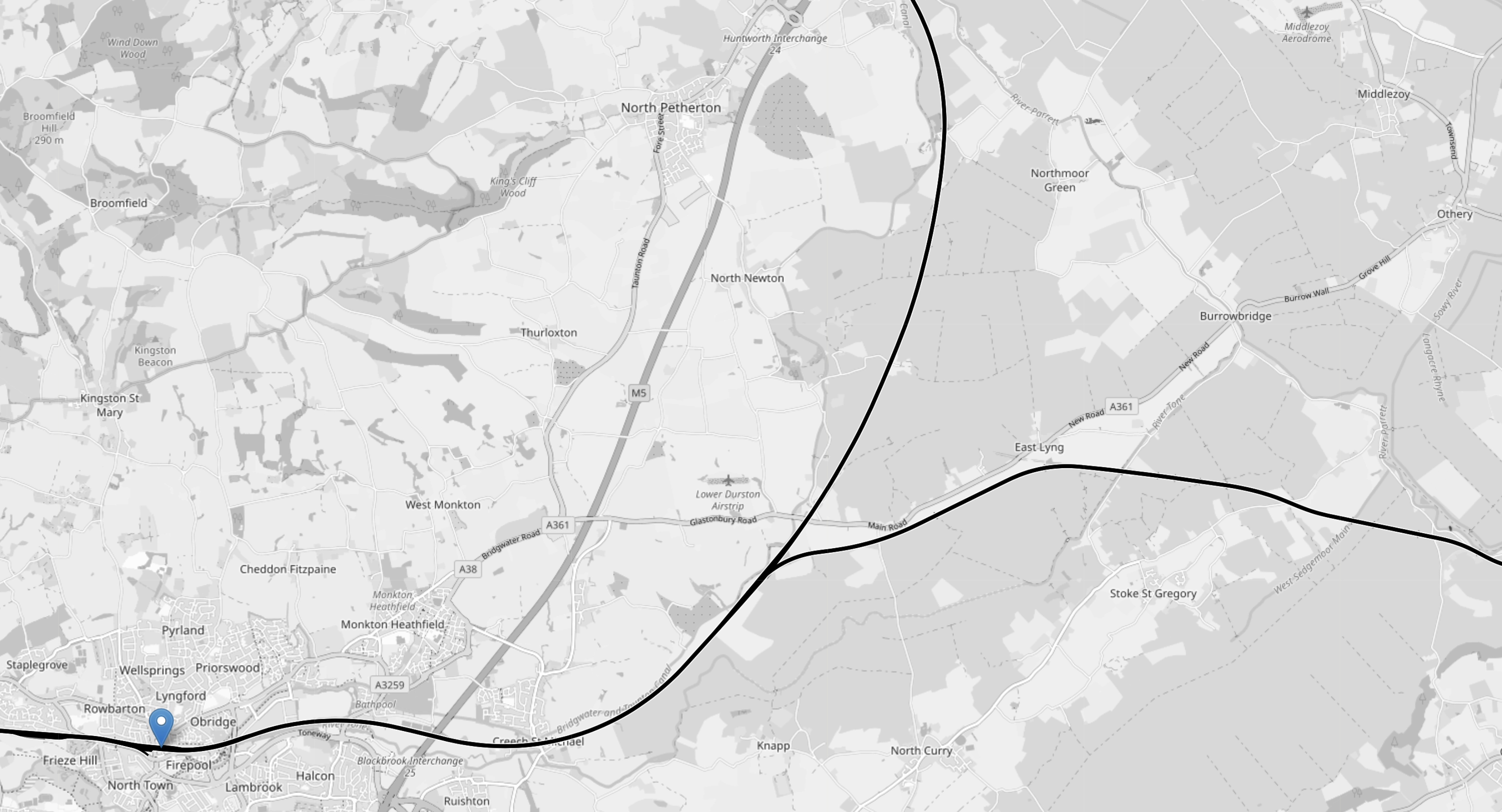
Note.
- Taunton station is indicated by the blue arrow.
- Running East-West across the map and through Taunton station, is the Reading-Taunton Line.
- Running more North-South across the map and through Taunton station, is the ~Bristol-Exeter Line.
- The two lines split going East at Cogload junction.
- Taunton station and Cogload junction are about 4.5 miles apart.
- Trains typically take about six minutes between the two places.
I believe there are three options for charging the trains.
Option 1 – Charge In Minehead Station
This would be possible, but as not all trains go to Minehead station, it probably wouldn’t be very practical.
Option 2 – Charge In Taunton Station
This would be possible, especially as most trains seem to call in Taunton station.
Option 3 – Electrify Between West Of Taunton Station And East Of Cogload Junction
Consider.
- The length of the electrification could be as long as is necessary.
- Trains would charge their batteries at line speed.
- Pantographs would be raised and lowered at line speed.
- Trains would not have to call at Taunton station.
- Trains could charge their batteries on both routes.
- Trains could charge their batteries in both directions.
I believe this could be the most efficient way to charge trains through Taunton.
Onward From Taunton
If the electrification through Taunton could be made long enough, so trains left the station with a full battery, the following would be possible.
- Going South trains should go past Plymouth.
- Going towards Newbury, trains should have enough in the batteries to reach Newbury and electrification for London.
- Going towards Chippenham, which is 63 miles away, trains should have enough in the batteries to reach Chippenham and electrification for London.
- Going towards Bristol Temple Meads, which is 44.8 miles away, trains should have enough in the batteries to reach Bristol Temple Meads.
New Rail Station For Mid Devon
The title of this post, is the same as that of this article on Exeter Today.
These are the first two paragraphs.
Devon is set to benefit from a major transport funding boost as the Government today confirmed plans for a new railway station in Cullompton and approved a long-awaited upgrade to the A382 between Drumbridges and Newton Abbot.
The announcement, part of a £92 billion national transport investment programme, includes over £47 million to reinstate passenger services between Portishead and Bristol — and, crucially for Devon, two brand-new stations along the Exeter to Taunton line, one of which will be in Cullompton.
It does appear, that according to its Wikipedia entry, Collumpton station has been a bit on-and-off.
In the October 2021 budget, development funding of £5m was allocated for the reopening of Wellington and Cullompton stations. However, in 2024 the Minister of State for Rail, Peter Hendy, stated that the proposed reopening of Cullompton station would no longer be funded by the UK government. Following the government’s spending review in June 2025, funding was confirmed for the station.
But now it appears to be definitely on.
This Google Map shows, the railway and the M5 passing Collumpton.
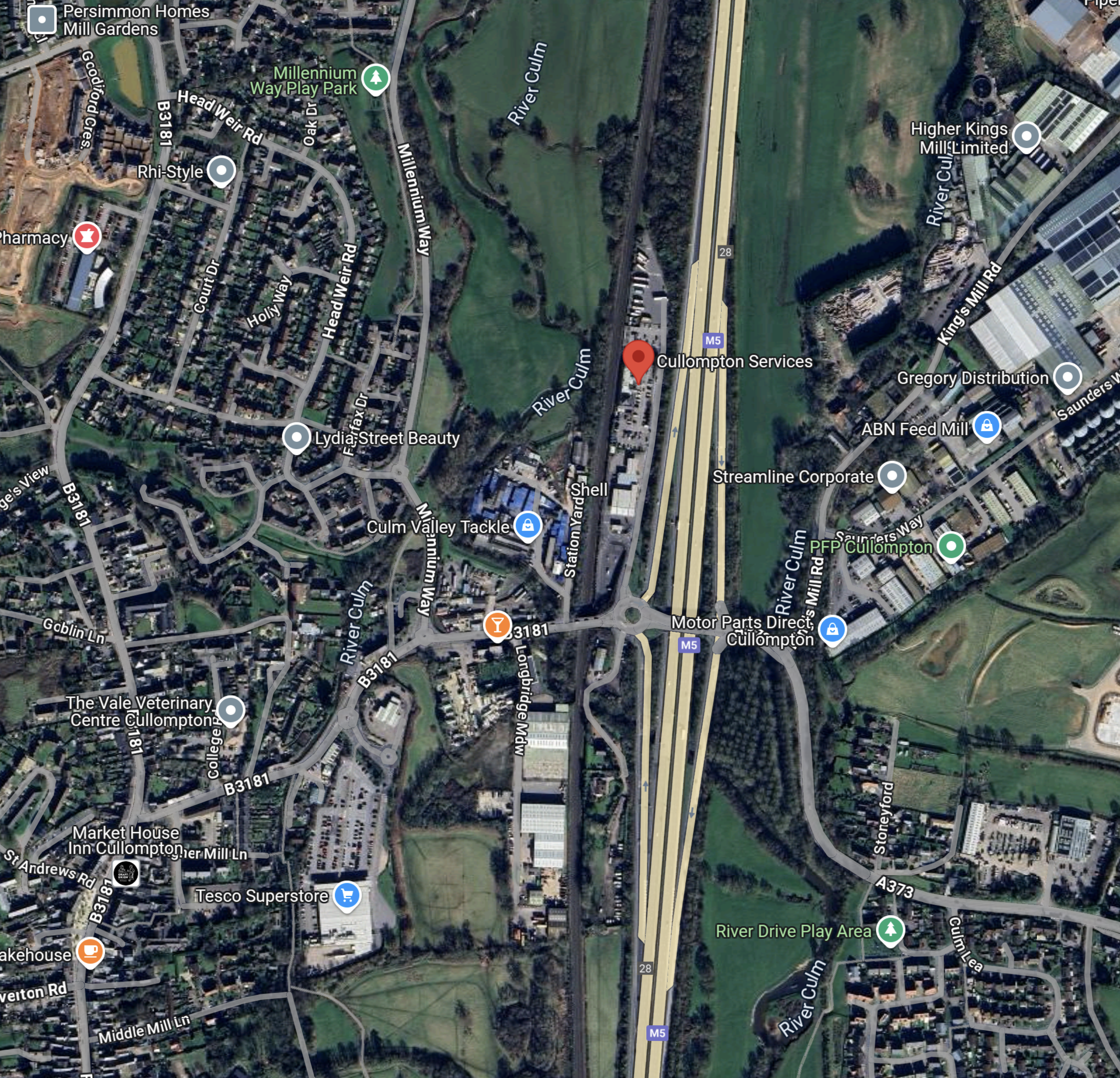
Note.
- The M5 runs North-South across the map, with Junction 28 about half-way.
- North-west of the junction are Collumpton Motorway Services.
- The Bristol-Exeter Line runs North-South to the West of the services.
This second Google Map shows the Northern end of the services.
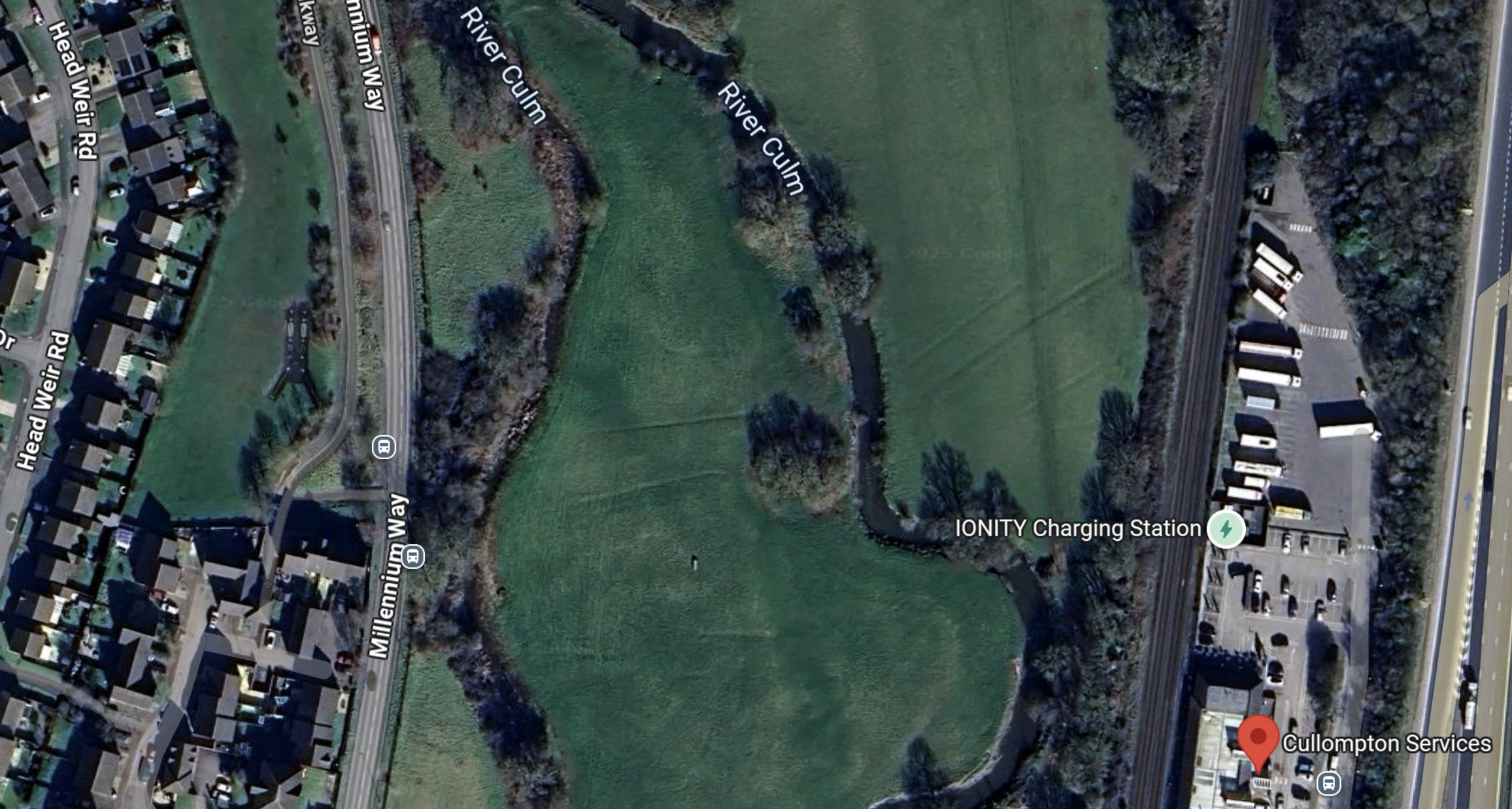
Note.
- Parking at the services appears rather limited.
- Trucks seem to be parked at the Northern end of the services.
- I feel there would be space to put a platform on either side of the rail lines.
- I doubt a bridge with lifts would be a problem.
- The station could share the facilities of the services.
- Could some of the fields to the West of the railway be used to create parking?
- The station could be built to accept nine-car Class 802 trains.
Collumpton station could be built to have a high capacity and direct access to the town and the M5.
I have some thoughts.
Could Collumpton Station Function As A Parkway Station?
I believe it certainly could for Exeter, Bristol and even London.
In Darlington Station – 26th June 2025, I showed how Network Rail are creating a 650-place car park at the station, which could be a major draw for travellers.
Could a large car park be provided here to attract travellers?
South West Rail Resilience Programme
This is the first paragraph of this article on Modern Railways.
The Government has paused the third phase of Midland main line electrification to Sheffield and Nottingham, plus the final phase of the South West Rail Resilience Programme (SWRRP), which involves strengthening cliffs at Holcombe.
If the final phase of the South West Rail Resilience Programme is paused, what happens if God decides to block the line through Teignmouth.
I have thought for some time, that one of the purposes of Okehampton Interchange station is to provide an alternative route to the South-West.
If the sea should destroy the coastal railway, as it did a few years ago, then passengers for the South-West could be ferried to and from Okehampton Interchange station by high-speed hydrogen-powered coaches along the A30, to catch trains to Exeter and London.
So, I would build a hydrogen filling station at Collumpton services, so that if the sea destroys the coastal railway again, the alternative of hydrogen coaches is ready.
If Okehampton Interchange station can also be used as an alternative, two alternatives might just ensure that the alternative routes never need to be used.
T-Pylons To The West Of Yatton Station
I talked about National Grid’s first T-pylons in National Grid Energise World’s First T-Pylons.
Today, I went and had a look for them and found where they cross the Bristol-Exeter Line between Yatton and Worle stations.
I took these pictures.













Note.
- The first nine pictures were taken going West between Yatton and Worle and the last eleven were taken going East.
- Some of the mature trees seem to hide the pylons, as the train passes.
T-pylons are deliberately smaller than traditional pylons, as these pictures show.





It is certainly a good attempt at producing a less noticeable electricity transmission line.

