Crossrail 2 ‘Cannot Go Ahead’ Without Four-Tracking Of West Anglia Line
This is the title of an article in Rail Technology Magazine.
This is the first paragraph.
MPs for constituencies along the West Anglia line called for the route to be four-tracked in order to accommodate new rolling stock and Crossrail 2 at a Westminster Hall debate yesterday.
I know the West Anglia Main Line very well, as for perhaps fifteen years, I used to travel on it, regularly to get between Cambridge and London.
The Problems Of The West Anglia Main Line
Summarising its shortcomings, I would include.
- Trains are too slow.
- Capacity on the line is too small.
- There are lots of level crossings, which cause problems.
- With the development of the port at London Gateway, there could be pressure to put more freight trains on this line, to go to and from the North.
- Services from London, should be better integrated with Peterborough and Norwich services.
- Ipswich and Bury St. Edmunds to Stansted Airport, is not easy by train.
This Infrastructure section in Wikipedia describes the West Anglia Main Line.
The line was initially 5 ft (1,524 mm) gauge, but between 5 September and 7 October 1844 it was converted to 1,435 mm (4 ft 8 1⁄2 in) standard gauge.
In 2013 the line was double track for most of its length, with small sections of single track on the Stansted branch and at Ware and quadruple track between Hackney Downs and Liverpool Street. The line is electrified at 25 kV AC and has a loading gauge of W8 except for the Stansted branch, which is W6.
The line is very much inferior to the Great Eastern Main Line.
The New Greater Anglia Franchise
The new Greater Anglia Franchise, will go a long way to sorting points 5 and 6, by introducing hourly services on the following routes.
- Norwich to Stansred Airport via Ely, Cambridge North and Cambridge stations.
- Colchester to Peterborough via Ipswich, Bury St. Edmunds, and Ely.
With improved services from London to Stansted, this will help sort out a lot of the problems on the line.
But these changes will only put more pressure on capacity on the West Anglia Main Line.
Freight
The West Anglia Main Line doesn’t carry large numbers of freight trains, but there could be pressure to increase freight on the line in the future.
Once the Gospel Oak to Barking Line is electrified, there will be another electrified route from London Gateway to Peteborough.
It might be decided to reinstate the rail line from March to Spalding and the Great Northern Great Eastern Joint Line, to take freight away from the East Coast Main Line.
If thiese routes get to be used for freight, it will put extra pressure for more capacity on the West Anglia Main Line.
More Capacity On The West Anglia Main Line
With demand for more capacity on the West Anglia Main Line, I think it is inevitable that the line will be improved.
This Future Developments section in Wikipedia, outlines what might happen.
If Stansted Airport’s expansion is authorised it is planned that the line will see many further changes. Long term proposals include four-tracking between Coppermill Junction and Broxbourne junction; an additional tunnel and platform edge on the Stansted Airport branch; one additional train per hour serving Stansted and up to six further trains per hour at peak times, including four into Stratford as a terminus. More stations, such as Broxbourne, will also have platform extensions to accommodate 12-car trains.
It seems likely that two tracks will be built alongside the line to Cheshunt as part of Crossrail 2. Intermediate stations from Tottenham Hale will transfer to Crossrail 2 releasing capacity on the main line for additional trains
Stansted Airport have certainly been a forceful advocate of four-tracking the West Anglia Main Line.
Four-tracking of the twelve or so miles between Coppermill and Broxbourne Junctions would allow the following.
- The possibility of at least 100 mph running on the fast lines.
- Separation of slow and fast services.
- Stansted and Cambridge Express services, that would be worthy of the name.
- The possibility of more freight trains.
Four-tracking would certainly do the following.
- Get the line ready to connect to Crossrail 2.
- Probably make all stations between Tottenham Hale and Broxbourne step-free.
- Add the station at Meridian Water to the line.
- Improve the freight gauge from W8 to W10, where needed.
I suspect that four-tracking will also remove some of the notorious level crossings on the line.
I have this feeling that the four-tracking of this line could be one of those projects, where the existing infrastructure works normally, whilst the new tracks are built alongside.
Fast Services To Stansted, Cambridge And Norwich
South of Broxbourne station, fast services to and from Cambridge, only stop at Cheshunt and Tottenham Hale.
Given that the Flirts, that will be running Cambridge and Stansted services in a few years will be 125 mph trains, would it be worth it to save a few minutes building the new fast lines to allow running at this speed?
But should the four-track section of railway stop at Broxbourne Junction?
Between Broxbourne and Bishops Strtford, the West Anglia Main Line, has wide margins and I think that there are possibilities of extending the four-track section further North, perhaps even to Bishops Stortford station.
As an example, this Google Map shows Roydon station.
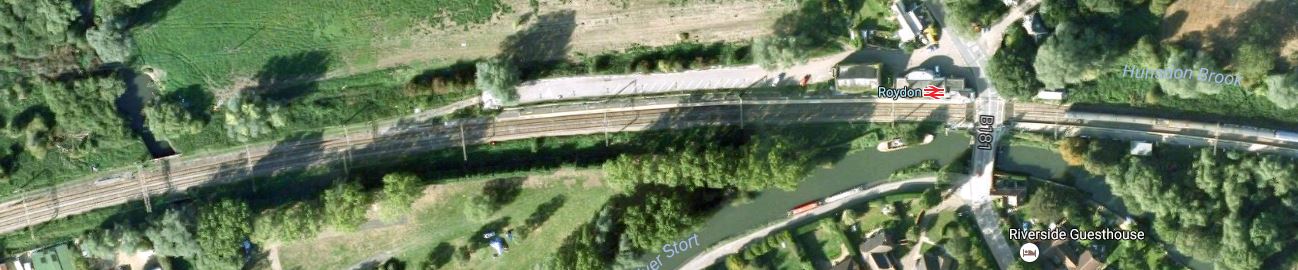
Roydon Station
The biggest problem at Roydon is the level crossing, but on a quick look, it would appear that four-tracking would be possible.
From my memories of driving past and going through Bishops Stortford station, I thought this station would be a major problem to four-tracking.
But look at this Google Map of the station.

Bishops Stortford Station
It would appear that space is not the premium I expected.
I think it would be possible to expand the station, to take advantage of two slow and two fast lines South of the station.
Surely, the fast lines, even if a good proportion of trains stopped at the station could accommodate twelve or more trains per hour (tph) to Stansted Airport, Cambridge and the North.
North of Bishops Stortford, all of the trains would be modern trains with the following characteristics.
- The ability to cruise at 100 mph or more.
- The ability to stop and start extremely fast.
So I suspect, that if the current infrastructure was improved, consistent 100 mph running would be possible to Cambridge.
Cambridge could be a problem with all the work going on.
- The expansion of the existing Cambridge station
- The building of the new Cambridge North station
- The reorganisation of services to cope with the new Greater Anglia franchise.
- The arrival of the East West Rail Link in the mid-2020s.
But I suspect Network Rail and Greater Anglia are working together on the solutions, to raise speeds all the way to Ely.
North of Ely, the Breckland Line has a lower speed limit of 75-90 mph, but if it were to be upgraded for 100 mph running, this would mean that the new Norwich to Stansted service via Cambridge using bi-mode Flirt trains, would be considerably faster, than the ten minutes short of two hours now possible with a change at Cambridge.
One thing, that I suspect will happen is that the following services will arrive and leave in a convenient pattern at Cambridge.
- Cambridge to/from Ipswich
- Stansted Airport to/from Norwich
- Cambridge to/from Kings Lynn
- Kings Cross to/from Cambridge
- Liverpool Street to/from Cambridge
- Peterborough to/from Cambridge
- Thameslink to/from Cambridge
Cambridge will become an increasingly busy interchange.
As an example, I think we could see a Norwich to Kings Cross time of under two hours, with a change at Cambridge. Perhaps not ninety minutes, but with an upgraded Breckland Line running 100 mph plus bi-mode Flirts, it wouldn’t be far off.
Coppermill Junction
Four-tracking is proposed to start at Coppermill Junction, just South of Tottenham Hale station.
This map from carto.metro.free.fr shows Coppermill Junction.
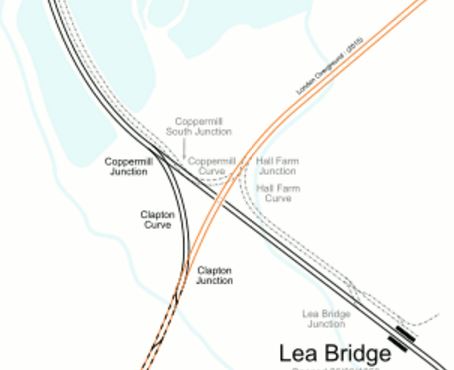
Coppermill Junction
Note.
- The tunnels for Crossrail 2 will emerge to the North-West of this junction.
- Rail access to the Crossrail 2 worksite would be a necessity.
- I talked about plans to reinstate the Coppermill and Hall Farm Curves in Rumours Of Curves In Walthamstow.
- The only inhabitants of the area are probably foxes, great crested newts and other sundry wildlife.
Surely, the creation of an upgraded track layout at Coppermill Junction, that allows Crossrail 2 to be built without disrupting services on the West Anglia Main Line and the Chingford Branch is important.
The reinstated Hall Farm Curve would also allow Chingford Branch services to run to Stratford for Crossrail and alternative Underground services.
The work to this junction, further emphasises that four-tracking of the West Anglia Main Line must be done before Crossrail 2 is built.
Crossrail 2
Politics, public relations and good project management all probably say, that when Crossrail 2 gets the go-ahead, four-tracking of the West Anglia Main Line, should be done first.
In a related and parallel project, the branch lines in South West London, should also be upgraded as early as possible to bring visible benefits.
- Longer platforms at stations where needed.
- Step-free access at all stations.
- Sorting of level crossings and bottle-necks.
These improvements are needed, even if Crossrail 2 is not built.
If I have a criticism of the current Crossrail and Thameslink projects, it is that they are big-bang projects, where nothing appears to have happened except disruption for years and then it will all come together in a great splurge in 2018-2019.
With Crossrail 2, there is possibly a chance to build the line, so that the benefits come in a steady stream.
An Understated Headline
This article on Business Insider is entitled A rail link between Oxford and Cambridge could help create a massive tech hub in the UK.
Could is not the word I’d use!
This page on the Government web site, contains a summary of the report, on which the article is based.
This is the second paragraph of the report.
The Commission’s central finding is that a lack of sufficient and suitable housing presents a fundamental risk to the success of this area. Without a joined-up plan for housing, jobs and infrastructure across the corridor, it will be left behind its international competitors. By providing the foundations for such a strategy, new east-west transport links present a once in a generation opportunity to secure the area’s future success.
As housing is so important to any development, this is crucial. The interim report makes a series of recommendations. This is the first.
- Government should go ahead with East West Rail’s initial phase, a new link cutting journey times by more than half on the route from Oxford to Bedford and Milton Keynes, ensuring it is delivered before 2024; and it should invest in developing as soon as possible detailed plans for both the next phase of East West Rail (which would complete the link to Cambridge) and for a new Oxford-Cambridge Expressway.
So why is the Government farting about?
I blame the following.
- The route via Bedford, contains lots of great-crested newts, in all the disused brick works.
- The name; East West Rail Link, doesn’t have North in it.
- Oxford doesn’t want a railway, that might encourage more visitors who would interfere with academic life.
- The Sir Humphries of this world went to one of two universities; Oxford or Cambridge. They believe the two academic cities shouldn’t be connected and certainly not via Milton Keynes.
- Addenbrooke’s hospital has objected, as it will bring lots of patients from the route to their world-class facilities.
- It doesn’t go near Islington for the Labour Party or Edinburgh for the SNP.
- Democracy
The Chinese would have built it last week or possibly yesterday, as it calls at Bicester Village!
United Airlines Introduce My Ideal Flying Class
The respected travelwriter, Simon Calder, on BBC Breakfast, alerted me to this story, which is fully reported in this article on USA Today, which is entitled United adds ‘Basic Economy’ fares with carry-on bag restrictions.
My Carry On Bag
When I flew to Las Palmas recently on easyJet, I did pay for baggage to go in the hold, as I thought I’d be taking more and I don’t have a carry-on bag, that is big enough.
Why is it, that all light carry-on bags seem to have wheels, which is just extra weight and wasted space,. to carry around?
All I want is a light square box with a comfortable handle. My current Mandarina Duck bag is shown in My Packing List.
Since then, I’ve cut down on what I take with me, so I do have a bit more space.
I could therefor easily use a smaller carry-on bag, especially, if I was going to a country I knew well like Germany, Italy,Spain or Poland.
On a more ambitious trip, I could certainly fill a bigger carry-on bag with useful items like lots of M&S Honeycomb Crispies.
But unfortunately, I haven’t found the ideal bag.
- No wheels.
- Small comfortable carry handle.
- No straps.
- Maximum volume to fit carry-on rules.
- Big enough to take a compact SLR and lens.
- Not too many specially-designed feature pockets.
- Secure.
I suspect that some clever American, will be designing the ideal carry-on bag for United’s Basic Economy.
Choosing Seats
I don’t!
This means I usually get an aisle seat, which is ideal for my needs.
- I tend to get a bit stiff sitting for three or four hours, so a walk to the toilet is easy to stretch my legs.
- I inevitably leave something I want in my carry-on bag, so if it’s in the overhead locker, can get it easily.
- I can get on at the last minute and know I can just sneak into my seat.
- I can usually get off easily.
- I can see what’s on the trolley, without reading the menu.
It will all go pear-shaped one day, when I get the dreadful centre seat of three.
My Coat
The picture shows the inside of my warm M & S winter coat.

My Winter Coat
Note the large internal pocket, which is big enough for a thick tabloid newspaper or a paperback book.
The external pockets, also are big enough for my camera, phone and a real hndkerchief.
A Few Travel Tips
Over the years, I have gradually cut down on what I take.
- Take a battery-powered electric toothbrush. The charger of most others takes up too much space.
- Charge phones, cameras and other devices, through a USB lead and just take a USB charger and adapter.
- Don’t take soap or shampoo, or anything the hotel should have.
- As I don’t use sun-screen, I don’t take that either.
- Take perhaps three still-rolled real handkerchiefs, as they have other users, like stylish tablecloths on trains.
- Take a spare SD card for your camera, already unpacked and ready for use.
- On a long trip, I take older socks, knickers and shirts, discarding them, when they get dirty.
- Take at least two credit cards in separate places, in case you lose your favourite.
- Don’t buy anything in duty-free. It only encourages them! And we have to carry it.
- Take a small shoe horn.
- Take an upmarket compact plastic knife/fork/spoon from IKEA, as you never know, when that delicious snack will need it.
- Never take nightwear.
- Take a torch.
- Take one of Sainsbury’s five pence orange shopping bags.
When I used to travel with C, we used to share a lot of things, like jumpers and tee-shirts, as we were of a similar size.
In fact, the last joke she ever said to me, was that I would have difficulty finding someone, to train to my packing habits.
Comclusion
I can’t wait for a European airline to introduce a Basic Economy class.
The Canary
One of my Google Alerts picked up a story from a web site called The Canary.
It looks like someone is trying to see up an independent news web site.
I wish them well!
I don’t think it’ll get many readers in Ipswich!
What Next For Class 385 Trains?
Scotrail have ordered a fleet of Class 385 trains, which will be built by Hitachi at Newton Aycliffe in the North-East of England.
If you look at Scotrail’s network, there are a lot of lines, where new trains will be needed in the next decade.
Most of these lines are not electrified, so will the Class 385 train, be available in a version say, that would handle lines like the Borders Railway?
Electrifying all lines will be costly and the Heritage Taliban, may object to overhead gantries marching all over Scotland.
Class 800 And Class 801 Trains
The Class 800 trains are electro-diesel trains with a range depending on the size of the fuel tanks, whereas the Class 801 trains are the pure electric version.
Like the Class 385 trains, they are members of Hitachi’s A-Train family, so I suspect that if asked to supply a bi-mode Class 385 train, that Hitachi know the route to create such a train.
Trains With Batteries
I have written two posts about the Japanese using batteries in electric trains.
- Japanese Trains With Batteries describes how some Tokyo Metro trains have batteries to get them to the next station, in an emergency situation.
- Battery Trains In Japan describes how battery trains are to be used on the OGA Line.
The Japanese technology, doesn’t seem as comprehensive as that I wrote about in Bombardier’s Plug-and-Play Train, but I’m sure that Hitachi must be thinking about trains with batteries,
Conclusion
I am inevitably drawn to the conclusion, that Hitachi will come up with a train, that can run say between Edinburgh and Aberdeen, substantially under its own power, aided by overhead electrification where it exists.
Is The Levenmouth Rail Link Going To Be Scotland’s Next New Railway?
I ask this question as this article in Global Rail News was asking the same question, with a title of Levenmouth – Scotland’s next railway?.
According to the article, the figures look good, for the reopening of the Levenouth Rail Link, with a Benefit Cost Ration of 1.3, which compares well with the figure of 0.96 for the successful Borders Railway.
This is also said in the Wikipedia entry for the Fife Circle Line under Future Services.
A Leven rail link would provide better services to support major industrial sites at Fife Energy Park, Methil Docks, the Low Carbon Park (under construction), Diageo, the businesses along the Leven Valley (including Donaldsons) and major retailers in Leven located close to the line (Sainsbury, B&Q, Argos, etc.). Levenmouth is an area of high deprivation and Fife Council estimates that an hourly train link (using the Fife Circle services)to Edinburgh would increase job vacancies by 500% since commuting for work would become possible.
There is one big difference between the Borders Railway and the Levenmouth Rail Link.
On a journey to Scotland’s capital from Leven, the travellers have to cross the large water.barrier of the Firth of Forth.
Is The Firth Of Forth A Psychological Barrier?
Does the Forth act as both a psychological batter, as well as a physical barrier to travel?
I don’t know for sure, but I hear the same sort of comments from my friends in Edinburgh about Fife, as North Londoners make about South London and probably South Londoners make about the North.
The much larger Thameslink project may get all the publicity and criticism, but London’s most modern cross-river link just keeps on giving.
The East London Line And The Levenmouth Rail Link
You might argue, what has the East London Line got to do with the Levenmouth Rail Link?
I believe that because of the geography of the two areas, with a major waterway between two centres of population, that the massive underestimation of passenger numbers, that occurred in East London could also happen across the Forth.
Luckily, that just as Marc Brunel provided a high-quality crossing under the Thames, the Victorians did this for the Firth of Forth.
Although, it could be argued that the Scottish crossing is more iconic and you get a better view.
As an aside, if the Forth Bridge, which opened in 1890 is a UNESCO World Heritage Site, surely Marc Brunel’s much older Thames Tunnel, should be similarly acknowledged.
Local Rail Services Across The Firth Of Forth
At present the local services across the bridge are four trains per hour on the Fife Circle Line.
That is not a high capacity service, given the line is not electrified.
If the Levenmouth Rail Link were to be rebuilt, it would connect to the Fife Circle and surely, it would mean that more trains could be timetabled to and from Edinburgh, via the new station at Edinburgh Gateway, which gives access to Edinburgh’s trams, the Airport and services to Glasgow and the West of Scotland.
Would those along the Levenmouth Rail Link respond to a new railway, as those who live in Hackney did to the East London Line?
I would be very surprised if they didn’t!
Rebuilding The Levenmouth Rail Link
The Levenmouth Rail Link is a classic branch line, with not much complication. Published plans show the following.
- It would be about five miles long.
- It would branch off the main Edinburgh to Aberdeen Line to the North-East of Glenrothes with Thornton station.
- It would terminate at Leven station.
- A branch would serve the large Diageo distillery.
This Google Map shows the junction with the main line.

Glenrothes with Thornton station is in the South-West corner of the map on the Fife Circle Line.
- Trains go West from the station to Edinburgh on the Fife Circle Line via Cowdenbeath and Dunfermline.
- There is a triangular junction to the East of the station.
- Trains go South from this junction to Edinburgh via Kirkcaldy.
- Trains go North from this junction to Perth, Dundee and Aberdeen.
To the North of this junction, the line splits, with trains for Leven, branching off to the East.
This map from Wikipedia shows the stations on the Fife Circle Line
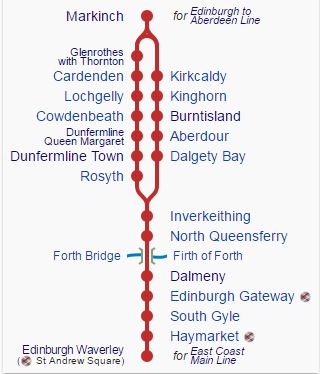
Note that the junction where the Fife Circle Line splits South of Markinch station, is the one shown in the Google Map.
Electrification
The Fife Circle and the Edinburgh to Aberdeen Line are not electrified and there are no scheduled plans to do so, other than the aspiration of having more lines with electric services.
But various factors will effect the types of trains between Edinburgh and Perth, Dundee and Aberdeen.
- Distances are not hundreds of miles.
- Virgin’s electro-diesel Class 800 trains will be working between Edinburgh and Aberdeen.
- Could Hitachi build electro-diesel versions of their Class 385 trains, as they share design features with the Class 800 trains?
- Will Hitachi add energy storage to Class 385 trains?
- Abellio are rumoured to be introducing trains with energy storage in East Anglia. Would this expertise be used by Abellio ScotRail?
I think we could see a cost-effective strategy implemented, that included electric trains, but a limited amount of overhead wiring.
- Edinburgh to Dalmeny – Electrified
- The Forth Bridge could be left without wires, if it were thought too sensitive for the Heritage Taliban.
- North Queensferry to Perth – Electrified
- Ladybank to Dundee – Not electrified
- Fife Circle via Cowdenbeath and Dunfermline – Electrified
- Levenmouth Rail Link – Not electrified
Note.
- As Stirling and/or Dunblane will be electrified, will Stirling to Perth be electrified?
- Between Dalmeny and North Queensferry, diesel or battery power would be used on local services.
- I have flown my virtual helicopter round the Fife Circle and it doesn’t look that electrification would be a nightmare.
- The Levenmouth Rail Link could be run by battery trains, with a charging station, like a Railbaar, at Leven station.
Appropriate trains would provide all services.
Services
Obviously, what services are introduced depends on passenger traffic.
But after a quick look at the lines, I suspect that the Levenmouth Rail Link fits well with current services on the Fife Circle.
Bear in mind too, that reopening the St. Andrews Rail Link , could be a possibility.
Conclusion
The railways North from the Forth Bridge in the East and Stirling and Dunblane in the West to Perth and Dundee could be much improved. I would do the following.
- Some short lengths of electrification.
- Bi-mode or battery versions of Class 385 trains.
All trains going over the Forth Bridge, should have large windows. The Bridge Visitor Centre must also have easy access with perhaps a free shuttle bus from Dalmeny station.
One of Scotland’s major assets, must be made to work for its living.
Looking For Bond Street Station’s New Northern Entrance
Bond Street station is going to get a new Northern entrance on the North side of Oxford Street.
So I went for a walk in the area and took these pictures.


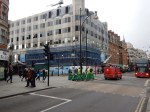


As you come out of the current entrances of the station on Oxford Street a building is rising on the opposite side of the road. Its Eastern end is on Marylebone Lane, where a new entrance is being built.
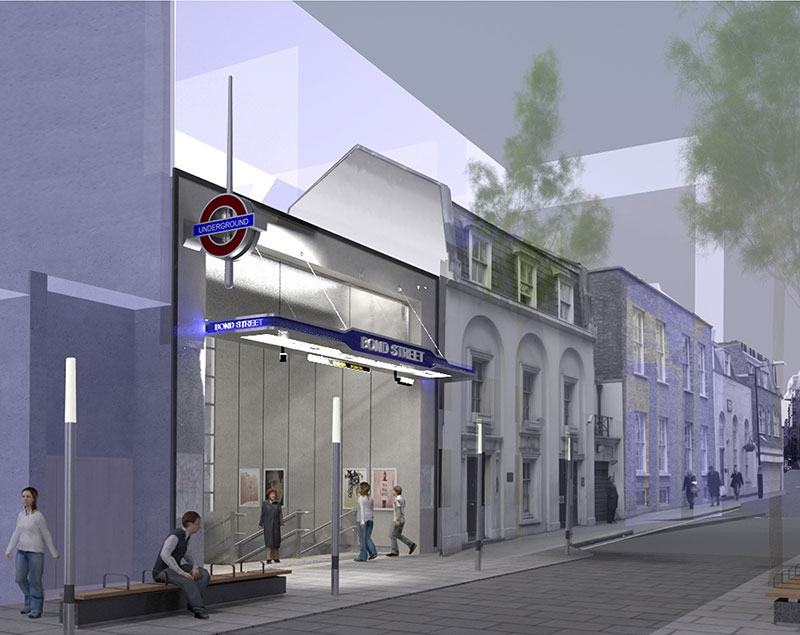
The New Marylebone Lane Entrance To Bond Street Station
Transport for London have produced a video called Bond Street station redevelopment for 2017 – virtual tour walk-through – Tube improvements.
It illustrates several features of the enlarged station.
But I can’t wait to experience the reality.
Are Murphy Group Playing A Long Game?
This news release on the Murphy Group web site is entitled Murphy Wins £60M+ London Overground Electrification Project.
Given, that it was known to be a difficult project, I don’t think I am alone in thinking that Murphy’s contract price was good value for London Overground.
Since then, progress has not been at a fast pace and some challenging problems seem to have emerged, but on whole professional commentators in magazines like Modern Railways an Rail Engineer have been broadly praising of the way the work is being done and what has so far been finished.
The troubles on the Holloway Road Bridge, which is not in Murphy’s contract, that I wrote about in Did The Project Management Go Wrong On The Holloway Road Bridge?, can’t have helped either.
I do wonder though, if the Murphy Group could be a beneficiary of the successful electrification of the Gospel Oak to Barking Line (GOBlin).
This Google Map shows the area between Gospel Oak and Kentish Town stations.
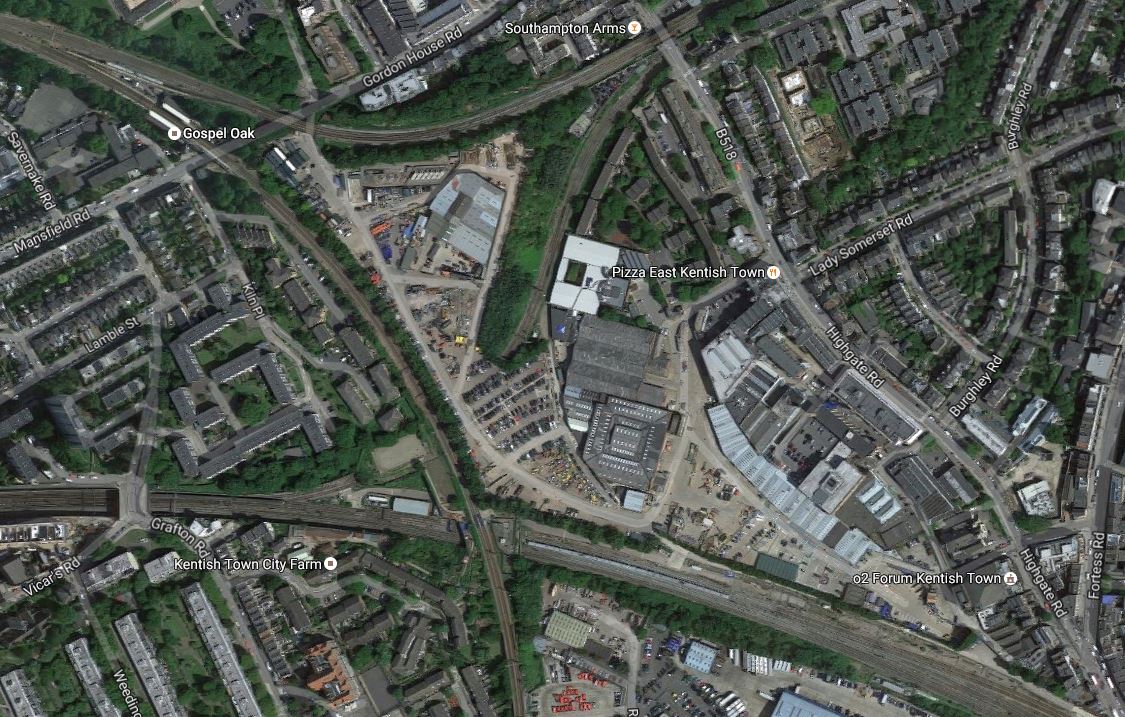
Murphy Group’s Site In Kentish Town
Note.
- Gospel Oak station in the top left, where the GOBlin meets the North London Line.
- The Midland Main Line curves across the bottom of the map, with Kentish Town station, just off the bottom right corner.
- There is another rail line (Tottenham North Curve ?) connecting the GOBlin to the Midland Main Line, that is current used by freight trains.
Between all these lines is a massive builders yard, which is the home of the Murphy Group.
In some ways giving the Murphy Group, the contract for the GOBlin upgrade and electrification, is like giving your local builder, the job of upgrading your house.
The Murphy Group have even accessed some parts of the work, by putting gates in the security fence between the railway and their yard.
This map from carto.metro.free.fr, shows the railway lines in the are.
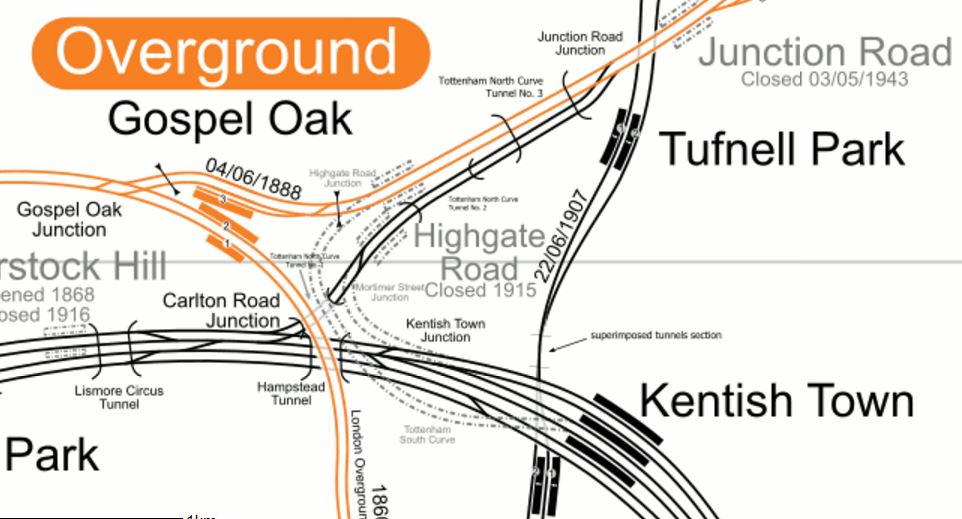
Lines Between Gospel Oak And Kentish Town
It shows how at times in the past, the rail connections from this area, were some of the most comprehensive in London.
There are already plans for some of the railways in the area.
- The Tottenham North Curve from Carlton Road Junction to Junction Road Junction is being electrified, so that electric-hauled freight trains can run between Barking and the Midland Main Line.
- Passenger services could be introduced on the Tottenham North Curve to create a second route across North London, linking Barking and Acton via West Hampstead Thameslink and the Dudding Hill Line.
- Could we even see a re-opened Highgate Road station?
I have a feeling, that all this, together with London’s enormous need for new housing will see the Murphy Group site developed, in a manner that is best for London. And the Murphy Group!
Consider.
- The development will have very good transport links.
- A reopened Highgate Road station, would be in the middle of the development.
- The development site is occupied by largely one company.
- The site is well-connected to railways for the transport of building materials and spoil.
- The site could be developed gradually, as the Murphy Group released the space.
Probably, the biggest problem would be finding the Murphy Group a new site.
It will be very interesting to see what happens on this very valuable site!
Brits Keen To Go Green But Don’t Want To Pay For It
The title of this post is the same as that of this article on Energy Live News.
It is an interesting article.
- People in London and Northern Ireland are more likely to pay a green premium.
- People in the South-East and Wales are most unlikely.
- More than one in 10 of those willing to pay more would be happy to pay an extra 31-50% for greener energy.
I think it is better value to make sure you don’t use the energy in the first place.
I also feel, that much of our housing stock can never be made energy efficient and should be knocked down and replaced with better quality housing.
East Of Wathamstow Queen’s Road Station – 16th November 2016
Don’t knock it, but the sun ruined some of these pictures.




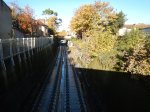
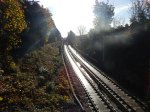

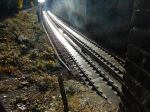

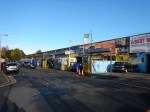

Note.
- I’m only one metre seventy, so taking pictures over a high bridge parapet iis not easy.
- Shrubland, Albert and Queen’s Roads are respectively Bridges 68. 69 and 70.
- From Bridge 70, you can get good views of the slab track.
- East of Bridge 70, there is extensive piling, that probably stabilises the cutting.
- East of Queen’s Road station, there was little evidence of overhead gantries.
- There appeared to be work going on at the Eastern end of the slab track, where the viaduct starts.
It looks to me, that there is still a lot of work to do and the planned reopening as a diesel-powered railway in February, that I wrote about in The Gospel Oak To Barking Line Is Planned To Reopen On February 6th 2017, must be in doubt.
Unless of course, all that the closure is intended to do, is get the track, bridges and viaducts, in tip-top condition for the actual electrification.
A little bird told me, that the work around Bridge 70 at Queen’s Road was particularly challenging, but there was very little evidence of work still being carried out. As the pictures show, there is slab track and lots of piling. The slab track is from Rhomberg and will hopefully last for sixty years (Modern Railways – August 2016)
It should be that the design of slab track used, is one that facilitates easy repairs if anything goes wrong.
 The Anonymous Widower