Connected Energy Wins First Order for Next-Gen Energy Storage System
The title of this post, is the same as that of this article on Renewable Energy Magazine.
This is the introductory paragraph.
Second life battery pioneer, Connected Energy will be installing the first of its new generation of optimized energy storage systems as part of Suffolk County Council’s latest project, The Hold. The Hold, a flagship heritage facility for Suffolk which is due to open later this year on the University of Suffolk’s Ipswich Campus, will house the council’s archive collection and feature a low carbon energy system of which Connected Energy’s E-STOR energy storage system will be a key part. The E-STOR will help optimize energy use and peak loads across a system including PV, EV chargers and critical HVAC, designed to create a controlled climate for the archived materials.
That certainly sounds like a good plan in a town, that I know well.
A few of my thoughts.
Second Life Renault Kangoo Batteries
This paragraph describes the system.
The new 300kW/360kWh containerized systems, which include 24 second life Renault Kangoo batteries, have benefitted from collaborative support from Renault and ABB to increase efficiencies on both the power and capacity sides of the system.
It is surely a good use of second-hand lithium-ion batteries from an electric Renault Kangoo. These batteries appear to have a capacity of 22 kWh and as only 15 kWh per battery is needed for 360 kWh, there must be a margin for refurbishing the batteries and removing any faulty cells.
Towns And Cities Like Ipswich
Ipswich is a town of around a hundred people, a hospital, a central shopping centre a small university, several office blocks, a railway station and a football team.
There must be many large towns and cities, with similar energy needs to Ipswich in the UK.
In East Anglia and Essex, there are fourteen; Basildon, Billericay, Bury St. Edmunds, Cambridge, Chelmsford, Colchester, Harlow, Harwich, Kings Lynn, Lowestoft, Norwich, Peterborough, Southend and Yarmouth
Connected Energy will have a large market to fill.
Keadby 3 Low-Carbon Power Station
This article on Business Live is entitled Huge Green Power Station Proposed By SSE As It Embraces Hydrogen And Carbon Capture.
SSE Thermal is working on a low-carbon 910 MW gas-fired power station to join Keadby and Keadby 2 power stations in a cluster near Scunthorpe.
A spokesman for SSE is quoted as saying they will not build the plant without a clear route to decarbonisation.
On this page of their web site, SSE Thermal, say this about Keadby 3.
As part of our commitment to a net zero emissions future, Keadby 3 will only be built with a clear route to decarbonisation, either using hydrogen as a low-carbon fuel, or equipping it with post-combustion carbon capture technology. The project is at the early stages of development and no final investment decision has been made.
It should also be noted that SSE Renewables have also built a wind farm at Keadby. The web site describes it like this.
Keadby Wind Farm is England’s largest onshore wind farm. This 68MW renewable energy generation site can power approximately 57,000 homes.
There are a lot of good intentions here and I think that SSE haven’t disclosed the full picture.
It would seem inefficient to use hydrogen to power a gas-fired power station to achieve zero-carbon power generation.
- If you are using hydrogen created from steam reforming of methane, this creates a lot of carbon-dioxide.
- If you are using green hydrogen produced by electrolysis, then, why don’t you store the electricity in a battery?
Perhaps, SSE are trying out a new process?
This Google Map shows the area of Keadby to the West of Scunthorpe.
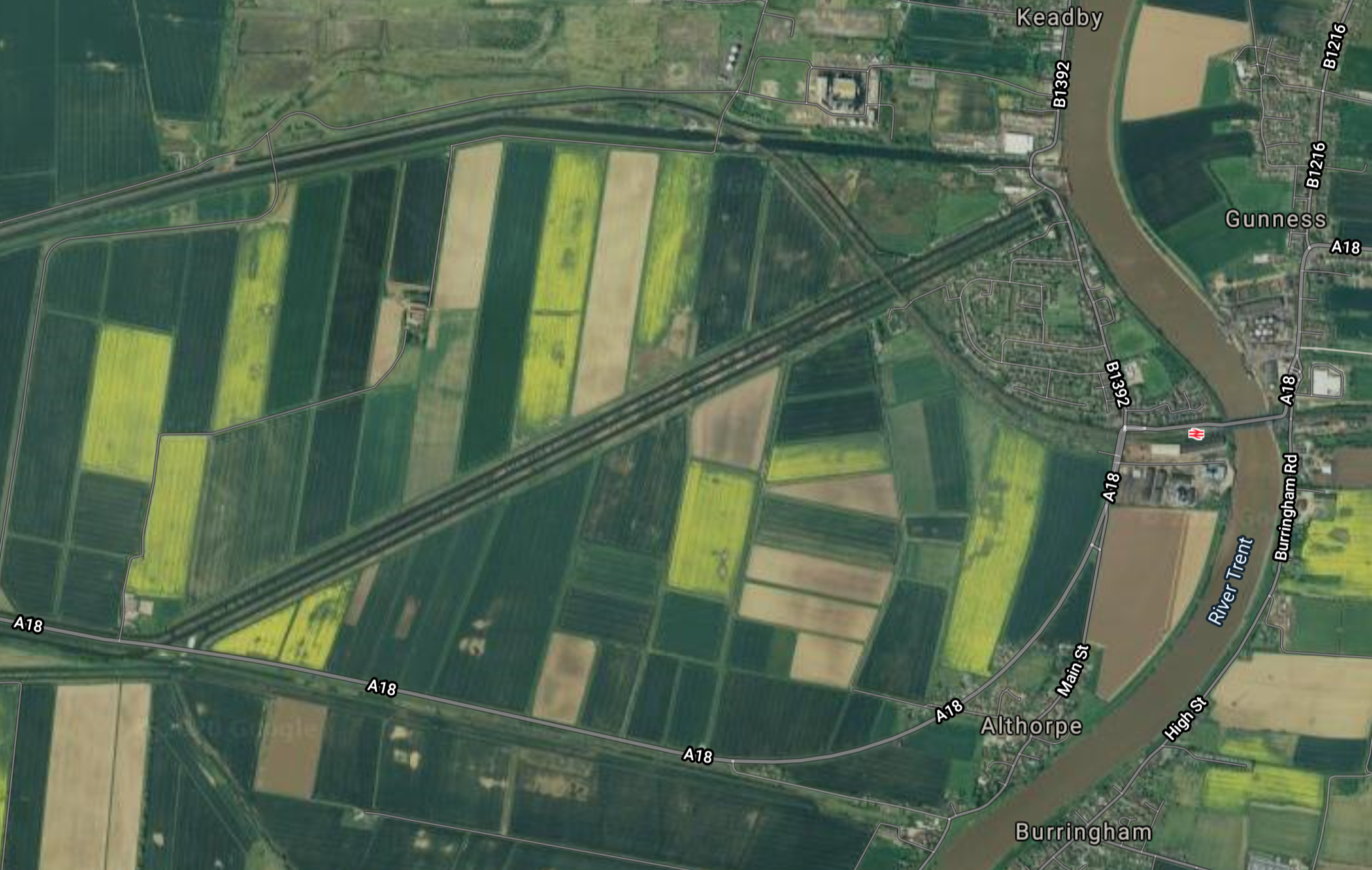
Note.
- The River Trent meandering through the area.
- Althorpe station is in the bend of the River,
- I’m fairly certain, that I remember an old airfield in the area.
- Keadby power station is a bit to the North of the waterway running West from the River and close to where the railway crosses the waterway.
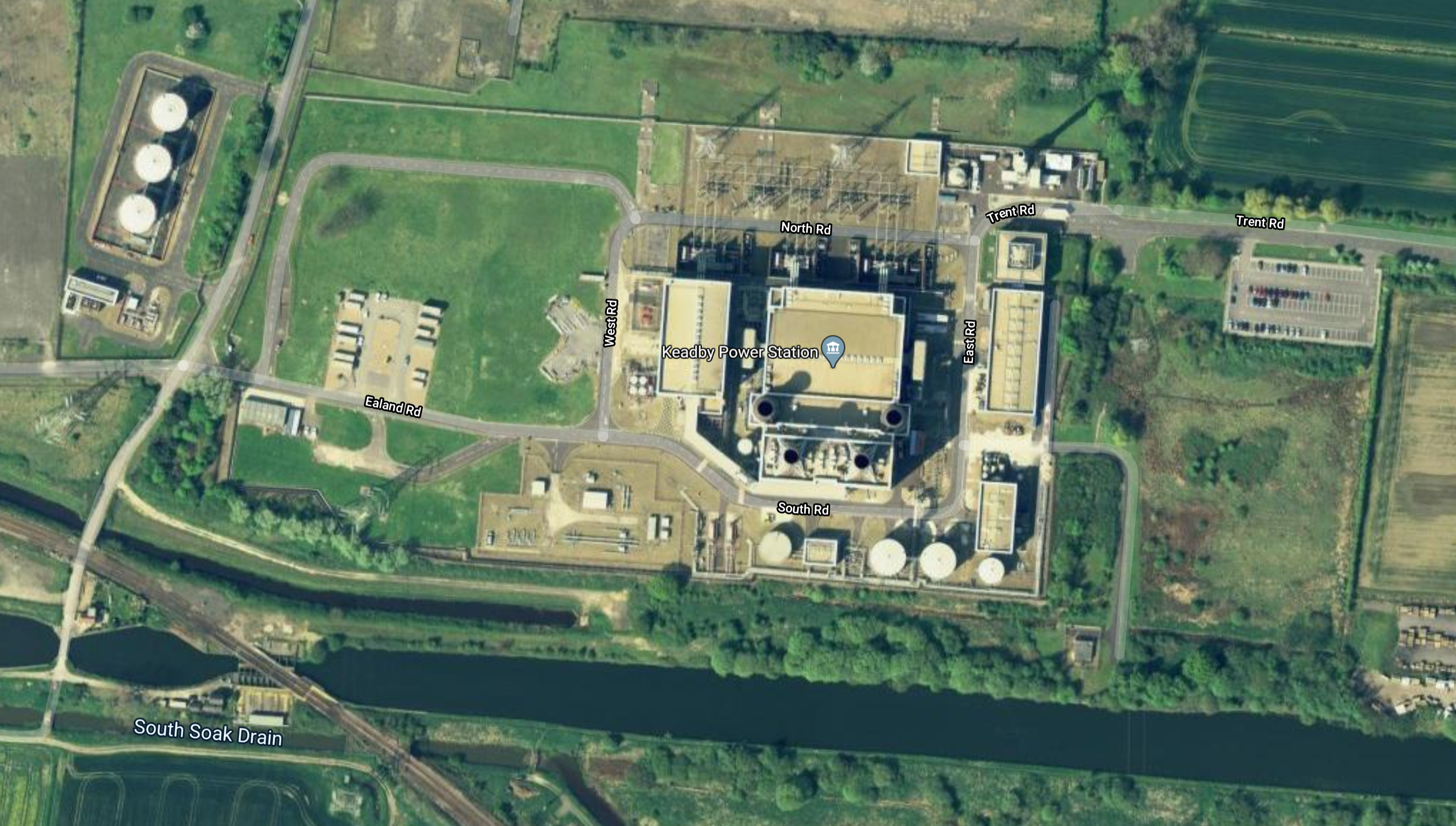
This second Google Map shows a close-up of the power station.
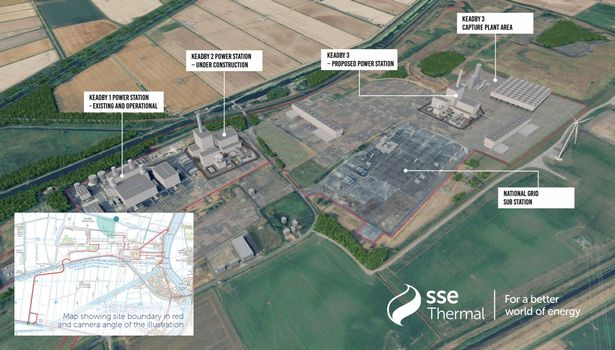
This visualisation from SSE Thermal shows how the site might look in the future.
For me the interesting location is the village of Althorpe, where C and myself had friends.
They were always getting tourists arriving in the village looking for Princess Diana’s grave!
Carbon Capture And Storage At Keadby
If SSE have three large power stations at Keadby, a shared carbon capture and storage system could be worthwhile.
- There are numerous gas fields in the area and a big gas terminal at Theddlethorpe, to where they all connect.
- I was surprised to see, that one of thee fields; Saltfleetby is owned by President Putin’s favourite gas company; Gazprom.
- Some of these fields are actually on-shore.
- The power stations probably get their gas from the same terminal.
Some of these gas fields that connect to Theddlethorpe could be suitable for storing the carbon dioxide.
As there is masses of space at Keadby, I can see more gas-fired power stations being built at Keadby.
All would feed into the same carbon capture and storage system.
If gas was needed to be imported in a liquified form, there is the Port of Immingham nearby.
Absorption Of Carbon Dioxide By Horticulture
Consider.
- Increasingly, horticulture is getting more automated and efficient.
- Automatic harvesters are being developed for crops like tomatoes and strawberries.
- Instead of storing the carbon-dioxide in worked-out gas fields, it can also be fed directly to fruit and vegetables that are being grown in greenhouses.
- Keadby is surrounded by the flat lands of Lincolnshire.
How long will it be before we see tomatoes, strawberries, peppers and cucumbers labelled as British zero-carbon products?
Offshore Hydrogen
I’ll repeat what I said in ITM Power and Ørsted: Wind Turbine Electrolyser Integration.
This is from a press release from ITM Power, which has the same title as the linked article.
This is the introductory paragraph.
ITM Power (AIM: ITM), the energy storage and clean fuel company, is pleased to share details of a short project sponsored by the Department for Business, Energy & Industrial Strategy (BEIS), in late 2019, entitled ‘Hydrogen supply competition’, ITM Power and Ørsted proposed the following: an electrolyser placed at the wind turbine e.g. in the tower or very near it, directly electrically connected to the DC link in the wind turbine, with appropriate power flow control and water supplied to it. This may represent a better design concept for bulk hydrogen production as opposed to, for instance, remotely located electrolysers at a terminal or platform, away from the wind turbine generator, due to reduced costs and energy losses.
Some points from the remainder of the press release.
- Costs can be saved as hydrogen pipes are more affordable than under-water power cables.
- The proposed design reduced the need for AC rectification.
After reading the press release, it sounds like the two companies are performing a serious re-think on how wind turbines and their links to get energy on-shore are designed.
- Will they be using redundant gas pipes to bring the hydrogen ashore?
- Will the hydrogen come ashore at Theddlethorpe and use the existing gas network to get to Keadby?
It sounds inefficient, but then the steelworks at Scunthorpe will probably want masses of hydrogen for carbon-free steel making and processing.
Boosting Power Station Efficiency
There is also a section in the Wikipedia entry for Combined Cycle Power Plant called Boosting Efficiency, where this is said.
The efficiency of CCGT and GT can be boosted by pre-cooling combustion air. This is practised in hot climates and also has the effect of increasing power output. This is achieved by evaporative cooling of water using a moist matrix placed in front of the turbine, or by using Ice storage air conditioning. The latter has the advantage of greater improvements due to the lower temperatures available. Furthermore, ice storage can be used as a means of load control or load shifting since ice can be made during periods of low power demand and, potentially in the future the anticipated high availability of other resources such as renewables during certain periods.
So is the location of the site by the Trent, important because of all that cold water?
Or will they use surplus power from the wind farm to create ice?
The Proposed North Sea Wind Power Hub
The North Sea Wind Power Hub is a proposed energy island complex on the Eastern part of the Dogger Bank.
- The Dutch, Germans and Danes are leading the project.
- Along with the Belgians, we have been asked to join.
- Some reporting on the Hub has shown, airstrips in the middle of the complex to bring the workforce to the site.
- A Dutch report, says that as much as 110 GW of wind power could be developed by 2050.
- We are also looking at installing wind farms on our section of the Dogger Bank.
Geography says, that one of the most convenient locations to bring all this electricity or hydrogen gas ashore is North Lincolnshire
A Very Large Battery
I would also put a very large battery on the site at Keadby.
One of Highview Power‘s proposed 1 GWh CRYOBatteries would be a good start. This will be four times the size of the 250 MWh CRYOBattery, which the company is currently designing and building at Carrington in Greater Manchester.
Conclusion
The three power stations at Keadby are the following sizes
- Keadby 1 – 734 MW
- Keadby 2 – 803.7 MW
- Keadby 3 – 010 MW
This adds up to a total of 2447.7 MW. And if they fit carbon capture and storage it will be zero-carbon.
Note.
- Hinckley Point C is only 3200 MW and will cost around £20 billion or £6.25 billion per GW.
- Keadby 2 power station is quoted as costing £350 million. or £0.44 billion per GW.
These figures don’t include the cost of carbon capture and storage, but they do show the relatively high cost of nuclear.
61GW Renewables And Storage Pipeline Could Bring In £125bn To Economy
I did think about calling this post something like.
- Do You Like Large Numbers?
- My Calculator Just Blew Up!
- I Don’t Believe It!
- No Wonder Rishi Sunak Has A Smile On His Face!
But I’ll use my normal introduction for this type of post!
The title of this post, is the same as that on this article of Current News.
This is the introductory paragraph.
The UK currently has a pipeline of 61GW of renewables and storage that if developed could bring in £125 billion to the UK economy.
The article also says that this pipeline could provide 200,000 jobs.
So where will this massive 61 GW of electricity come from?
- Off-shore Wind – 31.7 GW
- On-shore Wind – 11.9 GW
- Solar PV – 8.6 GW
- Storage – 8.5 GW
Where is the Nuclear Option?
iThe article also says that 18 GW of these projects are Shovel-Ready.
The figures come from UK trade association; Regen, whose Chief |Executive is the appropriately named; Merlin Hyman.
The page on the Regen web site, which is entitled Unlock Renewables For A Green Recovery, is the original document on which the Current News article is based.
Regen want three things from the Government, in return for creating all this renewable electricity capacity.
- Publish an Energy White Paper putting the UK on course for a flexible power system based on renewables and storage.
Commit to annual Contracts for Difference auctions to give investors confidence.
End the anti onshore wind policies in the English planning regime.
Some will not like the third condition.
I must go now, as I must go down the Chinese-owned Lucky Electronics Shop on Dalston Kingsland High Street to get a calculator with more digits to replace the one that blew up!
Beeching Reversal – Reinstatement Of The Beverley And York Rail Line
This is one of the Beeching Reversal projects that the Government and Network Rail are proposing to reverse some of the Beeching cuts.
The York And Beverley Line does what it says in the name.
A section in the Wikipedia entry is entitled Re-Opening Proposals and the treatment of the trackbed after closure would appear to be a case study in how not to mothball a railway.
- The original route has been built on in several places at Huntingdon, New Earswick, Pocklington and Stamford Bridge.
- A new route will have to be built to connect to the York and Scarborough Line at Haxby.
- There may also be problems at Beverley.
The only positive thing I can see, is that York City Council, want to re-open Haxby station. If this station were to be re-opened with a future-proofed design that might help in the wider scheme of reopening the Beverley and York Line.
This Google Map shows the original location of Haxby station.
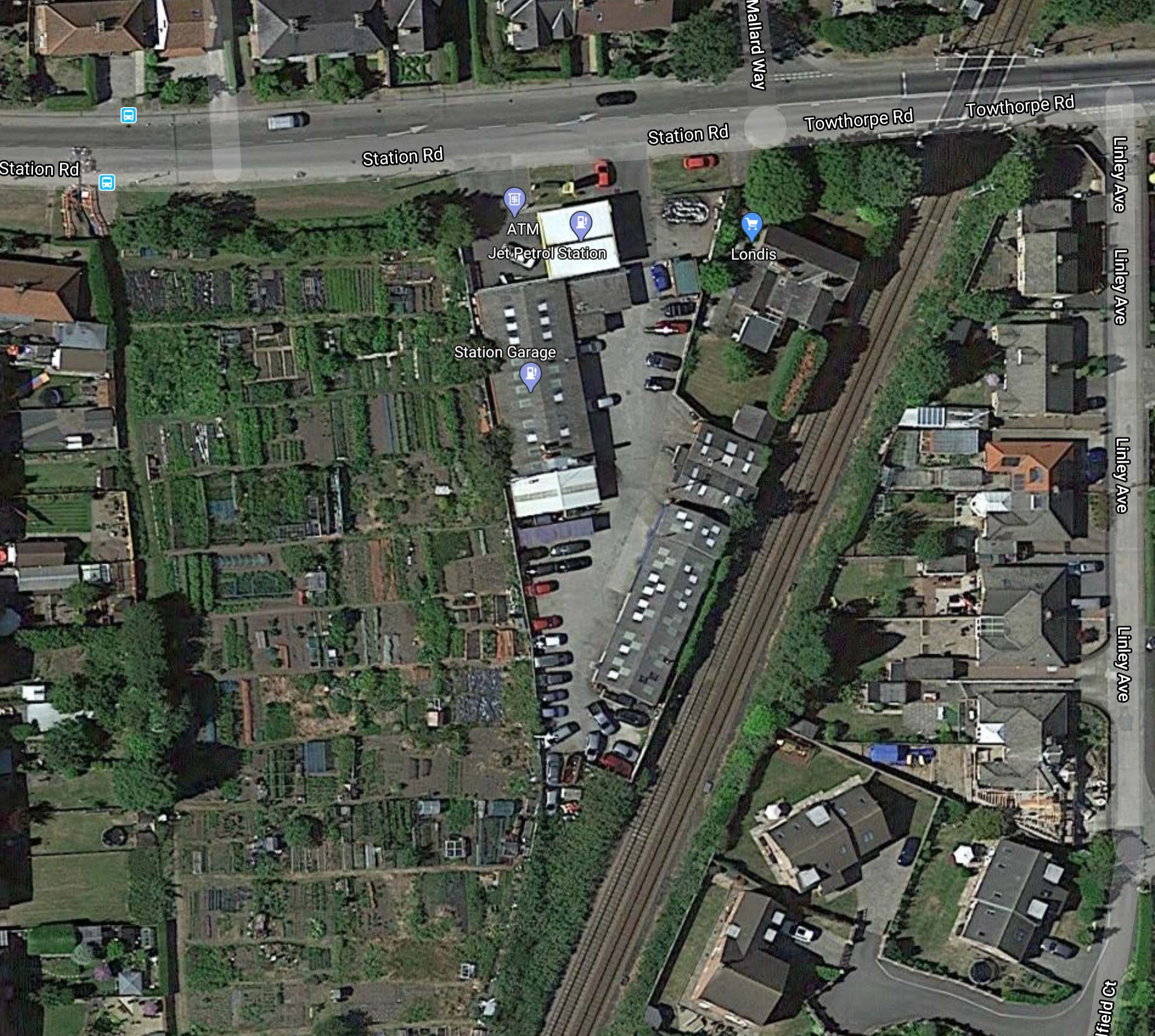
Note.
- There is a dreaded level crossing in the middle of the village, that typically has around two trains per hour (tph)
- The road going to the West at the top of the map, is called Station Road, which is a bit of a giveaway.
- The building on the triangular site is called Station garage.
- Some reports on the Internet say that allotments will be turned into car parks.
- According to Wikipedia 22,000 people live within three miles of the station site.
The station site appears to be hemmed in by housing and comments from readers on one report are complaining about car parking being a problem an definitely don’t want the station.
Wikipedia says this about the proposed service on the Beverley and York Line.
The report recommended reinstating a service from Hull via Beverley, Market Weighton, Stamford Bridge and Pocklington connecting to the York to Scarborough Line at Haxby, on a double track line with a frequency of 2 trains per hour, with intermediate stations only at Market Weighton, Pocklington and Stamford Bridge. The estimate journey time was under 1 hour.
As the Beverley and York Line can’t join the York and Scarborough Line in the middle of Haxby, would it join North or South of the town?
Joining to the North would allow the Beverley trains to call at Haxby, but that would mean the level crossing was busy with six tph.
This Google Map shows the countryside between Haxby in the North and Earswick in the South.
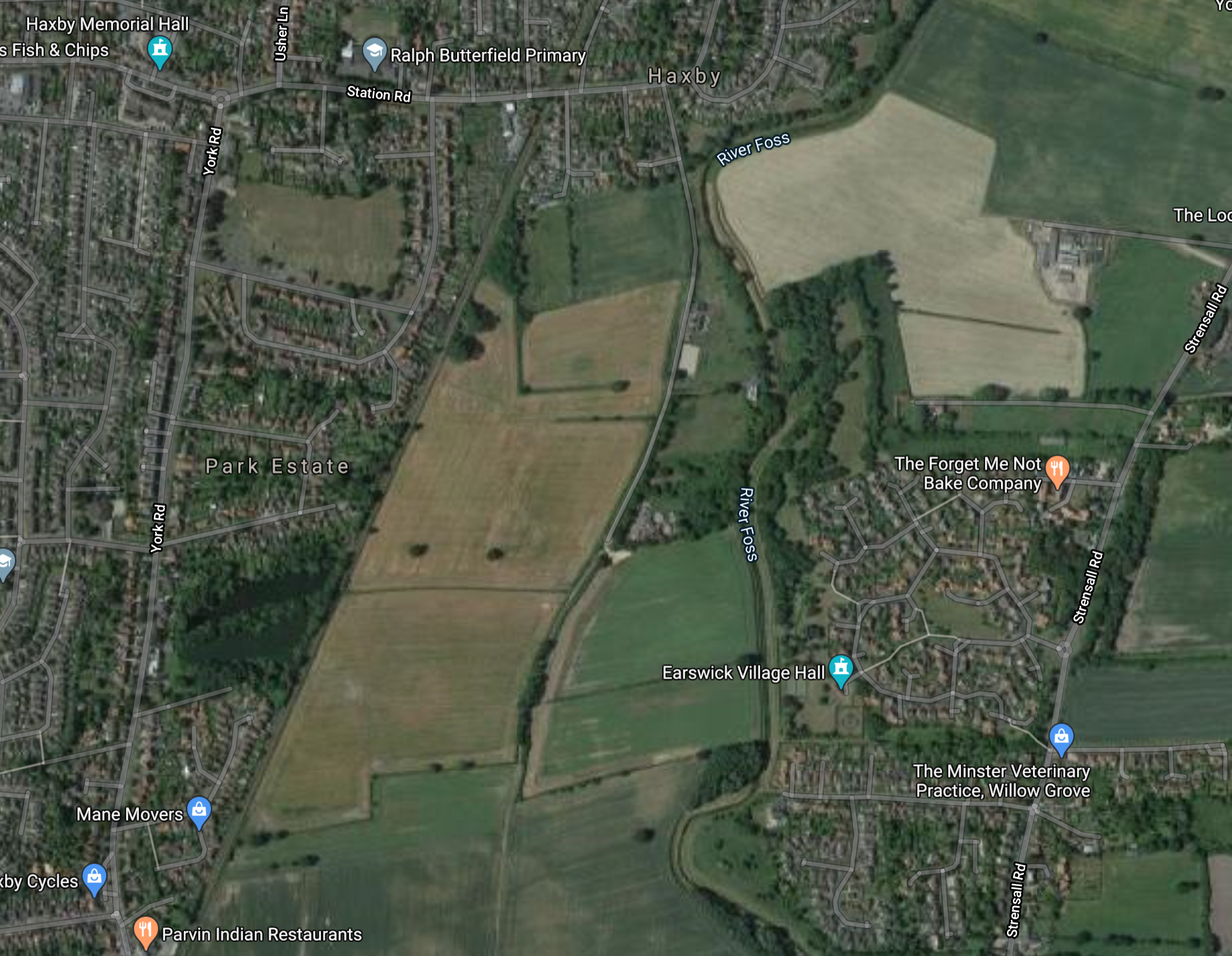
Note.
- The York and Scarborough Line going through the centre of Haxby and then passing down the West side of the light brown fields.
- York is to the South and Scarborough is to the North.
I wonder, if the Beverley and York Line could branch to the East here and skirt to the North of Earswick before continuing to Pocklington for Beverley.
Perhaps, a Park-and-Ride station could be situated, where the railway and the road called Landing Lane cross?
At Beverley, this Google Map shows how the Beverley and York Line connects to the station.
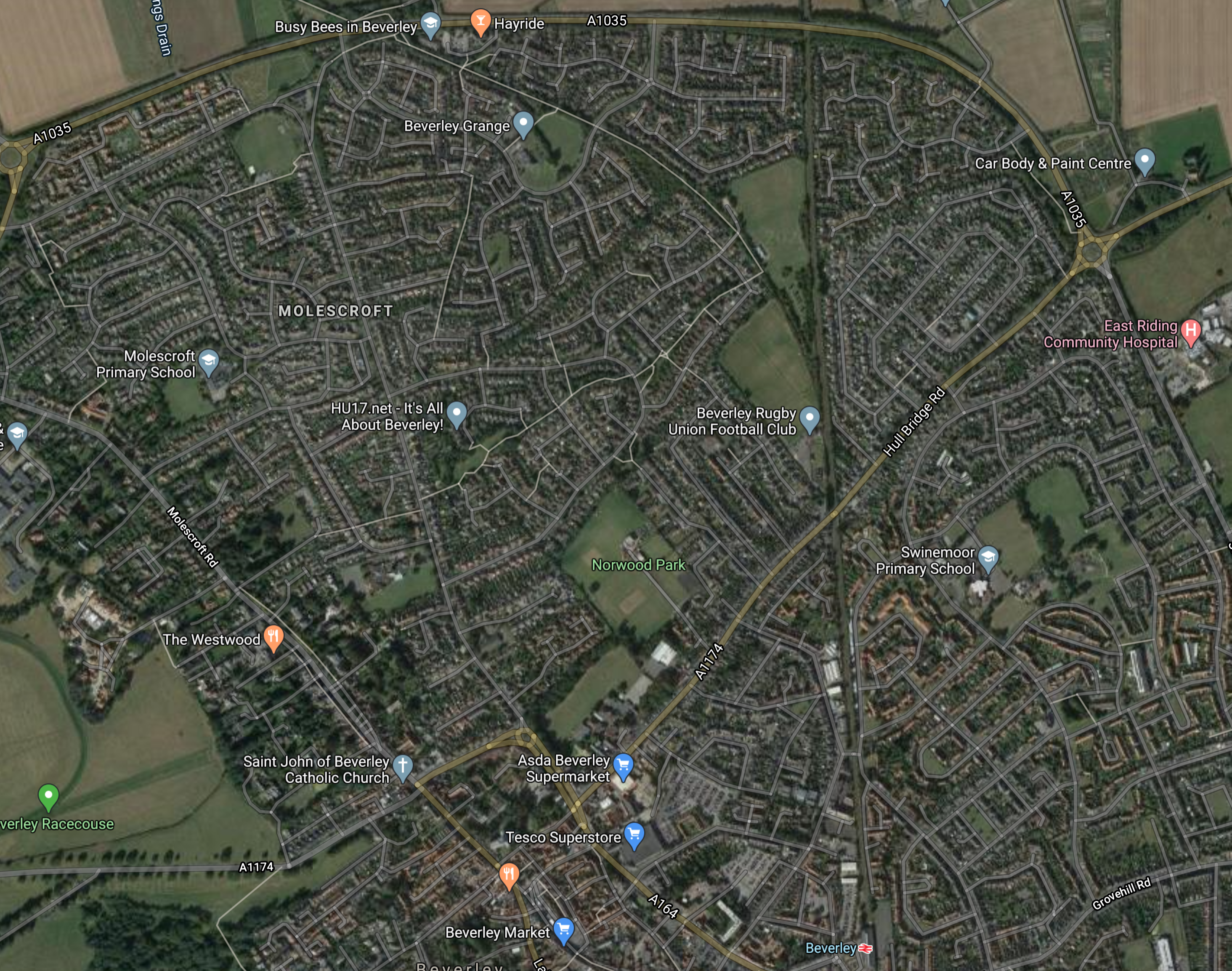
Note.
- Beverley station at the bottom of the map.
- The Hull and Scarborough running North-South through the station.
The line divides by Beverley Rugby Football Club, with the trackbed of the Beverley and York Line going off in the North-Westerly direction.
This seems a lot easier than at the York end of the route.
I have flown my virtial helicopter over much of the route between Beverley and York, and the trackbed is visible but missing in places, where construction has taken place.
Would The Route Be Single Or Double-Track?
The plans call for double track, but would it be necessary?
- There will only be two tph, that will take under an hour.
- No freight trains will use the line.
- The route is 32 miles long.
I suspect a single track would suffice, with a passing loop at Market Weighton station.
Should The Line Be Electrified?
I wouldn’t electrify the whole line, but I would electrify the following.
- Hull and Beverley, so that battery trains to and from London could top up their batteries.
- Haxby and York, so that battery trains to and from Scarborough could top up their batteries.
These two short stretches of electrification would allow battery electric operation between Hull and York, trains could charge their batteries at either end of the route.
Electrification Between Hull And Beverley
Consider.
- Hull Trains extend their London and Hull services to Beverley.
- Hull and Beverley are just over eight miles apart.
- Trains to and from London Kings Cross use the electrification on the East Coast Main Line to the South of Temple Hirst Junction.
- Hull and Temple Hirst Junction are thirty-six miles apart.
- Hull Trains and LNER use Hitachi Class 800 or Class 802 electro-diesel trains on services between London Kings Cross and Hull.
Hitachi’s proposed battery-electric conversion of these trains, would have a range of 56 miles, according to this infographic.

I have flown my helicopter along the route and counted the following.
- Level crossings – 5
- Modern road bridges – 5
- Footbridges – 5
- Other bridges – 5
- Stations – 1
Nothing looked too challenging.
In my view electrification between Hull and Beverley and at convenient platforms at both stations, would be a simple way of decarbonising rail travel between London and Hull.
If this electrification were to be installed, distances from the electrification between Hull and Beverley, these would be the distances to be covered on battery power to various places.
- Bridlington – 23 miles
- Doncaster via Goole – 41 miles
- Leeds – 52 miles
- Neville Hill Depot – 49 miles
- Scarborough – 45 miles
- York – 52 miles
Note.
- All of these places would be in range of a fully-charged Hitachi battery electric train running to and from Hull.
- Of the destinations, only Bridlington and Scarborough, is not a fully-electrified station.
- One of the prerational problems in the area, is that due to a lack of electrification to the East of Neville Hall Depot, electric trains from York and Hull have difficulty reaching the depot. Trains with a battery capability won’t have this problem.
- Hull and Beverley and a lot of stations in the area, would only be served by electric trains, with a battery capability.
There would be a large decrease in pollution and emissions caused by passenger trains in the area.
Electrification Between Haxby And York
Consider.
- York and Haxby are 4 miles apart.
- York and Scarborough are 42 miles apart.
- York and Beverley are 32 miles apart.
Note that unlike at Beverley, there is no need to electrify the end of the route, as trains can be charged in the turnround at York.
With a charging facility at Scarborough, the Class 802 trains of TransPennine Express could work this route if fitted with batteries.
Could Lightweight Electrification Be Used?
Electrification gantries like these have been proposed for routes, where the heavy main-line gantries would be too intrusive.
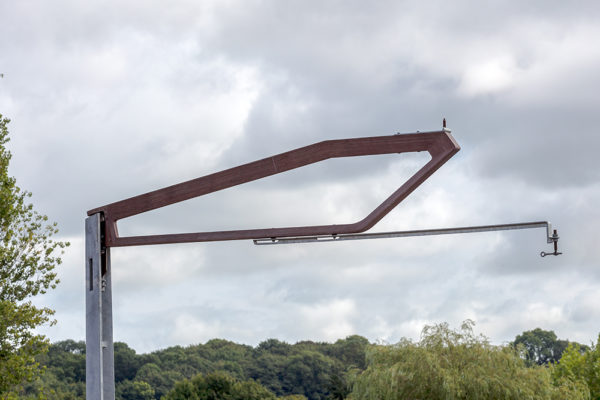
They could have a place in the rebuilding of lines like Beverley and York.
Trains Between York And Beverley
The UK’s railways need to be decarbonised before 2040.
As a train delivered today, would probably last forty years, I think it would be prudent to only introduce zero-carbon trains to the network, where they are able to run the proposed services.
There is no doubt in my mind, that all these local services in East Yorkshire could be run using battery-electric trains with a 56 mile range.
- Hull and Doncaster
- Hull and Leeds
- Hull and Neville Hill Depot
- Hull and Scarborough
- Hull and York via Beverley and Market Weighton
- Hull and York via Selby
- York and Scarborough
The only electrification needed would be as follows.
Electrification between Hull and Beverley.
Electrification of some platforms at Beverley and Hull stations.
Some form of charging at Scarborough.
Charging may also be needed at Bridlington station.
The trains needed for the route seem to fit Hitachi’s specification well and a Class 385 train to the following specification, would do a highly capable job.
- Three or four-cars.
- Batteries for a 56 mile range.
- 90-100 mph operating speed.
I’m also sure that Bombardier, CAF and Stadler could also provide a suitable train.
Could Tram-Trains Be Used?
I feel that they could be used successfully and might enable cost savings on the substantial rebuilding of the route needed.
- Lighter weight structures.
- Single track with passing places.
- Tramway electrification or battery.
- Less vidual intrusion.
- The service could also have more stops.
Perhaps too, it could go walkabout in Hull City Centre to take passengers to and from Hull station.
Conclusion
It is rebuilding the tracks between Beverley and York, that will be difficult in the reopening of this line, which with hindsight should have not been vandalised by British Rail.
But even, if the Beverley and York Line is not re-opened, it does look that if Beverley and Hull were to be electrified, it would enable a network of battery electric zero-carbon trains in East Yorkshire and allow battery electric trains to run between Kings Cross and Hull.
South Wales Metro Railway Works Imminent
The title of this post, is the same as that of this article on Rail Technology Magazine.
Work starts on the third of August and is described in this sentence,
TfW is now starting to build the South Wales Metro which will see major infrastructure works including the electrification of over 170km of track mostly with overhead lines, station and signalling upgrades and the construction of at least five new stations.
It will be one of the most innovative electrification projects ever performed in the UK, as it uses discontinuous electrification.
I explained discontinuous electrification in More On Discontinuous Electrification In South Wales, where I said this.
In the July 2018 Edition of Modern Railways, there is an article entitled KeolisAmey Wins Welsh Franchise.
This is said about the electrification on the South Wales Metro.
KeolisAmey has opted to use continuous overhead line equipment but discontinuous power on the Core Valley Lnes (CVL), meaning isolated OLE will be installed under bridges. On reaching a permanently earthed section, trains will automatically switch from 25 KVAC overhead to on-board battery supply, but the pantograph will remain in contact with the overhead cable, ready to collect power after the section. The company believes this method of reducing costly and disruptive engineering works could revive the business cases of cancelled electrification schemes. Hopes of having money left over for other schemes rest partly on this choice of technology.
Other points made include.
-
- A total of 172 km. of track will be electrified.
- The system is used elsewhere, but not in the UK.
- Disruptive engineering works will be avoided on fifty-five structures.
- Between Radyr and Ninian Park stations is also proposed for electrification.
Nothing is said about only electrifying the uphill track, which surely could be a way of reducing costs.
I wrote the last sentence, as surely coming down the hills, the trains can be powered by Newton’s friend.
The New Stations
This article on Business Live, gives the list of new stations and their completion dates.
- Crwys Road – End of 2022
- Loudoun Square – End of 2023
- Cardiff Bay – End of 2023
- Treforest Estate – End of 2025
- Gabalfa – 2028
If the builders crack on as they did at Horden station, I wouldn’t be surprised to see those dates achieved, with time to spare.
Electro-Diesel Tram-Train Order Expanded To Support Service Increase
The title of this post, is the same as that of this article on Railway Gazette.
This is the introductory paragraph.
National passenger operator MÁV-Start has exercised an option for Stadler’s Valencia plant to supply a further four Citylink electro-diesel tram-trains for the route being developed to link Hódmezővásárhely with Szeged.
The reason, I am posting this, is that I feel the use of diesel tram-trains may have applications in this country.
- The Class 399 tram-trains in Sheffield and the Class 398 tram-trains ordered for the South Wales Metro are both members of the Citylink family, that were built or will be built in Stadler’s Valencia plant.
- The Class 398 tram-trains will have batteries to extend the route on routes without electrification.
Perhaps, if they ran on bio-diesel, they may have applications, where electrification would be difficult or inappropriate and the distance is too long for a Citylink with batteries.
Financing Secured To ‘Enable Rapid Development’ Of Norway’s First Lithium Battery Cell Gigafactory
The title of this post, is the same as that of this article on Energy Storage News.
The article says that the gigafactory’s biggest competitor will be in Sweden.
With companies in the UK, like Hyperdrive Innovation, Gore Street Energy Fund and others developing massive demand for batteries, perhaps we should build our own gigafactory?
This article on Energy Storage News is entitled More Money For Lithium Exploration In Cornwall.
This is the introductory paragraph.
Cornish Lithium has successfully raised over £826,000 from shareholders to continue exploration for lithium in Cornwall, in both geothermal waters and in hard rock, and will build on the successful drilling programmes that concluded earlier this year.
I wrote about Cornish Lithium in How To Go Mining In A Museum.
Could an unusual tale becoming to a successful conclusion?
Conclusion
I think we can trust the Cornish, Norwegians and Swedes to ensure, we have enough lithium-ion batteries.
Exeter City Council Builds Its First Solar And Battery Storage Project
The title of this post, is the same as that of this article on Energy Live News.
This paragraph describes the scheme.
The plant, which had its preparatory work finished recently, will be built on an inactive landfill site and will comprise of a 1.2MW array of 3,702 solar photovoltaic (PV) modules, two battery storage containers and an electrical switch room.
I do think, this is a superb use for a old landfill site.
As I believe that some landfill sites still give off methane for many years, if this is the case, this can surely continue.
The scheme will also include a 1 MW/2 MWh battery and will be geared to providing power to a council operation’s facility and in the future to supporting an electric fleet.
This is a superb example of how to turn an unwanted toxic liability into a green asset, with several benefits.
I have not heard of something like this before, but by searching the list of solar and energy-from-waste power sites in the UK, I found a cluster around the M5 to the North of the village of Puriton.
This Google Map shows the area.
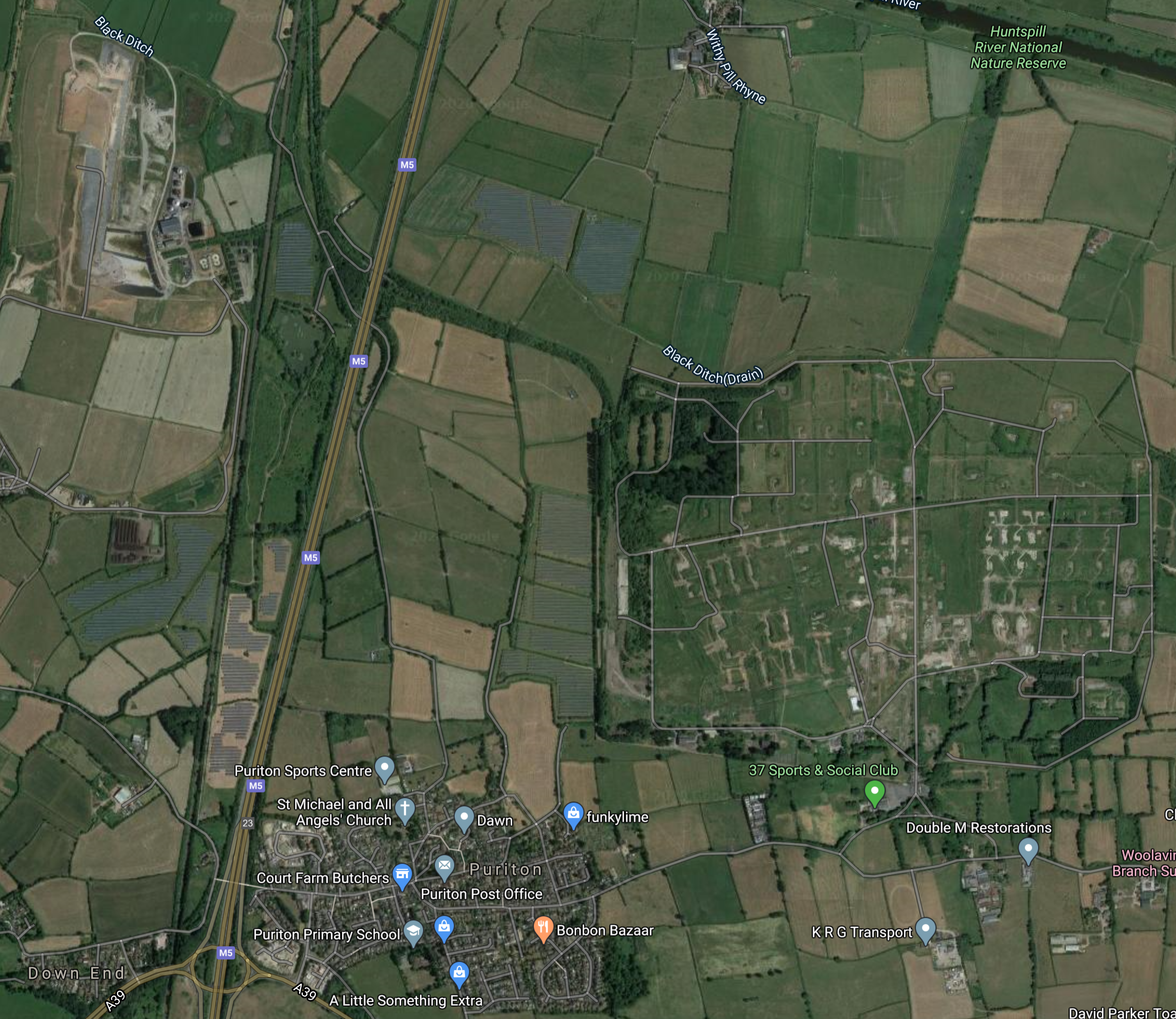
Note.
- The village of Puriton to the East of the Junction 23 of the M5, which is a forest of blue dots.
- The various solar farms showing as a blue-violet field. I can count fourteen separate fields.
In total, there are about half-a-dozen renewable energy producers in the area generating up to 25 MW of electricity.
The area to the North-East of the village with all the white dots, just above the green one, is the former Royal Ordinance Factory Bridgewater, which I’m sure solar farmers would like to get their hands on.
Would this become a modern version of swords into ploughshares?
Natron Energy, Developer Of Sodium-Ion Batteries, Raises $35M As Investment In Storage Surges
The title of this post, is the same as that of this article on pv Magazine.
This is the introductory paragraph.
The startup is building a battery using Prussian blue analogue electrodes and a sodium-ion electrolyte. Investors include ABB Technology Ventures, NanoDimension Capital, Volta Energy Technologies, Chevron, Khosla Ventures, and Prelude Ventures.
But what are Prussian Blue analogue electrodes?
Looking up Prussian Blue, it is more than just an colour used by artists, with some interesting chemistry.
Natron Energy have this mission statement on their web site.
Natron Energy (formerly Alveo Energy) is an energy storage company that is developing a new high power, long cycle life, low-cost battery technology for industrial applications. Natron’s batteries offer higher power density, faster recharge, and longer cycle life than incumbent technologies. They can be economically produced from commodity materials on existing cell manufacturing lines. Natron is backed by leading venture capital investors and has received support from ARPA-E.
Digging further, the company appears to be a spin-off from Stanford University.
Conclusion
It does appear, that if you have a feasible idea in energy storage, that you can get backing from names that people have heard of.
Beeching Reversal – South Yorkshire Joint Railway
This is one of the Beeching Reversal projects that the Government and Network Rail are proposing to reverse some of the Beeching cuts.
This railway seems to have been forgotten, as even Wikipedia only has a rather thin entry for the South Yorkshire Joint Railway.
The best description of the railway, that I’ve found is from this article in the Doncaster Free Press, which is entitled South Yorkshire Railway Line, Which Last Carried Passengers 100 Years Ago Could Be Reopened.
This is said.
The line remains intact, and recently maintained, runs from Worksop through to Doncaster, via North and South Anston, Laughton Common/Dinnington and Maltby.
I jave got my helicopter out and navigating with the help of Wikipedia, I have traced the route of the South Yorkshire Joint Railway (SYJR) between Worksop and Doncaster.
Shireoaks Station
This Google Map shows the Southern end of the SYJR on the Sheffield and Gainsborough Central Line between Shireoaks and Kiveton Park stations.
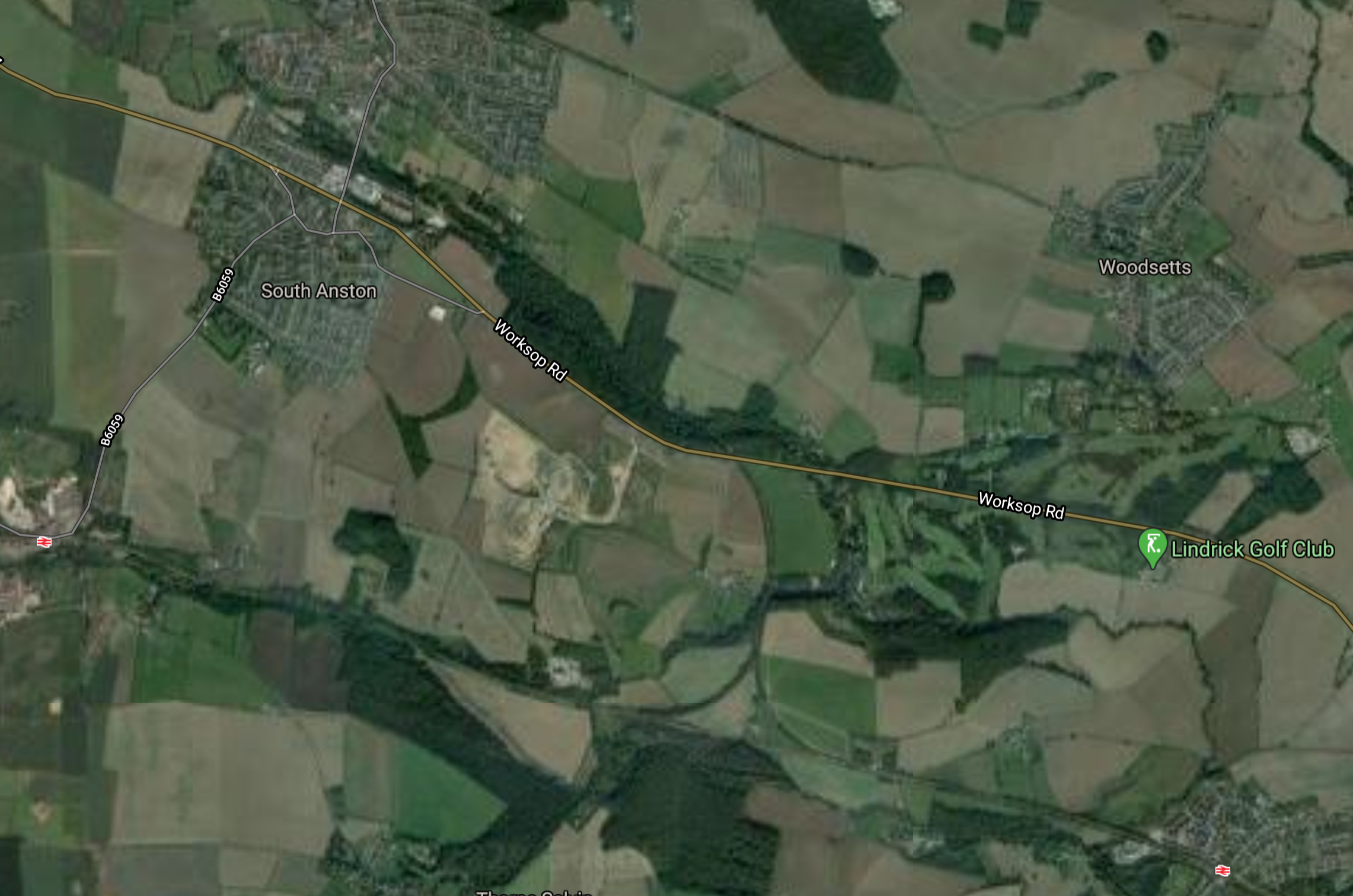
Note.
- Shireoaks station is in the East.
- Kiveton Park station is in the West.
- The SYJR starts at the triangular junction in the middle of the map.
- Lindrick Golf Club, where GB & NI, won the Ryder Cup in 1957 is shown by a green arrow to the North of Shireoaks station.
- The original passenger service on the SYJR, which closed in the 1920s, appears to have terminated at Shireoaks station.
The line immediately turns West and then appears to run between the villages of North and South Anston.
Anston Station
This Google Map shows the location of Anston station.
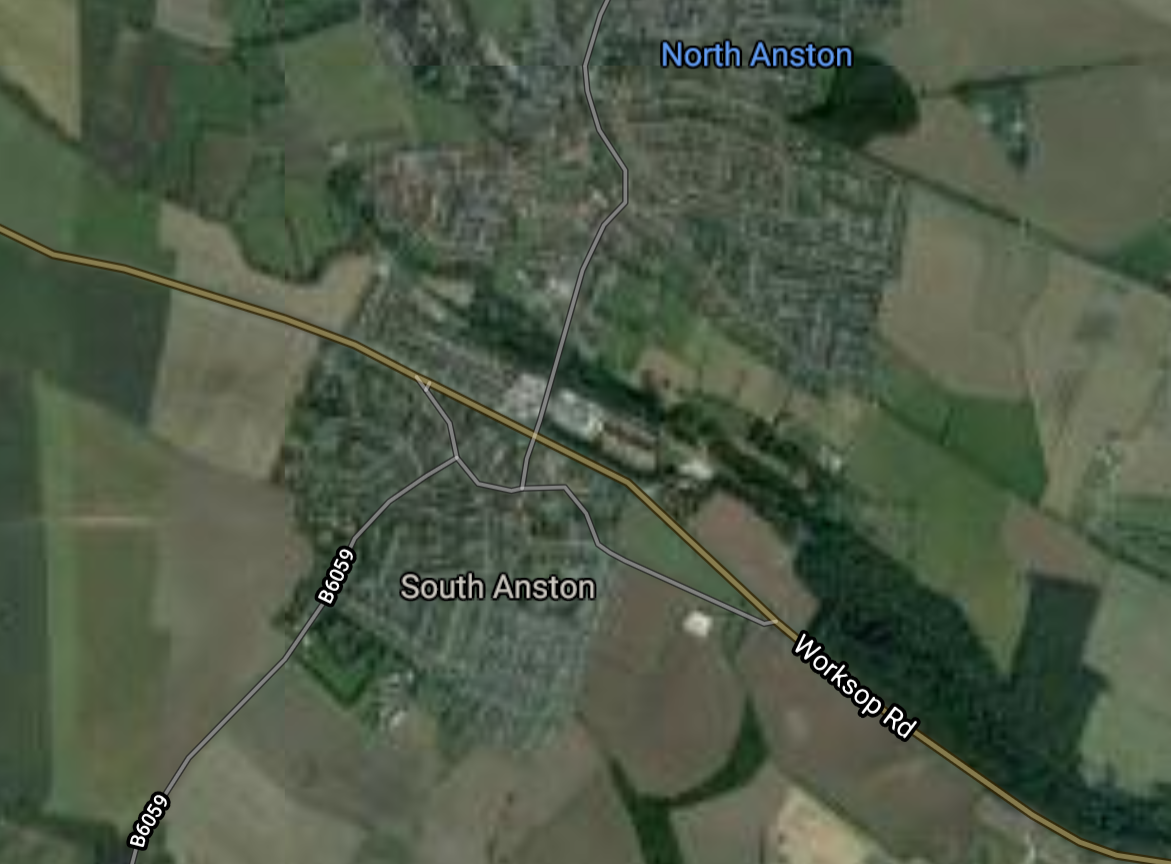
Note that the SYJR goes between the two villages and runs along the North side of the wood, that is to the North of Worksop Road.
Dinnington & Laughton Station
This Google Map shows the location of the former Dinnington & Laughton station.
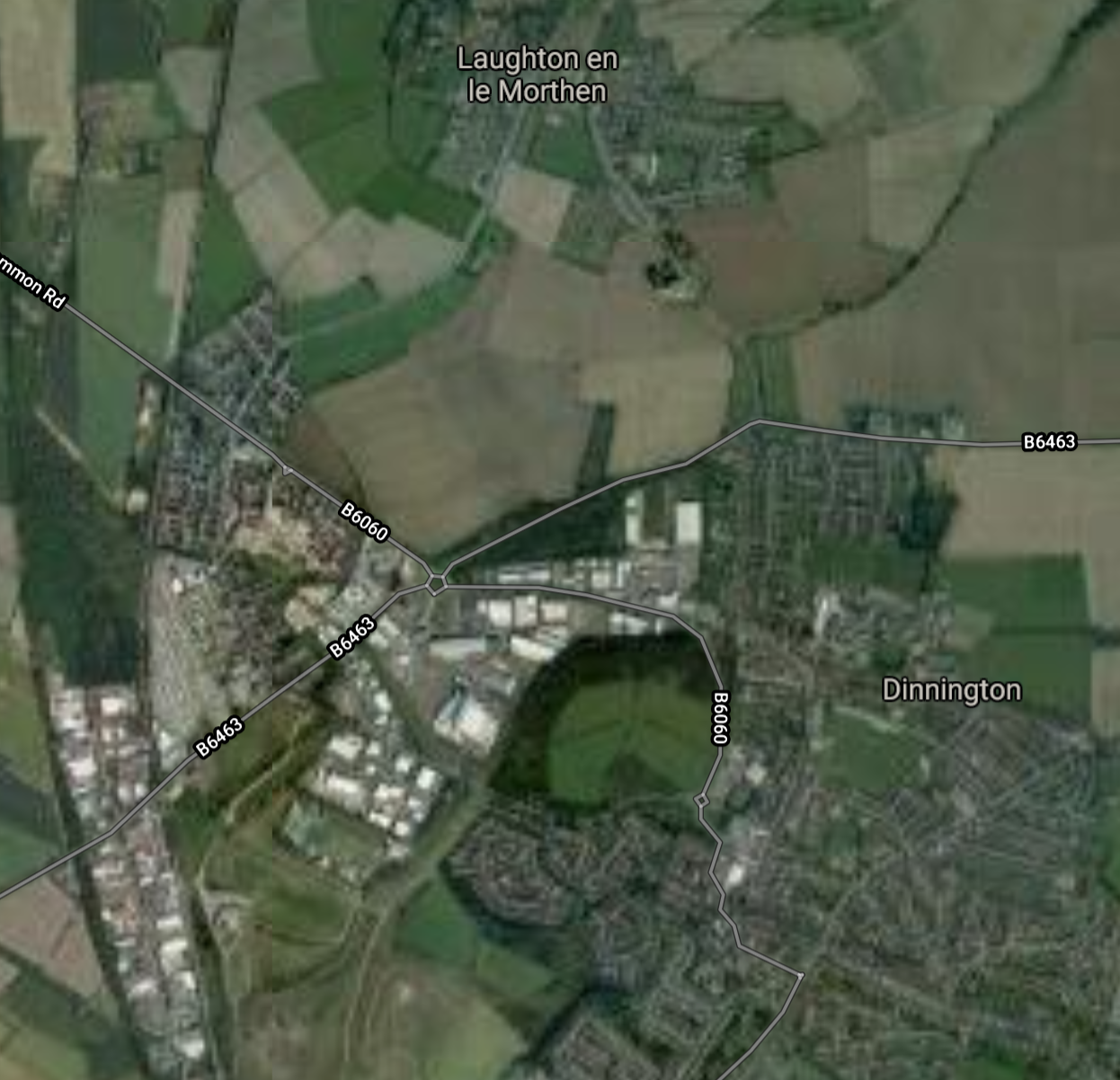
Note that the SYJR goes to the west side of both villages, so it would have been quite a walk to the train.
Maltby Station
This Google Map shows the location of the former Maltby station.
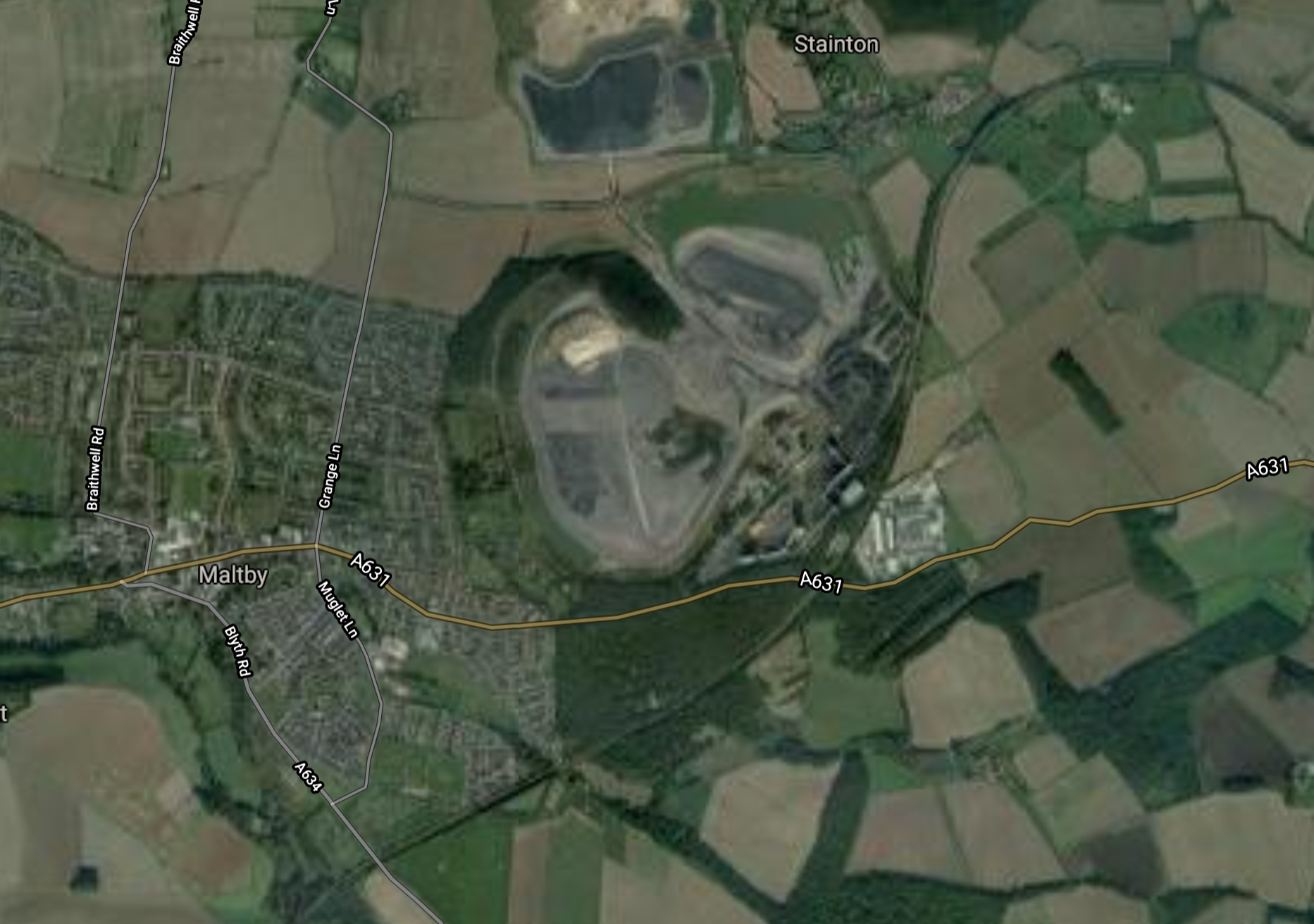
Note.
- The SYJR goes around the South side of the village.
- The remains of the massive Maltby Main Colliery, which closed several years ago.
I wonder if they fill the shafts of old mines like this. if they don’t and just cap them, they could be used by Gravitricity to store energy. In Explaining Gravitricity, I do a rough calculation of the energy storage with a practical thousand tonne weight. Maltby Main’s two shafts were 984 and 991 metres deep. They would store 2.68 and 2.70 MWh respectively.
It should be noted that Gravitricity are serious about 5.000 tonnes weights.
Tickhill & Wadworth Station
This Google Map shows the location of the former Tickhill & Wadworth station.
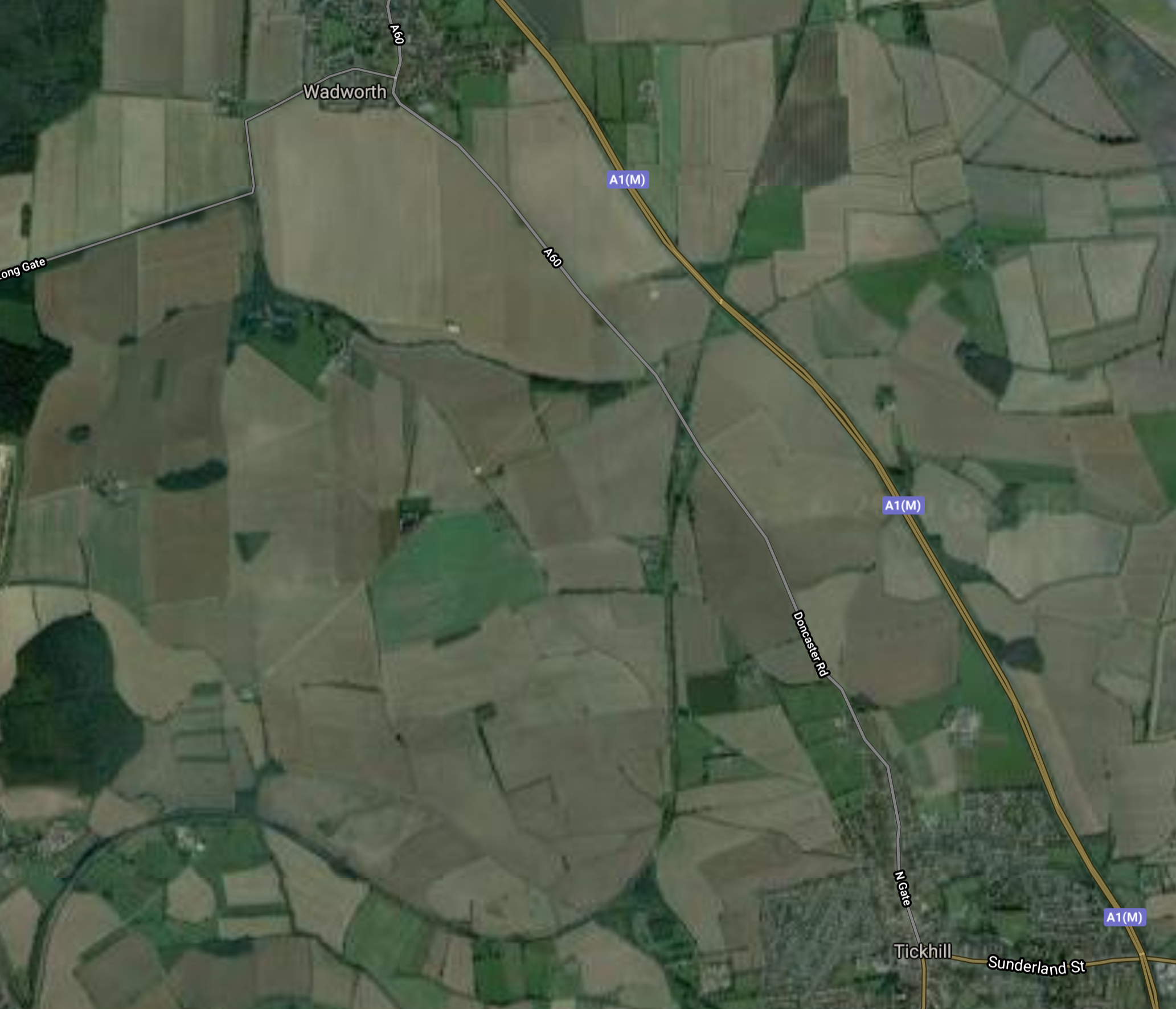
Note.
- Tickhill is in the South and Wadworth is in the North.
- Both villages are to the West of the A1 (M)
- The SYJR runs in a North-Easterly direction between the villages.
The station appears to have been, where the minor road and the railway cross.
Doncaster iPort
The SYJR then passes through Doncaster iPort.

Note.
- The iPort seems to be doing a lot of work for Amazon.
- The motorway junction is Junction 3 on the M18.
- The SYJR runs North-South on the Western side of the centre block of warehouses.
This is Wikipedia’s introductory description of the iPort.
Doncaster iPort or Doncaster Inland Port is an intermodal rail terminal; a Strategic Rail Freight Interchange, under construction in Rossington, Doncaster at junction 3 of the M18 motorway in England. It is to be connected to the rail network via the line of the former South Yorkshire Joint Railway, and from an extension of the former Rossington Colliery branch from the East Coast Main Line.
The development includes a 171-hectare (420-acre) intermodal rail terminal to be built on green belt land, of which over 50 hectares (120 acres) was to be developed into warehousing, making it the largest rail terminal in Yorkshire; the development also included over 150 hectares (370 acres) of countryside, the majority of which was to remain in agricultural use, with other parts used for landscaping, and habitat creation as part of environment mitigation measures.
It ;looks like the SYJR will be integrated with the warehouses, so goods can be handled by rail.
Onward To Doncaster
After the iPort, the trains can take a variety of routes, some of which go through Doncaster station.
I have some thoughts on the South Yorkshire Joint Railway (SYJR).
Should The Line Be Electrified?
This is always a tricky one, but as there could be a string of freight trains running between Doncaster iPort and Felixstowe, something should be done to cut the carbon emissions and pollution of large diesel locomotives.
Obviously, one way to sort out Felixstowe’s problem, would be to fill in the gaps of East Anglian electrification and to electrify the Great Northern and Great Eastern Joint Line between Peterborough and Doncaster via Lincoln. But I suspect Lincolnshire might object to up to fifteen freight trains per hour rushing through. Even, if they were electric!
I am coming round to the believe that Steamology Motion may have a technology, that could haul a freight train for a couple of hours.
These proposed locomotives, which are fuelled by hydrogen and oxygen, will have an electric transmission and could benefit from sections of electrification, which could power the locomotives directly.
So sections of electrification along the route, might enable the freight trains to go between Felixstowe and Doncaster iPort without using diesel.
It should be said, that Steamology Motion is the only technology, that I’ve seen, that has a chance of converting a 3-4 MW diesel locomotive to zero carbon emissions.
Many think it is so far-fetched, that they’ll never make it work!
Electrification of the line would also enable the service between Doncaster and Worksop to be run by Class 399 tram-trains, which are pencilled in to be used to the nearby Doncaster Sheffield Airport.
What Rolling Stock Should Be Used?
As I said in the previous section, I feel that Class 399 tram-trains would be ideal, if the line were to be electrified.
Also, if the line between Shireoaks and Kiveton Park stations were to be electrified to Sheffield, this would connect the South Yorkshire Joint Line to Sheffield’s Supertram network.
Surely, one compatible tram-train type across South Yorkshire, would speed up development of a quality public transport system.
A service could also be run using Vivarail’s Pop-up Metro concept, with fast charging at one or two, of any number of the stations.
Conclusion
This seems to be a worthwhile scheme, but I would like to see more thought on electrification of the important routes from Felixstowe and a unified and very extensive tram-train network around Sheffield.
 The Anonymous Widower