London Air Ambulance Gets A Brain Scanner
The BBC are running a story this morning about the London Air Ambulance having a portable brain scanner and that they are able to scan injured patients on the way to hospital.
I’ve had a few brain scans in my time, but I can’t imagine one of the machines that have scanned me, being air-transportable in anything less than a C-130 Hercules.
But search the Internet and you find the device. It’s called an InfraScanner. It works using the same infra-red spectrum as a television remote control.
This superb piece of medical engineering, or others based on the same technology, must end up in the bag of every A&E doctor, or those who work in areas where there is a high risk of brain injuries, like sporting events or combat zones.
Fasciitis In My Foot
I have got fasciitis in my right foot. It has nothing to do with my current conditions, as I have had it at odd times over my lifetime.
The last time was probably about twelve or fifteen years ago and it was a lot worse than my current bout.
A chiropodist and my doctor have both recommended rolling a cold drinks can with my foot.
I keep the tin in the fridge. Incidentally, I chose the tomatoes as it is more robust than say a can of Coke.
Doing it on a carpet is easier too!
Let’s hope it all works!
Incidentally, are there any other words with a double-i in the middle? You have a few plurals like radii with the letters at the end.
Sounds like a Pointless question to me!
Why The London Tramlink Should Be Extended To The Royal Marsden Hospital
One of my Google Alerts picked up this article in the Sutton Guardian entitled Bunker for breakthrough cancer therapy machine could fit 24 Routemaster buses.
It is about the creation of a concrete bunker at the Royal Marsden Hospital to house a cross between an MR Linac machin which is decribed like this here on the Institute for Cancer Research web site.
The MR Linac combines two technologies – an MRI scanner and a linear accelerator – to precisely locate tumours, tailor the shape of X-ray beams in real time, and accurately deliver doses of radiation even to moving tumours.
All this leads to more and more patients going to the Royal Marsden Hospital in Sutton to get treatment.
As many will not be in the best of health and would not relish a stressful journey, surely now is the time to build extension A of the London Tramlink to Sutton and the Hospital. This map shows the current proposal.
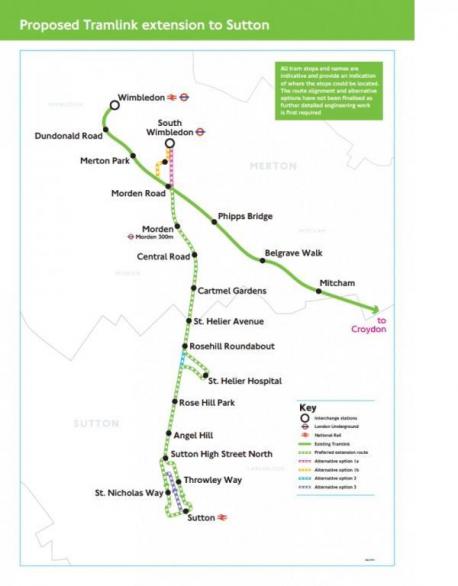
St. Helier Tramlink
The Royal Marsden Hospital is South of Sutton.
As Sutton is a Thameslink station, this Tramlink extension will give access to the Royal Marsden from a large area of London and the South East.
Glasgow Bin Lorry Driver Should Have Been Charged
According to this article on the BBC web site, a former prosecutor has said that the driver of the Glasgow bin lorry, that killed six people should have been charged. The report starts like this.
A former senior prosecutor has strongly criticised the decision not to charge the driver at the centre of the Glasgow bin lorry tragedy.
Brian McConachie QC said there was sufficient evidence to prosecute Harry Clarke.
He said the Crown Office had “jumped the gun” in not pressing charges.
I feel very strongly about this. After I had my stroke, my eyesight was terrible and I decided that to start driving again would not be a responsible thing to do.
My current GP, who has seen me for three years, feels that if I wanted to, I could get my licence back.
But quite frankly I couldn’t be bothered. And I have a lot of backing from my healthy bank account.
What worries me, is how many other Harry Clarkes are there driving around?
In the last four years, I had lifts from other drivers a few times and quite frankly with two of them my eyesight seemed better.
My eyesight problem incidentally, is that I can’t see moving objects low down on the left. So one nightmare on the street, is meeting a crocodile of young children, say being led by their teachers. Luckily I haven’t done anything I shouldn’t! A few times though, people wheeling cases have pulled in front of me from the left and I’ve bumped into the case. Only once have I ended up on the ground, as usually my balancing skills which are still tip-top have got me out of trouble.
Harry Clarke was extremely irresponsible, in not reporting his failing health problems!
Incidentally, if say I was fifty and had got my eyesight problem, as I live in London, I would get a Freedom Pass, entitling me to free public transport in Greater London. I get one anyway as I’m over the qualifying age.
Dementia Has Stabilised
According to this report on the BBC web site, research from the University of Cambridge has shown that dementia levels are stabilising.
A few years ago, Oxford University proved a link between having low B12 levels at 50 and dementia, if you had dementia in your family.
Could it be, that GPs, who now check out bloods regularly are having an effect?
When first tested at 50, my B12 levels were non-existent. Now at 68, they’re spot on!
And what is one way to help your B12 levels? – Go gluten free!
As other studies at other world-class universities, like Nottingham, have shown that a gluten-free lifestyle lowers your changes of getting cancer, I think that going gluten-free because of my coeliac disease, wasn’t one of the worst lifestyle decisions I made.
INR Testing Around A Simple Procedure
A couple of weeks ago, my dentist found a small lump in my mouth,so he advised getting it removed and tested to see that it was nothing serious. The procedure was booked to take place on Thursday, the 30th of July and he advised me to make sure my INR was lower than 2.4 and not to take any Warfarin on the day before. Obviously, he didn’t want me to bleed too much, especially as the position of the lump made stitching impossible.
My INR had been 2.6, 2.5 and 2.6 on the Sunday, Monday and Tuesday, taking my normal dose of 4 mg., which as I take it most days, is unsurprisingly my average dose.
On the Tuesday, to lower te INR slightly, I cut my dose to just 1 mg., with the consequence by Wednesday morning the INR had dropped to 2.3. As the doctor had said no Warfarin on the Wednesday, my Control Engineering training said that could drop the INR below 2. So I just took 1 and the INR was 2.1 on the day f the operation.
After the operation, as I wasn’t bleeding I took 3 mg of Warfarin, but by the Friday morning my INR had dropped to 1.6, so that evening I took 6 mg. On the Saturday morning, the INR had gone up a bit to 1.7, so to nudge it towards the desired value of 2.5, I took six that day.
In the week of the operation despite changing the dose to control my INR, I sactually averaged 3.8 mg. over the week.
Since then I’ve taken my normal 4 mg. and my INR has been fairly steady around 2.4.
I think this exercise shows the value of self-testing your INR. Admittedly, I was employing my Control Engineering training and experience to give the doctor what he wanted and keep my INR at a reasonably safe level, but the ability to self-test regularly around an operation must make things better for everybody concerned.
The doctor told me afterwards that I hadn’t bled too much, but then when I’m cut by a professional as opposed to torn in a fall say, I don’t seem to bleed much!
In the end, the lump had been removed and I heard today, that it was totally benign.
Do We Have Too Many Breast Cancer Charities?
That may be a controversial thing to say, but these posters for a new breast cancer charity have been appearing everywhere in London.
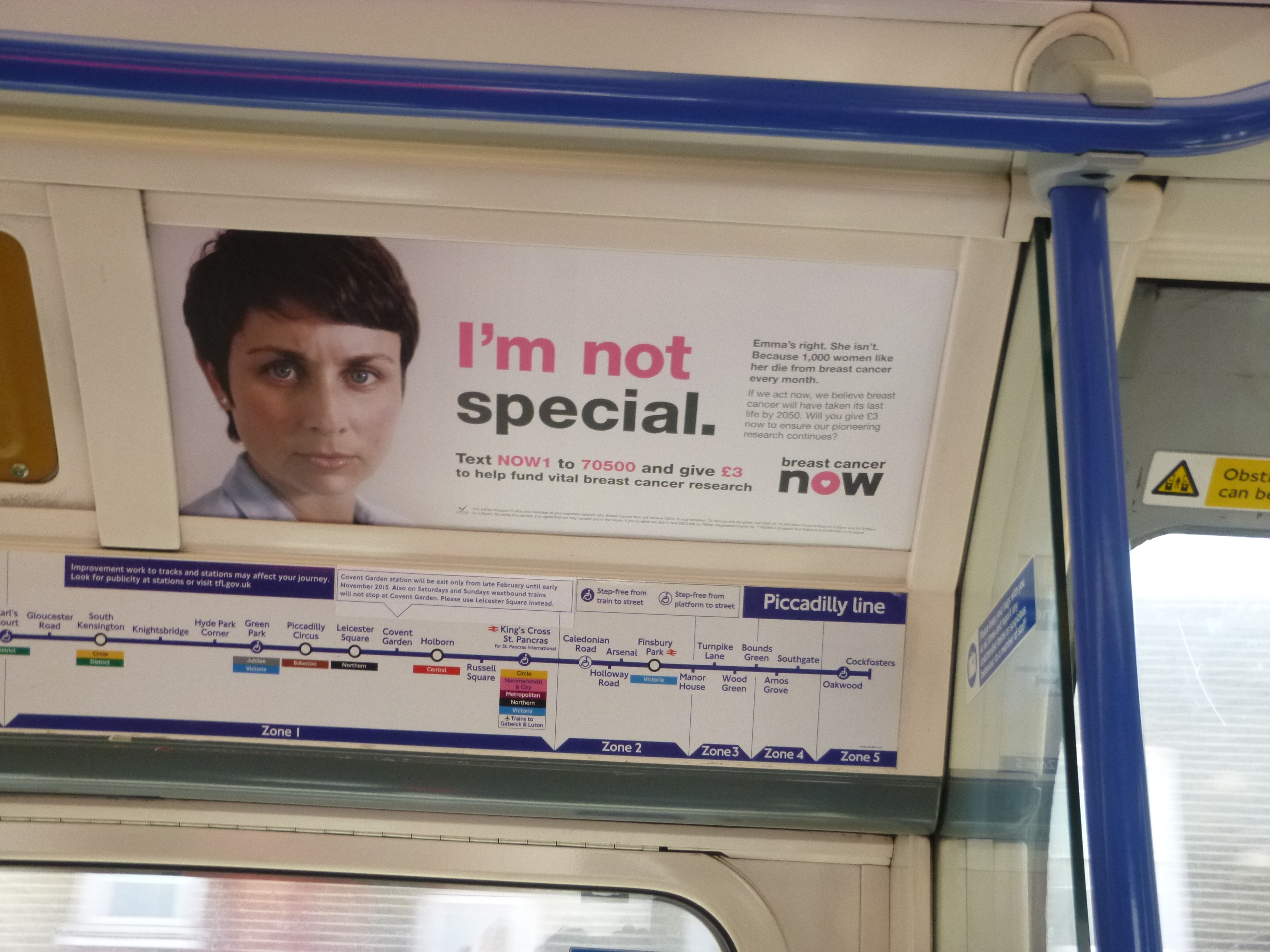
Do We Have Too Many Breast Cancer Charities?
Now C successfully survived breast cancer, so it is not a subject I know nothing about.
But I think now, that some of the most promising cancer research, like looking at the genetics, is very expensive and covers the whole spectrum of cancers.
So surely, this is where we should give our money. I incidentally subscribe to three different cancer charities, none of which are directly linked to breast cancer.
Although, Cancer Research UK, which I support, does support research into breast cancer.
Hope For Sufferers Of Cystic Fibrosis?
This morning, the BBC is showing this report entitled Gene therapy stabilises lungs of cystic fibrosis patients.
It is encouraging news, but also I suspect that it is very interesting technologically.
The genes are actually give to the patient through an inhaler, in a much simpler treatment regime.
Could Britain Become The World’s Health Hub?
Matt Ridley in The Times yesterday has an article entitled Britain has the chance to be the world’s doctor. This is an extract.
A new report commissioned by three parliamentarians, Meg Hillier, MP, Lord Crisp (former chief executive of the NHS) and the surgeon Lord Kakkar, and written by researchers at the London School of Hygiene and Tropical Medicine, makes the case that Britain is well placed to become the world’s “health hub”. Just as the City of London is the world’s financial centre and Wimbledon is the centre of tennis, so Britain is already a surprisingly dominant player in research, practice, policy and regulation when it comes to health, and widely emulated around the world. There is an opportunity here.
I have been privileged in my life and have had insight in London, Cambridge and Liverpool into substantial developments and research that are going to make the world a healthier place.
It is our pre-eminence in health research and the related fields like information, that is driving the world’s health forwards.
Ridley gives some surprising facts, like that even the much-criticised NICE has an international offshoot that gives advice to countries with limited health funding.
It is an article that gives a positive outlook on the future and finishes with this statement.
If America is the world’s soldier, Germany its engineer, Brazil its farmer, China its manufacturer and India its service provider, then Britain can be the world’s doctor.
Everybody worried about the future of healthcare, should read this article.
Do We Featherbed Groups In Society?
I got my monthly State Pension today and at £677.16, that will do me for my day-to-day expenses for the next month. It doesn’t cover trips out of London, but it does allow me the odd light lunch in a restaurant.
But I also get other benefits just because of my circumstances, as a 67-year-old man, who lives alone.
I get a Council Tax discount because I live alone. But is that right as I live in a family house with a garage in a desirable part of London? If I didn’t get it, I’d still live here as that would be my choice, but I am blocking someone more worthy than me of buying this house.
I have a highly-insulated house with an efficient boiler, but should I get a winter fuel allowance? It would be better if the money was not paid at all, but used to improve our housing stock’s energy efficiency, so that those on a pension actually saved the money all through the year.
I have a Freedom Pass, which gives me free transport on buses, Underground, Overground and trains within the Central London area. This is one of the reasons I moved to Dalston. But is it too generous on the one hand and not universal enough on the other? Surely, a better system, would be one where you nominated your bank card as your transport pass and in the free areas, the system didn’t charge you. The advantage of this would be that London could enter into reciprocal arrangements with areas like Birmingham, Liverpool, Manchester and Newcastle, so that we could use each other’s concessionary area at a discount. Would this encourage more of us to travel to explore the country and perhaps spend money in attractions, cafes and shops, we wouldn’t dream of visiting now?
This morning according to this report on the BBC, the Liberal Democrats are saying that those who have a second house they use in a beautiful area, should pay double Council Tax on their second home. Here! Here!
I live in Central London and I am starting to resent the traffic. Not because I drive, but because of the pollution and noise often put out by cars used as glorified shopping trolleys and baby buggies. We let all drivers get off too lightly with the problems they cause in cities and if they got the message, we may see more cycling and walking, and better air quality. We might even see better delivery systems for goods, where transmissions were hybrid or electric, like London’s newer buses.
It will happen eventually, that all cars pay road charges based on mileage, fuel used and congestion. But I doubt we’ll see it soon, as there are no votes in it. It’ll probably be introduced in London first, as cycling gets more common and Crossrail shows everybody what real railways can be like.
But would a city like Birmingham, where the car is king, and pedestrians are targets to hit when crossing the road, accept charging to pay for the updating of the numerous railways and more trams in the city?
And then there’s lifestyle, fitness and health!
Many people drink, eat and smoke too much and governments don’t really discourage it forcefully. It would be an interesting exercise for a town or city to declare a city centre non-smoking and see what happens. I can remember, when ahead of the smoking ban the landlord of my local pub in Suffolk declared it a smoke-free zone. He got some moans, but not from his bank manager.
The NHS is in crisis, but this is mainly a problem of the irresponsible patients making. So if we can get people back to the straight and narrow, we might help the dear old NHS out.
For a start, I would like to see a law, that no-one could stand for elected office or sit on the board of an NHS body, if they were a smoker!
I could go on a lot more. But we must all change our lifestyle, if we want this country to be a place, that is really worth living in.

