Manchester Metrolink’s New £350 Million Trafford Park Line To Open In April
The title of this post is the same as that of this article on Rail Magazine.
The Wikipedia entry for the Trafford Park Line, says this about the planned opening.
The final stretch of track was laid November 2019, with the first test trams running soon after. In December 2019 it was announced that the line was expected to be opened in April 2020, seven months earlier than originally planned.
I wonder why, the line is opening early.
It would be interesting to know!
It could be the old chestnut of bad planning, with planners putting in a lot of float, so they are not late.
The Junction At Pomona Station
This Google Map shows the junction at Pomona, where the Trafford Park Line leaves the Eccles Line.
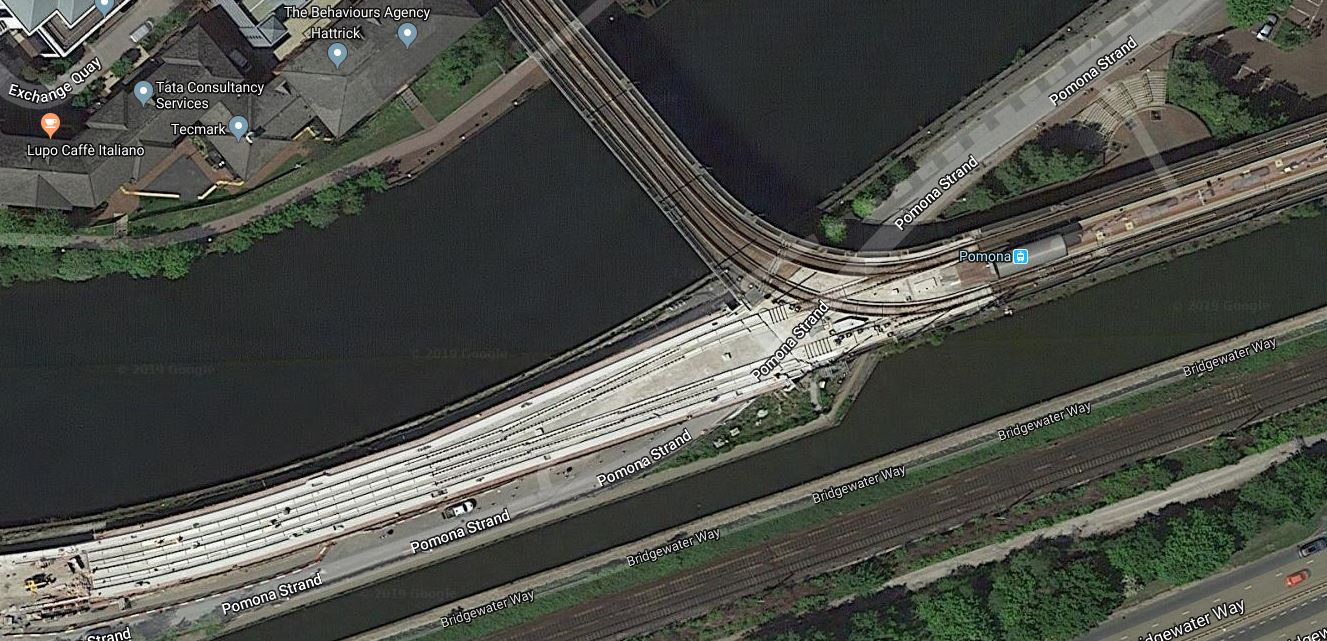
I don’t know when the picture was taken, but you can clearly see tracks going West.
Wharfside Tram Stop
This Google Mapshows the Wharfside tram stop.
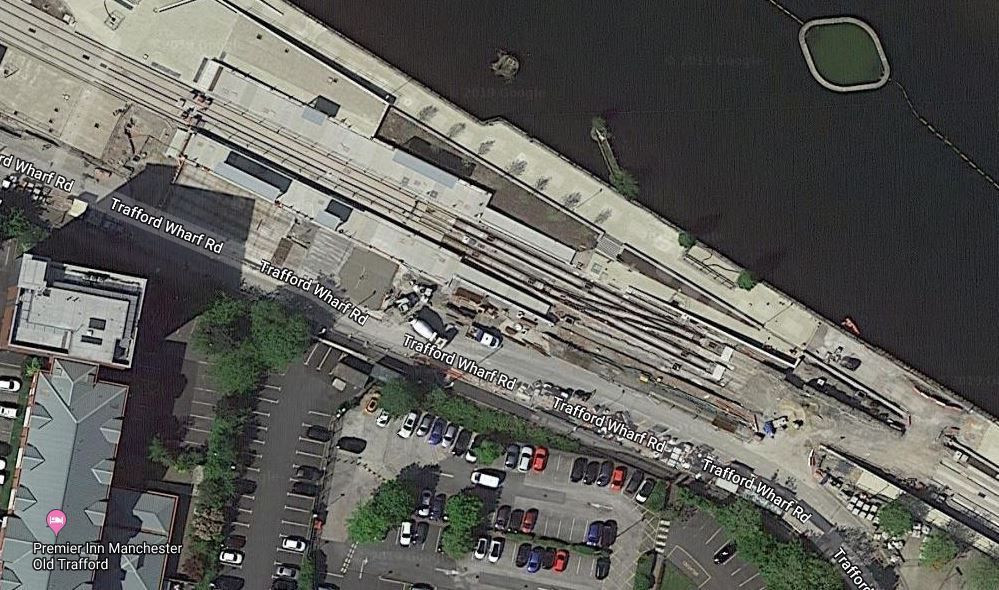
It does look like there are only a few more tracks to lay.
The Trafford Park Line And The Imperial War Museum North
This Google Map shows the Trafford Park Line threading its way past the IWM North.
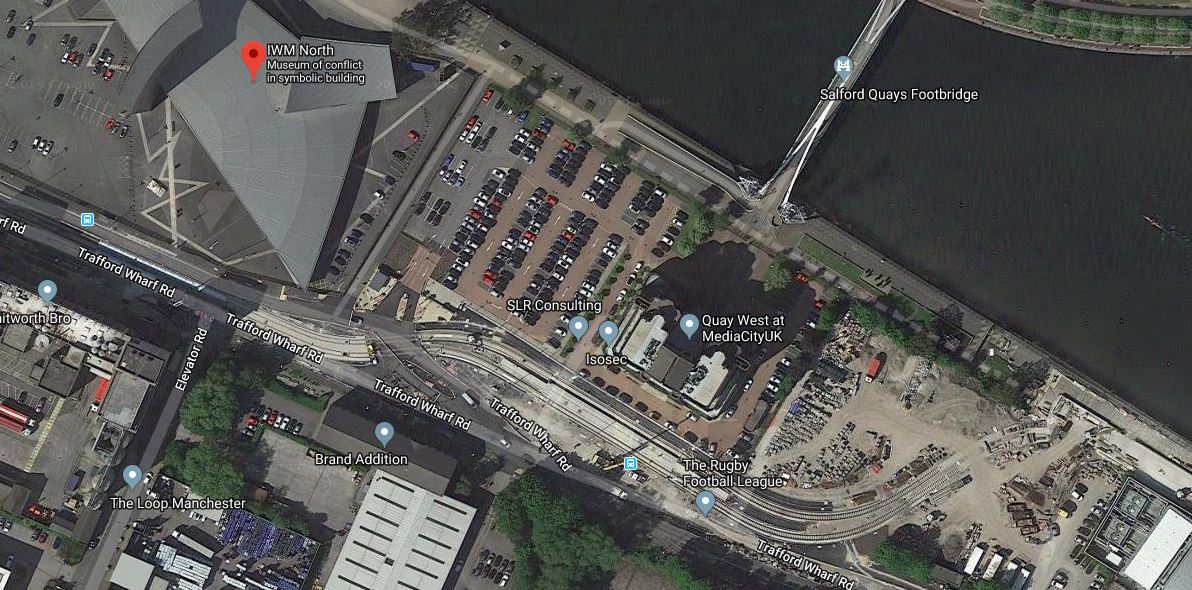
The works seem mainly complete.
The Terminus At The Trafford Centre
This Google Map shows the Trafford Centre.
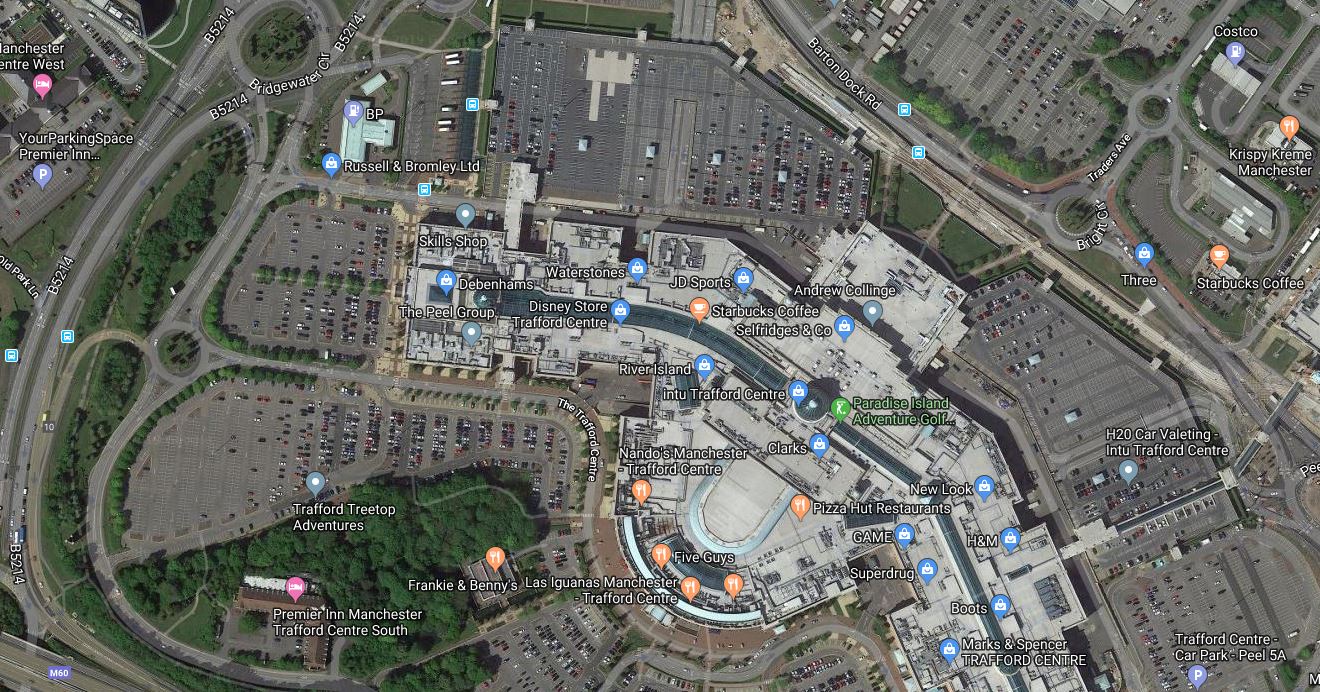
The tram stop will be in the North East of the Centre.
This enlargement shows ithe tram stop more clearly.
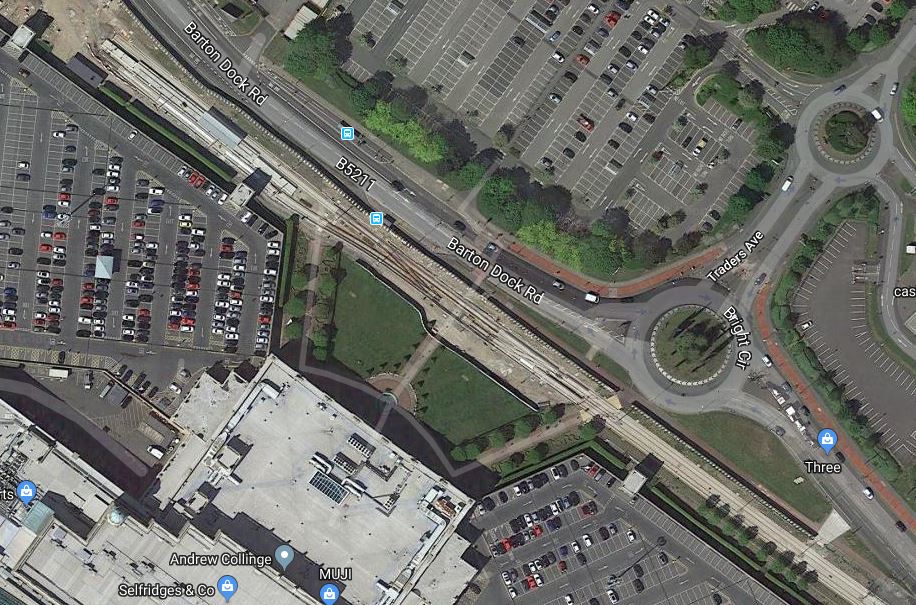
Note that the tracks will be extended to the North-West to Port Salford on the other side of the Mancvhester Ship Canal.
Tram Services On The Trafford Park Line
Trams will run between the Trafford Centre and Crumpsall on the Bury Line.
- Crumpsall has been updated with a third platform.
- Trams will call at Deansgate-Castlefield, St. Peter’s Square, Piccadilly Gardens, Market Street, Stutenhill and Manchester Victoria station in the City Centre.
- At present there appear to be no plans to connect the Trafford Centre with Manchester Piccsadilly station.
It looks to be that some passengers will change in the City Centre to get to and from the Trafford Centre.
What Is A Pimby?
We all know that a Nimby (Not In My Back Yard!) doesn’t want fracking, a nuclear power station or a new railway to be built or something similar near to where they live.
But I believe, we could see the rise of a new type of protestor – the Pimby or a Please In My Back Yard!
I was reading this article on CleanTechnica, which is entitled Coal-Killing Long-Duration Energy Storage For Vermont (Vermont?!?).
The article is about Highview Power’s planned energy storage facility in Vermont, which I wrote about in Encore Joins Highview To Co-Develop Liquid Air Energy Storage System In Vermont.
This paragraph is from Highview.
“Unlike competing long-duration technologies, such as pumped hydro-power or compressed air, Highview Power’s CRYOBattery™ can be sited just about anywhere. The CRYOBattery has a small footprint, even at multiple gigawatt-levels, and does not use hazardous materials.”
You could imagine a community, , perhaps miles away from the nearest power station, where jobs and economic prospects are being held back by a dodgy power supply.
So the community might start to protest not about building perhaps a gas-fired station to satisfy their electricity needs, but in favour of a Highview Power system and some renewable wind or solar power.
Pimbys might also protest in favour of a new railway station or electrification of their branch line. Providing the power for the latter would be a good use for a Highview system.
How I Became A Convert To Hydrogen
The title of this post is the same as that on this article on the Sydney Morning Herald.
I think that this article is significant, as it is written by Dr.Alan Finkel, who is Australia’s Chief Scientist.
It is a well-written article about the production of hydrogen with an Australian slant and is a definite must-read.
Greater Anglia Submits Bid to Improve Colchester Station
The title of this post is the same as that as this article on Rail Advent.
Colchester station is a busy station, that handles four and a half million passengers in a year.
The main stations on the Great Eastern Main Line have following passenger numbers in millions.
- Shenfield – 4 – Fully step-free
- Ingatestone – 0.8
- Chelmsford – 8.5 – Fully step-free
- Hatfield Peverel – 0.4
- Witham – 2.5 – Fully step-free
- Kelvedon – 0.8
- Marks Tey – 0.6
- Colchester – 4.5 – Partially step-free
- Manningtree – 1.2 – Fully step-free
- Ipswich 3.3 – Fully step-free
- Needham Market – 0.1
- Stowmarket – 1.0 – Going step-free
- Diss – 0.7
- Norwich – 4.4 – Fully step-free
I think it is fairly obvious, that the the very busy Great Eastern Main Line has not been high in the queue for full step-free access.
As the article says, Colchester has a lift on one side of the station, there is only a wheelchair stair lift on a staircase on the other side.
Why did one of the busiest stations on the line get only half a solution?
Probably, a civil servant who lives in leafy Surrey, said “Colchester has two entrances! Their driver can come round! And it’s only East Anglia!”
There are developments, that are happening, that make updated step-free access at Colchester station absolutely essential.
- Greater Anglia are replacing the train fleet and all those new trains will attrract more passengers.
- All the new trains are step-free between train and platform.
- Greater Anglia will be increasing the frequency of trains between Colchester and Stowmarket and probably in other sections of the route as well.
- Greater Anglia are introducing a new service between Sudbury and Colchester Town. Wheelchair passengers between London and Sudbury will need to change at Colchester, as Marks Tey is not step-free.
- Greater Anglia is extending the Peterborough and Ipswich service to Colchester. This will surely increase the number of passengers wanting to cross over at Colchester.
The current system will work until three people turn up in wheelchairs at the same time.
Greater Anglia will get it in the neck, when the fault lies with the civil servants’ belief that East Anglia is a backwater that doesn’t need good facilities.
Other Stations
These stations on the Great Eastern Main Line has no step-free access or plans to install it.
- Ingatestone
- Hatfield Peverel
- Kelvedon
- Marks Tey
- Needham Market
- Diss
Note.
- Strangely, Ingatestone is probably the most important, as when the line is closed for engineering works, it is used as a bus interchange.
- Marks Tey is also important, because of interchange between Sudbury and London. Watch this one as Pritti Patel is the MP.
- Diss has had serious disabled access problems in the past.
- Needham Market could be difficult, but Stowmarket is an alternative.
All the stations between Liverpool Street and Shenfield will be fully step-free, when Crossrail is completed.
Conclusion
Personally, I feel that the whole Great Eastern Main Line should be made step-free.
Will The Queen Be Amused?
The picture shows another terrible bus livery in dark colours.

Try spotting one of these in the distance with dodgy eyesight!
There seems to be a design competition, to see who can design the most camouflaged bus!
When I first saw this bus, I thought it was advertising Crown’s new paint for the Army!
See Fist-Fighting Mice On The London Underground
The title of this post is the same as that of this article on Ian Visits.
An extraordinary picture is being shown.
Abellio To Lose ScotRail Franchise Three Years Early
The title of this post is the same as this article on Rail Magazine.
This is the introductory paragraph.
The ScotRail franchise managed by Abellio will end in March 2022 – some three years earlier than planned, Scottish Transport Secretary Michael Matheson confirmed on December 18.
I don’t live in Scotland, so perhaps I shouldn’t comment too strongly.
- When I’m in Scotland, I find the performance of ScotRail little different to Greater Anglia, which is also managed by Abellio.
- In the last three or four years, I have only suffered serious delays a couple of times on Greater Anglia and one was severe weather-related and the other was the usual suspects trying to steal the overhead wires.
- In that period, I can’t remember being delayed seriously in Scotland.
- I was also in Scotland for the Commonwealth Games and the rail service coped well with all the visitors.
But Scotland has suffered more than its fair share of Network Rail and train delivery problems.
- Late delivery of electrification.
- Poor design of the Borders Railway.
- Problems with the new Class 385 trains from Hitachi.
- Problems with the delivery of the Inter7City trains.
- Disruption caused by the rebuilding of Glasgow Queen Street station.
Is another factor, the endorsement of the SNP in the recent General Election?
I have a feeling that this enforced divorce will be a pension pot for lawyers.
Northern Welcome New Link Between East And West Yorkshire
The title of this post is the same as that of this article on Rail Technology News.
This is the introductory paragraph.
Rail Operator, Northern Railway, is celebrating the improved links between East and West Yorkshire today (Dec 19) following the introduction of a new service on the network, providing a direct service between Halifax and Hull.
The tone may be a bit self-congratulatory by Northern, but it is to me a very necessary service.
- The trains run hourly.
- Looking at today’s early morning Saturday service, it appears to have doubled the frequency to and from Leeds.
- Families and friends are more spread out these days..
- Events like football matches and concerts bring in supporters and attendees from a lot further, than when the rail services were carved in stone.
I shall be very interested to see the figures for ridership on this new service..
The Suffolk Experience
Over the last few years, Suffolk’s cross-county service between Ipswich and Cambridge has gone from an hourly single-car Class 153 train through two and three-car Class 170 trains to the proposed four-car Class 755 trains.
Greater Anglia may be having trouble introducing the Class 755 train, but the proposed capacity increase is there. They are also proposing to double the frequency on the Eastern section of the route.
Nationwide
Hopefully, we’ll see more improvements in services on routes like these all over the country. Certainly, Northern and Greater Anglia have been increased threir train fleets to provide more services.
I would also like to see a nationwide capacity standard for routes like these between cities and large towns.
More Eurostar Services Between London And Amsterdam Are On The Way
This article on NL Times is entitled NS, Eurostar To Run 5 Trains Daily Between Netherlands & London; More Sustainable Than Flying, Says NS.
The article contains these points.
- Five trains per day between London and the Netherlands.
- This is a total of 4,500 p-assengers in both directions.
- The train only creates twenty percent of the carbon emissions per passenger journey.
- Currently, twenty-three percent of passengers between London and the Netherlands use rail.
- A fourth train will be added in 2020, with a fifth in 2021.
- Eliminating the Customs check in Brussels when travelling to the UK, should bring Amsterdam to London times to around four hours.
NS or Dutch Railways seem fairly bullish about expanding the services between London and the Netherlands.
I believe that NS are right.
- The British and especially Londoners are very used to taking four hour journeys on a train to Edinburgh and Glasgow.
- The British with their poor language skills, don’t consider the Netherlands to be as foreign as Belgium, France and Germany
- The Dutch will surely develop better rail connections from Amsterdam into Northern Germany.
- Will the Dutch persuade Austrian Railways to run NightJet services from Amsterdam to Central Europe?
I also feel that just as people cruise from port-to-port, there will be a parallel development of rail cruising from city-to-city. Surely, Amsterdam would be a place for the cautious to start.
Conclusion
NS seem to be thinking of more than five trains per day and I wouldn’t be surprised to see around ten trains per day before 2030.
 The Anonymous Widower