Spain – Luxembourg Rail Motorway Service Launched
The title of this post is the same as that of this article on Railway Gazette.
This is the first paragraph.
A ‘rail motorway’ service carrying unaccompanied lorry trailers 1 219 km between Barcelona and Luxembourg was launched on February 19.
This is the fifth such service to be operated across France and will be operated five times a week, with a sixth service to be added in April.
One of these services takes unaccompanied lorry trailers between Calais and a terminal near Perpignan, so you might wonder why this service doesn’t start in the UK.
The only place, that it could serve in the UK would be Barking, due to our antique loading gauge not being able to accept piggyback trailers.
So we can’t really link the UK to this freight network.
There is an excellent discussion on Rail Forums, which goes through the issues.
Barking
Barking is probably not the best place for a terminal for unaccompanied lorry trailers.
It is close to the heavily-congested M25, but surely trains of unaccompanied trailers could be assembled in other parts of the UK and taken to Barking.
But rail lines connecting Barking to the North include the North London and Gospel Oak to Barking Lines, both of which would need drastic gauge enhancement to take the traffic. As these routes are crowded London commuter routes, this work would go down like a whole squadron of lead balloons.
Specialist Freight
If you stood by the Gospel Oak To Barking Line for twenty-four hours, you would see some specialist freight trains going through, often carrying cars or vehicle components.
I think there will be growth in this sector, perhaps for high-value or perishable cargo, in purpose-built trains. But it would only take a few trucks off the roads.
There is also the problem, that a lot of specialist cargo is only one way.
- Minis go from Oxford to Europe.
- Ford cars and vans go from Europe to the UK.
- Perishable fruit and vegetables go from Southern Europe to the UK.
- Scotch whisky and seafood would go from Scotland to Europe.
I am certain, there is a profitable market niche here to pair compatible cargoes.
High Speed Parcel Traffic
Could we also see a network of overnight high speed parcel trains linking Europe’s major conurbations and commercial centres?
Conclusion
Neither specialist freight or high speed parcel trains will make much of a dent in the number of trucks, that will continue to clog the motorways to the Port of Dover.
An Automated Shuttle Train On The Marlow Branch Line
The Marlow Branch Line has the following features.
- It is 7 miles long, between Maidenhead and Marlow stations.
- It is single-track.
- It is not electrified
- Trains on the route are two-car diesel trains.
- There is a single platform at Marlow station.
- There is an electrified bay-platform at Maidenhead station.
- There are three intermediate stations.
- The service frequency is one tph.
- Trains take six minutes to go between the two terminals.
A unique problem is that trains reverse at Bourne End station on each trip, which takes 4.5 minutes for the driver to change ends and restart the train.
Currently a round trip from Maidenhead to Marlow takes 49 minutes.
By using an automated shuttle train, could this round trip time be reduced to enable one train to operate at a frequency of two tph?
Automation would reduce the 4.5 minutes at Bourne End to perhaps thirty seconds, but that would only bring the round trip time down to 41 minutes.
The station stops on the round trip would be as follows.
- Furze Plat – 30 seconds
- Cookham – 30 seconds
- Bourne End – 30 seconds
- Marlow – 1 minute
- Bourne End – 30 seconds
- Cookham – 30 seconds
- Furze Plat – 30 seconds
- Maidenhead – 2 minutes
Adding the stops up, that leaves just twenty-four minutes to cover the fourteen miles of the round trip.
This is an average speed of 35 mph.
I think that an appropriate train would be able to run an automated shuttle, with a frequency of two tph.
The train (or tram-train) would have the following features.
- It would be battery-powered
- It would have an operating speed of perhaps sixty mph.
- It would have fast acceleration and deceleration.
- It would probably be a tram-train to negotiate the tight bend at Bourne End station.
The following infrastructure works would also be needed.
- The track would be improved to allow higher speeds.
- The points would be automated at Bourne End
- A fast charging system would be added to the bay platforms at Maidenhead and possibly Marlow stations.
An automated shuttle may have possibilities on this most difficult of branch lines.
An Automated Shuttle Train On The Slough-Windsor & Eton Line
The Slough-Windsor & Eton Line has the following features.
- It is 2.5 miles long.
- It is single-track.
- It is not electrified
- Trains on the route are two- or three-car diesel trains.
- There is a single platform station at either end with no intermediate stations.
- The service frequency is three tph.
- Trains take six minutes to go between the two terminals.
The service on this line, can get exceedingly full and needs greater capacity.
To run the ideal four tph, trains would need do a round trip between Slough and Windsor & Eton Central in fifteen minutes.
If we assume that the two end stops take a total of three minutes, then that leaves just twelve minutes to cover the five miles of the round trip.
This is an average speed of 25 mph.
As with the Greenford Branch, I think that an appropriate train would be able to run an automated shuttle, with a frequency of four tph.
The train (or tram-train) would have the following features.
- It would be battery-powered
- It would have an operating speed of perhaps fifty mph.
- It would have fast acceleration and deceleration.
- It would have three- or four-cars.
The only infrastructure works that would be needed, would be to provide a fast charging station at Slough station.
An Automated Shuttle Train On The Brentford Branch Line
The Brentford Branch Line
There are various proposals to add a passenger service to the Brentford Branch Line.
The Brentford Branch Line has the following features.
- It is 4 miles long.
- It is a mixture of single and double-track.
- It is not electrified.
- There is a bay platform at Southall station, that could be used, as a Northern terminal.
- Freight trains also use the line.
If the Greenford Branch can mix an automated shuttle and freight trains, then it would be very likely, that a similar approach would work on this branch.
The train (or tram-train) would have the following features.
- It would be battery-powered.
- It would be highly automated.
- Charging would be carried-out in the bay platform at Southall station.
A service of at least two tph would be provided, that would link Brentford to Crossrail.
An Automated Shuttle Train Between Romford And Upminster
The Romford-Upminster Line has the following features.
- It is 3.5 miles long.
- It is single-track.
- It is electrified with 25 KVAC overhead electrification.
- The maximum speed is only 30 mph.
- There is a single platform station at either end with one intermediate station.
- The service frequency is two tph.
- Trains take nine minutes to go between the two terminals.
- No other trains use the line.
To run the ideal four tph, trains would need to do the round trip between Romford and Upminster in fifteen minutes.
If we assume that the two end stops take one minutes and the two intermediate ones take thirty seconds, then that leaves just twelve minutes to cover the seven miles of the round trip.
This is an average speed of 35 mph.
As with the Greenford Branch, I think that an appropriate train would be able to run an automated shuttle, with a frequency of four tph.
The train (or tram-train) would have the following features.
- It would be able to use the 25 KVAC overhead electrification.
- It would have an operating speed of perhaps sixty mph.
- It would have fast acceleration and deceleration.
The only infrastructure works that would also be needed, would be to improve the line to allow higher speeds.
An Automated Shuttle Train On The Greenford Branch Line
The Greenford Branch Line has the following features.
- It is 2.5 miles long.
- It is double-track.
- It is not electrified.
- There is a single platform station at both ends with three intermediate stations.
- The service frequency is two trains per hour (tph).
- Trains take 11-12 minutes to go between the two terminals.
- Freight trains also use the line.
To run the ideal four tph, trains would need to do a round trip between West Ealing and Greenford in fifteen minutes.
If we assume that the two end stops take two minutes and the six intermediate ones take thirty seconds, then that leaves just eight minutes to cover the five miles of the round trip.
This is an average speed of 37.5 mph.
I don’t have the calculation experience or knowledge of train performance to prove it, but I think that an appropriate train would be able to run an automated shuttle, with a frequency of four tph.
The train (or tram-train) would have the following features.
- It would be battery-powered.
- It would be highly automated.
- It would have an operating speed of perhaps sixty mph.
- It would have fast acceleration and deceleration.
The following infrastructure works would also be needed.
- The track would be improved to allow higher speeds.
- The points would be automated.
- Level access between platform and train would be provided.
- A fast charging system would be added to the bay platforms at Greenford and/or West Ealing stations.
If four tph could be achieved on the Greenford Branch with just one automated shuttle and no electrification, this would be exactly what the operator, the passengers and the Government ordered.
Automated Shuttle Trains With A Train Captain
There are various short routes on the UK rail network, where shuttle trains work a frequency of perhaps two or three trains per hour (tph), that is generally felt by passengers and train operators to be inadequate.
Examples include the following.
Could the frequency on these lines be increased using automation?
The Automated Docklands Light Railway
The Docklands Light Railway is not a simple railway, but it is fully automated.
- Trains are driverless
- A Train Captain is responsible for patrolling the train, checking tickets, making announcements and controlling the doors.
- The Train Captain can take control of the train if required.
It is a system that seems to have worked well for many years.
An Automated Shuttle With A Train Captain
Could a similar principle be applied to a shuttle train?
As an example, I’ll use the Bromley North Line.
Consider.
- The line is two miles long and trains take five minutes each way.
- The current frequency is three tph.
- There are problems at Grove Park station with connections in the Peak.
- The route is double-track.
- The current service is operated by a single train, manned only by a driver.
It would appear if the Bromley North Line could be run at four tph, this would be a welcome improvement.
One of the problems of driver-operated shuttle services like this, is that at each end of the route, the driver must change ends, which takes a couple of valuable minutes.
To operate a frequency of four tph, the round-trip must be performed in fifteen minutes.
- Each leg takes five minutes.
- There are four stops in a round trip; one at Grove Park, one at Bromley North and two at Sundridge Park.
I believe that a single automated train, with a Train Captain on board to look after safety, open and close the doors and start the train after each stop, should be able to handle the much-needed four tph on the Bromley North Line.
How Would The Automation Work?
Many years ago, a Central Line driver explained to me how the original automation of the Victoria Line worked.
- A train would arrive in the station and stop in the correct place automatically with high precision.
- The doors would be opened.
- After passengers had unloaded and loaded, the doors would be closed.
When the doors were closed and everything was safe, the driver would push a button to ask the automation to take the train to the next station.
Automation has moved on since the 1960s, and I believe that some form of on-train automation would be able to handle a simple shuttle.
- Only one track would probably be need to used to remove the complication of points.
- Only one train would be used for the shuttle, as this increases safety.
- Sensors would determine the exact position of the train.
- CCTV cameras, including ones looking forwards and backwards, would be relayed to the Train Captain and their Control Station in the middle of the train.
- The Train Captain would have an Emergency Stop Button.
If something goes wrong or the train is being taken to and from the depot, the Train Captain would go to the forward cab, switch off the automation and drive the train in the normal manner.
I am sure, that it would not only be a very safe system, but if it made full use of the capabilities of modern trains, it would speed up services sufficiently, so that frequencies could be increased.
What Trains Would Be Suitable?
I think that the choice of trains would be wide, but I think they must have the following characteristics.
- An ability to perform a station stop and restart quickly.
- Fast acceleration and deceleration.
- Level access between platform and train.
- Walk-through interior, to help the Train Captain perform their duties.
- Lots of wide double doors and large lobbies.
All these characteristics would enable the train to save time on the route.
Power would be anything that could be used on the route. For the Bromley North Line, that would be either third-rail electrification or battery power.
Battery power, though on this route, would have a problem.
If the train is running an intense shuttle service, with stops taking a minute or even less, the train never stops long enough to charge the batteries. As the route is electrified with 750 VDC using third-rail, this would need to be used on the Bromley North Line.
Although, I have used the word train in this section, I suspect trams, tram-trains or light rail vehicles could be used.
All vehicles would retain their driving cabs for the following reasons.
- If there is a problem, the Train Captain can drive the train, as happens on the Docklands Light Railway.
- If the train needs to be positioned to and from a depot, the train could be driven manually.
I also feel that for these reasons, the Train Captain would be a fully qualified driver.
Examples of vehicles that could be used, if appropriate automation were to be fitted include.
Class 399 Tram-Train
Class399 tram-trains are working successfully in Sheffield and they have been ordered for the South Wales Metro, where they will run under both overhead and battery power.
As an Electrical Engineer, I believe that it would not be the most difficult piece of engineering to fit these tram-trains with the ability to run under third-rail power.
The tram-trains would have similar capacities, cross-section and performance to the current Class 466 trains.
The only modifications that would be needed to the route, would be to adjust the platforms used by the tram-train to give level access between tram-train and platform.
A Three-Car Aventra Or Similar
Three-car Class 730 Aventra trains, have been ordered by West Midlands Railway and Aventras have also been ordered to run using third-rail power.
As with the Class 399 tram-train, these trains could probably work the route successfully, subject to suitable platform modification.
How Fast Could Stops Be Performed?
I have timed stops on the London Overground and the London Tramlink rarely do you find a time from brakes on to brakes off in excess of a minute, without a red signal being involved.
I have measured some London Overground stops are at thirty seconds some London Tramlink stops at twenty seconds.
If a shuttle had the track to itself and the train was a modern design, I could see maximum timings on the Bromley North Line as follows.
- Bromley North – One minute
- Sundridge Park – Thirty seconds
- Grove Park – One minute
Surely, with station stop times like these and perhaps faster running than the current 30 mph, the goal of four tph could be comfortably achieved.
What Happens With Delays?
Suppose, an incident occurs, and the train is delayed.
After the incident is successfully sorted, the train could just carry on or wait until it was on schedule for the next train.
Within a few minutes, the train would be running to time.
Some Other Selected Routes
Over the next few days, I will be adding calculations for other routes.
Slough And Windsor & Eton Central
Extra routes will be added here.
Conclusion
On the Bromley North Line, selective automation should be able to enable a four tph service using one train or tramtrain.
Would Batteries Help Voltage Change-over In A Dual Voltage Train Or Tram-Train?
Battery Power And Tram-Trains
Consider.
- The Class 399 tram-trains in Sheffield can work on both 25 KVAC and 750 VDC overhead electrification.
- Their German cousins in Karlsruhe can work on both 15 KVAC and 750 VDC overhead electrification.
In Karlsruhe, there is a ceramic rod between the two overhead cables with different voltages and the pantograph rides across. I suspect that clever power electronics on the tram-train measures the voltage and converts it automatically to that needed to power the tram-train.
I haven’t been able to see how Sheffield connects the two different voltages, but I wouldn’t be surprised if a similar system with a ceramic rod is used.
Look at this picture, I took of a Class 399 tram-train in Sheffield.
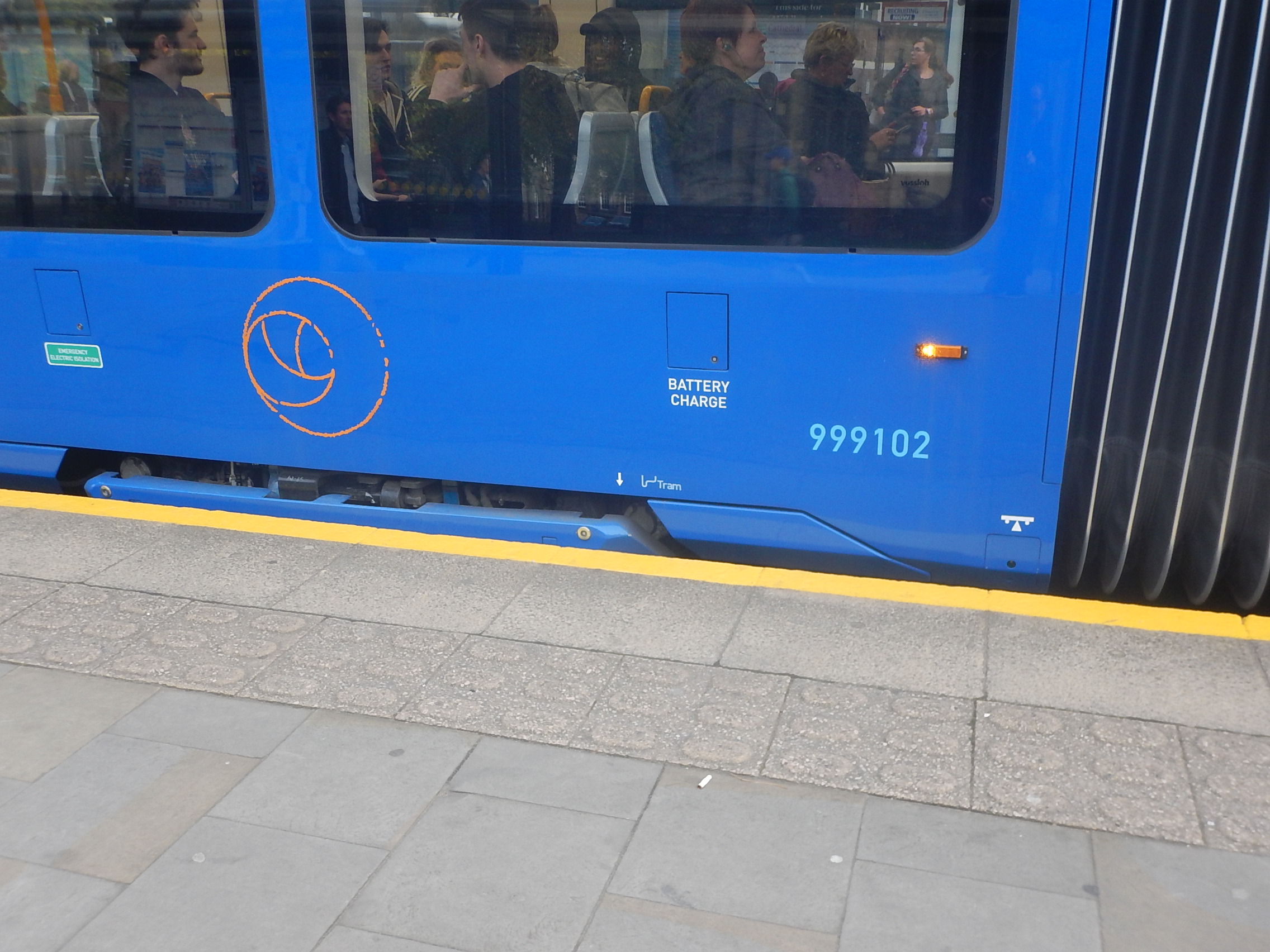
Note the BATTERY CHARGE socket to the left of the car number.
Why would an electrically-powered vehicle need a battery?
I suppose it could be to start up the tram-train in the morning and raise the pantograph.
But could it also be for emergency power, to move the tram-train short distances, such as in depots or to assist the vehicle through the dead sections, where the power supply changes from one voltage to another?
The Class 399 tram-trains ordered for the South Wales Metro will also have to cope with discontinuous electrification. So is the technology needed for this already installed in the tram-trains in Sheffield?
Battery Power And Dual Voltage Trains
Suppose you have a train like a Class 378 or Class 700 train, that can run on both 25 KVAC overhead and 750 VDC third-rail electrification.
Third-rail trains with contact shoes deal with discontinuous electrification all the time.
If a dual-voltage train had a battery that could take it say two hundred metres, then I believe that voltage changeover could be simplified and speeded up.
I have watched Class 717 trains change voltage at Drayton Park station and what changes would a limited battery capability make.
The third-rail electrification would stop several metres short of the station and would be removed in the station itself.
Going towards Moorgate, this would be the procedure.
- The train would stop in the station as it does now.
- The driver would drop the pantograph, whilst passengers unloaded and loaded.
- The driver would close the doors.
- The train would accelerate away on battery power.
- After a few metres the train would contact the third-rail and the train’s computer would change from battery to third-rail power.
Going away from Moorgate, this would be the procedure.
- The train would automatically disconnect from third-rail power, where that stopped to the South of the station.
- The train would automatically switch to battery power.
- The train would stop in the station as it does now.
- The driver would raise the pantograph, whilst passengers unloaded and loaded.
- The driver would close the doors.
- The train would accelerate away on overhead power.
The stops should be no longer, than a normal station stop without power changeover.
Conclusion
Batteries may well reduce the time taken to change voltage
London’s Second Quietest Train Station Is Set To Close In May
The title of this post, is the same as that of this article on IanVisits.
This is the first paragraph.
Angel Road, London’s second quietest train station is set to close in May, the Department for Transport has announced. With just over 33,000 passengers in 2017/18, it’s beaten to the bottom spot only by South Greenford station’s 26,500 passengers.
It will be replaced on May 19th 2019, by the new Meridian Water station, which will be 580 metres to the South.
The Old Order Changeth Yielding Place To New
Two dinosaurs; the Labour Party and the motor industry, got big shocks yesterday.
But both are trying to live in the past with CEOs, who still think that we’re in the 1960s.
This morning, my message read out on Wake Up To Money was this.
I don’t drive any more, but the future is electric and the UK is blessed with a position and a climate to become one of the first countries to power most vehicles with renewables. Vehicle manufacturers must change or die!
Our renewable electricity generation infrastructure is growing apace and in the last few days, the world’s largest offshore wind farm opened, as reported in this article on the BBC, which is entitled First Power From World’s Biggest Offshore Wind Farm.
The Hornsea Wind Farm will have a generating capacity of 6 GW. This is nearly twice as large a capacity as the troubled Hinckley Point C nuclear power station.
But whereas Hinckley Point C will produce continuous power, Hornsea will only produce power when the wind blows.
The National Grid are tasked with keeping the lights on and I agree with them, that energy storage is the solution.
- There are 25,000,000 homes in the UK. If every house in the UK was fitted with a 10 kWh storage battery, that would be a capacity of 250 GWH.
- There are 30,000,000 cars in the UK. If every car in the UK was electric and had a 30 kWh battery, that would be a capacity of 900 GWH.
These are very large numbers and just as the Internet passes data all around the UK and the world, the UK’s National Grid will access all these batteries to store energy, when perhaps the wind is blowing at night and retrieve it when there is a high demand.
On a domestic level, you may have an electric car and a battery in your house, with perhaps solar panels on the roof.
- At night and on sunny days, your batteries will be charged.
- At times of high demand, your stored energy may be sold back to the grid.
- Controlling it all would be an intelligent computer system, which would make sure that your car always had enough charge and you had enough energy for the house.
The problem is that nearly all of our houses and cars don’t fit this model.
The proposed closure of the Honda plant is Swindon, is the first of the many casualties in car manufacturing, that will surely happen.
More by luck, than judgement, when I moved to London after my stroke, I bought a house with the following features.
- Low energy consumption.
- A flat roof, that is now covered in solar panels.
- A garage, that would be suitable for an electric car. Although, I don’t drive, the next owner of this house, probably will.
Millions of houses in this country should be demolished and the land used for new houses that fit the modern age.
The Labour Party is living in the 1960s and Corbyn and McDonell still believe that the Robin Hood approach of stealing from the rich and giving it to the poor, is still the way to go.
But these days, most people want to be responsible for themselves. This is why there has been such a growth in people in the gig economy like Uber, Deliveroo and County Lines.
Everybody wants to take control of their lives and their own micro-economy. That is why I left a safe job at ICI in 1969, at the age of just twenty-two.
Like me, those who start their own successful business don’t want government to come along and use it on pet projects that always seem to fail.
Most politicians and especially Labour ones have never done a real job in their lives and Labour’s defections will hopefully be the first of many from all political parties.
I hope that February 18th 2019, will be remembered as the day when two dinosaurs realised they needed to change their spots.
But they won’t change willingly!
However!
- Companies and individuals will soon be buying electric vehicles in large numbers and only buying diesel and petrol ones, where there is no alternative.
- Voters will not vote for policies that stink of the past, that don’t fit their micro-economy.
There will also be a lot of unsaleable houses and second-hand cars!
 The Anonymous Widower