West Drayton Station – 29th March 2018
These pictures show the progress at West Drayton station.
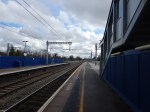

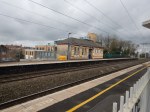
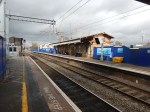
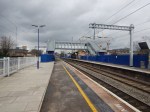
There’s still quite a bit of work to do.
GWR Announces Plans To Replace Class 332s As It Takes Over Heathrow Express Service
The title of this post, is the same as that of this article on Global Rail News.
In some ways, I was surprised that Heathrow Airport are handing over the running of Heathrow Express to Great Western Railway (GWR).
But.
- It seems, that the main problem, in that HS2 want their depot for construction of their new line.
- GWR will use twelve Class 387 trains to run the service as opposed to the the current fourteen Class 332 trains.
- The new trains will be updated with First Class, high speed wi-fi and more luggage space.
- The deal seems to run to 2028.
I do think, that the main reason could be, that this gives FirstGroup or MTR Corporation a say in all the railways, serving or going near Heathrow Airport.
- GWR is owned by FirstGroup.
- Crossrail is operated by MTR on begalf of Transport for London.
- South Western Railway is a joint venture between FirstGroup and MTR.
The operation of Heathrow Express by GWR completes the set.
My post; MTR Vying To Join Heathrow Southern Rail Bid, could link MTR to the proposed Heathrow Southern Railway, who are hoping to create a link into Heathrow Airport from the South.
One of the plans of Heathrow Southern Railway is to create a new Basingstoke/Guildford – Woking – Heathrow – Paddington service.
- This would have a frequency of two trains per hour (tph) between Paddington and both Basingstoke and Guildford.
- This would mean there would be a four tph Frequency between Paddington and Woking via Heathrow Terminal 5, Heathrow Terminal 2/3 and Old Oak Common.
- Creating the new service by extending Heathrow Express, means that the new service can take-over the paths used by Heathrow Express, to and from Paddington.
- It is also worth noting that the Class 387 trains, that GWR are proposing to use on Heathrow Express are dual-voltage and can run on tracks with third-rail electrification.
Heathrow Express will become a double-ended service, in much the same way that Gatwick Express takes passengers from both London and Brighton to the airport.
GWR taking over Heathrow Express must make the operation of trains to and from Heathrow Airport easier.
Why Change The Trains?
I think there are various reasons.
Operation And Maintenance
Obviously, if GWR uses only Class 387 trains on their shorter electrified routes from Paddington, this gives advantages in terms of operation, maintenance and staff utilisation and training.
I suspect too, that GWR have the depot space and sidings, to accommodate all the Class 387 trains they need.
Increasing Fleet Size
There are two published plans y to increase rail services to Heathrow.
- Heathrow Southern Railway would like to extend Heathrow Express to Woking and ultimately to Basingstoke and Guildford.
- Western access to Heathrow could also be a route for Heathrow Express to perhaps Reading and Oxford.
In the future there could be other services.
- Developments could mean that a Heathrow-Gatwick service could be possible and worthwhile.
- There is speculation in the media, about a direct service between Heathrow and Southampton.
Any expansion of services would probably need more trains.
If they need more Class 387 trains in the future, there are two operators, who have small fleets of Class 387 trains.
- Great Northern have twenty-nine trains.
- c2c have six trains.
Some of these might become available, as the operators consolidate and update their fleets.
Acquiring more Class 332 trains could be problematical.
The Class 387 trains route, means that Heathrow Express will remain a fleet of identical trains.
Operation On Routes With Third Rail Electrification
Any expansion of Heathrow Express to the Western side of Terminal 5 could connect to the extensive network of third-rail electrification.
For this reason, a Heathrow Express fleet without the capability to use third-rail electrification, would be limited in its market.
The Class 387 trains have been designed as dual voltage units and could work on third-rail networks by adding third-rail shoes.
Can Class 332 trains work on third-rail routes?
Operating Speed
The Class 387 trains are also 110 mph trains, whereas the operating speed of the Class 332 trains is 100 mph.
The faster operating speed must help operation on the busy fast lines to and from Paddington, where the Class 800 trains are 125 mph capable.
Train Length Issues
Consider.
- The current Class 332 trains, run as nine-car trains, consisting of one four-car and one five-car trainset.
- Class 387 trains are basically a four-car trainset, which can run as four, eight or twelve-car trains.
- To complicate matters, Crossrail, which will use the same platforms at Heathrow are planning to nine-car Class 345 trains, but these could be lengthened to ten or even eleven cars.
These probably cause no problems with the current service, as running eight-car Class 387 trains would probably provide enough capacity.
Would a twelve-car Class 387 train need some platforms to be lengthened?
A four-car Class 387 unit is 80.77 metres long, so a twelve-car train would be 243 metres long.
This compares with the following.
- Heathrow Express Class 332 – Nine cars – 206 metres.
- Crossrail Class 345 – Nine cars – 205 metres
- High Speed Train running with eight carriages – 220 metres
- Inter-City 225 running with nine carriages – 246 metres
- Two five-car Class 444 trains running togeyther – 230 metres
- Two five-car Class 800 trains running together – 260 metres
A twelve-car Class 387 train is long, but not wildly out of line.
As the pairs of Class 800 trains work into Paddington,, I suspect twelve-car Class 387 trains can do the same.
If there is a problem, it will be in the Hathrow stations.
Alternatively, could some extra cars be built by Bombardier to create five-car trains, that would work as ten-car units, which would be around two hundred metres long?
Joining And Splitting Of Trains
Could Heathrow Express benefit from trains with the ability to split and join?
When there are more than one route to the West from Terminal 5, there may be advantages for trains to split and join in Terminal 5 station, to serve more than one destination to the West of the airport.
This picture was taken, as I watched two Class 387 trains joining together.
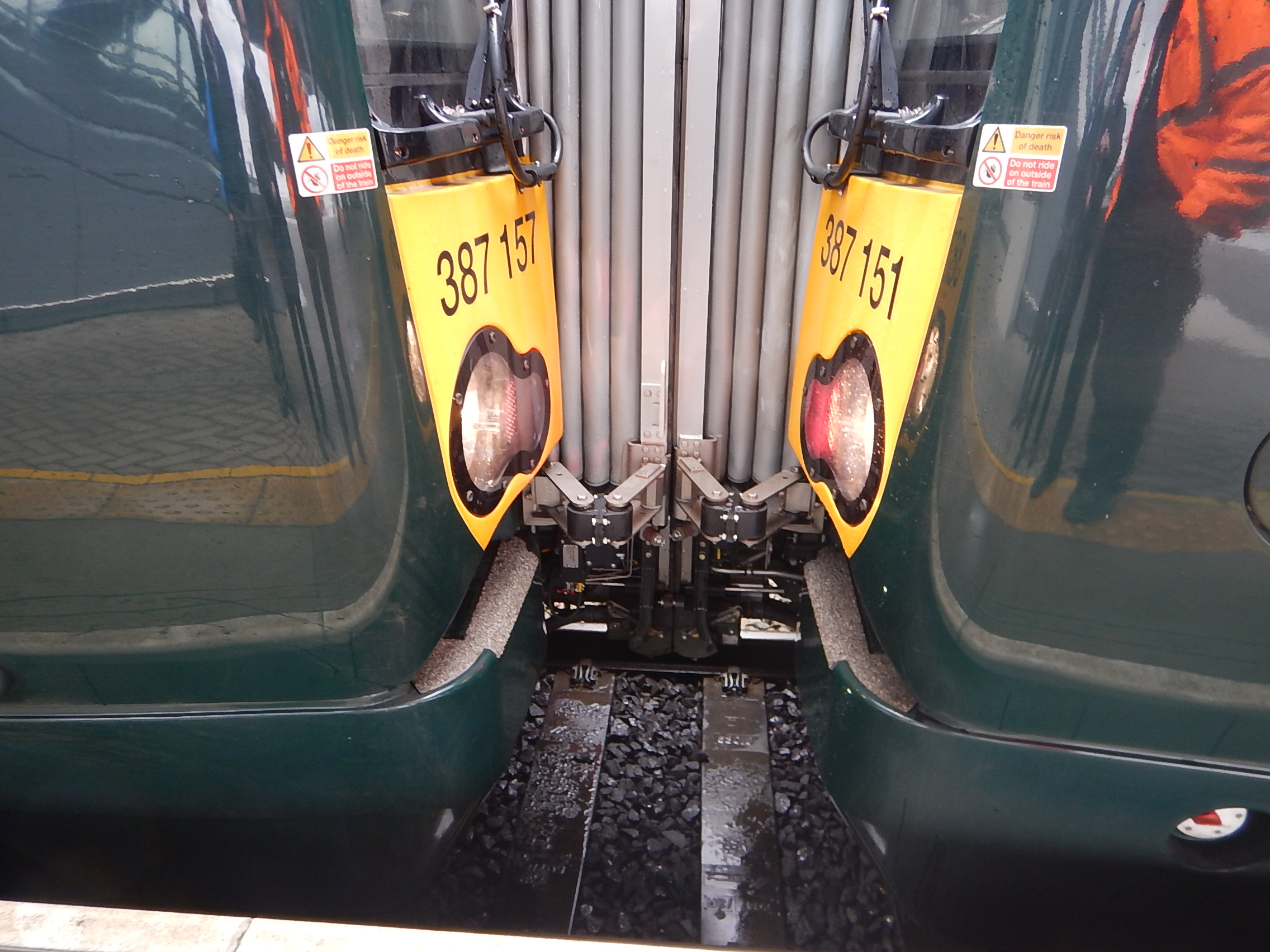
Note the driver in the cab on the right, controlling the process.
There is also a gangway between the two Class 387 trains, which the Class 332 trains don’t have.
Updating The Trains
The production of Class 387 trains has only just finished at Derby, but the Class 332 trains were built twenty years ago.
So could it be, that creating a modern fleet with all the features needed is easier with the later trains?
Suitability For Use With Heathrow Southern Railway Proposal
There are various issues here.
These concern fleet size and capacity
- Any extensions to the South and West will need more trains.
- If express services between Basingstoke, Guildford and Woking, and Paddington via Heathrow are successful, this could lead to calls for more services and other destinations, which could need more trains.
- If five-car units were needed, then Bombardier could probably oblige.
- There may be a need to lengthen platforms at the Heathrow stations.
Expanding a Class 387 train fleet would be easier.
There are also line speed issues.
- What would be the design operating speed of Heathrow Southern Railway’s tracks alongside the M25? – 90, 100 or even 125 mph!
- Could the operating speed of the Chertsey Branch Line be increased to the same speed, as there are only two stations; Chertsey and Addlestone?
The 110 mph maximum speed of a Class 387 could be a serious advantage, as speed sells!
How Many Trains Would Need To Be Converted?
Currently, there are fourteen Class 332 trains working Heathrow Express services.
They usually work in pairs, so there are seven trains.
If these are replaced by twelve-car Class 387 formations, that means up to twenty-one trains will be needed for the airport services from their current fleet of forty-five trains.
Eight-car formations would need fourteen trains.
Conclusion
It appears to me, that it is good decision to change the fleet for Class 387 trains.
Overall Conclusion
It’s all coming together for Heathrow Southern Railway.
A Scoop For Train-Spotters
Various news sources are reporting that Kim Jong-Un’s visit to China was first noticed by train spotters.
This article on the Washington Post, says this.
The detective work started Monday when train spotters and North Korea watchers noticed two suspicious developments: tight security at the China-North Korea border and train delays across the northeast.
The article also says that a popular Chinese nickname for the North Korean dictator is Fatty the Third.
New Passenger Rail Routes In The West Midlands
Looking for possible privately-funded rail projects, I have come acrossseveral proposed rail route re-openings and improvement schemes in the West Midlands on Wikipedia.
Birmingham-Peterborough Line
The Birmingham-Peterborough Line is a major route between Birmingham and the East.
I am including it, as there are aspirations to add new stations at Castle Bromwich and Fort Parkway.
Between Birmingham and Nuneaton must be a candidate for in-fill electrification, especially as this section has two freight terminals.
Camp Hill Line
The reopening of the Camp Hill Line across Birmingham has been a long term ambition of the City Council for years.
The current status of the proposed development of the Camp Hill Line is given in Wikipedia under Future Plans.
This is the last part of that section.
In 2017, the newly elected Mayor of the West Midlands Andy Street pledged to get work started on restoring services to the line by 2020. And officials were said to be investigating the business case for a fourth station at Balsall Heath (previously called Brighton Road) This would mean Lifford and Camp Hill would be the only stations not to be reopened.
In August 2017, West Midlands Trains announced plans as part of their franchise deal that the line would reopen by December 2019 as part of a £1 billion investment in the West Midlands. This included a new station at Moseley.
In February 2018, Mayor of the West Midlands, Andy Street, said that the viaduct would not be needed, as Hereford to Birmingham New Street trains could be diverted along this line, meaning that extra capacity at Birmingham New Street was not required to open this line.
Note that the original completion date for this scheme was 2025 and it has now been moved forward to December 2019.
The current scheme seems to include the following.
- Four new stations at Balsall Heath, Moseley, Kings Heath and Hazelwell.
- A possible connection into Birmingham Moor Street station.
- Birmingham New Street to Worcester services would use the Camp Hill Line.
It seems that this scheme provides a rail service to a new part of the city and also releases capacity at Birmingham New Street. I think there’s some Brummie cunning at work and that a simpler scheme is being created, that could involve.
- The new stations.
- None or very little new electrification, track and signalling.
- No connection to Moor Street station.
- Services from Birmingham New Street to Kings Norton, Redditch and Bromsgrove using new Aventra trains running on batteries on the Camp Hill Line, which would call at all stations.
- An improved Birmingham New Street to the new Worcester Parkway station using new CAF Civity diesel trains, along the Camp Hill Line.
- Will CrossCountry’s Cardiff-Nottingham service be rerouted via the Camp Hill Line?
The New Street to Worcester services could be rerouted earlier, if it was necessary to squeeze more capacity out of New Street station.
Note that if all services stopped at Bromsgrove, when it gets its electric service on the Cross-City Line in May 2018, passengers for a lot of destinations, would surely change at Bromsgrove, rather than New Street!
Darlaston Loop
The reopening of the Darlaston Loop has been suggested by Andy Street, who is now Mayor of the West Midlands.
I suspect that this reopening fits within a larger overall scheme.
South Staffordshire Line
Network Rail and Midland Metro, both seem to have aspirations to run services on the South Staffordshire Line.
Re-opening Proposals in the Wikipedia entry gives full details of the proposals. Included are.
- Freight trains on a single track.
- Midland Metro on a single track with passing places.
- National Rail services.
- Tram-trains sharing with freight trains.
This is the last entry.
In September 2017, the new franchise operators, West Midlands Trains, plans to restore disused railway lines including the South Staffordshire Line which would be an extension of the existing Birmingham to Stourbridge Junction service which it plans to extend to Brierley Hill in the future.
On the Wikipedia entry for the Midland Metro, under Wednesbury and Merry Hill – Extension, this is said.
From Line 1 in Wednesbury, the Brierley Hill Extension (WBHE) would follow the disused South Staffordshire Line, through Tipton to the vicinity of the former Dudley Town station (which closed in 1964 and was later the site of a freightliner terminal), then on-street into Dudley town centre. It would leave Dudley alongside the Southern Bypass to access the railway corridor, leaving it at the approach to the Waterfront/Merry Hill area and Brierley Hill and then on to Stourbridge.
Centro has stated that the WBHE would provide 10 trams per hour, alternately serving Wolverhampton and Birmingham. Journey time from Brierley Hill to West Bromwich was stated as 31 minutes.
There are a lot of possibilities.
Various things might help in the design.
- There is space for two tracks. It has been suggested that one is for trams and one for freight.
- Midland Metro’s trams can run on battery power, so no electrification is required, if all other trains are diesel-powered.
- Midland Metro’s trams and West Midlands Trains’s new diesel trains are both built by CAF, so are they compatible enough to share a track?
- Modern signalling gets better and better.
I think we might see a very innovative plan for the use of this line.
Sutton Park Line
The Sutton Park Line is another line in the est Midlands area, that could be re-opened.
Re-opening in the Wikipedia entry gives full details of the proposals.
In February 2008 it was announced that Birmingham City Council, Network Rail and Centro were launching a feasibility study to assess the possibility of re-opening the line to passenger services. In January 2015 the line was put on hold for reopening to passenger trains. In April 2017, the proposals were being looked at again as part of a spin-off to the HS2 scheme. In December 2017, it has been proposed that the line could reopen as part of the Governments plans to reopen lines closed in the 1960s and later cuts by British Rail.
I would think, that one of the main reasons, this line is being reopened is that is connects several of the other suburban lines in Birmingham. It also allows freight trains to by-pass Birmingham New Street station.
Walsall-Wolverhampton Line
This is said about reopening a passenger service on the Walsall-Woverhampton Line in Wikipedia under Future Plans.
The West Midlands Combined Authority have announced their intention to restore a passenger service to the line by 2027, along with new stations at Willenhall and Darlaston James Bridge.
Note.
- At the present time, this route is for freight.
- It has had passenger services on and off for fifty years.
- It can be used as a diversion route around engineering works.
If a direct service were to be reinstated it would take just twelve minutes, as opposed to an hour via Birmingham New Street station.
It strikes me that this would be a simple route to upgrade.
Walsall and Wolverhampton stations are electrified.
The route is surely short enough to be handled by a battery-powered train.
Signalling is probably up-to-date.
There is also this report in the Wolverhampton Express and Star, which is entitled Spring Satement: £350m Housing Deal For The West Midlands, which says this.
The deal comes after ministers revealed plans to bring the line between the town and city back into use, including new railway stations at Willenhall and James Bridge, Darlaston.
Things seem to be happening on this route.
Possible New Stations
I’ll summarise the possible new and reopened stations.
- Aldridge – Sutton Park
- Balsall Heath – Camp Hill
- Castle Bromwich – Birmingham – Peterborough
- Darlaston James Bridge – Walsall-Wolverhampton
- Fort Parkway – Birmingham – Peterborough
- Hazelwell – Camp Hill
- Kings Heath – Camp Hill
- Moseley – Camp Hill
- Pelsall – South Staffordshire
- Willenhall Bilston Street – Walsall – Wolverhampton
Could a common design be created, so that the cost of stations is reduced?
Is There A Plan?
The West Midlands Combined Authority and the train operation company for the area; West Midlands Trains, seem at a first look, taken all the freight and disused routes and seeing how they can be linked into a network to the benefit of Birmingham.
But I think it is more than that!
The trains and trams are a varied fleet.
- CAF Urbos trams. – Can be fitted powered with batteries
- Bombardier Aventra trains in three- and five-car units. – Might be possible to be powered with batteries
- CAF Civity diesel-multiple units in two- and four-car units.
Full details have not been given about the Aventras, but it could be that all trams and trains are capable of moving for perhaps a dozen miles under their own power. Obviously, the CAF Civitiies can go a lot further on diesel fuel.
I have some questions.
- Could all these trains, mean that the lines can be added to the current network without installing too much electrification?
- Is it only the South Staffordshire Line and the Darlaston Loop, where new track needs to be laid?
- CAF are a company noted for innovation, who are opening a factory in Wales. Have they got a Spanish Surprise to help the WMCA create a world-class network?
- Are architects and engineers working on a unique platform design, that all trains can share?
- Could the Camp Hill Line and the Walsall-Wolverhampton Line have a passenger service, as soon as there are trains to run the service?
I wonder if there is a plan to bring in new routes continuously!
- Electric trains on the Chase Line to Rugeley Trent Valley station and to Bromsgrove station will be first in 2018.
- Walsall and Wolverhampton using the Wallsall-Wolverhampton Line
- New Street and Worcester using the Camp Hill Line.
- New Street and Bromsgrove using new stations on the Camp Hill Line.
- Coleshill Parkway tand Walsall using the Sutton Park Line.
- Walsall and Stourbridge Junction using the South Staffordshire Line and diesel trains.
- Wednesbury and Merry Hill using the South Staffordshire Line and trams.
Note.
- The early bonus of the new electrification.
- Walsall and Bromsgrove will develop into well-connected hubs.
- Euston and Walsall will be introduced by West Midlands Trains.
- As the network expands, new trains are delivered.
- Stations will be added continuously.
- All parts of Greater Birmingham will benefit.
Is this the way, Andy Street will market the network to his customers?
Swansea Bay Metro
Looking for possible privately-funded rail projects, I have come across the Swansea Bay Metro on Wikipedia.
Wikipedia outlines the project like this.
- A new line from Baglan to Swansea station diverting the mainline from the current route via Neath, reducing journey times to Cardiff to 30 Minutes
- The new Main Line would have stations at Swansea Bay Campus and SA1
- Reopening of the current freight only Neath Valley Line to passengers with new stations at Jersey Marine, Neath Abbey, Neath (shown as Neath 2) and Aberdulais
- A new line from Neath to Llansamlet Interchange via a new station at Llandarcy
- New stations on the existing Swansea to Baglan at Llansamlet Interchange, Phoenix and Morfa
- New stations at M4 J45, Morriston, M4 J46 and Pontlliw
- A new station on Station Road.
It is a comprehensive project that would probably cost over a £1 billion.
This could just be the sort of project that Chris Grayling felt could be developed.
This study document from Professor Mark Barry gives more details of a possible proposal.
This map is included.
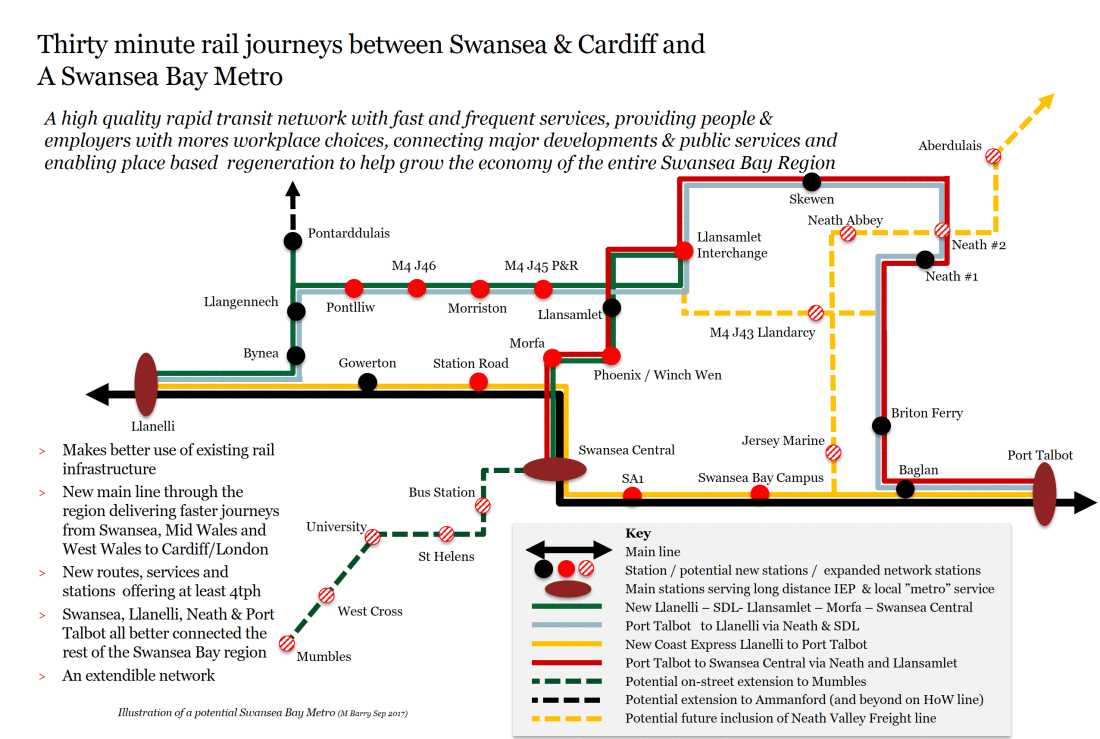
It certainly is a comprehensive project.
York-Beverley Line
Looking for possible privately-funded rail projects, I have come across the York-Beverley Line on Wikipedia.
This is an extract from the Wikipedia entry.
Following the Government’s plans to reinstate lines closed in the 1960s which was announced in November 2017, it has been proposed that the line could reopen as a result.
The line runs between Bootham Junction on the York-Scarborough Line and Beverley Junction on the Hull-Scarborough Line.
This diagram from Wikipedia shows the detailed route.
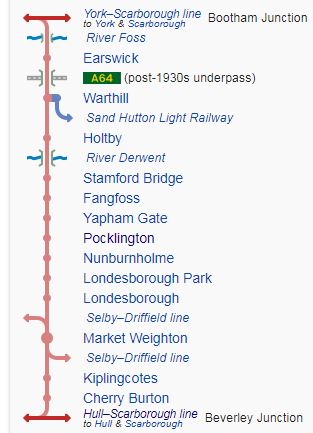
I only know the area as a visitor, but it would appear to be a valuable new connection.
The Ringwood Branch Line
Looking for possible privately-funded rail projects, I have come across the Ringwood Branch Line on Wikipedia.
It would appear that the plan is to open a section of the Southampton to Dorchester Railway from Lymington Junction to a new Ringwood station.
This is said in Wikipedia.
A report from the Association of Train Operating Companies (ATOC) published in June 2009 recommended the rebuilding of part of the line from Brockenhurst to Ringwood. It looked into the feasibility of reopening disused lines and stations, and concluded that there was a business case for investing £70m in the new link with an hourly service.
This diagram from Wikipedia, shows the lines in the area.
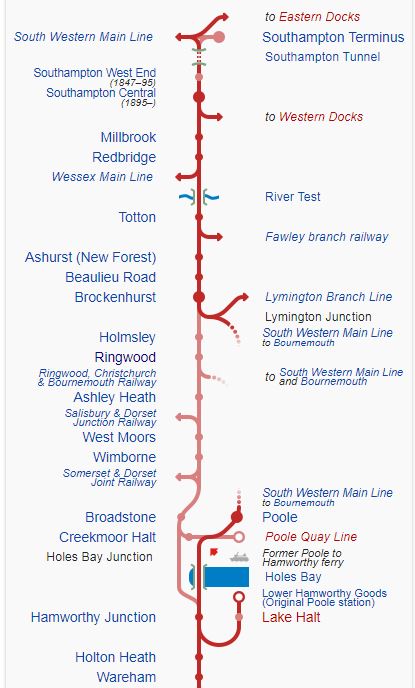
Note.
- Would any other stations be reopened?
- The line was all double-track.
- I’ve flown my helicopter from Brockenhurst to Ringwood and you can clearly see the old track-bed.
This Google Map shows a portion of the route.
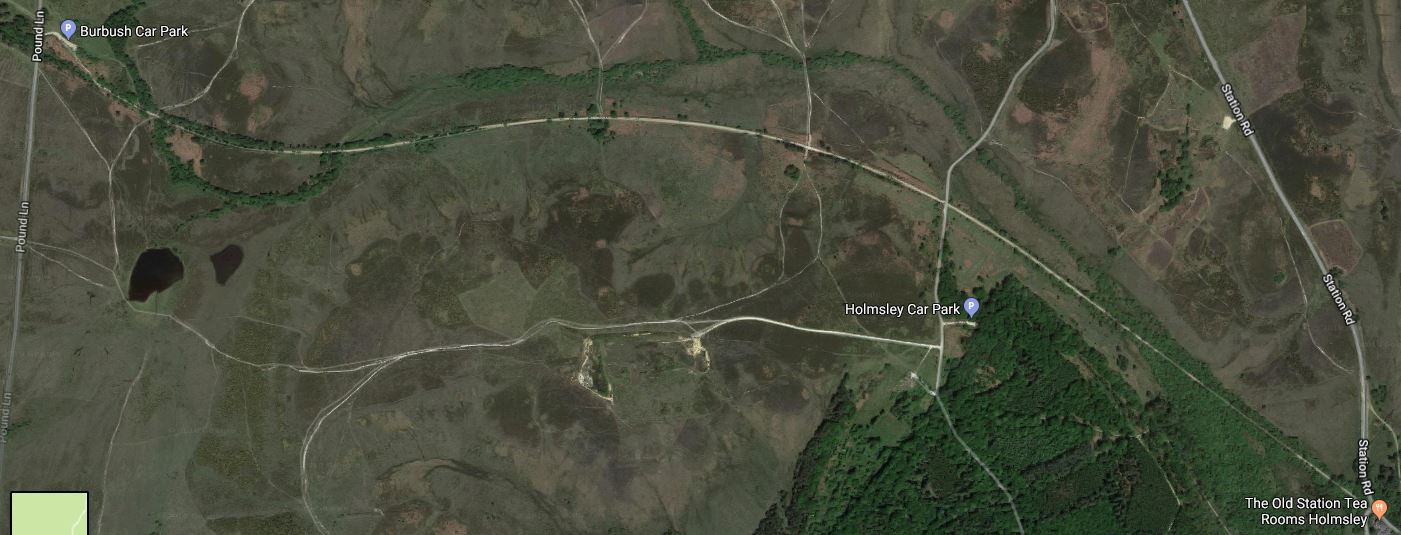
The route runs in a curve between Byrbush Car Park in the West and Holmsley Station Tea Rooms in the East.
Earlier, I quoted that ATOC have suggested an hourly service. Would this be one of the following?
- A shuttle between Ringwood and Brockenhurst like the Lymington Branch Line, which also starts at Brockenhurst.
- A through train to London.
- A through train to Southampton.
Given the number of active and proposed routes in the area, there willprobably be better ideas.
NR Set To Reach Major Shotts Electrification Milestone Over Easter
The title of this post is the same as that of this article in Rail Technology Magazine.
I’m not totally sure, but it looks like they will complete the overhead wires between Edinburgh and Glasgow along the Shotts Line.
They certainly seem to be moving on apace with electrification in Scotland, unlike around the North West of England.
The Heath Rail Link In Devon
Looking for possible privately-funded rail projects, I have come across the Heath Rail Link in Devon on Wikipedia.
This is said.
In January 2018, a new company, Heath Rail Link met with Network Rail to discuss plans and progress. During the meeting, Network Rail gave authorisation for Heath Rail Link to lease the line once funds were submitted for it.
I also found this article on Heritage Railway, which is entitled A Fourth Tourist Line In South Devon In 2020?.
Something is definitely happening, but will it lead to anything?
Will the line be a heritage railway or will it be run by something like a Class 230 train?
The Cranleigh Line
Looking for possible privately-funded rail projects, I have come across the Cranleigh Line on Wikipedia.
This is part of what is said on Wikipedia about Possible Reopening, in a eport by Buchanan and Partners in 1994.
The report estimated that around 500 car users could transfer to rail each day. The cost of reinstating the line between Guildford and Cranleigh was projected at £24 million which would include the base, civil, electrical, engineering and signalling works. It did not include land acquisition costs, legal costs and bridge works. The reinstatement of the bridge over the River Wey was costed at £750,000.
The report concluded that, based on a preliminary analysis of the line’s potential returns, re-opening would not be feasible. The line was, according to the report, likely to recoup only 3% of the capital investment in the first year of re-opening, and this without taking into account its operating costs. British Rail usually insisted on a figure of at least 8% before investing capital into re-opening a line. Nevertheless, the County Council decided to commission a detailed economic feasibility study by British Rail into the line’s potential for re-opening, and looked into the possibility of using a light railway or tramway substitute.
What would a report say now?
Given that the line runs between the busy stations at Guildford and Horsham, the latter of which has a Thameslink frequency of two trains per hour, I think that the answers would be very different.
The route would also be one, that could be run by a third-rail tram-train!
Consider.
- The tram-trains would use battery power, where there is no third-rail electrification.
- The route between Guildford and Peasmarsh Junction is electrified and has no stations.
- The route between Horsham and Stammerham Junction is electrified and has no stations.
- Between Peasmarsh Junction and Stammerham Junction, there were stations at Bramley & Wonersh, Cranleigh, Baynards, Rudgwick and Slinford.
- Stations could be rebuilt and added to as required.
- Between Peasmarsh Junction and Stammerham Junction, the new line would be without electrification.
Could the new line share the route with walkers and cyclists?
I think there is a chance here to create a new type of light rail link!
 The Anonymous Widower