Toilets In Class 345 Trains
I visited this topic in Do Crossrail Trains Need Toilets? over two years ago, when I said this.
Surely, a much better and more affordable solution would be to update the ribbon maps in all Underground and Crossrail trains to show if the station had toilets, in the same way, they show the step free access. Some extra signs on stations showing the status and location of toilets would also be a good idea.
Incidentally on the Essex and Reading legs of Crossrail, several of the stations already have decent toilets. Getting off a train and catching the next one, to have a relaxed toilet break, is probably not a huge delay, due to the high frequency of the trains.
London has a chance to set high standards in this area, without putting toilets on any trains.
My views haven’t changed, but I do think that now the Aventra is in limited service, I can speculate further.
Walk-through Trains, First Class And Toilets
London now has five walk-through trains.
- Class 378 trains on the London Overground.
- S Stock on the London Underground
- Class 700 trains on Thameslink.
- Class 707 trains on South West Trains
- Class 345 trains on Crossrail.
In some ways the Class 700 train is the odd train out, as it has both First Class seating and toilets.
It should also be noted that Greater Anglia’s new Class 720 trains don’t have First Class, but it appears they have toilets.
Walk-through trains are an undoubted success, as any Overground or Underground passenger will confirm, after seeing the way other passengers move around the train to both get a seat and be able to make a convenient exit.
First Class causes problems, as it blocks off this passenger circulation, unless it as one end of the train. But this means that First Class passengers might have a long walk to their seat at the wrong end of the day.
I wonder if walk-through trains encourage passengers to not use First Class, as the freedom to circulate in Standard Class makes the travel experience better.
It will be interesting to see how posh commuters from Frinton take to Greater Anglia’s new Class 720 trains.
Another problem of First Class sitting at one end of the train, is that if toilet provision is made, there must be a toilet near to First Class.
So if you don’t have First Class in a train up to perhaps ten cars, you can get away with perhaps a universal access toilet and a standard one.
From comments I get, most people seem to like the Class 395 trains or Javelins, that work the Highspeed services to Kent. These trains are six-car, with no First Class and two toilets.
So are these trains setting the standard for the Greater Anglia’s Class 720 trains?
Toilets On Class 345 Trains
The initial layout of Crossrail with terminals at Abbey Wood, Heathrow, Reading and Shenfield, has a longest journey from Reading to Shenfield of 102 minutes according to the Crossrail web site. But there are toilet facilities at Reading and Shenfield.
However, there is the possibility, that Crossrail trains may serve other terminals like Gravesend, High Wycombe, Southend and Tring.
Tring to Southend would be a journey of two hours, so a toilet is probably a necessity.
The current Class 345 trains have been designed to be nine-car units, although at present they are running as seven cars because of platform length issues at Liverpool Street.
I’ve read somewhere that Crossrail has been designed so that the trains can be increased to ten cars, if there should be a need for more capacity.
- Platforms have been lengthened to at least two hundred metres.
- All stations seem to have been updated for a large number of passengers.
- Lengthening from seven to nine cars is obviously a simple matter.
- A similar lengthening of the Class 378 trains was not a major exercise.
So surely, it would be a simple matter to slot in a car with a toilet.
So perhaps we might see an extra tenth car added to Class 345 trains, that is tailored to the route, as this ability to add and remove cars, is a feature of all Aventras.
Hitachi’s Class 800 trains also have the capability, as I suspect every well-designed train has.
The Ultimate Airport Train
Imagine a tenth car on Heathrow services.
- Disabled toilet.
- Ticket machine.
- Visitor information and shop.
- Space for large luggage.
The mind boggles!
Conclusion
If an operator wanted Aventras with a disco car, I’m sure Bombardier would oblige! At a price!
Glasgow Looks To Venice With Water Taxi Service To Airport
In Wikipedia, there is a section called Venice of the North. Included in the list of thirty-seven cities are the likes of Ansterdam, Birmingham, Copenhagen, Gdansk, Lubeck, St. Petersburg and Stockholm.
But surely Amiens, Colmar, Manchester, Skipton and various places I’ve never heard of, is taking the list too far!
The title of this post is the same as an article in the Scotsman, about a Glaswegian, who intends to start a water taxi service to Glasgow Airport.
This Google Map shows Glasgow Airport, which has the Black Cart Water to the North and the White Cart Water to the East.
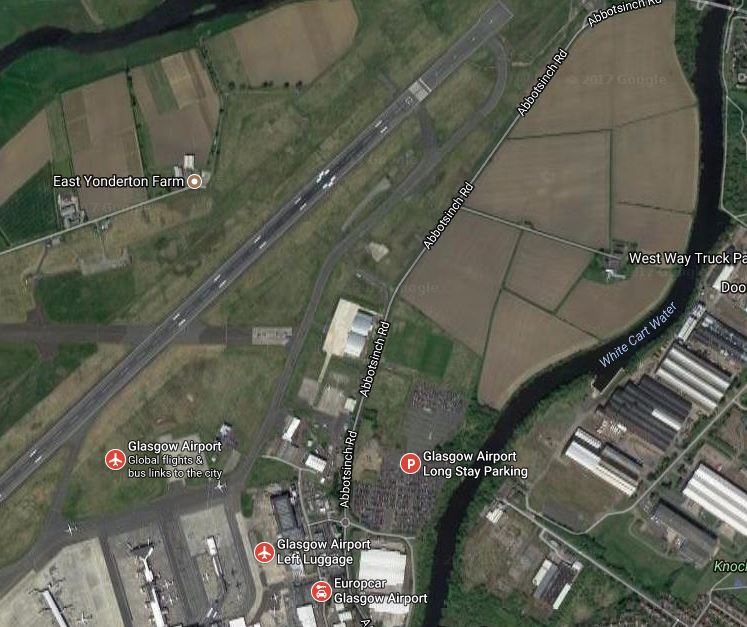
The two waters join to the North of the Airport and then flow into the River Clyde.
This is proposed.
- The boat terminal at the airport would be on a pontoon on the White Cart Water, about five hundred metres East of the airport.
- Transfer from the airport to boat would be initially by golf buggy.
- The trip to the City Centre would take 25 minutes by fast boat.
It’s the sort of plan, that if carried out with style could work very well!
This Google Map shows the River Clyde through Glasgow.
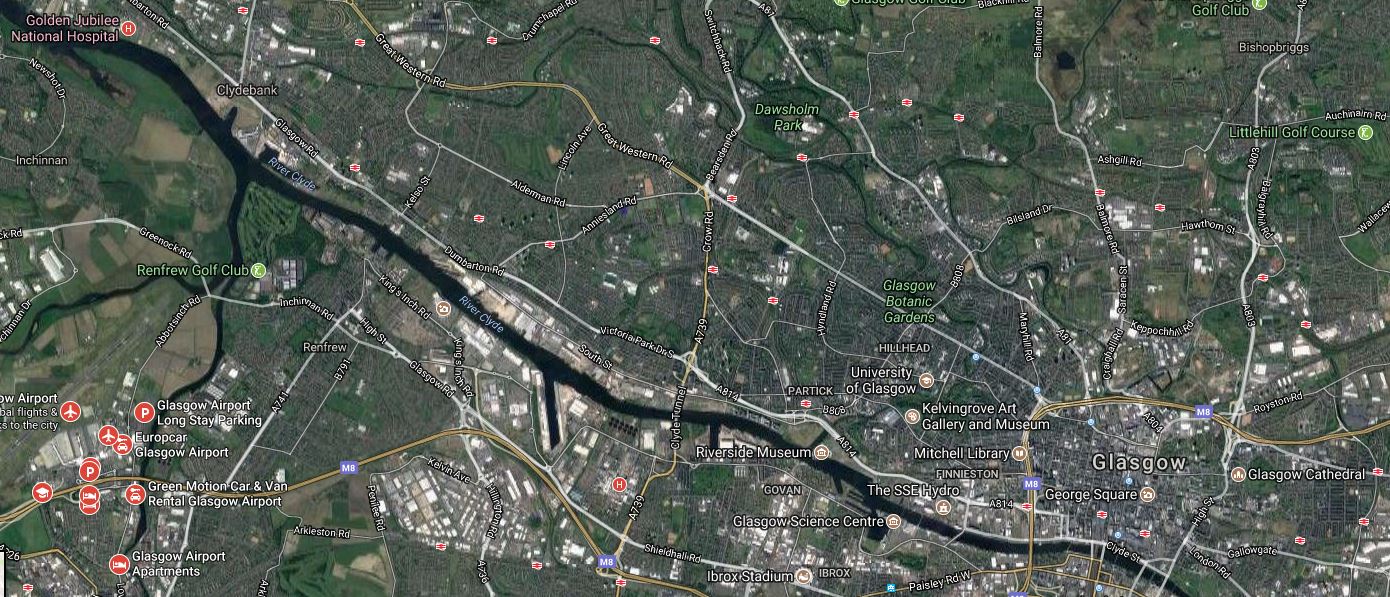
Unlike the Thames through London, it appears to be straight.
The Airport is at the West of the map between the fork of the Black and White Cart Waters.
It was always thought that river buses on the Thames wouldn’t work, but over recent years, the Thames Clippers seem to have made a success of it.
Perhaps someone will make the same concept work in Glasgow.
Conclusion
I wish the guy well and I suspect that in a few years, the Clyde will be an important commuter, tourist and sairport route.
It just needs the right design of boat.
What Is Happening At Platform 9 At London Bridge Station?
I regularly come home from Waterloo station, by walking to Waterloo East station and then getting a Southeastern train to London Bridge station, from where, I get a 141 bus to a zebra crossing on the corner opposite my house.
Location is important, when buying a house!
You might ask, why I don’t use the Jubilee Line between Waterloo and London Bridge. I prefer not to be in a dark tunnel in an small-diameter Underground train, when there is a full-size alternative on the surface.
When the new Southeastern Franchise is awarded, I wouldn’t be surprised to see a succession of large-windowed trains, like Aventras, replacing the over twenty-years-old Class 466 trains. They could become a tourist attraction linking Greenwich and Westminster via The Shard, that would be so much more interesting than the Jubilee Line.
This diagram from Wikipedia shows the proposed platform layout for London Bridge station from 2018.
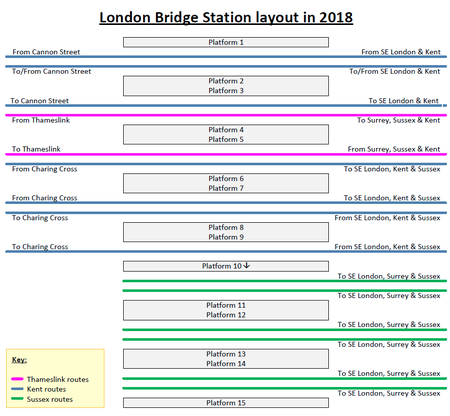
Note.
- The island Platform 6 and 7 is flanked by two lines coming from Charing Cross station.
- The island Platform 8 and 9 is flanked by two lines going io Charing Cross station.
- The tracks through Platforms 6 and 9 appear to be on loops from the track going through the other paired platform.
I assume the layout is to get sufficient platform capacity for the ten-car trains going through the station.
Look at this Google Map of the station.
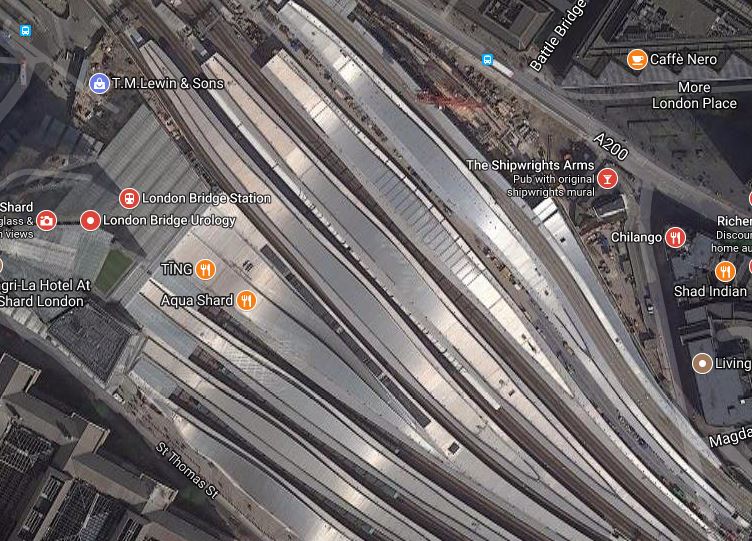
The Platforms are numbered from top-right to bottom-left.
- Platform 1 doesn’t appear to be complete and will be a bi-directional platform into Cannon Street station.
- Platforms 2 and 3 are the first through island platform and serve Cannon Street.
- Platforms 4 and 5 are the second through island platform are are for Thameslink.
- Platforms 6 and 7 are for trains coming from Charing Cross.
- Platforms 8 and 9 are for trains going to Charing Cross.
- Platform 10 upwards are bay platforms for terminating services.
Note.
- The generous width of the through island platforms.
- Ot appears it might be possible to put a second platform on the other side of the track through Platform 9. Let’s call it Platform 9a
- This extra Platform 9a and the bay Platform 10 could be easily connected, with a walk-through.
These pictures were taken from outside the station and show the area to the West of Platform 9.

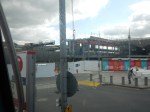


Some substantial construction work is going on.
These pictures were taken inside the station.
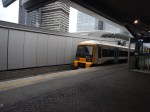



I wonder what the final outcome will be!
The First Year Of The Night Tube
This article on City AM has a title of The Night Tube has topped expectations by boosting London’s economy by £171m in its first year.
This is a paragraph that details the economic effects.
Figures released to mark the first anniversary of the service show that the Night Tube is expected to top 8m journeys this weekend – which will be 15 per cent more than forecast, and has boosted London’s economy by £171m in its first year, supporting more than 3,600 jobs.
When you consider that Friday and Saturday night running has been achieved without any visible new infrastructure, this must be considered a good result.
It’s even created a few more jobs on the Underground, so why were the unions against the concept at the start? This is detailed in this section called Strike Action in the Night Tube entry in Wikipedia.
Safety
I have been following the Night Tube and it appears the only serious overnight death on the Underground, since the Night Tube started was the death of a student on a section of the Underground, that was not part of the Night Tube.
The couple of times, I’ve used the Night Tube, most of the passengers seems to be workers going to and from their jobs. Some looked tired, but serious drunks were noticeable by their absence.
Gatwick Airport
I was going to Victoria to get the Gatwick Express to the Airport and the Night Tube certainly seemed to be becoming a popular route for catching an early flight. I even saw a couple of obvious flight crew.
Cities Outside London
Are other cities following London’s lead?
- There are grumbles on the Internet about Merseyrail’s early closure.
- Manchester Metrolink seems to close at eleven.
- The Nottingham Express Transit seems to close at Midnight.
- The Sheffield Supertram seems to run from before six in the morning until around midnight.
- Edinburgh trams seem to run until half an hour before midnight.
- The Midland Metro don’t say on the web site.
- The Newcastle Metro runs to around midnight.
- Blackpool Tramway has a last tram around one in the morning.
- The Glasgow Subway closes half an hour before midnight most days, but at six on a Sunday.
- Cardiff trains seem to shut around eleven.
Compare this to the London Underground, where the first train is generally before six and the last one is around or just after midnight.
Conclusion
The Night Tube has been good for London and it will soon be joined by the Night Overground.
With massive investment going into local transport systems in Birmingham, Cardiff, Glasgow, Liverpool, Manchester and Newcastle, I wonder which of these cities will follow London’s example.
The Class 345 Trains Are More Numerous
I took the train to Ipswich today to see Town host Brentford.
There were three Class 345 trains in a neat row at Ilford EMU Depot and another in Shenfield station.
Wikipedia now says that there are seven in service, but eleven are planned by September according to this article in the International Railway Journal.
Waterloo Upgrade August 2017 – 18th August 2017
I took a train to and from Waterloo to Woking today, so that I could take pictures of the Platform 1 to 8 works at Waterloo and to have lunch at a branch of Carluccio’s, which is close to the Woking station.
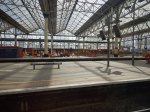
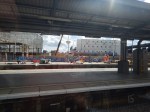
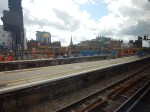
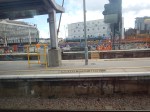

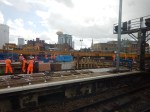
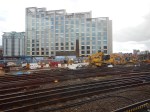

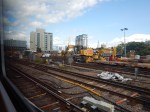
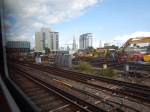
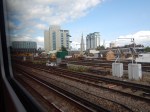
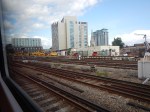
I went out on a train from Platform 11, but unfortunately, the train came back into Platform 14.
London Over/Underground And New York Subway Compared
This article on Business Insider, is entitled I rode London’s famous Underground system for a week — and I saw why New York’s subway will never catch up.
It is good read.
Crossrail Funding Contributions From Developers Forecast To Hit £600m Target A Year Ahead Of Schedule
The title of this post is the same as that of this article in City AM.
The funding has come from the mayoral community infrastructure levy (MCIL) and Section 106 contributions.
The two biggest contributions came from |Tower Hamlets at £40m and Westminster at £34m.
What the author doesn’t point out is the collateral benefit from all this extra development. Transport for London must be getting more far revenue from more passengers going to and from the developments.
It’s certainly good news.
Are areas like Birmingham, Leeds, Liverpool, Manchester and Newcastle seening similar cast flow increases?
NR States Ambition To Keep Liverpool Moving During Major Lime Street Work
The title of this post is the same as the title of this article on the Rail Technology Magazine web site.
This is the first two paragraphs.
Liverpool Lime Street will remain “open for business” whilst it undergoes major work this autumn, Network Rail has today reassured passengers in the region.
The latest stage of work will take place between 30 September and 22 October in what is one of the biggest upgrades the station has seen since the 19th century.
The station upgrade is part of a £340 million railway investment in the Liverpool City Region.
This document from Network Rail describes the scope of the project in detail.
These are some extracts from the document.
What Are The Benefits For Passengers?
The Liverpool City Region Railway Upgrade Plan will deliver for passengers:
- A bigger and better railway network with longer and faster trains
- More reliable railway infrastructure
- Better facilities for passengers, especially at stations
- Increased capacity/additional services
What Will This Mean In Practice?
- Three extra services per hour, in and out of Lime Street station, such as the planned new First Transpennine Express
services from Liverpool to Glasgow in 2019. - Better east-west connectivity to and from Liverpool.
- New services to Chester via Liverpool South Parkway and the opportunity to develop more routes into North Wales in the future.
- New station facilities and interchange at Newton-Le-Willows.
- A new station at ‘Maghull North’ to support growth in passenger demand.
- New signalling which will improve the reliability of the network and speed up decision making to minimise disruption.
- Works to facilitate the running of new trains on the Wirral and Northern lines.
Liverpool Lime Street Station
Liverpool Lime Street station will be getting a major upgrade consisting of the following.
- Two new platforms between the current platforms 7 and 8.
- Platform lengthening.
- Improved signalling and electrification.
- More shops.
This should enable another three trains per hour to be handled.
It’s over fifty years since I first arrived in Lime Street to go to Liverpool University and the station has changed a lot in those years. Network Rail are saying, that this upgrade will cope with the doubling of passenger number expected before 2043.
Using Liverpool South Parkway Station As A Relief Terminus
The upgrade will mean that at times during the works, trains into Liverpool will not be able to access Lime Street. So some trains will terminate at Liverpool South Parkway station from where passengers can take Merseyrail’s Northern Line to the City Centre.
How many of our large cities can cope, when the main station is closed?
- Glasgow proved they can, when Queen Street station was closed.
- London is managing biow, with mahor works going on at Waterloo.
- Manchester’s ability to cope will surely be greatly improved when the Ordsall Chord opens.
- Birmingham seemed to manage during the rebuilding of New Street station.
- Newcastle has the Metro to help.
- Sheffield has a second station at Meadowhall.
Would Leeds be the city to struggle?
Liverpool will probably cope well, as there are various rail routes into the City, that avoid Lime Street, most of which have four trains per hour.
I always remember the Liverpool Bus Strike of around 1967. Liverpudlians just walked, as did most of the students like me, who needed to get into the University.
I don’t think, it will come to walking this time, as Network Rail have promised quality buses.
Conclusion
There is a lot of work to do, but after the example of Waterloo, it is likely to go fairly well to plan.
But there will be a few hiccups.
Crossrail To Heathrow, Reading And Southend
Crossrail To Heathrow
In the Wikipedia entry for Crossrail, there is a section called Extensions.
This is said under a sub-section called Heathrow Express.
The RUS also proposes integrating Heathrow Express services from Heathrow Terminal 5 into Crossrail to relieve the GWML and reduce the need for passengers to change at Paddington.
Note RUS refers to Network Rail’s Route Utilisation Study of 2011 and GWML is the Great Western Main Line.
Currently, Heathrow Express takes fifteen minutes to go between Paddington and Heathrow Central stations, with Heathrow Connect taking thirty-two minutes with five stops.
The journey time calculator on the Crossrail site, says the trains will take twenty-three minutes with six stops. But as I said in Are Crossrail And Bombardier Having Us On?, Crossrail’s journey time estimates aren’t very good to say the least.
I think until the Crossrail trains reach Heathrow next May 2018, any speculation I make of the time they take between Paddington and Heathrow Central will be very wide of the mark.
However, this can be said of Heathrow Express and Crossrail to Heathrow.
- As the RUS says Heathrow Express services use four paths per hour on the GWML in both directions and these paths would be released for other services if Heathrow Express used the dedicated Crossrail tracks.
- Most Heathrow Express passengers will not be going to Paddington or the surrounding area of the station.
- When fully developed Crossrail will connect Canary Wharf, the City of London, the West End and the Queen Elizabeth Olympic Park, to name just four important destinations, directly to Heathrow Airport.
- If Crossrail works as it says on the box, every travel guide and expert, will recommend you use your contactless bank card to travel on this wonderful new airport train.
- I would suspect, that given Heathrow’s expansion plans, that the Heathrow branch of Crossrail has a capacity in excess of ten trains per hour (tph).
- The accommodation and comfort level in Crossrail’s Class 345 trains is high and well suited for an airport service.
I think that Heathrow Express will be increasingly deserted by passengers, in favour of the cheaper and more convenient Crossrail.
So could the two services be integrated together?
In theory, Heathrow Express could use the Crossrail tracks to Paddington, but there would be problems.
- Heathrow Express trains would have to leave the Crossrail tracks to get into Paddington.
- Would Crossrail want non-stop trains speeding through suburban stations like Southall, with their high suicide rates?
So then why not create a Heathrow Express, that used the Crossrail tracks and stopped at say Old Oak Common (for HS2), Paddington, Bond Street, Farringdon (for Thameslink), Liverpool Street and Canary Wharf?
- Heathrow Express would have to buy new trains compatible with the platform-edge doors in Crossrail’s tunnels.
- Where would the trains be turned back? Perhaps a turnback facility could be built at Liverpool Street at a cost of several hundred million pounds!
- It would still speed through suburban stations.
- Trains moving at different speeds would reduce the capacity of Crossrail.
- As Crossrail and Heathrow Express will use the same platforms at stations, how do you stop people without expensive special tickets using Heathrow Express?
Heathrow will continue to argue to keep Heathrow Express, but in practice in the future, it will be as outdated a concept as trains pulled by steam engines.
So one of two things will happen.
- Heathrow Express will continue as now, using two valuable platforms at Paddington and the four equally valuable paths per hour on the GWML.
- It will be discontinued.
I believe that in some date in the future, only three rail services will serve Heathrow.
- London Underground’s Piccadilly Line.
- A Crossrail service to London and the East.
- A Crossrail service to Reading and the West, which would rejoin the slow tracks of the GWML to the East of Langley station.
The two Crossrail services would probably be run back-to-back, so that fewer trains were turned back at Heathrow.
The two Crossrail branches to Heathrow and Reading would merge easily to the West of Hayes and Harlington station and there would be no complications caused by Heathrow Express trains crossing to and from the fast lines.
Crossrail To Reading
Just over a month ago, Transport for London (TfL) ordered four extra Crossrail trains and announced extra services to Heathrow and Reading. I discussed this in Crossrail Expands Before It Opens
I said this.
Four new Class 345 trains are being ordered, which will mean that in the Off Peak the following will happen.
- Trains between Whitechapel and Paddington will increase from 16 tph to 20.
- Trains between Paddington and Shenfield will increase by two tph
- Trains between Paddington and Abbey Wood will increase by two tph
- Trains between Paddington and Reading will double from two tph to four.
- Trains between Paddington and Maidenhead will increase from four tph to six
- From December 2019, six tph will call at Heathrow Terminal 5.
I also found this quote in the article on Global Rail News, that was the source for the increased services.
The increased service frequency will be achieved, in part, by replacing five Great Western Railway services with Elizabeth line trains.
So could we be seeing a degree of co-operation between TfL, Crossrail and Great Western Railway, whereby the following services are provided?
- Slow stopping services are run by Crossrail on the two slow lines.
- Fast and semi-fast services are run by Great Western Railway on the two fast lines.
This would be operationally simple and might even create extra paths into London for more long-distance services.
The problem are the local stopping trains to Oxford (2 tph) and Bedwyn (1 tph). Will they run on the slow or fast lines between Paddington and Reading?
Consider the service to Bedwyn.
- A five-car Class 800 train could run the service.
- Small modifications at Bedwyn would probably be needed to allow the Class 800 train to use the turnback.
- The train would run using electricity until the wires ran out near Newbury and then diesel.
- The service could run semi-fast or non-stop between Paddington and Reading.
- Nine-car Crossrail Class 345 trains would probably need a lot of platform lengthening, in addition to the electrification to be used to Bedwyn.
And the stopping service to Oxford.
- A five-car Class 800 train could run the service.
- A planned new bay platform at Oxford station would handle the service.
- The train would run using electricity until the wires ran out near Didcot and then diesel.
- The service could run semi-fast or non-stop between Paddington and Reading.
- Niine-car Crossrail Class 345 trains would probably need some platform lengthening, in addition to the electrification, to be used to Oxford.
If the two services are considered together, they could join and split at Reading to save paths on the fast lines.
I think that on balance to use a pair of Class 800 trains would be better than to extend Crossrail past Reading.
Consider.
- A second service to Bedwyn could be easily added.
- A large number of long-distance trains call at Reading station.
- Reading has been designed for easy interchange between fast and slow services.
- Crossrail will be providing at least four tph between Paddington and Reading that stop at all stations.
- Reading has services into Waterloo.
I’m certain that the train companies can find a very efficient solution.
I can see a situation, where Great Western Railway aren’t going to need many Class 387 trains in the Thames Valley.
Crossrail To Oxford
This may seem a bit over the top, but analysis might show, that the best way to create more capacity between Reading and Oxford, might be to extend two Reading Crossrail services each hour to Oxford, when the electrification to Oxford is complete.
Crossrail To Southend
Just as it appears there is co-operation between Crossrail, Great Western Railway and TfL, could similar co-operation between Crossrail, Greater Anglia and TfL, result in improved services on the Shenfield to Southend Line? I wrote about this in Crossrail Tests Its Trains In Southend.
The Long Distance Class 345 Train
Adding Oxford and/or Southend to Crossrail services, may need a sub-class of Class 345 train to be created, due to the length of the journey. Toilets would be the obvious addition.
 The Anonymous Widower