London Bridge Station Will Be A Game-Changer For Many Passengers
After my first glimpse of the new London Bridge station, which I posted in London Bridge Station Wakes Up, I have a feeling that the station could be a gam-changer for many passengers.
These are a few of the ways the new station will help. Some are very specific for me, as I live in Dalston, without direct access to the Underground.
London Bridge Station Is Bus-Friendly
Ever since the new bus station at London Bridge has opened, it has been easier for those like me in Islington, Hackney and Tower Hamlets to get to the station, as there are several buses between our area and London Bridge.
But now the top entrance under the Shard is now complete, you can take one escalator to the concourse under all the tracks.
You can also still walk through direct to platforms 10-15, which I often do, as these platforms are the terminals for trains to and from Freedom Pass territory. There’s also a convenient M&S Simply Food, which I regularly use.
I also think that, as the concourse,has better access to and from Tooley Street, this will help those wanted to use buses on Tooley Street.
This visualisation from this page on the Thameslink Programme shows what Tooley Street will look like.
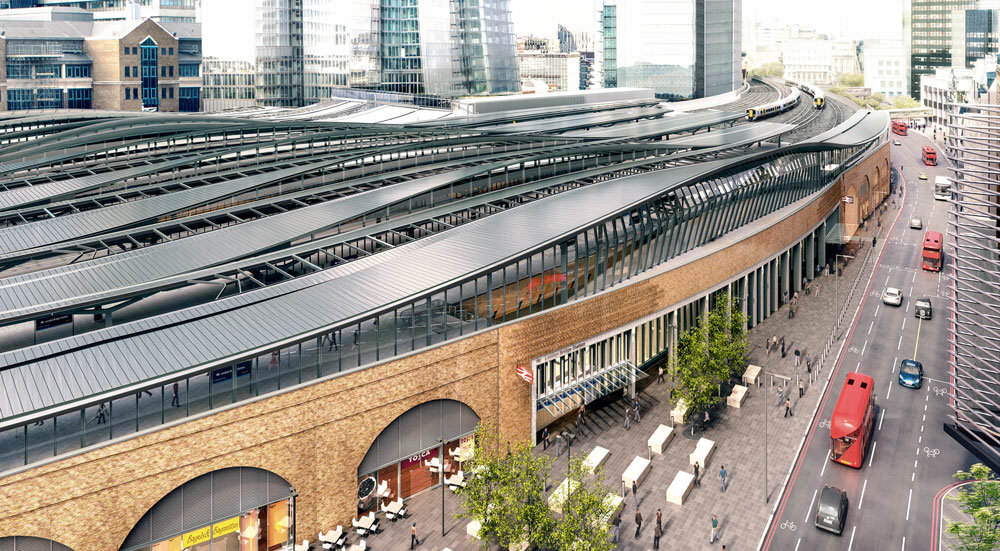
London Bridge Ststion And Tooley Street
There seems to be a wide pavement between the traffic and the station.
London Bridge Station Is Reasonably Tube-Friendly
The main London termini serving the South, are not as far as I’m concerned the easiest to get to by Underground, especially from East London.
Victoria and Waterloo are a long way to the West and Cannon Street and Charing Cross are downright difficult to get to.
However, the Northern and Jubilee Lines probably make London Bridge, the easiest terminal for the South for many to use.
Will Thameslink Be Considered Part Of The Tube?
Since it opened in the 1980s, I’ve always considered that Thameslink should have been considered to be another Underground line.
Although, I really haven’t used Thameslink seriously, until I moved back to London in 2010.
I believe that the following things should be done to make Thameslink better for passengers and increase ridership on the line.
- Show all Thameslink routes and stations on the Tube map.
- Allow Oyster and contactless bank card ticketing at all Thameslink stations.
- Have the same Freedom Pass rules as Crossrail.
- Run Thameslink stations under TfL design, information and operational rules.
- Thameslink stations should be manned from first to last train.
- Disabled passengers should be able to just turn up and ask for assistance.
- Thameslink should be part of the Night Tube.
As I suspect that as these conditions will apply to Crossrail, surely both lines running under the same rules would be very passenger friendly.
I look forward to the day, when I touch in with my bank card at Finsbury Park and touch out at Cambridge or Brighton.
London Bridge Station Will Be An Easier Walk To The City
I’ve walked across London Bridge in late afternoon on a sunny day and the pedestrian traffic to London Bridge station from the City is large.
It would appear that all the work being done on the Tooley Street side of the station, will open up routes to the concourse under the tracks and create better walking routes to and from the City.
Unfortunately, it’s probably not possible to totally pedestrianise Tooley Street, as there is nowhere for the traffic to go.
London Bridge Station For Cannon Street And Charing Cross Avoidance
Before work on the station started, you could always avoid going to Cannon Street or Charing Cross stations to get a train, by catching it as it passed through London Bridge
But it wasn’t the easiest of connections.
Now though with the new platforms 8 and 9 open, you can see how Cannon Street and Charing Cross services will be handled at London Bridge station.
London Bridge Station And Thameslink
If I needed to use the old London Bridge station to access Thameslink services, it wasn’t the easiest.
But now that I can see how I will access the Thameslink platforms at London Bridge, I will probably use a 141 or 21 bus through the City.
I have a feeling that London Bridge will see a bigger increase in passenger use of the Thameslink platforms, when they reopen, as the interchange at London Bridge will be so much easier than say St. Pancras.
In fact, London Bridge station, just amplifies how bad the passenger-friendliness is at St. Pancras station.
Island Platforms And Thameslink
On Crossrail all Central London stations between Woolwich and Paddington, would appear to be island platforms or ones where you can walk across between the Eastbound and Westbound platforms without any steps.
If you look at some of the classic Underground stations, built over the last hundred years, like Angel, Bermondsey, Gants Hill, Pimlico, Regents Park and Southgate, then they are all built to this simple design.
- Escalators and/or lifts are probably easier to provide, as these can descend to the central space to serve both lines.
- A large circulation space can be built between the tracks.
- When staff are provided on the platforms, it probably means they can be more efficiently provided.
- Passengers can easily reverse direction, either deliberately or because they’ve got on a train going in the wrong direction.
- The layout might be better for health and safety reasons, if say power fails on one track and passengers need to be evacuated.
It is for these and other reasons, that I think island platforms, should be built wherever possible.
But on the central section of Thameslink, only London Bridge has an island platform.
To make matters worse the idiots, who designed St. Pancras Thameslink station, inexplicably chose to build it with two separate platforms.
Thus, they made say New Barnet to Luton Airport with heavy bags, much more difficult than it should be.
You actually wonder, if that journey will be more convenient, when London Bridge is fully connected to Thameslink, by doing the extra stops to London Bridge and changing trains there.
Probably not, as the extra stops would take twenty minutes or so!
But if they had a good coffee stall and kiosk on the platform at London Bridge, you might think about it.
Abbey Wood Station – 29th August 2016
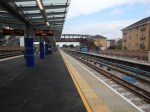
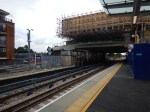
Abbey Wood Station, now appears to have two completed Southeastern platforms.
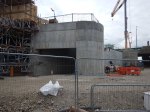
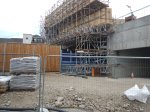
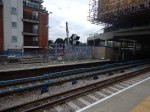
Note.
- The two Southeastern platforms form a wide island platform, which is numbered 1 and 2
- It would appear that there will be a second island platform for Crossrail. Could they be numbered 3 and 4?
- I also think, that both island platforms will be connected to the station building on the overbridge, by escalators and lifts
- It does seem to me that the space is a bit limited for the two Crossrail platforms and their overhead wires.
All pictures seem to show that the Southeastern lines are on the Southern pair of tracks and the Crossrail ones are on the Northern pair.
But under Future in the Wikipedia entry for Abbey Wood station, this is said.
Abbey Wood is being rebuilt in preparation for Crossrail, due to commence operation in 2018. Abbey Wood is the terminus of one of two eastern branches of Crossrail and will offer cross-platform interchange between terminating Crossrail services (at 12 trains per hour on new line) and existing Southeastern services (along existing tracks). This is instead of continuing services to Ebbsfleet International along existing tracks as those lines are congested and may delay Crossrail services.
Does cross-platform interchange mean that one Crossrail and one Southeastern track will share each platform?
This visualisation of the station doesn’t give any definite clues.
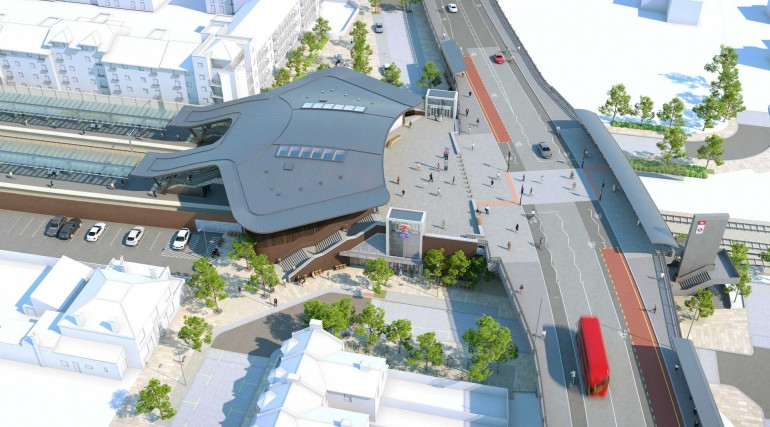
Abbey Wood Station
If we look at the morning peak and Southeastern trains turn up in Platform 1, with lots of passengers for Crossrail, surely if they’ve all got to go up one escalator and down another to get to Crossrail on the other island platform, it is a inefficient passenger flow, compared to a simple cross-platform interchange.
The reverse would happen in the evening.
So it must just be possible, that each island platform will have one Southeastern line and one Crossrail line.
Those Frenchmen at carto.metro.free.fr have this view of the lines between Plumstead and Abbey Wood stations.
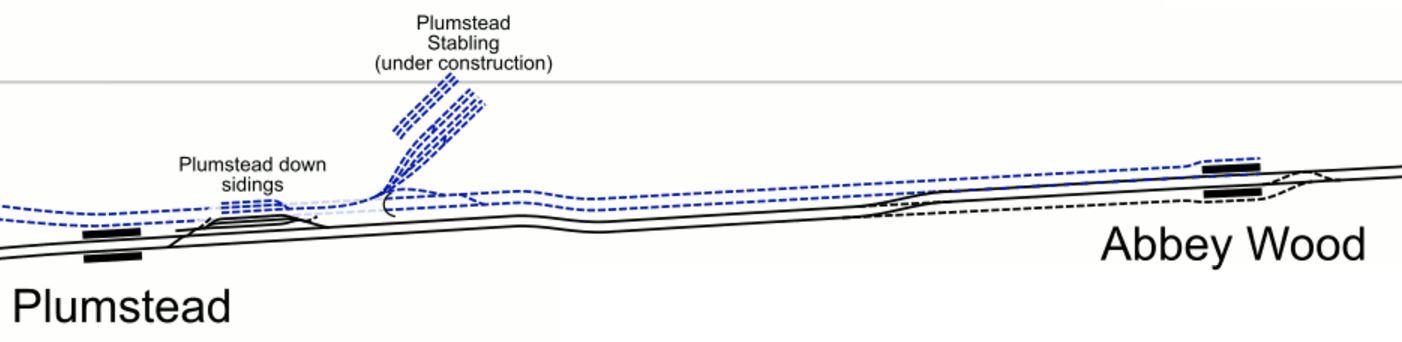
Crossrail Between Plumstead And Abbey Wood Stations
The map would appear to show the following.
- Platform 4 is a bay platform used by Crossrail and it is directly connected to the down (from London) Crossrail line.
- Platform 3 is directly connected to the up (towards London) Crossrail Line.
- There is no Crossrail lines shown to the East of Abbey Wood station.
- There is only one crossover between the two Crossrail lines, to allow trains from London to call at Platform 3 at Abbey Wood.
- The next crossovers on Crossrail, are at Custom House station.
- How do trains arriving in Platform 4 at Abbey Wood, get onto the up line through the tunnels?
- There would appear to have to be changes to the tracks, if Crossrail services are to be extended beyond Abbey Wood station.
I wonder if service levels give us any clues.
- At present there are eight Southeastern services per hour (tph) running through the station in the Off Peak.
- Six services go to and from Cannon Street and two terminate at Charing Cross.
- Wikipedia says Crossrail will run 12 tph in the Peak and 8 tph in the Off Peak.
Surely in an ideal world, if both services have an 8 tph frequency, it should be arranged that they the two services have a cross-platform interchange.
It should all be as clear as mud, in a few months.
Details Of The New London Bridge Station
These are a selection of pictures showing design details of the new London Bridge station.
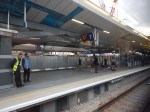

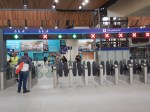
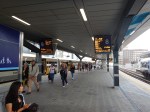

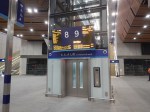
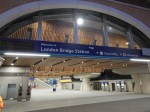
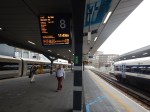
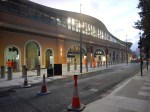
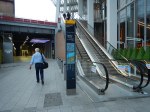
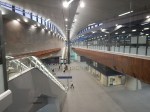
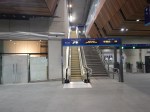
One thing that is noticeable, is that the station is very information rich. Are Network Rail trying to get passengers through the station with the minimum of questions asked to staff?
I will probably add some more pictures.
London Bridge Station Wakes Up
Part of the new concourse of London Bridge station opened at five o’clock this morning.


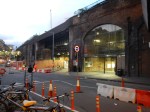
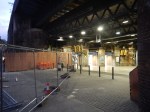
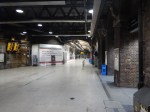
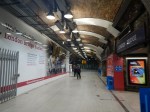
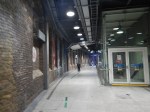

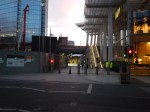


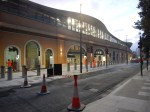
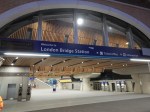
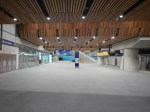
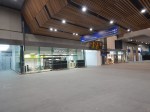
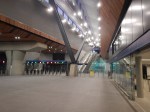
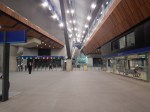
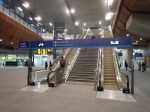



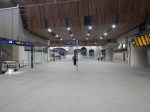
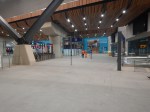
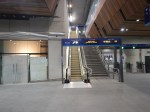
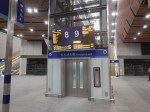
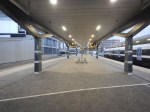
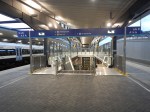

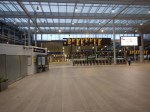
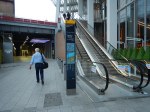

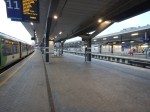
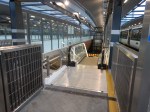
I got there around 05:30, so at least there would be some light.
Points to note.
- The concourse is underneath the platforms.
- Often when this is done, as at Brussels Midi, the concourse is dark and claustrophobic. London Bridge certainly isn’t, as natural light is allowed in and there are masses of LED lights.
- The concourse is split into an open side and one where you must have a valid ticket.
- Escalators join the platforms in the centre.
- The island platforms have three escalators, two sets of stairs and a lift.
- The first through platform; 8 and 9 for Charing Cross, form a wide island platform.
- If platforms 4 and 5 for Thameslink, are as wide as 8 and 9, they will be a game-changer for those with limited mobility on Thameslink.
- Currently, the only dreary public area, is the old cross-passage between Tooley Street and Guy’s Hospital, but that dates from a few years ago and is probably going to be updated.
It is certainly a very good start.
The Aventra Car Length Puzzle
I think that Bombardier have a very flexible nature to how long a car can be in the new Aventra. This flexible length, could be enabled in part, by the way the trains are built, which I believe used aluminium exclusions and a lot of specialist weldimg. I wouldn’t be surprised that if you wanted a 40 metre long car, then Bombardier would be able to build it.
They now have three orders for the train and they can be summarised as follows.
The information has been gleaned from Wikipedia, Modern Railways and other sources.
Crossrail Class 345 Trains
The Class 345 trains for Crossrail have the following characteristics.
- 9 cars – Wiki
- articulated trains
- 200 metres long – Wiki
- Around 23 metres long cars – MR
- 3 pairs of doors per car – MR
Seating will be a mixture of Metro-style and some groups of four.
This article in Rail Technology Magazine says a lot about the design of the trains. This is said about seating.
“The layout of the seats is also different per different carriage, so where people will crowd there’s more space, and at the end of the trains, where people might not be crowding on, there’s more seats. So a lot of thought has gone into the ergonomics of this train.
“But generally, the average journey on this train will be 15 minutes – so what people want is to be safe, comfortable, and air conditioned, but they really want to get on. Capacity is one of the big drivers – but 450 seats if a really good ratio.”
So perhaps the old Tube rule will apply – If you want a seat go to the front or back of a train.
Dividing nine-cars into a 200 m. long train, gives a car-length of 22.22 m, which is probably good enough for around 23 metres.
But if you assume that the two driving cars are identical and the trailer-cars between them are 23 metres long, you get two 19.5 metre driving cars at either end. Given that the train is articulated and there is a need for a Crash-worthiness crumple zone at both ends of the train, it could be that so that the middle trailer cars are identical as they are in the Class 378 train, that the end driving cars are slightly shorter, which could be structurally stronger.
If the two driving cars are 20 metres, then you get a trailer car length of 22.85 metres.
Could it be too that all different facilities like wheelchair spaces and transverse seating are in the driving car?
I also have this feeling, if I remember correctly, that if you can cantilever a heavy weight forward in the nose, that this helps dissipate the kinetic energy in a crash. It’s why car engines are often placed as far forward as the design will allow.
This statement can be found a couple of times on the Internet including in this article on Railway Gazette.
There will be a mixture of ‘metro-style’ and bay seating, with four wheelchair spaces and a number of multi-use spaces with tip-up seating to accommodate prams or luggage.
Only a detailed look inside a finished train will find out what they are really like.
London Overground Class 710 Trains
The Class 710 trains for London Overground have the following characteristics.
- 4 cars – Wiki
- articulated trains (?)
- Around 20 metres long cars – MR – Similar to Class 378 trains
- 2 pairs of doors per car – MR
Seating will depend on where the trains are deployed and will be Metro or traditional, although the September 2016 edition of Modern Railways says its all longitudinal. Passengers won’t like that between Liverpool Street and Cheshunt.
Abellio East Anglia Trains
These trains haven’t been allocated a class yet and this is the best description from this article in Rail Magazine describes the trains.
The Bombardier units will be based on the Class 345 Aventras being delivered for Crossrail, but with the focus on seating capacity rather than standing space. The trains will come in two versions: ten-car and 240 metres long; and five-car and 110 metres long. All will be electric.
Note, if these train and car lengths are correct, the cars are longer than for the Class 360 trains and a ten-car Aventra is as long as a twelve-car Class 360 train.
I think it would be reasonable to assume, that the driving and trailer cars for both length of trains are identical, as this would give the operator various advantages.
- Having only one type of driving car must ease driver training and rostering.
- Servicing will surely be easier to organise.
- If say a route needed a six-car train, then an extra car could be easily added.
Three different ways of calculating the car lengths can be used.
Method 1 – If d is the length of the driving car and t is the length of the trailer car, you get two simultaneous equations.
2d+8d = 240
2d+3t = 110
These give a trailer car length of 26 metres and a driving car length of 16 metres.
I don’t think that sixteen metres is too feasible, even if Bombardier could build one.
Method 2 – The driving cars are 20 metres long.
This car length would be a compromise driving car length that would work with both Class 345 and Class 710 trains, to give identical driving cars across all trains.
The length of a trailer car will be as follows.
- 10-car – 25 metres.
- 5-car – 23.3 metres.
What is intriguing is that if 25 metre trailer cars were used in a five-car train, this would give a train length of 115 metres. So two five-car train running as a pair, would fit any platform able to take a ten-car train.
Method 3 – The trailer cars are a fixed length.
- 20 metre trailer cars would give 40 and 25 metre driving cars for 10-car and 5-car trains respectively.
- 23 metre trailer cars would give 28 and 20 metre driving cars for 10-car and 5-car trains respectively.
- 24 metre trailer cars would give 24 and 19 metre driving cars for 10-car and 5-car trains respectively.
- 26 metre trailer cars would give 16 and 16 metre driving cars for 10-car and 5-car trains respectively.
I suspect there’s a compromise in there somewhere, that will allow both types of car to be all of the same length.
I suspect that it could be 20 metre driving cars and 25 metre training cars, as indicated by Method 2.
Consider.
- Both train layouts, allow two five-car trains to fit a ten-car platform and if they can, work as a pair.
- As with the Crossrail trains, I wonder if the driving cars will have all the specials like disabled toilets, wheelchair and bicycle spaces and First Class seating.
- You could even have different versions of the driving cars. First Class, bicycle, accessible toilet etc.
- Perhaps only one First Class seating area is needed per train.
- Would all routes need bicycle spaces?
- If the trailer cars were longer, then this would mean there could be a more relaxed interior with more space for tables.
Again as with the Crossrail trains, only a detailed look inside a real train, will show the car lengths and the interiors.
Conclusion
It all leads me to the conclusion that Bombardier have a very flexible design.
- Pictures show the driver’s cab to be generously-sized.
- Pictures show that the driver’s cab might be cantilevered outwards from the train, which would increase crash-worthiness.
- I’m tending to believe that driving-cars will all be the same for the driver, but the space behind the cab will be used for special parts of the train like disabled toilets, bicycle spaces and First Class seating. The latter is traditionally placed at one end of many EMUs, anyway.
- Trailer cars might be of a flexible length between 20 and 26 metres long.
- Saying you could only have one length of trailer and dtiving cars would be so Henry Ford
- The number of doors in each car can be two or three pairs.
Bombardier have attempted to allow the customer to procure a train to their precise needs.
But overall, I’m still puzzled.
Could Hamilton’s 55-Place Penalty Be Good For The World?
If you want a good explanation of how Lewis Hamilton ended up with a 55-place penalty in a 22-car race, then this article on the BBC, which is entitled Belgian Grand Prix: Lewis Hamilton’s grid penalties explained.
It does what it says in the title.
This extract, which describes the new technology in Formula One, is significant.
Governing body the FIA realised that the turbo-hybrid engines were highly complex pieces of kit, as well as introducing revolutionary new technology.
How revolutionary? A road-car petrol engine has a thermal efficiency – its ability to convert fuel-energy into usable power – of about 29%, a figure they have been stuck at for decades. A road-going turbo-diesel can be as efficient as about 35-40%.
Modern F1 engines, the best of which produce more than 950bhp, are approaching 50% thermal efficiency – and exceed it when the hybrid system is on full energy deployment.
It is a truly amazing step forward in technology in such a short amount of time, and these advances will soon filter down to road cars, which was the whole point of introducing them into F1.
So that means that if your vehicle does say 29 mpg, then in perhaps a decade, its equivalent will be doing over 50 mpg, as increased thermal efficiency translates into less fuel usage.
There is a lot of innovative technology generally getting itself involved with the humble internal combustion engine and where they are used.
- Engines, whether petrol or diesel will get more efficient, in terms of energy efficiency.
- Engines will get lighter and smaller.
- Transmission and braking will increasingly be electric, with onboard energy storage.
- Energy storage for larger applications like buses, trucks and trains, will use alternatives to batteries.
- Engines will become more complex and will be controlled by sophisticated control systems.
It is definitely a case of |Formula One leading the way.
But I suppose Formula One is one of the few places where there is an incentive to be more efficient.
With passenger cars, more efficient vehicles have generally sold better. But an incentive is probably needed to get people to scrap worthless and inefficient vehicles.
Perhaps a properly thought out carbon tax, would accelerate more efficient buses, trucks and trains.
It is interesting to note, that hybrid buses are commonplace, but when did you see a hybrid truck?
Could it be, that local politicians have more control over the bus fleets in their area and many of the worst trucks are run by cowboys, who don’t care so long as they earn their money?
It is also easier to complain about your buses, than say trucks moving builders rubbish around, if they are noisy, smelly or emitting black smoke.
But I do think the key to more efficient buses, trucks and large off-road construction equipment, is probably a mixture of better engines and some better method of energy storage, that means say an eight-wheel thirty-tonne truck, could sit silently at traffic lights and then move quietly away, when the lights go green. A lot of buses can do that! Why not trucks?
I also think that the next generation of trains will use onboard energy storage.
- It enables regenerative braking everywhere, saving as much as a quarter of the electricity.
- Depots, sensitive heritage areas and downright difficult lines can be without electrification.
- It enables a get to the next station ability , if the power should fail.
As modern trains from many manufacturers, are increasingly becoming two end units with driving cabs, where you plug appropriate units in between to create a train with the correct mix for the route, energy storage and hybrid power cars will start to appear.
Intriguingly, Bombardier have said that all their new Aventra trains will be wired for onboard energy storage.
So a four-car electric multiple unit, might be changed into a five-car one with on-board energy storage to run a service on a short branch line or over a viaduct in an historic city centre.
What A Plonker!
Of all the stupid road accidents that happen every year, yesterday’s one in Kent must rank as the most stupid.
This article on the BBC, which is entitled M20 motorway shut after lorry crash causes bridge collapse, gives full details.
There will be a lot of questions asked about this digger and as Dellboy would say, its right plonker of a driver.
- Why didn’t the truck and the digger have a specialist escort?
- Did the driver understand metres and/or feet and inches?
- What is the name of the company responsible, so that I can sue for a ruined holiday, spent camping on the M20?
At least the driver didn’t kill or serious hurt anybody, although it must have been a close run think for the motorcyclist.
A couple of weeks ago, I was seriously delayed because of another plonker, who crashed with a train on a level crossing at Waterbeach.
I think we could bring in a law, which meant that everybody, who is delayed by anything like this incident can contact a central insurance number or web site, where you can easily add your claim to the pile.
After all if my train is late, I can get a refund and have been able to for years. Recently, I was travelling on a Cheap Day Single ticket from Manchester to London, which arrived in London about two hours late, due to an unspecified problem. I filled in a form on the Virgin web site, when I got home and I had my compensation in a week or so.
The insurance companies have the power to knock some sense firmly into the minds of these idiots, who endanger everyone’s lives.
A Second New Stations Fund Is Launched
This article in the European Railway Review is entitled £20m fund for new railway stations across England and Wales.
The twenty million pounds is the second New Stations Fund, which provides up to seventy-five percent of the cost of a new or reopened station.
The first fund was used to help fund the following stations.
- Ilkeston in Derbyshire – New station – Opening in Autumn 2016
- Kenilworth near Coventry – New station – Opening in Summer 2017
- Lea Bridge in London – Reopened station – Opened in May 2016
- Newcourt in Devon – New station – Opened in June 2015
- Pye Corner, Newport – New station – Opened in December 2014.
Note that all stations are on existing railway lines.
Incidentally, I use Lea Bridge station about three or four times a month, as I have a direct bus connection to the station to connect to trains along the Lea Valley.
Which stations in Wikipedia’s lkist of possible proposed stations, do I think will be funded by the next New Station Fund?
These are a few that I think could be possible.
- Aldridge in Walsall
- Ashton Gate in Bristol
- Caerleon in Newport
- Castle Bromwich in Birmingham
- Charfield in Gloucestershire
- Chipping Sodbury in Gloucestershire
- Cottam in Preston
- Corsham in Wiltshire
- Cwm in Monmouthshire
- Egginswell in Devon
- Finningley in South Yorkshire
- Haxby in York
- Henbury in Bristol
- Horfield in Bristol
- Leiston in Suffolk
- Long Ashton in Somerset
- Marsh Barton in Devon
- North Filton in Bristol
- Park Farm in Kent
- Portishead in Bristol
- Soham in Cambridgeshire
- Town Meadow in Wirral
- Wisbech in Cambridgeshire
- Wootton Bassett in Wiltshire
Note.
- Bristol seems to have a lot of possibilities, but that is because they are creating MetroWest.
- I have rejected several schemes as they are rather large and I reckpon, there is a practical limit of a station costing say five million pounds.
- I have also rejected stations, where a whole line like the Camp Hill Line or the Wealden Line is proposed to be reopened.
- Leiston, Soham and Wisbech are additions of my own, based on my thoughts in Making Sense Of The New East Anglia Franchise.
- There are no new Welsh proposals outside South-East Wales, which got Pye Corner in the first New Stations Fund.
I suspect that now the fund has been announced, some good proposals will be put forward.
Out of interest, these are the numbers of new and reopened stations of the last few years.
- 2013 – 1
- 2014 – 3
- 2015 – 12
- 2016 – 4
I think that 2015 has the highest total, due to the reopening of the Borders Railway.
An Illustration That Ipswich In Sixty Is Possible
I went to football at Ipswich today.
The match was a bit mediocre, but the result was the right one and Grant Ward scored a delightful goal.
Usually, after a three o’oclock kick-off, I try to get the fast 17:09 train back to Liverpool Street, where it is scheduled to arrive at 18:19 after two stops at Manningtree and Colchester. I can’t ever remember this train ever being later than more than a couple of minutes.
Today, instead of the usual rake of Mark 3 coaches pulled by a Class 90 locomotive, the train was a Class 321 electric multiple unit. I suspect the change of train was due to engineering works on the line North of Ipswich and the fact that London-Norwich services were being run as two separate services; London-Ipswich and Ipswich-Norwich.
From Colchester, which was left on time, after a stop of perhaps three minutes, the train ran non-stop to London, probably at about an average speed of 100 mph or nearly so.
I didn’t notice any slackening of speed at Shenfield, and after just 59 minutes, the train was passing through Stratford.
We eventually stopped outside Liverpool Street to wait for a platform at 64 minutes and finally stopped in platform 10 at Liverpool Street station at 67 minutes, three minutes ahead of schedule.
This article in the East Anglian Daily Times, is entitled Faster trains to Ipswich as part of new franchise.
This is said.
Rail journeys between Ipswich and London will take, on average, 64 minutes from the introduction of the new timetable in 2019 once new “Stadler Flirt” InterCity trains are introduced on trains to the capital. At present the average journey time is 73 minutes.
That is more than the stated aim of the Great Eastern rail campaign to have services running to Ipswich in 60 minutes – but Abellio Greater Anglia managing director Jamie Burles said the last four minutes could only be shaved off journey times once Network Rail has carried out improvement work to the line.
So it looks like Abellio aren’t that far from 64 minutes with a nearly thirty-year-old British Rail designed and built Class 321 train.
- Judging by the smooth ride all the way, I suspect that most of the track and overhead wires is now to a good standard.
- Perhaps a minute or so can be saved in each of the two stops, by the better acceleration, braking and door systems of the new Stadler Flirts.
- Better signalling and control of trains at Liverpool Street would surely save a couple of minutes.
Having seen a full station at Ipswich, when I arrived for the match, I suspect that work needs to be done at that station, to create more capacity for Cambridge, Felixstowe, Lowestoft and Peterborough trains, so that London-Norwich services are not slowed by full platforms at Ipswich.
But overall, I’m led to the conclusion, that Jamie Burles statement is substantially correct.
I suspect that once all of the trains on the line are 100 mph trains, with a fast 100-0-100 mph profile for stops, that we’ll be approaching that 64 minute average for trains between Ipswich and London.
I suspect for the magic 60 minutes to be obtained consistently by all trains, that the following will have to be done.
- Enough extra platform space is created at Ipswich so that London-Norwich and London-Lowestoft services have exclusive use of the current platforms 2 and 3.
- All electrification on the Great Eastern Main Line needs to be of a high standard and capable of handling regenerative braking.
- Crossrail needs to be fully integrated with longer distance East Anglian Services.
- The Southend to Shenfield Line needs to be updated, so it can reliably present and accept trains to fit the schedule at Shenfield
- All trains are either Stadler Flirts or ombardier Aventras, with perhaps a few 100 mph trains awaiting replacement.
- Liverpool Street station has enough platforms for the longer trains.
I suspect too, that Network Rail will have to do some smaller work, like lengthening some platforms, adjusting the signalling and adding a crossover.
With some work North of Ipswich, I suspect that Norwich in Ninety will be implemented at the same time as Ipswich in Sixty.
Walking Routes Around London Bridge Station
The walking routes around London Bridge station have been revealed.
They are shown in this plan.

London Bridge Concourse
It would appear that the new concourse is all at street level and that lifts, stairs and escalators take you to the fifteen platforms that run across the top.
It all sounds very simple and passenger friendly.
In some ways the key will be information, in that say you want to go to Purley, you will need to be directed there without fuss.
I have a feeling that the best way to work the station, is as you approach to call up http://www.nationalrail.co.uk on your mobile phone, choose Live Departure Boards and then type in London Bridge and your destination. As this information is generally available fifteen minutes before the train leaves, this should give you enough time to walk to the platform.
I’ve done it so many times on my phone, I just type “nat” to get started.
I would hope that the visual information system is just as quick.
 The Anonymous Widower