Crossrail 2 October 2015 – Managing Excavated Materials
How Crossrail 2 gets rid of all the excavated materials from the tunnels is important to London, its residents and visitors.
I think it is true to say, we don’t want to see herds of trucks moving tunnel spoil to landfill.
Crossrail took most of the spoil to Wallasea Island to create a nature reserve, moving most of the spoil there by rail and water.
In this document on the TfL website entitled Building Crossrail 2 – our approach to minimising construction impacts, this is said about managing excavated materials.
From Tottenham Hale and New Southgate in the north to Wimbledon in the south, tunnels will be bored over approximately three years by large machines known as Tunnel Boring Machines (TBMs). These machines would be similar to the ones used to build the Crossrail 1 tunnels, excavating earth and building a tunnel around them as they go.
Current proposals are that two TBMs would be deployed to each of the following ‘drives’:
- New Southgate to Stamford Hill junction, where the machines would be dismantled at the proposed Stamford Hill shaft
- Tottenham Hale to Victoria and Wimbledon to Victoria, where the machines would be dismantled at the proposed Victoria Coach Station shaft
The excavated materials would be removed along the tunnels, rather than taking material out on the surface through station worksites and using vehicles to remove it. The construction of Crossrail 2 is being planned to minimise lorry movements where possible. By connecting the tunnels first we would provide an underground route to remove excavated soil from our sites. As a result a typical Crossrail 2 station would need roughly half the number of waste lorry movements compared with similar projects in the past, which would minimise the risks to public safety, congestion and pollution.
We are already planning ways of finding productive uses for excavated material. Crossrail 1 has used almost all of its excavated material in land reclamation projects across London and the South East, including creation of the bird reserve at Wallasea Island.
Obviously, it needs to be filled out a bit, but it is a good starting framework.
So it would appear that tunnelling would start from three sites.
- New Southgate
- Tottenham Hale
- Wimbledon
These three sites are all on major rail lines, with a brief look saying there is quite a bit of space at each. So at least there is space for a couple of sidings, where trains can be filled up with tunnel spoil for moving away from London.
In these posts I take a more detailed look at the three sites.
Crossrail 2 Consultation – October 2015
This is the latest Crossrail 2 Consultation from the TfL web site.
I will be extracting relevant information piece-by-piece from the consultation documents.
This is a list of my extracts.
- Angel Station
- Dalston Station
- King’s Road Chelsea Station
- Managing Excavated Materials
- New Southgate Station
- Shoreditch Park Area
- Tooting Broadway Or Balham
- Tunnels, Shafts And Head-Houses
- Wimbledon Station
I shall be starting with ones that are relevant to where I live in Dalston.
These are links to various Crossrail 2 documents I’ve used as sources.
This page is Crossrail 2’s index.
Crossrail 2 October 2015 – Shoreditch Park Area
This is Crossrail 2’s map of their possible worksites in the Shoreditch Park area. It comes from this Crossrail 2 document entitled Crossrail 2 Shafts.

Crossrail 2 Shoreditch Park
Note that the Worksites are labelled A to E.
To show them in more detail, this is a Google Map of the same area.

A Google Map Of The Area
Crossrail 2 have said this about the choice of work site.
A single worksite would be required to build and equip the shaft and the junction.
We are currently considering a number of options for the shaft in the area. Our current options have been selected because they would allow us to position the possible ‘Eastern Branch’ junction under the open space of Shoreditch Park.
Bear in mind that Crossrail 2 tunnels will be twenty or so metres down, so positioning the junction, which could be noisy, as trains rattle over the points, under a park some fifty metres and more from any dwellings, could be a good idea. Crossrail 2 wouldn’t want a repeat of the Victoria Line noise problems at Walthamstow
If we assume that one work site is what they’d like to do, I don’t feel that they would use more than two. The sites are as follows.
- Sites A and B to the West are commercial storage.
- Site C is the North-West corner of the Park
- Sites D and E are in the Britannia Leisure Centre.
The sites D and E are on the Hackney branch of the line, so unless that line is built in Phase 1, I doubt that they will be used.
If they are, knocking down and rebuilding leisure centres or commercial premises is a lot less costly and inconvenient, than demolishing houses or flats.
I don’t know what Crossrail 2 will do, but I visited the Crossrail site at Stepney City Farm, which is over a massive junction on Crossrail, so is very similar to Shoreditch Park.
I found a very good relationship existing between all parties. There certainly hasn’t been any bad reports about the Stepney City Farm site on the web.
This report is from the East London Advertiser.
Crossrail 2 will cause themselves a lot of problems, if they don’t do as well as Crossrail!
I took these pictures as I walked from the Britannia Leisure Centre through Shoreditch Park to Eagle Wharf Road. At the end of Eagle Wharf Road, I crossed the Regent’s Canal and looked at the building in Eagle Wharf Road from the towpath.



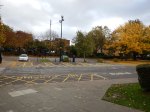

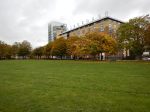


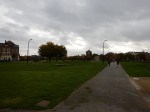

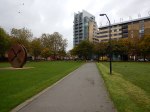

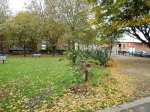


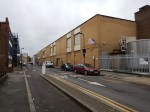


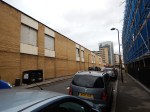

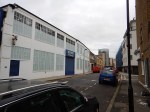
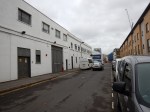
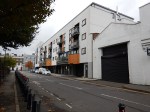
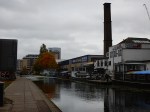


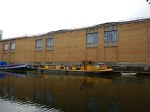
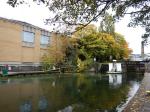
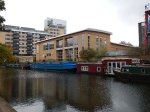
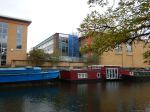
I can’t see any obvious reason, why the Leisure Centre would be used for Crossrail 2, as neither of the commercial buildings in Eagle Wharf Road are of the finest quality and given Crossrail’s treatment of Mile End Park, there would appear no reason the corner of the Park can’t be used.
One of the great advantages of the Park, would be that if you need to bring in some really heavy equipment, you’d just remove the iron railings and roll it through the gap.
Under current plans, there would appear to be no reason to extract or insert a tunnel boring machine in the Shoreditch area.
But choosing the Park would allow this to be done if required.
There is also the problem of a head-house.
It might be difficult to provide one in the Park, but evacuating into a large park from a problem in the tunel might be very safe.
Head houses on the sites in Eagle Wharf Road could even be built into any new buildings on the site.
Architecture and engineering design is moving on apace and who knows what will be possible when Crossrail 2 is built?
Crossrail 2 Changes Its Mind!
This map from the Crossrail 2 web site, show the new route for Crossrail 2.
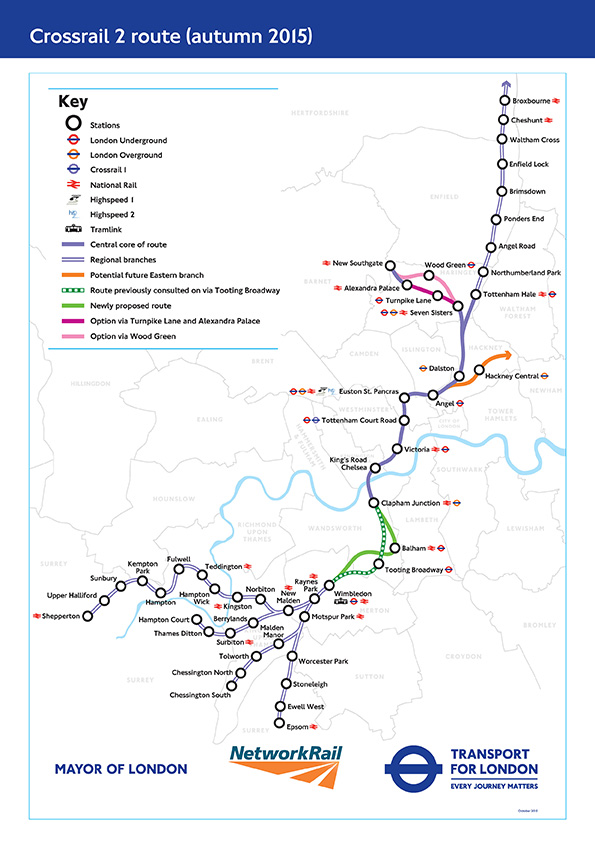
Crossrail 2 Route – Autumn 2015
So what are the changes and how do I think they stack up?
Broxbourne Instead Of Hertford East
Broxbourne station is the first, where traffic from Bishop’s Stortford, Cambridge, Hertford East and Stansted Airport all come together.
So perhaps by making Broxbourne a station, where passengers from Cambridge or Stansted can change across a platform for Crossrail 2 and all its destination in Central and South West London is a good idea.
As someone, who lived for nearly thirty years near Cambridge, it would certainly have pleased me.
This Google Map of Broxbourne station explains a lot.
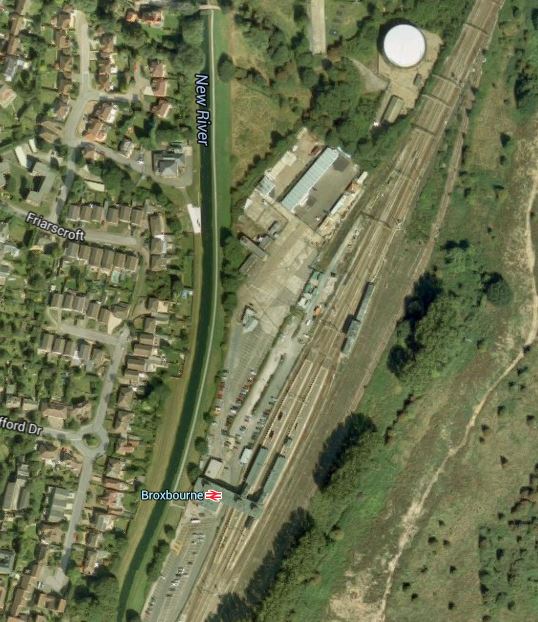
Broxbourne Station
Note that Broxbourne station is now a four platform station sitting on a large site. For comparison purposes this is a Google Map of Hertford East station.
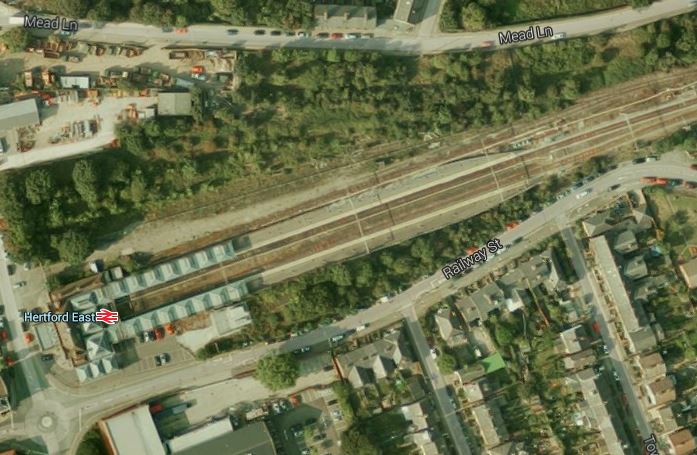
Hertford East Station
It is a much more cramped site compared to Broxbourne. The other stations on the branch would need substantial upgrading.
- Ware is a one platform station with an adjoining level-crossing.
- St. Margaret’s is a small station with a level-crossing.
- Rye House is a small station on another cramped site.
I suspect that operating an intensive service over the level crossings and the partly single-track branch was considered a serious obstacle to using Hertford East as a terminus of Crossrail 2.
There are other possible reasons.
- There is lots of space at Broxbourne for car parking and a proper bus interchange.
- As it now looks that the West Anglia Main Line will be four-tracked for a lot of its route, could cross-platform interchange be provided between the fast services from Cambridge, Stansted and the North and Crossrail 2, at Broxbourne.
- The space at Broxbourne would allow some extra platforms to be created.
- Broxbourne may well be a better interchange between fast services and Crossrail 2 than Tottenham Hale, which is another station on a cramped site.
Broxbourne has so much more potential for extra services than Hertford East.
The Future Of The Hertford East Branch
The Hertford East branch may turn out to be just a branch after Crossrail 2 is built.
If for instance, the West Anglia Main Line was to be three- or four-tracked as far as the Hertford East branch,then Hertford East services could have their own dedicated tracks to Broxbourne, just as the East London Line does to Highbury and Islington station.
This gives a service with the following characteristics and advantages.
- Generally Hertford East services are self-contained and could be mainly a two, three or four trains an hour shuttle, with possibly extra services to and from Liverpool Street in the peak.
- The frequency is probably limited by the level crossings on the branch.
- Hertford East services could probably be arranged, so they didn’t have to cross the West Anglia Main Line, which could remove a capacity restraint on the main line.
- Passengers would change at Broxbourne to and from fast services to Liverpool Street and Crossrail 2
- Would a separated branch give scope for some clever platform arrangements at Broxbourne?
- Would a separated branch free up paths into a very crowded Liverpool Street?
I think it is true to say, that if the level crossings and single-track sections on the branch could be removed, this would allow a much better service to Hertford East.
Turnpike Lane And Alexandra Palace Or Wood Green?
In the original plan, where Crossrail 2 passed through Turnpike Lane And Alexandra Palace stations, this gave possible interchanges to the following lines.
If the only station in that area is Wood Green, Crossrail 2 loses the connection to the Hertford Loop Line, which was at Alexandra Palace.
By 2019, the Hertford Loop Line will have good connectivity to the following lines.
- Piccadilly Line at Finsbury Park
- Victoria Line at Finsbury Park and Highbury and Islington
- Thameslink at any station between Alexandra Palace and Finsbury Park
- Crossrail at Moorgate
- Harringay could be linked to Harringay Green Lanes on the Gospel Oak and Barking Line.
- North and East London Lines at Highbury and Islington.
Some of these links will probably be better than they are now by 2019, due to upgrading at Finsbury Park and Highbury and Islington stations.
So I suspect that building two stations instead of one for Crossrail 2 in the Wood Green area was not considered good value for money.
Crossrail 2 have produced a detailed document about their route through the area.
Kings Road Chelsea
The contentious Kings Road Chelsea station has moved slightly, but those who think they are above the plebs still seem to be against the new station.
For a bit of sense, you can always read this report on Crossrail 2 from the local council. I particularly liked this extract on station size.
A King’s Road Crossrail station would not be “five times the size of Peter Jones” or as big as the “Westfield shopping Centre” as some have claimed. Kensington and Chelsea would remain the planning authority for the station development and the station would therefore have to be in keeping with the traditional scale and character of this part of the King’s Road. –
Or they could read up about that other difficult to design station; Camden Town, which I described in The Camden Town Station Upgrade Exhibition.
Good design there,seems to have sent the Nimbys back to their caves.
Tooting Broadway Or Balham?
Both Tooting Broadway and Balham stations are on the Northern Line, but I think Balham is being preferred as it is also a busy main line station.
As some of the main line services through Balham, are duplicated by Crossrail 2, the new line now offers opportunities to release the pressure off the lines through Balham.
If you look at a map of the railway lines in the area, it may be that Crossrail 2 will send the new tunnels in a wide circle from Balham to Wimbledon under Tooting and Haydons Road stations, so that the tunnels are dug totally under existing railway land.
Using Balham rather than Tooting Broadway seems a good idea.
Crossrail 2 Shafts
Crossrail 2 have also published a list of where their shafts will be.
- Downhills Recreation Ground
- Stamford Hill area
- Shoreditch Park area
- Victoria Coach station – According to Wikipedia, the freeholder want to redevelop this site and relocate the coach station.
- Westbridge Road
- Wandsworth Common
- Springfield
- Weir Road
I shall update this as I find out more.
The Revival Of Sleeper Services In The UK
I like sleeper trains and have used them three times in recent years.
The Deutsche Bahn sleeper between Munich and Paris, had one big disadvantage compared to the two Scottish trips – Customer service was not up to the standard First Class passengers expect and get on the Caledonian Sleeper.
The biggest problem, was that there was no waiting facilities at Munich station, as everything closed a couple of hours before the train left.
The last trip I did down from Scotland was during the Commonwealth Games and after an evening session, I couldn’t find a hotel room in Glasgow. I got a First Class sleeper cabin all to myself for just over a hundred pounds, so it was probably cheaper than getting a room in the city and coming down by train in the morning.
Every time, I go North of the Border in future, I’ll always look into the possibility of taking a sleeper down after my visit.
In the UK, sleeper trains seem to be having a revival with both the Caledonian Sleeper and Night Riviera going through a process of upgrading with either new or refurbished carriages.
But in Europe, they seem to be declining.
I wonder what Nigel F***** would make of that one!
We certainly have a different attitude to railways in this country.
Stations For Inclined Lifts
After the superb installation at Greenford, I wonder if stations like these will get inclined lifts in their third space.

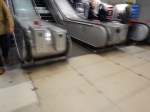
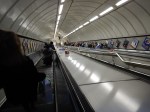
It would probably be dependent on the layout of the stations, but we’ll certainly see more.
Highbury and Islington station might be able to have a central inclined lift, but then to get to the platforms, there are further difficult stairs. If ever a station was built that would be difficult to provide step-free access, it is this one.
Walking Between St. Pancras And Euston Stations
In 2011, I wrote Getting Between Kings Cross/St. Pancras and Euston about how I walked between the stations.
This route has now been formalised with green signs.



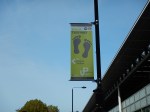




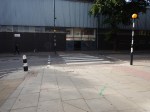



I think when they finish the roadworks, it’ll be a good route. This is cut and modified from my original post.
So how would I make it better, so that in effect we had one super station for the north?
- Perhaps, it should be marked on the ground, as a Kings Cross/St. Pancras to Euston walking route.
- You might even provide some eco-friendly transport along the route, like an electric shuttle bus or bicycle rickshaws.
- A couple of suitably placed Boris bike stations would help too.
- Shops and cafes should be developed along the road. There are some already.
I was right that this would happen.
Sudbury To Cambridge – D-Train, IPEMU Or Tram-Train?
In D-Trains For East Anglia? I reported on how possible Anglia franchisees, were looking at using Vivarail D-Trains between Marks Tey and Sudbury on the Gainsborough Line.
So as someone, who lived by the disused line from Sudbury to Cambridge Line via Haverhill for nearly twenty years, I have views on whether this route should be opened.
The Case For Reopening
After my stroke, for a year, I lived just North of Haverhill, in the middle of nowhere. The only way to get to say Cambridge, Ipswich or London, was to get a taxi to either Newmarket and get a train or Haverhill and get a bus.
As with many people, a station in Haverhill would have given me an alternative route, using a cheaper taxi!
But for many who live along the Stour Valley getting to Cambridge and its employment opportunities means the car or a bus.
Haverhill is now a town of 30,000 souls and when the line closed, the population was under a quarter of that figure.
So although the case for closure of the Stour Valley Railway in 1967, was strong, there is probably just as strong a case to provide a high-quality public transport system between Sudbury and Cambridge via Cavendish, Clare and Haverhill.
The Route Today
Much of the route is still there, although in places it has been built upon.
But I believe, as do others, that a single-track railway with passing places could be built between the West Anglia Main Line, just South of Shelford station to Sudbury station on the Gainsborough Line thst connects to the Great Eastern Main Line at Marks Tey station.
If the line is built mainly single-track, this would be more appropriate for an area of outstanding natural beauty and it would make it easier to squeeze the line into difficult places like the station at Sudbury, which is shown in this Google Map.
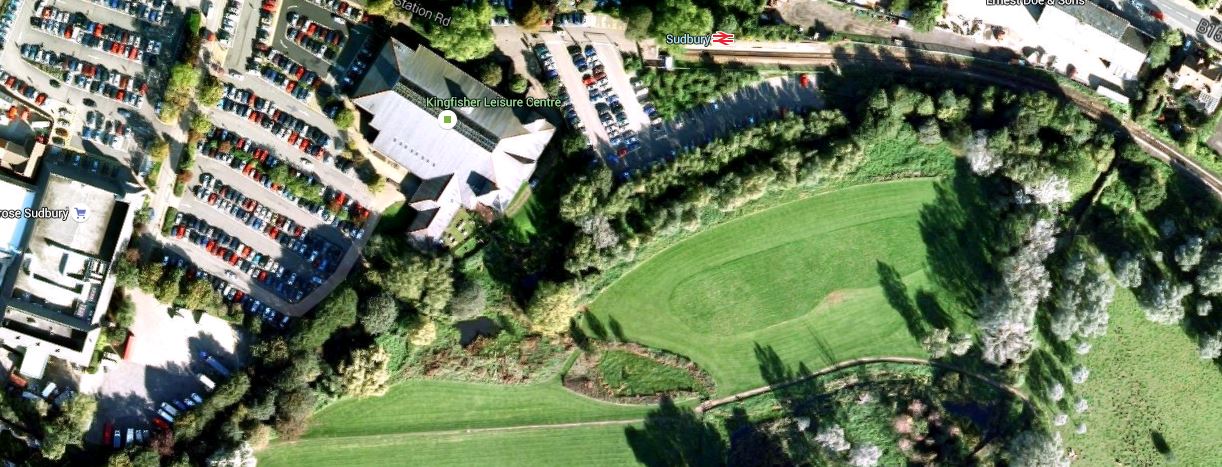
Sudbury Station
The route of the overgrown disused rail line, goes out towards the South-West.
The route of the line is still visible in the other major town on the line; Haverhill. It is shown on this Google Map.
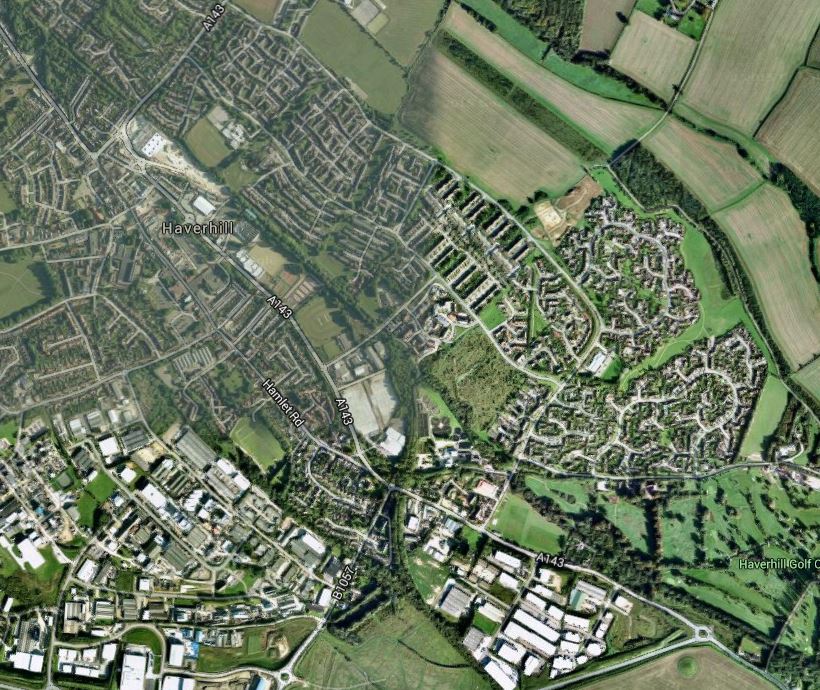
The Railway Through Haverhill
The railway goes across the town from North-West to South-East. It does split with one branch going South over a massive brick viaduct and the other going East towards Clare, Cavendish and Long Melford.
Much of the line now is a footpath through the town, which I suspect could share the route with a single-track railway or tramway. Tesco’s probably wouldn’t mind if the station was just to the North of their massive car-park.
I suspect that all stations would be designed to be as simple as possible.
Several of those on the new Borders Railway like Eskbank, Galashiels, Gorebridge and Newtongrange are well-designed single platforms and some have no means to cross the railway.
Stations like these would be practical and unobtrusive.
Possible Rolling Stock
Because of the limited nature of the track, which as I pointed out could possibly be mainly single track, I think that some types of rolling stock can be ruled out.
If say, the line was to be run using something like two or three-car Class 168 trains, there could be capacity, vibration and noise problems.
So I think we’re left with the following.
- D-train or Class 230 trains
- IPEMUs
- Class 399 tram-trains
I shall now look at each in detail.
Class 230 Trains
Class 230 trains or D-trains have been talked about as possibilities for the Gainsborough Line and these conversions from London Underground D78 Stock could certainly travel easily between Marks Tey and Shelford, before going on to Cambridge.
Other than possible hostility to their origin and second-hand provenance, I can see other problems with these trains.
- When running between Shelford and Cambridge, would they get in the way of faster trains to and from London and Stansted.
- Would they have a noise and vibration problem, as they trundled through quiet villages?
- Extending the service at either end to perhaps Colchester and Cambridge North might be difficult.
- They would have a shorter life-span than the other options.
But we haven’t seen a Class 230 train in service yet.
IPEMUs
IPEMUs or battery-powered trains have only been seen briefly on UK railways and that was at Manningtree, where Bombardier and Network Rail ran the prototype in a successful trial in public service.
They are full size four-car electric trains and could run from Marks Tey to Shelford on batteries, charging up on the electrified main lines.
In addition they would have the following other advantages.
- They have a high-capacity, with all the facilities that all types of passengers could want or need.
- There could be no need to put up any overhead wires between Marks Tey and Shelford.
- They would probably have a very low intrusion factor into the environment.
- When they are on the main lines, they become normal trains, so there would be no disruption to other traffic.
- They could also extend the service to between say Colchester and Cambridge North.
Perhaps the only disadvantage of IPEMUs, is that being full-sized trains, the railway might have to be fully-protected with fences.
Class 399 Tram-Trains
Class 399 tram-trains are the unusual one of the three. But in some ways they are the most versatile.
They are a three-car high-capacity 100% low-floor tram, very similar to those you see in Blackpool, Birmingham, Croydon or Nottingham. But in addition to being able to run using a tram 750 VDC overhead supply, they can also run as a train using the standard 25kVAC supply of the main line railway.
They combine the best characteristics of both means of transport.
In the next couple of years they will be trialled in Sheffield on an extension of the Sheffield Supertram to Rotherham.
For those that worry about the technology, several German cities have large systems of mixed trams, trains and tram-trains, so it is not by any means untried. Especially, as a Class 399 tram-train is a German standard tram-train, modified for our overhead voltage, which incidentally is much more standard, than the German’s 15kVAC.
The tram-train would start at Cambridge or Cambridge North stations and run as a tram to Shelford station, where it would become a tram running on the route of the Stour Valley Railway all the way to Sudbury, where it would continue along the Gainsborough Line to Marks Tey, where it could use the overhead wiring to go to Colchester if required.
A Class 399 tram-train would have advantages and disadvantages compared to say the IPEMU.
I’ll deal with the disadvantages first.
- It is a three-car tram of slightly smaller capacity than the four-car IPEMU.
- It would need to have a track electrified to 750 VDC using a simple overhead catenary.
- They have tram interiors and no toilets.
- They are slightly slower on train sections, than the IPEMU.
But it does have advantages too.
- They are 100% low-floor vehicles, so have comprehensive step-free access.
- Stops can be a very simple design without any expensive foot-bridges, lifts or long disabled ramps. Just like Croydon for example!
- They are good sight-seeing vehicles for a beautiful part of the country
- When the line allows it, they can get up to speeds of nearly 70 mph on a main line railway.
- Tram-trains have all the flexibility and manoeuvrability of trams, so they can go off for a meander rather than a direct route, if necessary.
- If used between Cambridge and Marks Tey,instead of going direct from Cambridge to Shelford, they could take a loop around the Addenbrooke’s site.
- Or perhaps if they turned at Cambridge North, they could perhaps do a tour of the Science Park rather than a simple reverse.
It is a terrible pity that the Cambridge Guided Busway was designed before tram-trains became a viable alternative.
Conclusions
It is very much a case of who pays the money makes the choice.
- The Class 230 train is a remanufactured train that doesn’t need any expensive electrification, but may have noise, vibration and performance issues.
- The IPEMU is a brand-new train that doesn’t need any expensive electrification and has all the performance, comfort and facilities of any modern full-size electric train.
- The Class 399 tram-train is also brand new, needs only simple electrification and infrastructure and has all the performance and flexibility of a tram coupled with many features of a full-size electric train.
If the choice was down to me, I would discount the Class 230 train, but only because the other two solutions are new and not remanufactured old ones, which will have to be replaced at some time.
So why not have the new IPEMUs or Class 399 tram-trains, both of which would probably give first-class service for a large number of years?
Both the new trains are types of trains, that will be common on the UK rail network, so as the knowledge base increases we’ll probably find ways of using them both to create very high-class public transport systems.
Choosing between the two new solutions is extremely difficult.
As neither has run in extended service on the UK rail network, I feel that for the moment I’ll duck that difficult choice.
As an aside, this analysis has proved to me, that the Cambridge Guided Busway may have been a good decision at the time based on the knowledge available, but with the arrival of IPEMUs and tram-trains, it is very much a technology that few will choose in the future.
Connecting To The Chiltern Main Line
I took these pictures as my train came back from Oxford Parkway station rejoined the Chiltern Main Line using the Bicester Chord.

I think that no-one could complain about the quality of all the work.
Bicester Village Station
C and myself spent a good few days at the up-market Shopping Outlet at Bicester Village soon after it opened.
Now it has a Bicester Village station to go with the shops.



Incidentally, the announcements for the station on the train are also given in Chinese.
 The Anonymous Widower