Are Tram-Trains A Good Idea?
After my trip around Germany and France, have I come to any conclusions about the concept of tram-trains?
I must admit, I was sceptical when I set out, as some of the claims about the advantages of tram-trains seemed too good to be true!
So what are their strengths? And how would they fit the planned test route to Rotherham that will extend the Sheffield Supertram?
Dual Voltage
In both Mulhouse and Paris, the tram-trains are dual voltage and can run on both 750 V DC and 25kV AC. This type of tram-train will become the standard as main lines are increasingly electrified with the higher AC voltage.
In the case of Sheffield, which will be electrified to London, Doncaster and other places in the next decade or so, dual voltage Class 399 tram-trains will be essential to future proof the system.
Standard Gauge
All except one of the tram and tram-train systems I used or saw were standard gauge systems. The exception was Darmstadt, where trams were of a narrow gauge. Any standard gauge system could be used by tram-trains of the same gauge. In the UK, France and Germany that means to incorporate tram-trains on a tram network, that the tram network must be standard gauge.
There are no tram systems in the UK, that are not standard gauge.
Tram-Trains Can Be Low Floor
Buses and trains are moving towards totally flat and low floors, where to enter you just step or wheel yourself across.
The Mulhouse and Paris Siemens Avanto tram-trains achieve this and it has been stated that the Class 399 tram-trains for Sheffield will be low-floor.
Tram-Trains Are Larger Than Trams
Generally tram-trains are larger than trams. I don’t know for sure, but this could be for crash-worthiness reasons when running as trains.
With Sheffield this is an advantage as the Sheffield trams are bigger than most of those in other systems.
Tram-Trains Are Faster Than Trams
I don’t know at what speed the tram-trains that I rode ran, but it was certainly faster than the average tram.
Tram-Trains Are Almost As Fast As Pacers
A Class 142 Pacer has a top speed of 120 km/hr, whereas the Siemens Avanto used in Mulhouse and Paris has a top speed of a hundred and the Class 399 tram-trains for Sheffield have a top speed of 110 km/hr.
I suspect though that the electric vehicles have better acceleration and braking, so they might even be quicker over a route like the Hope Valley Line. I won’t comment on the passenger experience, but I will say that they probably have a slightly higher capacity of over two hundred, if you count standing passengers.
Tram-Trains Release Platforms In City Centres
This was well-illustrated in Kassel, where the Hauptbahnhof has been effectively released for other uses after the building of two underground island platforms.
By joining services together it might also be possible to release platform needs, just as Thameslink and Crossrail will do in London.
I’ve spent a lot of time waiting for local train services in Sheffield, so is there any scope for joining more services together.
Acting Like Trams In A City Centre
This was impressively shown in Kassel, where except for the colour and size, you couldn’t tell which vehicles were trams and which were tram-trains.
Sheffield’s tram line layout is very like Kassel with a shared centre section.
Acting Like Trains On Train Lines
Once on a railway line, the trams must be able to use the voltage of that line, have the same crash protection and signalling of a train and have the performance not to interfere with all other traffic.
Tram-Trains Can Have Alternative Power Sources
Around the world, there are several examples of tram-trains that have on-board diesel engines as well. Kassel has ten for a start.
And there are of course the battery trams in Nice and Seville.
Tram-Trains Don’t Need Lines To Be Converted
If tram-trains need to use a line they don’t stop other traffic like freight trains and express passenger services using that line. In some places in the UK, tram lines have been created by ripping up heavy rail tracks, which might need to be used again.
Tram-Trains Can Create An Extensive Network
The Manchester Metrolink has a network of around ninety kilometres, whilst Sheffield’s Supertram has a length of around thirty.
Compare this to Kassel at over a hundred and eighty kilometres and Karlsruhe at over two hundred and sixty.
The two German cities are substantially smaller than the two major English ones.
Tram-Trains And Sheffield
Tram-trains are not some difficult concept, but any competent group of railway, tram, electrical and control engineers should be able to create a system that works pretty well.
At least in choosing the line to Rotherham, they haven’t set themselves too difficult a task. Sheffield also has a very good layout in the area to the east and north of the main line station.
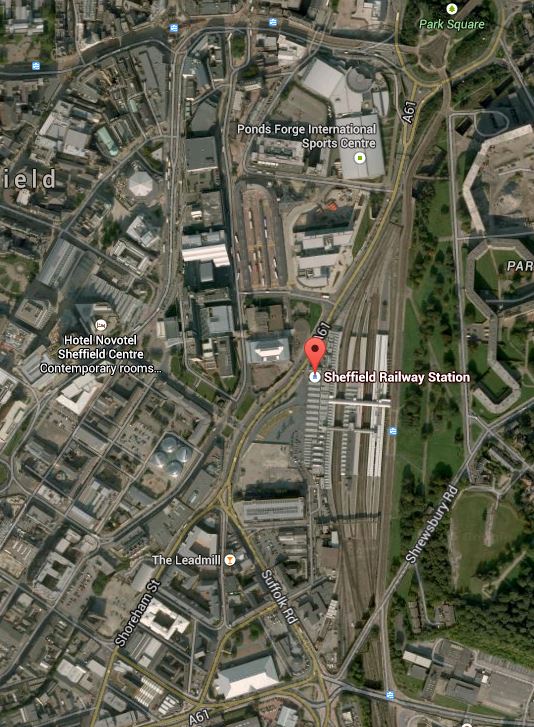
The Trams Around Sheffield Station
There are some things to note in this Google Earth map.
1. At the top right of the map, the three branches of the system meet in a triangular junction. The northern branch goes to Meadowhall and in the future Rotherham, the southern branch goes past the rail station and the western branch goes through the city centre. I don’t think that services use this junction in every posible direction, but it appears to have been future-proofed to cater for all eventualities.
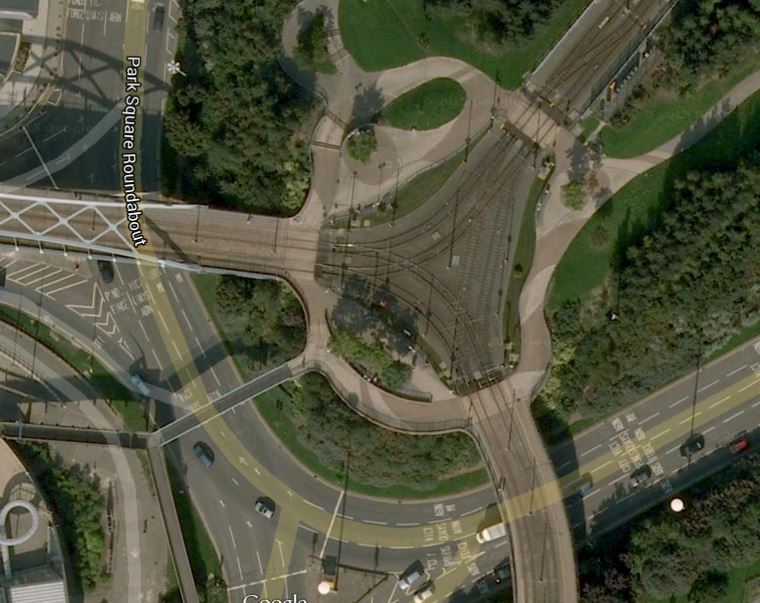
In this enlargement, the tracks and wires are clearly shown.
2. The southern branch past the station runs parallel to the rail lines.
3. There is quite a bit of space to put in extra tracks.
I also think, that after seeing the systems in Kassel and Karlsruhe, Sheffield could incorporate tram-trains fairly easily. Not being the first is a definite advantage, as ideas, designs and technology have moved on, as the Mulhouse system showed.
At some point in the future a lot of rail lines in the Sheffield area are going to be electrified to the main line standard of 25 kV AC and this might mean that the line used by the tram-trains to get to Rotherham in future may have this voltage. The Class 399 tram-trains themselves will be bought with a dual voltage capability, so they won’t care, but it seems a pity to put up one set of wires and then rip them down for another. Perhaps, you put up main line catenary initially and use it to provide a 750 DC supply! I’ll leave that one to the engineers.
An Extension To Dore
Plans have existed in the past to extend the Sheffield Supertram to Dore and some reports state that Dore will be linked to Meadowhall to improve HS2 connectivity. This Google Earth map shows Sheffield and Dore and Totley stations.
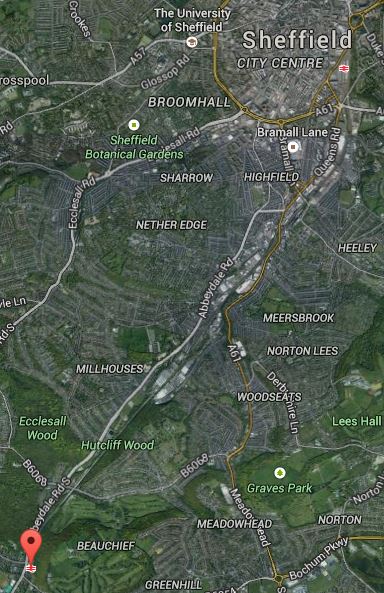
Sheffield To Dore
Dore and Totley station is on the Hope Valley Line, which will probably be electrified in the next ten years or so.
So could tram-trains come past Sheffield station and then go down an electrified Hope Valley Line?
I know little of the area, but because plans have been drawn up in the past, others must have a good idea. This document from Sheffield University written in 2003, gives a summary of what might happen.
But it predates any thought of tram-trains in Sheffield.
Could The Hope Valley Line Run Tram-Trains To Both Sheffield And Manchester?
This section in Wikipedia’s article about the Hope Valley Line, talks about proposals to to extend the Manchester Metrolink to Rose Hill Marple station on a spur off the line. Tram-trains could be used.
As Dore and Totley station is at the Sheffield end of the Hope Valley Line, could we see tram-trains going to both Manchester and Sheffield?
And What About Manchester And Sheffield?
I can remember reading in my Meccano Magazine in the 1950s about the ground-breaking electric-hauled Woodhead Line between the two cities.
This is said about tram-trains in the Wikipedia section for extensions to the Manchester Metrolink.
Metrolink and the TfGM Committee have prepared five costed proposals for extending Metrolink using tram-train technology over the existing heavy rail network in the region; along the Mid-Cheshire Line (between Stockport and Hale), the Hope Valley Line (between Manchester and Marple), the Glossop Line (between Manchester and the dual termini at Hadfield and Glossop), the Manchester to Sheffield Line (between Manchester and Hazel Grove), and along the Manchester to Southport Line (between Manchester and Wigan via Atherton), with an estimated total funding requirement of £870 million as of 2013.[197] TfGM intend to proceed to the identification of potential rail industry funding options, subject to a review of lessons from a tram-train pilot scheme in Sheffield.
So could we see the opening up of routes between the two cities using tram-trains, if the trial in Sheffield to Rotherham is successful.
The old Woodhead Line is just over sixty kilometres long, which means that from what I saw in Karlsruhe and Kassel, tram-trains could easily handle the distance between Manchester and Sheffield.
An interesting possibility for which the technology exists is a dual voltage tram-train leaving Manchester and taking the Hope Valley Line, which is electrified at its western end, which then travels over the Pennines to Dore, using either diesel or battery power, from where it becomes a tram on Sheffield’s network.
It won’t happen soon, but it is no fantasy, as I’ve seen all the technology needed in Kassel, Karlsruhe and Essex.
So will we see, heresy-of-heresies, an operational merging of the tram systems across the Pennines?
But imagine two, three or even four new tram-trains an hour on each of the routes between Manchester and Sheffield, that would extend their journeys into the city-centres, rather than need valuable platform space at Sheffield or Manchester Piccadilly stations.
I don’t know the lines well, so this might be pure speculation, but as the systems in Germany showed, if you get the track, power and signalling working, then good tram-trains can go virtually anywhere they’re needed.
A Vision For The North?
Let’s assume that the tram-train experiment from Sheffield to Rotherham is a success, which after my German and French experiences, I wouldn’t bet against.
So what happens next?
That is very much in the hands of the politicians, at both a national and local level, but from Sheffield and Manchester I could see tram-trains getting used on the numerous local lines that fan out from Manchester and Sheffield.
1. At present many of these lines are served by dreaded diesel Pacers, so the new tram-trains would be very welcome.
2. Some lines like the Hallam Line between Sheffield and Leeds via Barnsley could probably be just electrified with 750 V DC, to allow tram-trains to run.
3. As at Kassel not all lines would need to be electrified, as other technologies exist.
Everybody needs to have a bit of vision and if the Class 399 tram-trains, do what it says in the specification, we could be seeing them all over a dense network of lines in the north.
If all of these lines were upgraded, there is one thing that will happen for certain. The areas will improve in all ways, with better housing, more jobs and business and leisure opportunities.
Conclusion
To answer my original question, tram-trains are not a good idea, but a brilliant affordable solution to the big problem of urban transport all over the world.
In the UK, we must prove that the technology will work in a UK environment and I suspect there are many councils, tram and train operators eagerly awaiting the outcome.
How To Organise Chaos
At the moment N1 is seems to be in permanent chaos on the roads.
But I don’t drive, so why should I bother?
Every day, perhaps two or even four times, I take a bus to or from the Angel or Highbury Corner.
Yesterday, I wanted to get to Paddington to go to have lunch with a friend in Burnham near Slough. My normal method to that station, is to walk to Dalston Junction and take the East London Line to Whitechapel, where I get the Metropolitan across London. That may seem a long way round, but it’s quite reliable in the time it takes. But yesterday the Metropolitan and \district lines were not serving Whitechapel, due to engineering work. So I thought, I’d get a bus to the Angel, where I’d swap to a 73 or 30 for Kings Cross, from where I’d get the Hammersmith and City Line to Paddington. Highbury and Islington is solid at the moment due to the rebuilding of the bridge, so the direct route up the Essex Road using a 38 or 56 would be sensible. But then that road was locked solid, as they’d decided to resurface it, on a weekend with no Metrolitan Line and jams at Highbury Corner.
It took nearly an hour, to do a journey that takes just twenty minutes normally. I was even later to Kings Cross as there were diversions on the way, which meant I missed my train to Burnham by five minutes. I might have actually caught it, if the ticket machine at Paddington hadn’t gone bonkers and issued loads of blank tickets.
The problems could have been avoided, if whilst they’re doing the bridge replacement at Highbury and Islington, they refrain from doing any other major works.
It was no better today and they’ve now moved the road works further towards me on the Essex Road.
Someone is definitely not getting their project management right!
By TGV Est From Strasbourg To Paris
This was a two hour twenty minute trip on the top deck of a TGV on the LGV Est, which is one of the fastest lines in Europe. It cost me around £57 for the nearly 400 km. And that was a walk-up fare. London to Newcastle would probably cost me about £121 booked off-peak at a walk-up.
The train was regularly cruising at just over 300 kph.
Transport for London Have A Small Problem
This year a the end of May, some of the Lea Valley Lines and the Shenfield Metro part of Crossrail come under the control of Transport for London.
But what are they going to do with the iconic Tube Map?
This reasoned article on The Londonist gives their ideas including starting again and imagining how Harry Beck would have drawn it now!
Whatever they do, millions will think it’s been done wrong.
A Quick Crepe And Then The Eurostar Home!
I’d booked myself on the last Eurostar back to London and I just had time for a crepe and some cider at Cafe Breizh, near the Metro station of Saint-Sébastien – Froissart, which is just two stops south of Republique on Line 8.

A Quick Crepe At Cafe Breizh
I made the mistake though of trying a new route to the Gare du Nord using Line 4. It didn’t take any longer but I spent twenty minutes finding my way to the Eurostar terminal, as the signage from that line was poor to say the least.
Of the three direct Eurostar destinations that I have used in Europe; Brussels, Lille and Paris, the French capital’s terminal seems to have been designed with the sole purpose of persuading passengers, that they are better off staying in the city. I can’t wait until direct services to Marseilles start!
A Diversion In Paris
As I had some time in Paris, I went to look at their first tram-train line, T4.
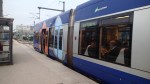
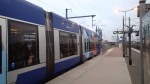

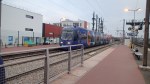


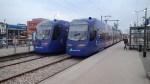
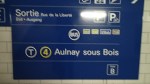
I didn’t ride the tram-train, as it was very crowded and I couldn’t find out how you bought a ticket.
But as it appeared the tram-trains were the same as those in Mulhouse, it was an experience I could pass.
The trams run from Bondy on RER Line E to Aulnay sous Bois on RER Line B.
Strasbourg Station
Strasbourg station is unusual in that they’re put a glass canopy on a magnificent nineteen-century station.




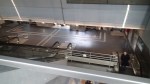









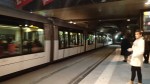

I liked it. The design also allows the Strasbourg trams to be in a tunnel under the front of the station and be accessed by lifts and escalators.
As the building of these glass or plastic canopies and roofs is getting easier and cheaper, due to the work of structural engineers, I think we’ll see a lot more Strasbourg-style stations.
Exploring Strasbourg
I didn’t have much time in Strasbourg before I needed to catch the TGV Est, so I used the excellent tram system to explore the city.



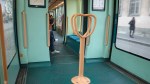


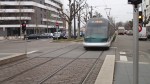










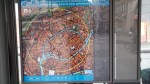
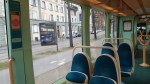


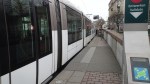
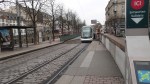
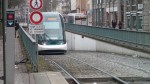






The trams are all low floor, which as a Londoner, you appreciate, as all the buses are going that way. The New Rputemasters are totally flat and no-one should have to accept anything less.
Strasbourg’s successful introduction of trams has been credited with helping to start the tram-revolution in France. Like Nottingham, which was an instant success in the UK, both networks are 100% low-floor. This doesn’t apply tro all UK tram networks.
As a Londoner, you appreciate this, as all the London’s buses are going that way. The New Routemasters are totally flat and no-one should have to accept anything less.
From Mulhouse To Strasbourg
After exploring Mulhouse, I took an early evening train onto Strasbourg. Theation journey was done without any trouble, but as there was no information system on the train and station names were not too visible, I was worried about being taken to Nancy.
But a fellow passenger put me right.
Surely, in these days, it should be a European law that all trains have good information systems and that station names are clearly illuminated.
At Strasbourg the station wasn’t a problem, although in common with most European stations, the lighting levels, weren’t at the levels you get in the UK.
After a little bit of searching, I found that the tram to my hotel was in a tunnel under the station and with assistance from a helpful local, I was able to purchase a ticket and go the two stops needed.
Often the pasengers’ experience of a train, tram or metro journey can be improved significantly with clear signs and good lighting.
A Quick Exploration In Mulhouse
On the way from Basel to Strasbourg, I stopped off at Mulhouse to have a look at the city and ride its tram-trains.
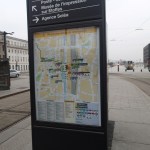

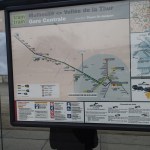
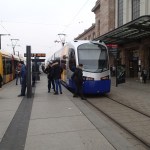
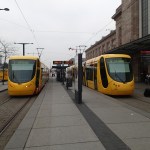
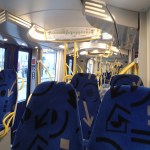

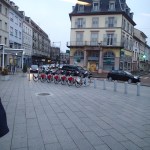
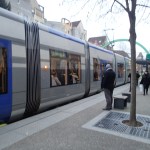

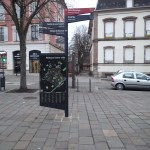



The line is a good bit short of its planned length and rather infrequent at the moment, but compared to the two German systems in Karlsruhe and Kassel, it is a step up in design quality.
I should also say, I was impressed with both Mulhouse and its trams and tram-trains.
There was a lot of information maps everywhere and this was an order of magnitude better than anything I’d seen in Germany.
The Germans could do a lot worse than hop over the border with a camera and pinch the designs used in Mulhouse.
I particularly liked the red finger on the finger post, which always pointed to the historic city centre. So simple, I wonder why I’ve not seen it before!
If you look at the proposal for the extension of the Sheffield Supertram to Rotherham using a tram-train, it has similarities to the system in Mulhouse.
The Siemens S70/Avanto tram-trains used in Mulhouse are dual voltage capable of running on 750 V DC or 25kV AC. The Class 399 Sheffield tram-trains which are being made by Vossloh are said to have a similar capability. You could argue that being able to run on both these voltages is akin to the dual-voltage Class 378 which run on both voltages. The Class 378 halts for the changeover at places like Acton, but surely modern electric systems can be designed that handle the changeover between voltages automatically.
 The Anonymous Widower