Jerry’s Wonderful Wiring
In sorting out my kitchen, I need to adjust the wall between the kitchen and the living area.
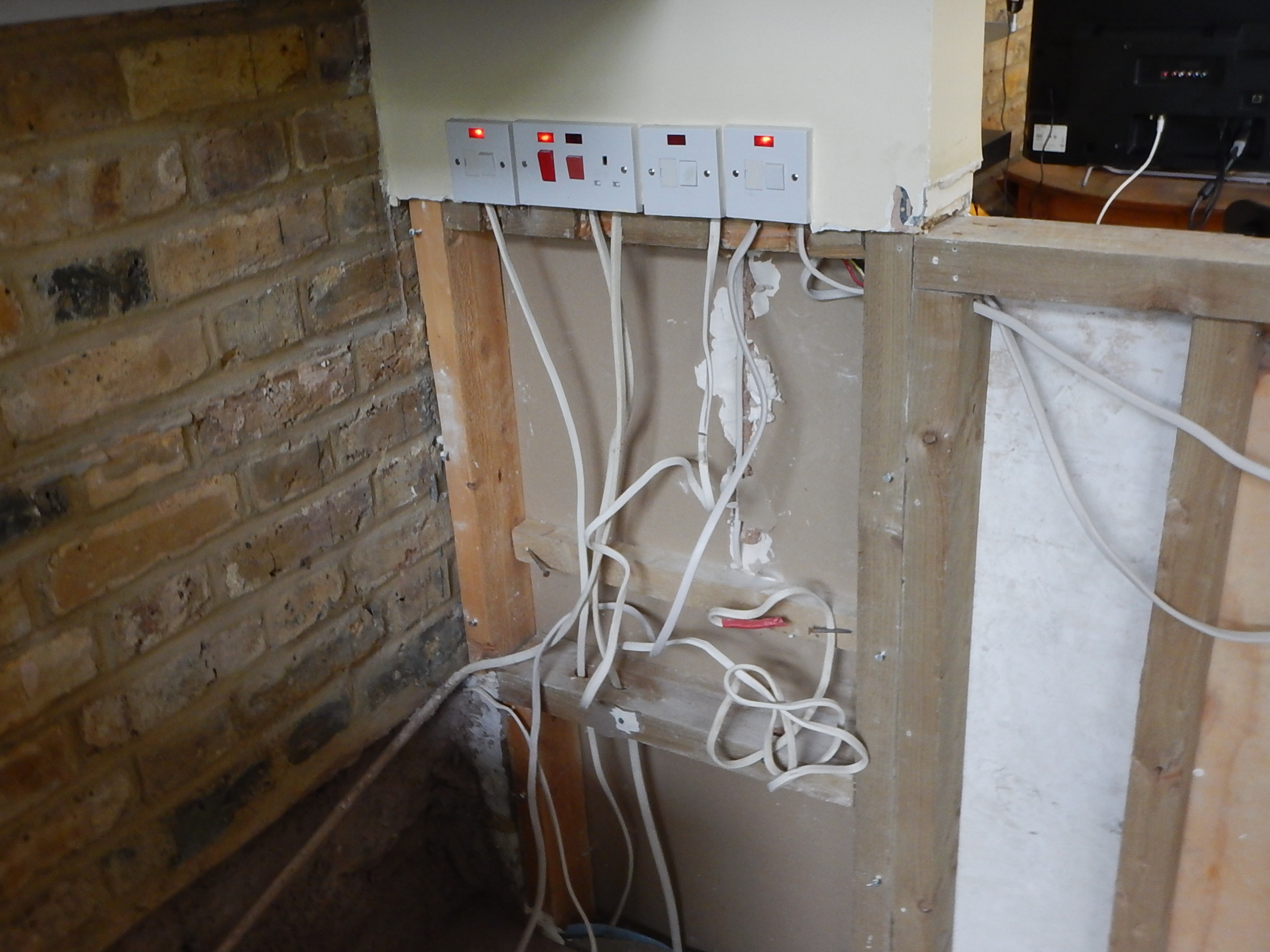
Jerry’s Wonderful Wiring
Jerry obviously thought he was a very competent electrician.
But my experienced Hungarian handyman and myself think otherwise.
Is A Rat A New Make Of Car?
I took this picture at Hillsborough yesterday.

Is A Rat A New Make Of Car?
I would assume that Burrows is a car dealership.
When I first read the one with a red background, the car make looked like a Rat.
A Small Cooking Spoon I Can Hang Up
There are two types,. of designers in the world; those like Kenneth Grange, who will never accept second best and then their are all the others.
I strive for perfection and only accept second best, when the best is impossible.
These pictures show my quest for a small cooking spoon that I can hang above my cooker. Where else is there to put the tools, you use to actually cook the food as opposed to prepare it.



My mother had a small wooden spoon, that was always used to stir beans or in a small milk saucepan.
I have been looking for one for myself for about ten years now and I’ve never found one, quite small enough.
I did find the red spoon, shown in the first picture, in John Lewis and I use it a lot. A small one like it, in blue, would be ideal, as it fits the IKEA hooks above my cooker.
So I decided to make it possible to hang the smallest wooden spoon, I’ve got alongside.
I just drilled a hole in it, with my trusty pocket drill and attached a cable clip.
It seems to work.
Farewell To BT Vision
I have not got rid of BT Vision and if I want to watch football that is shown on BT, I now watch it on Sky.
To say I’m pleased to be rid of BT Vision is an understatement.
- BT don’t seem to have any logical channel numbering, unlike Sky and Freeview and I could never remember where something would be shown.
- Often I had to resort to going through the channels one at a time, until I found what I wanted.
- Sky is logical, as all the Sports channels seem to be together and if I want an event, I can easily find what I want, stating from 405 or so.
- Regularly, I don’t watch a match, but listen to it on Radio 5. BT has this annoying habit of changing to a screen of programs that I might watch, if I had an IQ of about 12.
- Sky just gives me information with a useful clock.
Whoever, designed their system should be sent to manage the satellite station on St. Kilda.
Sense About Steel
This article in the South Wales Evening Post is entitled Swansea Bay Tidal Lagoon one solution to Tata Steel crisis, insists council chief Steve Phillips.
He is right and I said so in The Death Of Traditional Steel-Making.
I also said that in addition to the tidal lagoon, a comprehensive metro should be developed all over South Wales.
Green Steel
This article on the BBC is entitled Tata Steel: Would-be UK buyer Liberty’s jobs hope.
Sanjeev Gupta, the head of the Liberty Group, is reported as saying this.
We would look to transition from blast furnaces to arc furnaces, from imported raw material to domestically available scrap, from making carbon steel to making what we call green steel – melting and recycling scrap using renewable energy.
As I heard the quote on the radio, I can verify that it is more or less correct.
I don’t know, whether what Mr. Gupta said can be achieved, but it strikes me that it is a feasible idea.
Will Manchester Get A Crossrail-Style Levy?
My Google Alert for Crossrail found this story in Planning Resource, which is entitled Crossrail levy model proposed for Greater Manchester mayoral CIL. This first paragraph sums it up.
A proposed city-regional mayoral Community Infrastructure Levy (CIL) for Greater Manchester would operate in the same way as the existing pan-London charge to raise funds for the Crossrail project, with councils able to implement their own levies alongside the mayor’s charge, it has emerged.
Will Manchester’s council leaders and voters go for it?
From here in London, where if the Mayor wants to fund something sensible like Crossrail 2, all the Mayoral candidates and the Boroughs seem to back it, I can’t see all ten Manchester boroughs agreeing, as they seem to have a long record of doing things their own way!
Power From Renewables Surges To High As Emissions Fall
This was the headline on a story in the Business section of The Times today.
Apparently nearly a quarter of the UK’s electricity was generated from renewables last year.
In 2014 it was 19.1%, but last year it was 24.7%.
It all goes to show, that we should think long and hard about building any massive power stations; nuclear, coal or whatever.
I have decided that now is the time to put solar panels on my roof.
The Death Of Traditional Steel Making
If we’re being serious about making steel using the traditional methods of blast furnaces, converters and lots of energy, it’s not a very green process and it contributes to pollution and global warning.
We have a serious oversupply of steel in the world and this page lists production by countries.
In 2014, the world produced 1670 million tonnes of steel, of which we produced just twelve.
Looking at the production levels, there are quite a few countries that produce produce small numbers of million tonnes of steel like we do.
As China produced 822 million tonnes of steel in 2014, how many of these countries will be forced out of steel making in the next few years?
What will save steel making in a lot of countries is improvements in technology.
The parts of the steel industry, that seem to be the most profitable are the downstream uses of the metal, like making rails for railways. In this country, we have a reputation for using steel in innovative ways, but few of these uses need steel made in Britain, although they may need a quality steel to start with.
But that quality steel can come from anywhere with the knowledge to produce it.
China will acquire that knowledge, just as the Japanese did in the 1950s and 1960s.
It is interesting to look at iron ore by country in 2014. Out of a world product total of 3.22 million tonnes, we see.
- China – 1.5 million
- Australia – 0.66 million
- Brazil – 0.32 million
- India – 0.15 million
- Russia – 0.1 million
So does this partly explain China’s massive production of steel?
I think Australia and Brazil are the two most important countries on this list. Both have large amounts of energy and because they are ambitious intelligent countries, as the steel-making technology develops, will we see them increasingly becoming makers of quality steel?
I don’t know, but it says to me, that even producing quality steel in a niche market won’t be profitable for long.
The money and employment is in using quality steel, not in making it.
It may be a hard unpopular view, but we should let the rest of the world fight over supplying us with quality steel. If we want security of supply, I’m sure the Aussies would provide it.
As to the steel-making areas like Teesside and South Wales, we have to move on.
The Future On Teesside
In fact Teesside seems to be doing that, if a BBC report this week wasn’t truly negative.
What puzzles me about Teesside, is that there is little mention in the media about York Potash. This is from Wikipedia.
The project intends to mine the world’s largest deposit of polyhalite – a naturally occurring mineral – located on the Yorkshire coast.
The mine site is located outside the village of Sneatonthorpe, between Whitby and Scarborough in North Yorkshire. The project plans to construct two 1,500 m (4,900 ft) shafts to reach the mineral seam which includes a mineable area of around 25,200 hectares (62,000 acres).
To minimise the amount of visible infrastructure within the North York Moors National Park, a protected area, the polyhalite will then be transported 37 kilometres (23.0 miles) in an underground tunnel to the company’s processing plant at Teesside. After granulation and drying, the finished product – marketed by Sirius Minerals as POLY4 – will be exported from the nearby harbour facilities.
Could it be that, this project appears to not be very green and in the minds of many is creating a giant hole in the North York Moors National Park?
My view is that the UK needs more big projects like York Potash, that earn billions of pounds from exports, create thousands of jobs and don’t despoil the environment.
So what have we got for South Wales and Port Talbot in particular?
Nothing as big as York Potash, but there are plans for the world’s first tidal lagoon power station in Swansea Bay Wikipedia says this about the Tidal Lagoon Swansea Bay.
It is planned to be the first of six tidal lagoon power plants to be constructed in the United Kingdom, and one of four planned to be built in Wales. The tidal lagoon would have a capacity of 320 MW.
The project was named as part of the UK government’s 2014 National Infrastructure Plan and was granted planning permission by theDepartment for Energy and Climate Change in June 2015. Power production is expected to begin in 2019. The operational life time of the artificial lagoon is 120 years, effects of global warming have been included in the planning. It is also to be constructed to withstand 500-year-storms and to function as a coastline protection against storms and floods.
So what are we waiting for?
The economics depend very much on the strike price for electricity generated and the Government seems reluctant to set one. I do wonder if they have got themselves tied in knots with trying to build a white elephant at Hinckley Point, that they can’t think of anything else.
Consider.
- I’m not against nuclear power, but Hinckley Point C is so expensive and its strike price is so high, that it will be a millstone around the necks of energy users for decades.
- If we want to go nuclear, there are smaller and proven reactor systems available.
- Electricity generation is going more distributed with the growth of solar panels, local heat and power systems and other technology.
- Large energy users are changing technology to cut use.
- The tidal lagoon technology gives protection against storms and floods.
- Tidal lagoons could be the twenty-first century equivalent of the nineteenth-century seaside pier.
- If the technology and economics of the tidal lagoon work, it will produce carbon-free electricity for at least 120 years.
- There are other places, where tidal lagoons could be built.
You could bet your life on the Dutch building a tidal lagoon, but they don’t have the tides.
Rather than back a doomed steelworks, the Government should back the unique energy project of the Tidal Lagoon Swansea Bay.
If the energy economics don’t work out, you still get the coastal protection and leisure facilities.
A Metro For Teesside
The Tees Valley Metro has been in planning mode for some years and I can’t understand why it hasn’t happened yet.
All that seems to have happened is the opening in 2014 of James Cook University Hospital station, which I wrote about in James Cook Station – The Reinvention Of The Halt. The station certainly seems to be attracting a level of use, typical of a station of its type.
I also wrote about the metro in The Creation Of The Tees Valley Metro.
A Metro For South Wales
The Welsh are also keen to create a South Wales Metro for some time. I wrote about my observations on the trains in the area in The Welsh Could Be Having A Lot Of Fun Playing Trains In The Cardiff Valleys.
This project should be beaten into action as soon as possible.
It is interesting to take a look at a Google Map of the coast between Swansea and Port Talbot.
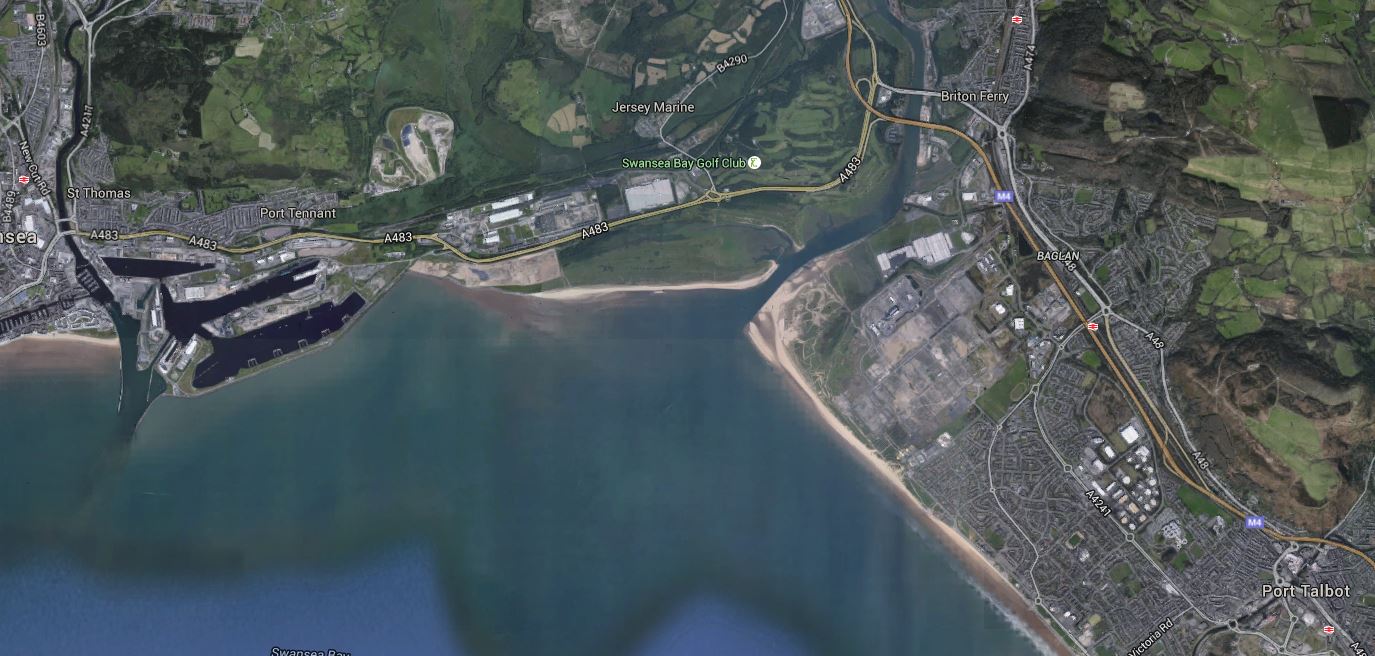
Swansea To Port Talbot
I don’t know the area well, but I know many people, who have enjoyed leisure time spent all along the South Wales Coast.
Perhaps, if the steelworks were to be closed, it could be treated to a Barcelona solution, where their steelworks was closed and the area turned into beaches and parks, which formed part of the Olympics in 1992.
The Tidal Lagoon Swansea Bay would be generally sitting in the western part of the bay.
I believe that a comprehensive South Wales Metro, could go a long way to creating more jobs, than will be inevitably lost at Port Talbot.
Conclusions
Steel production is virtually dead in the UK and we must move on.
If we can find an innovative project to replace steel making, we should back it and as with York Potash, it doesn’t necessarily mean billions of public money.
But decent infrastructure and local rail, tram and bus systems can go a long way to creating the jobs needed everywhere.
In both the examples of Teesside and South Wales, surely if nothin else, a decent metro would give a boost to tourism.

