John Major Talks Sense Again
I told a story yesterday about John Major and today he pops up on the BBC’s web site talking about Scotland and its political relationship with England.
Here’s an extract.
In a rare intervention into politics, former Prime Minister Sir John Major calls for the Scottish Parliament to be given powers to control everything except foreign affairs, defence and the economy.
Sir John warned against the dangers of devolution before the 1997 election. Today he calls for what some call “devo max”.
If you are wondering why the former Tory leader’s dressing in tartan, he explains that in return the English (and, of course, the Conservative Party) would see the end of the hated Barnett formula which gives Scotland more money to spend and a cut in the number of Scottish (usually Labour) MPs.
This may not seem like a live issue today, but it will be in the run-up to the next election. Scotland’s re-elected First Minister Alex Salmond has always believed that the Tories were most likely to give him at least some of what he wanted.
This is how Sir John puts it:
“The present quasi-federalist settlement with Scotland is unsustainable. Each year of devolution has moved Scotland further from England. Scottish ambition is fraying English tolerance. This is a tie that will snap – unless the issue is resolved.
“The union between England and Scotland cannot be maintained by constant aggravation in Scotland and appeasement in London. I believe it is time to confront the argument head on.
Everybody should read the full article, as it talks a lot of sense.
I particularly liked this comment by a reader on the report.
Wow!
Major speech by a major politician
How on earth, gold help us, did we ever end up with New Labour
So let’s hope the British Parliament does the sane thing in the next few weeks and makes sure that they control the country and not the owners of a few newspapers.
At least none of these proprietors are no Berlusconi!
Dog Control Orders
I have heard of the controversial control orders before, but never ones related to dogs.
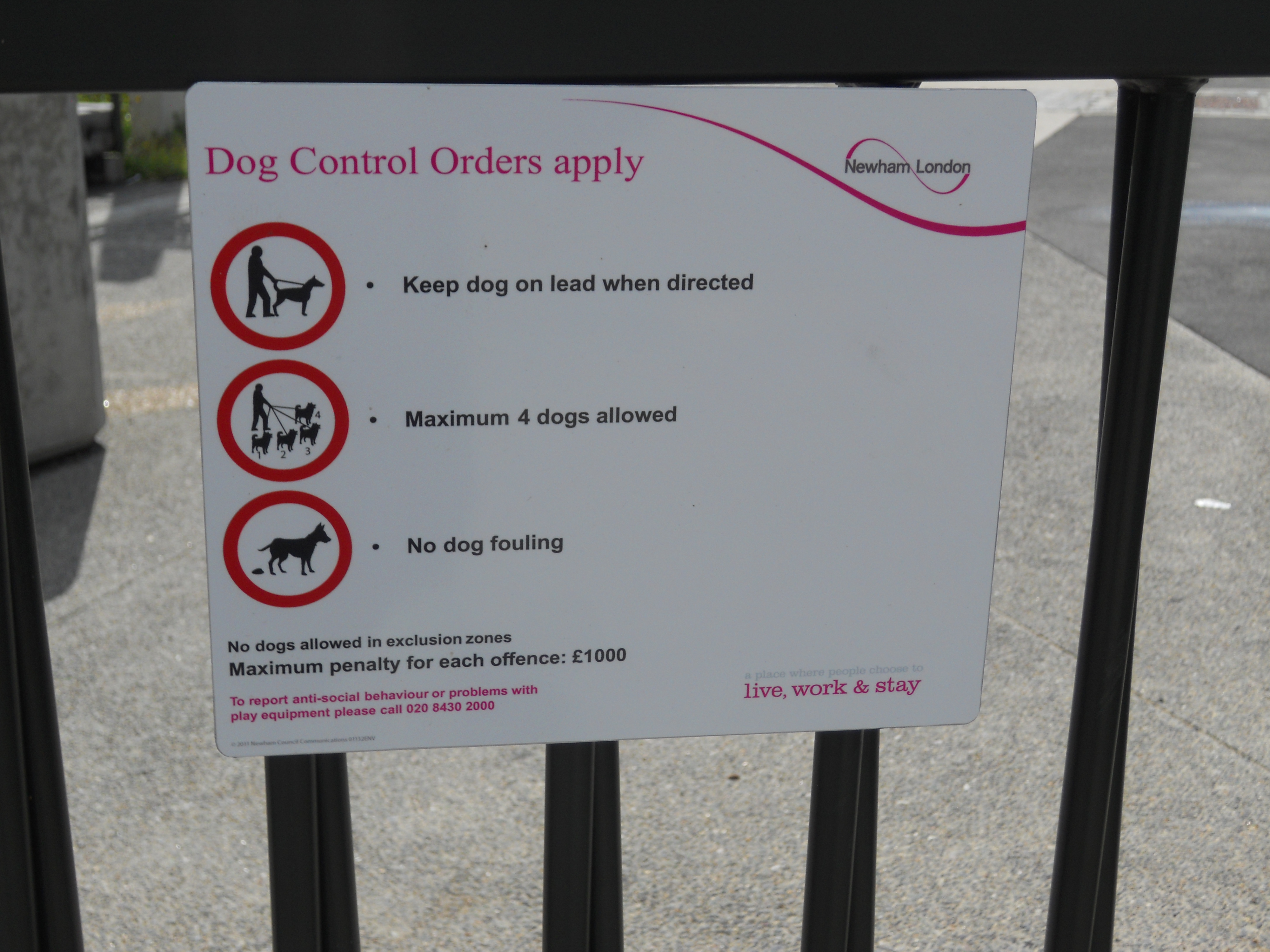
Dog Control Order in Newham
They don’t seem to be as oppressive as those beloved of NuLabor.
Advertising In The News of the Screws
The Times yesterday published a list of the major advertisers in the News of the Screws since the beginning of the year.
Some of the companies I’ve never heard of, so it just shows what a waste of money some advertising is.
Here are a few points.
- Sky spent the most.
- The second highest spender was everything everywhere. Who the hell are they?
- The next few were companies like Boots, O2 and P&G, with a few other companies that I don’t use like Proctor and Gamble, Tesco, Asda and Vodafone.
- The next was a company called Shop Direct. See point 2.
- Some of the rest were respected companies like BT, Vauxhall, Dixons, B & Q and Unilever.
- At the botton was T J Hughes and Specsavers. The first of these is now bust and the latter probably does better with its TV adverts.
I know I don’t ever read adverts, but you can read what you like into this list.
Some companies advertising policies really work, as I don’t, know who everything everywhere, Shop Direct and another called Harveys are. I’m assuming the latter isn’t the sherry maker, as no-one drinks sherry these days.
The World’s Nastiest Card Game
Danny Baker asked on Radio 5 for card game stories. Here is the e-mail I sent entitled, The World’s Nastiest Card Game.
Many people have played hearts, black maria, scabby or other variants of this trick winning game, where you mustn’t win hearts or in some versions the queen or other high spades.
There is a version called cancellation hearts, which is played with two packs of cards shuffled together. The one difference is that if in the same trick, two identical cards are played, they don’t count towards who wins the trick. But they do count in the scoring. So if you don’t like someone, they get dumped on in a big way.
It is one of the games that is ideal for odd numbers of upwards of 5 people or more. Drink improves it tremendously and it is not unknown that the odd fight breaks out.
It is also a game beloved of divorce lawyers, as it is very good for business.
Roy Jenkins’s Lunch in Holloway Prison
Roy Jenkins is best known for being a prominent Labour politician of the 1960s and 1970s. I suspect he was someone who knew his food and drink, as many of those educated in one of our oldest Universities do.
In the early 1970s, C used to visit Holloway Prison as part of the Cameron Group. She often described the group in the way the inmates did and that was “The Ladies in the Pink Hats”. It probably applied to some of the group, but not to C.
One night she came home and told the story about the new Home Secretary, Roy Jenkins and his visit to the prison. He said that he wanted to go everywhere and this didn’t go down well with the governors and the guards. But remember Roy’s father had been in jail because of a riot during the 1926 General strike, so quite rightly, he probably had strong views about how inmates should be treated. He certainly wasn’t a hanger and flogger.
After the tour, the governor suggested lunch and had probably prepared a lunch to impress the Home Secretary. But Roy said he wanted to eat with the prisoners.
After a heated argument, he pulled rank and did so.
Halfway through his meal, he pushed it away muttering something like, “I wouldn’t give this to my dog.”
Being Home Secretary is not an easy job.
Popbitch Was Late This Week
Usually I get Popbitch on a Thursday, but this week’s edition turned up today.
It has an interesting piece on the News of the Screws, which if the story is true, gives a whole new meaning to phone hacking.
From West Ham to Abbey Mills on the Greenway
The Greenway has now been reopened close to West Ham station and it is now possible to walk along it past Abbey Mills Pumping Station and on to Stratford again.









Note the large bridge, which I suspect will be used to take those walking to the Olympic site over Stratford High Street.
It will be good when it is fully open again from Hackney Wick to West Ham and on to Beckton. It will be one of the best walks in London.
Why All This Fuss About Harry Potter?
I’ve never read a Harry Potter book or seen any of the films! And don’t intend to either!
To me, the only good thing about the phenomenon is the jobs, money and tax revenue that it has created in the UK. I’m also interested in how J K Rowling wrote the book in a cafe in Edinburgh. It is the better story as it is all about getting yourself out of a hole by doing something creative.
Is The News of the Screws Too Powerful For Advertisers To Boycott?
I haven’t read the News of the Screws in years. Advertisers are boycotting the paper because of their hacking of mobile phones.
But is this counter productive and against the best interests of the so-called readers of the paper? Martin Lewis of Money Saving Expert has said on Radio 5, that he will to continue to write a column for the paper. He stated the reason was that as a crusading journalist, who fights against financial abuse, the best way he can get his message over is in the largest circulation, English language paper in the world. He also said that this week his column would carry a message deploring the hacking.
I admire his stance and understand his point. After all, if you’re a crusading journalist it matters to you, whether you get your message over or not.
It’s the same with the Central Office of Information, who are one of Britain’s biggest advertisers. Should they pull their advertising of such things as benefits and valuable public information from the paper? I suspect they should, as probably News of the Screws readers are too stupid to understand it.
It’s a difficult area and I suspect the best solution would be to impose sanctions against the paper, if any wrongdoing is proved.
The Beautiful Blonde Brazilian on a 38 Bus
One of the good things about London, is often you get into spirit raising conversations on the bus.
Take today, when I was returning from the Waitrose at the Angel for the second time, because they didn’t have any of my preferred brand of yoghurt the first time, I ended up sitting next to a young lady, or was it a girl, with long blonde hair. As I always do, when I sit next to someone of the opposite sex, I always ask if it is OK to sit there. I may have lots of faults, but I was brought up to hold doors, give up my seat on buses and tubes and generally be polite. I’ve found it to be to my advantage in life.
We chatted until I got off and found that she was a Brazilian student from the far south of the country. She was liking her stay in London and she was pleased at her reception in the city. As a Londoner, I was pleased we’d welcomed her so well.
Despite being a wreck I must still have something left, as she didn’t think I was some old groper and turn her face to the window. But neither did the lady on the 141.
So there might be some hope for me!

