A Grand Muck Heap Competition
This was organuised in about 1981 or so to raise funds for the Easton Harriers.
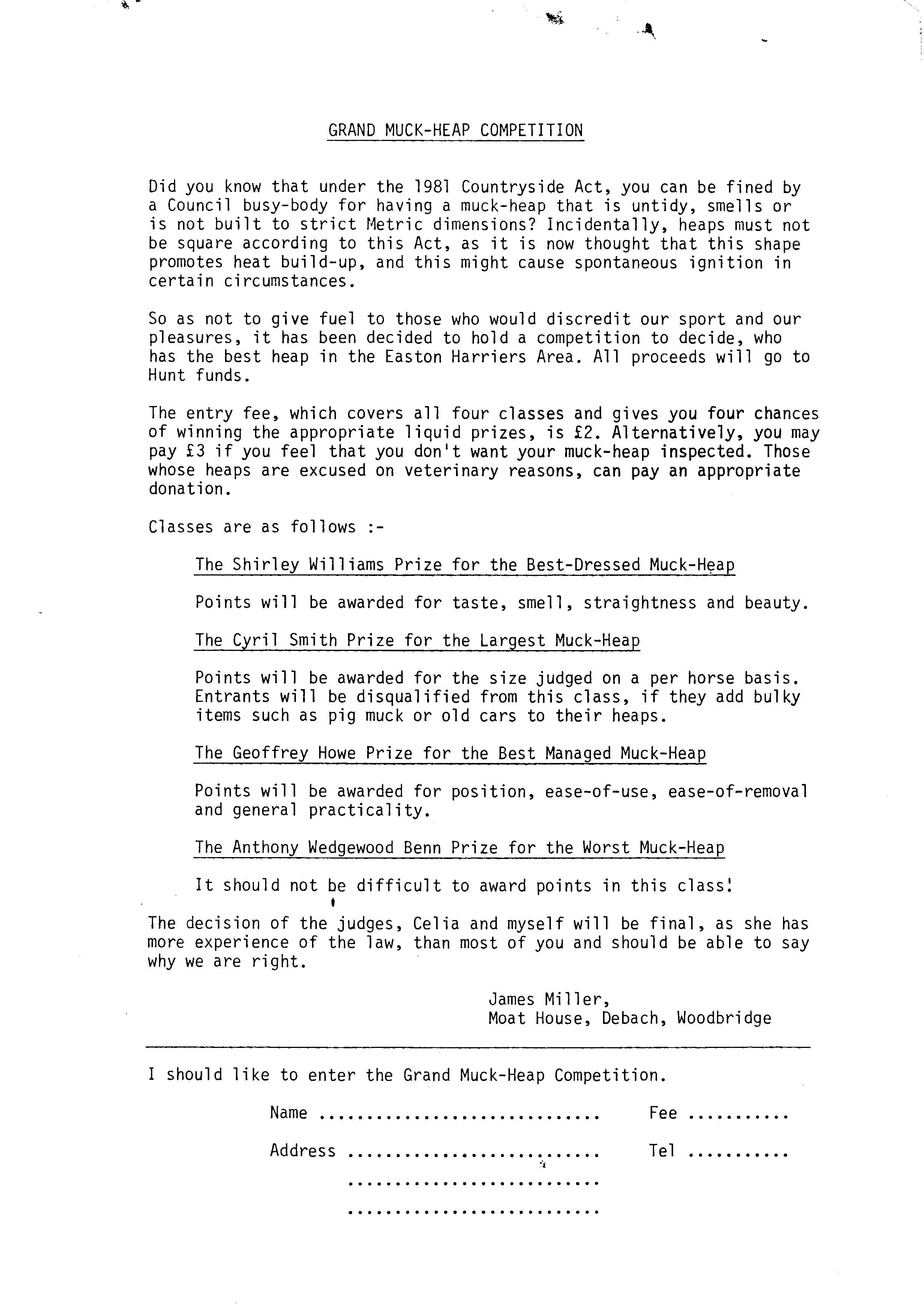
Grand Muck Heap Competition
Feel free to copy this idea, but give any money to a suitable charity. My preference would be one supportring research into pancreatic cancer.
A New Type of Football
Yesterday evening I watched the FA Cup replay between Ebbsfleet United and AFC Wimbledon. Both are very much fans-supported clubs, with Ebbsfleet being owned by the on-line community MyFootballClub and AFC Wimbledon having emerged after the transfer of Wimbledon to Milton Keynes.
Will we be seeing more clubs like these? It could be possible that next season AFC Wimbledon are in the Football League.
One thing that was different, was that there was a pitch-side advert for the Samaritans at the match.
Giving It To a Museum
Today I contacted The Centre for Computing History in Haverhill and later they collected some of my boxes of software. They may also take some of my old hardware, like a DecWriter, a very early and powerful HP Vectra and the Artemis 1000 system.
They certainly need help in all forms.
Thowing Away the Past
I’m having big clear out, prior to moving. The skip arrives today and masses of stuff is going in it. At the moment, I’ve got boxes and boxes of rubbish waiting for it.
Do I find moving stressful? Not as stressful as living in this house without being able to drive!
An Edinburgher Makes Peace with Glasgow
Gavin Mackay successfully makes sausages in South Korea. He had a bit of a problem with the seasoning and eventually found one in Glasgow. This he admitted is very unusual for a man from Edinburgh, as ne’er the twain shall agree!
It’s Gibbon Time
It was good to see the Goodies in all their glory on Saturday. C used to like them and was always amused by the references to gibbons, as were the children.
James Blunt and His Part in Stopping World War 3
The story isn’t quite as dramatic as that, but it shows the different in attitude between US and UK forces, when it comes to dealing with a little local difficulty over Pristina airfield in Kosovo with the Russians.
In the end the view of General Mike Jackson prevailed over that of his commander, the US general, Wesley Clark. So Blunt and his troops, encircled the Russians and when the Russians food and water ran out, the Russians felt it prudent to co-operate and share the airfield.
But even so, Blunt admitted that he wouldn’t have fought the Russians, as he didn’t want to be the man who started World War 3, even if he had been court-martialed later.
Colonel Tim Collins Shoots From The Hip
Colonel Tim Collins, was the army officer who gave the inspirational speech to his troops before the last Iraq War.
He’s just been on Kate Silverton’s program on Radio 5, being as forthright as anybody I’ve heard in the last few months.
A few points.
- He said that Tony Blair had surrounded himself with obsequious advisers who weren’t up to the job.
- He wished that the second Iraq war had been more like the first, with a coalition of sixty countries.
- On Northern Ireland he said that Yesterday’s men are still trying to get the war going. But the real problem is lack of jobs and especially for young people in the province.
- He was very scathing about Defence Procurement, saying that they squandered all the money.
- Asked about the defence cuts, he said something like if Virgin could do the long-range troop deployments, the Navy the strike and the battlefield helicopters were under the Army, then what is there for the Air Force to do.
- As Colonel Tim is a proud Irishman, I was surprised he would want to have dinner with Oliver Cromwell. But then he said he wanted to get to know the man.
It was an amazing interview full of common sense and humanity.
Drinks at the Horse and Groom
I read yesterday in the East Anglian Daily Times, that the Horse and Groom pub in Melton is to be turned into three houses.
I’ve never drunk in the pub, but I suspect some of the locals will miss the hostelry.
I remember though a story about this pub that was told to me at a dinner party in the mid-1970’s.
One of the guests was involved in a project with the Borstal at Hollesley Bay, where on a Saturday or Sunday, they took a group of young offenders and got them to do up the homes of elderly pople in Ipswich. He told how after the work, he usually took them into the Horse and Groom, as it was a very quiet pub, to give them half of shandy or a soft drink, to show his appreciation, before returning the youngsters to the Borstal at seven. I have a feeling that the Govenor knew what he was doing, but I can’t be sure.
Anyway one night the landlord says that someone wanted to see him out the back of the pub. He was greeted by the local police Sergeant, who asked if he’d got lads from the Borstal with him. He said yes and the sergeant said that they’d been a complaint. The sergeant then asked what time, the boys would be leaving and the story-teller said they’d definitely be gone by seven. The sergeant then said they’d better be as they were raiding the pub just after the hour.
Of course the complaintent got their satisfaction that something was being done, but the quiet drinks were able to continue.
I just wonder where those kids ended up in life. Did treating them like real adult human beings help? I certainly hope so!
The Sting in the Tail
There always is, isn’t there!
I’d decided that the best way to get home from the hospital, would be to take a bus to Haverhill and then take a taxi.
As I left the hospital the 13 bus was there, so I ran to get on it. I may have had a stroke, but I can still run ande walk a few hundred metres or so.
I assumed that the bus would go straight to Haverhill Bus Station, as the previous one had done a couple of weeks ago. But this one did an unguided tour of all the delightful estates and I ended up being dumped in a place I did not recognise. It hadn’t helped that because of the rain I couldn’t see out of the bus in the dark.
So it was a long walk to the Bus Station and then I couldn’t get a taxi without half-an-hour’s wait.
So something that should have been easy, made me late!
I get more fed up with the countryside every day.

