Snippets From 1862
I’ve just bought a reprint of Bradshaw’s Illustrated Hand Book to London, which was originally published in 1862.
It was bought in Waterstone’s in Islington, as a present for a friend’s birthday, but I spent most of my lunch in Carluccio’s round the corner reading it. It is full of interesting information and some very surprising differences and facts.
1. Nelson’s Column is known as The Nelson Column.
2. The Houses of Parliament is known as the New Houses of Parliament, as it has just been built.
3. The Crystal Palace gets a lot of pages.
4. There is a lot of description of places anyone familiar with London would recognise.
5. Under rules for railway travellers, it says that passengers are forbidden to smoke on trains or in stations. But obviously, it was acceptable for the engines to do this!
6.They also have a table of money of all nations. As Germany wasn’t yet united, they have separate rates for Hamburg, Prussia and the German States. The Swiss rate is given against one of their coins, which was a thirty-two franc.
More details on the book are given here.
A Disastrous Year
Not my words, but those of the the Chief Executive of the Co-Operative Group, Richard Pennycock, as reported on the BBC after the groups £2.5billion loss. He went on to add this.
These results should serve as a wake-up call to anyone who doubts just how serious the challenges we face are.
“The scale of this disaster will rightly shock our members, our customers and our colleagues,
The Co-Operative Group of 2015, will be a totally different organisation to what it is now! If it still exists! \which I seriously doubt!
There is one truism in any business that always applies. Unless you are totally professional in all things, then your venture will not succeed, as those that stick to professional principles will put you out of business.
Not Long Now For The New Pudding Mill Lane Station
The Wharf is reporting that the Stratford top Bow Church section of the DLR will be closed over the weekend.
The DLR has is not running between Stratford and Bow Church from Friday 18 April until Friday 25 April due to Crossrail works at Pudding Mill Lane.
The completion next week will see the opening of the new Puddling Mill Lane station, 100metres from the original.
So it looks like it won’t be long before access to the Olympic Park, the Greenway and the ViewTube is a lot easier.
Fracked Or Fiction
I went to the London Geological Society today to see a lecture called.
Fracked or fiction: so what are the risks associated with shale gas exploitation?
The lecture is described here on their web site.
They will put up a video in two or three weeks, which you can watch to make your own mind up.
My overwhelming conclusion after the lecture was that before we can embrace fracking in earnest, we must collect a lot more information. For example, we don’t know the background levels ofearthquakes and natural gas seepage in this country. So if say it is thought, that fracking had caused a small earthquake, can we be sure that that isn’t one that we habitually get in this country.
A secondary conclusion, is that my engineering knowledge indicated that there are several very fruitful areas for the development of new technological solutions to mitigate some of the possible problems of fracking.
Stopping fracking is probably an easy task for opponents, as it can be portrayed as dangerous in several ways, that appeal to the sensationalist media. And of course the benefits of low gas prices aren’t so obvious, until they actually happen.
You can compare fracking with that other nimby-opposed project; HS2. This can be opposed in terms of noise, vibration and construction and visual disturbance cost, but the benefits of better and faster journeys is easier to understand by the man on the Birmingham train.
What The Heck Is This?
I like properly engineered or crafted products.
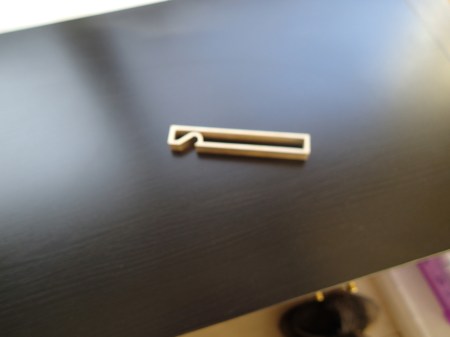
What The Heck Is This?
As a clue, it is cast in solid brass!
Can anybody tell me, what to use it for?
Should Scottish Islands Be Given More Independence?
The BBC this morning is running a report about more independence from Scotland and the rest of the UK.
Scottish Secretary Alistair Carmichael has promised to deliver greater powers for the Northern and Western Isles.
The Orkney and Shetland MP said government from Edinburgh had been “just as bad and just as dangerous” for the islands “as it is from London.”
He hopes to deliver “genuine and long lasting reform,” and said an agreement should be in place by midsummer.
Why not?
It could be argued that a greater degree of independence hasn’t done the Isle of Man and the Channel Islands any harm!
But if we look at giving this independence to any area of the UK, giving them control of their strengths and natural resources and such things as infrastructure, education and planning could only be positive.
I probably know most about infrastructure and especially railways than anything else and if we look at Scotland and London, where transport policy has been partially devolved, we’ll see a lot more rail projects than say in the North East or South West, so I’ll look at one example.
If East Anglia had control of its transport, they would have probably dualled the A47, A11 and A140 by now and would be seriously thinking about improving the London to Norwich and the Peterborough to Ipswich rail lines. The latter is probably needed to be electrified, to enable Felixstowe to compete with the London Gateway.
This type of local control could only be good for an area.
But as I said in this article on Mayors, central government doesn’t like to give up power.
The Most Disastrous Television Channel Launch In History
In four days time on the 20th April, it will be the fiftieth anniversary of the attempted launch of BBC2.
I remember it well. My family thought we’d give it a go, but then a power cut in West London changed everything.
The whole incident is reported here. Here’s the first paragraph.
Fifty years ago this weekend, BBC Two went on the air for the first time. Or rather, it was supposed to go on the air. In fact, a massive power cut wiped out the entire launch schedule and led to one of the most disastrous nights in broadcasting history.
It was supposed to be a spectacular opening night for BBC Two. In the end, it was a spectacular shambles.
When the history of television is written a hundred years from now, this night will have a strong chance to be the worst start to any channel ever.
However, the bad start probably gave the channel an awful lot of publicity.
You should remember that in the nineteen-sixties power cuts were a much more common occurence than they are now. The electrical network just wasn’t as good as it is today.
A Shepherd’s Pie With A Crust
Last night I experimented with the Genius bread and parmesan crust on a shepherd’s pie.
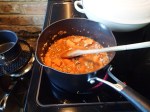

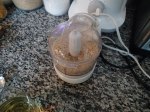

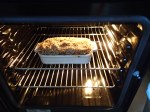


The recipe I used was my standard one. I actually just made enough for one, although I’ve now got enough in the fridge for a lunch later in the week.
It was good, but the next one will be better! Especially in the looks department.
The great thing about it, is that you don’t need to feel and mash the potato. I’m quite capable of doing that with my gammy left hand, but I like to try to be the laziest cook in London.
Should We Nuke Russia?
The title of this post is not a serious question in the way you think it is.
I was thinking about how we control Russia in its expansion into Ukraine and wondered how much gas we buy from the country. Google found me this article on the Forbes web site. It has the title of Nukes Best Option Against Russian Gas. It however did give some interesting facts about Russia and its gas, particularly with respect to the sale of the gas. The article contained the answer that I wanted in this sentence.
Russia gets about €300 billion a year (US$417 billion/yr) from fuel exports to Europe, almost 20% of its GDP
So it looks like that by its policies and purchases, the EU is strongly supporting Russia. The article also contained these paragraphs.
It is unfortunate that Germany closed down almost half of their nuclear plants in the wake of Fukushima, 8 out of 17. Nukes really come in handy during this kind of energy conflict. It would behoove Germany to rethink that decision and to postpone their plans to shut down the remaining nuclear plants over the next ten years, to give them more leverage to address the Russian aggression as they continue transitioning to alternatives.
Until recently, Germany’s 17 nuclear plants produced power exceeding the energy produced by all of the Russian gas entering Germany. With eight shut down, the amount of nuclear energy produced still offsets much of that produced by Russian gas. If Germany insists on prematurely shutting the rest of its nuclear fleet, then the amount of gas needing to be imported into the country will double, even with projected increases in renewables.
This explains the title of the article.
The writer has a point. Whether we like it or not, Europe and especially Germany is playing the Russian’s game, by buying more gas and giving Putin the funds to be aggressive.
The sooner we stop buying gas from Russia the better. We need to start fracking and build more nuclear power stations.
 The Anonymous Widower