A Glow In The Dark Road
I found this story on the BBC web site. It describes how photo-luminescence is going to be used in The Netherlands to make a road safer. It follows a similar idea in a park in Hammersmith that I reported here.
I backed a guy, who was doing something similar thirty years ago, but nothing came of it, I probably wasted a grand, so it wasn’t something I couldn’t affoprd.
I have only seen one successful application of the technology and that was in the Hotel Windsor in Nice to create a ceiling of stars, that dimmed as you went to sleep.
It was very romantic and I wonder if the hotel still has the same ceiling.
But whatever happens to the road in The Netherlands, I believe it is a technology that has lots of applications and we’ll see a lot of it in the future.
The Bacon Factory Curve Opens
The BBC are reporting that the Bacon Factory Curve or the Ipswich Chord to give it its official name, is now open. Here’s the summary.
A new £59m railway giving the Port of Felixstowe a direct link to the Midlands is opening to freight.
Until now freight trains have had to travel in to Ipswich and then out again, adding a hour to journeys.
Hopefully, this small piece of track will improve timekeeping of trains that pass through or by the junction.
As I first posted about this curve in February 2013, construction has been pretty fast.
Have the government and Network Rail decided that lots of small projects can improve the efficiency of the railway significantly?
The Lack Of Left-Luggage Facilities
On the 26th of April, Ipswich are playing in Burnley, and I shall be going.
Unfortunately, the match is on Sky and starts at 12:15, which means taking the 08:30 train to Preston out of Euston, where I change for Burnley.
It is not a difficult journey and I’ve done it before.
However, this time, I think it might be a good idea to go on holiday the next week and there is an ideal flight out of Liverpool to Gdansk on the Saturday evening.
So as it is easy to get to Liverpool Airport from Burnley, via Preston, it would be ideal.
But what do I do with my case for the holiday?
Preston is a major train interchange, but in common with most mid-sized stations in the UK, it doesn’t have any left luggage facilities.
So if I do decide to go on holiday that week, I’ll have to come home to get my case and use a more expensive flight, than the good value one out of Liverpool.
It strikes me that there is an opportunity for someone to create a nationwide system to handle left luggage.
Countryfile Is Showing The Gormley Statues
Just watching Countryfile and it’s showing the Gormley statues on Crosby Beach.
Was This What Really Annoyed The Board At The Co-op?
Prufrock in The Sunday Times looks into the trouble at the Co-op and has this interesting paragraph.
Apparently, certain senior members of the Co-op movement first decided Sutherland had to be stopped after he cut a long-standing entitlement to first class travel for the 20 board members, whose number includes a farmer, a university lecturer and a nurse. Free travel is a perk that disappeared years ago from all but the most lavish plc boards.
So I conclude that to really live well as a socialist, it has to be at the expense of others.
Celery, Ham And Spinach Gratin
This recipe from Lindsey Bareham was my supper last night and there is enough left for lunch today.

Celery, Ham And Spinach Gratin
Perhaps the most interesting thing is the topping. I just took two slices of Genius soft brown sliced loaf, took off the crusts and then blitzed them in my Little Chopper with a couple of table-spoonfuls of finely grated parmesan. Simple, efficient and perfect every time! I use the same topping in Cinty’s fish pie.
I said I would have it for lunch today. This is the cold gratin on my plate.

Cold Gratin For Lunch
It was very nice and the crust held-up well after a night in the fridge.
Mayors Are The Future
This is the theme of an interesting article in The Spectator entitled Governments have failed – mayors are the future. It is a must read.
As a Londoner, I always argue, that London’s transport system and especially the Underground, Overground and buses are so good, because they are controlled and often designed by people who answer to the people, business and visitors to London.
I can remember, when I left London in the 1960s and started to use Liverpool buses a lot, how I found the plastic covered seats strange, compared to the cloth ones on the RT buses in London.
Even in those days, London did its own thing, because that is what London Transport, the controlling Greater London Council and electorate wanted. Ken and Boris have raised this local control to a new level. And it’s not just these two, but the next London mayor, whoever he or she is and which party they belong to, will raise the standard higher.
This paragraph is very much to the point.
Londoners (there are more of them than Scots and Welsh put together) can argue that Boris has made more of an impact on their lives than David Cameron. And this is with the Mayor of London having fewer powers than most mayors. He is one of many from around the world — Tony Tan in Singapore, Yury Luzhkov of Moscow and Wolfgang Schuster in Stuttgart — who argue that the city is the optimum government unit.
So when voters outside of London complain that London gets too big a slice of the cake, is the problem not London, but their second-rate politicians, who fight local squabbles, rather than do the best for their electorate?
You also have the problem that central government doesn’t like giving power to elected mayors in cities, as it reduces their own power.
But surely, if say Leeds wants a tram system, then that should be a decision for the people, businesses and local politicians of that city.
The Punishment Of Nigel Evans
The Times is reporting that Nigel Evans faces financial ruin because of the £100,000 he spent paying for his defence on serious sexual assault and rape charges.
Surely, as the Court found him not guilty, his costs should be met from public funds.
I know it was a civil case, but I was once sued by a veracious litigant and defending the action cost me ten grand. I could afford the legal costs at the time, but how many other people are found innocent or win their case and are seriously out of pocket?
It is an unfairness that should be removed from our legal system.
Open Data Will Improve Public Transport
I was actually looking to see if anybody else had spotted that London buses now have time displays, which I reported here.
But I did find this article entitled, Smart data will only work if the network data is truly open.
The article says that London has one of the biggest real-time passenger information systems in the world. All of the data is available free for developers. The article then says this.
Developers have created more than 100 apps for the city’s buses alone. They offer everything from route planners for the disabled to scalable tube maps, with live updates when lines are disrupted, and apps that let you know where to board a train so you can get off as close to your exit as possible.
So is it right to think that as time goes on, more and better apps will be written to make difficult journeys easier?
You could envisage apps, where you entered your start and destination and the system made suggestions, as to how to get there fastest, when say the local low life had nicked the signal cable or a bus or train had broken down.
The one thing that the article misses, is the data connection from the smart device to the central system.
Surely to cope in the near future, all vehicles will have a wi-fi connection. First Manchester is reported here to be fitting wi-fi to all its buses.
Once you have a fast local connection between vehicles and passengers, other possibilities will become feasible.
As an example, I often catch a 38 bus to the Angel, where to get to Kings Cross, I change to a 73 bus or take the Northern line. If the bus had a rearward facing camera, I could link to this to check for the 73 bus.
One of the great things about this technology is that you don’t need everybody to be using it on a bus, as bus passengers will talk to each other and share their information. I say this because you see people at bus stops texting to find the arrivals and then showing them to other passengers.
None of the apps because of the open data will cost Transport for London a penny. The reverse could be true in that the apps might encourage more passengers to travel and travel on the more lightly-used part of the network. If more people travelled by bus, hopefully this would reduce car traffic, thus allowing more road space for buses.
Such is the power of software!
If You Want To Know The Time Get On A Bus
I was on three big red taxis today and they’ve had a software upgrade on the information display.

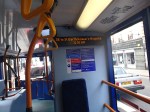

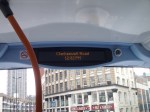
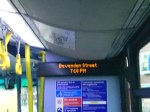
I haven’t noticed the time before, but I was away Tuesday and Wednesday and only took one bus yesterday.
Since I created this post, I’ve been on about six or so buses. All were showing the time! Even a very elderly example! I did see a New Bus for London pass and it looked like this was showing the time as well.
It will be interesting to see the indirect effects of this technology change!
Will people be on time more, as they should spot they are late, even when they’ve left their watch at home?
Will it cut watch thefts, as people might wear them less on public transport?
Will there be a clamour for more clocks on the Underground, the Overground and trains?
 The Anonymous Widower