My Credit/Charge Cards Got Cloned
I use an American Express Charge Card for my travel, for the insurance and also because, if I know I’m picking up rail tickets, I don’t have to think which card I’m using. It is contactless, so I kep it separate from my Freedom Pass to avoid card class and often I don’t take it out with me.
I also have a John Lewis Partnership Card, which I use for everyday purchases and on-line, as it doesn’t use that non-protection system Verified by Visa, which is a pain in the arse.
Over the last two weeks, both have been cloned and used online for substantial purchases. With both cards, the fraud protection systems at the card companies picked up the illegal uses and the cards were stopped , causing me the hassle of having to update various web sites, where the card is stored.
So how did the cards get cloned?
I’m not sure, but both of the card statements often come in the post on the same day. I doubt it’s anything to do with the Royal Mail, although because they are moving buildings in the main sorting office that serves me, there has been a couple of things that have gone astray or turned up late.
Normally, when the statement arrives, I put it by my computer and pay it the next time, that I go on-line. I then shred the statements.
But I’ve been away a lot in the last month or two and I’ve had builders around, which caused the shredder to be out-of-use for a time.
So perhaps I was less than zealous in shredding a statement!
I suspect that as I put the green sacks for recycling outside late on a Wednesday night, someone has been raking them over and removing ones that might be promising
One thing I have done is make the American Express card paperless, so there is nothing incriminating from that going in the rubbish.
Unfortunately, the John Lewis card has no paperless facility and as it is not contactless, I am seriously thinking of giving it the order of the boot. It will certainly be going into temporary retirement.
In fact, I would say don’t get a new credit card unless the following conditions apply.
- The card’s call centre and processing is based in the UK.
- All statements can be paperless.
- Past statements are available on-line in an easily readable form.
- Cards are contactless.
I think contactless cards are important. Most contactless payments are in big retailers or in London on transport. Transactions are probably caught on CCTV and there is often no handy piece of paper that could be taken by untrustworthy staff. The twenty pound limit also means that you can’t use them for the sort of purchases criminals like.
I have worked on very secure projects in the past and only access my bank accounts from one computer that never leaves my house.
People ask me if I would use ApplePay or the future AndroidPay. I certainly would, as if say the system was cloned and I lost money, Apple or Google would be finished. Until proven otherwise, I feel that they are more secure than contactless cards.
If you worry about contactless cards, just reflect on the fact, that I have been unable to find any negative comment about their use on London’s transport system, which is one of the largest contactless card-based systems in the world. There are so many out there who hate Boris with an absolute passion, that if anything had happened, it would be repeated ad infinitum.
The weak link in all these systems isn’t the technology, it’s the fact that we do stupid things, like drop our phone or card (Guilty, as charged!) and that criminals end up in retailers and card companies in positions, where they have access to sensitive data.
How can you be sure, that the nice man in the corner hardware store hasn’t taken your card details and sold them on to someone, who has the knowledge to take card numbers, expiry dates and names and addresses to defraud on-line retailers and service providers?
The Smart Money’s On Isis Destroying Itself
This is the headline on a serious piece in the Times by Ed Conway, which talks about Islamic State and there adoption of gold as their currency!
If you can get a copy of yesterday’s Times read it.
There’s more details here in Wikipedia.
Ed’s piece is a fascinating article and it shows how crazy these cruel male chauvinist pigs are!
I know we have problems with our current monetary standard, but no serious central banker or politician would suggest opting for a metal based currency.
I wonder what Islamic State think of bitcoins?
We Don’t Fight Wars Like That Anymore!
There is an obituary in The Times today of John Campbell, who won a Military Cross and Bar, whilst serving in Popski’s Private Army, which was officially the No 1 Demolition Squadron and a unit of British Special Forces in World War II.
I grew up just after the Second World War and just as newspapers today, use the actions of C-list celebrities, in those days, Sunday papers like the Express and Dispatch, were full of tales of derring-do, as the Nazis and the Japanese were eventually defeated.
As my next door neighbour, a sometime Colonel in the Engineers, once said, there’s only one rule in the British Army – In case of War, ignore the rule books.
Vladimir Peniakoff or Popski wrote them.
We probably can’t do what he did these days, when we’re trying to curb the atrocities of groups like Islamic State, but I’m sure he’d have had an innovative solution.
This paragraph from the Wikipedia entry for the PPA is informative.
PPA was unusual in that all officer recruits reverted to lieutenant on joining, and other ranks reverted to private. The unit was run quite informally: there was no saluting and no drill, officers and men messed together, every man was expected to know what to do and get on with it, and there was only one punishment for failure of any kind: immediate Return To Unit. It was also efficient, having an unusually small headquarters.
Isn’t that how you’d run a company to develop new technology?
Is My Life Going Round In A Curious Circle?
In the 1970s, my late wife; Celia and myself lived, with our then three sons, on the eleventh floor of Cromwell Tower in the Barbican.
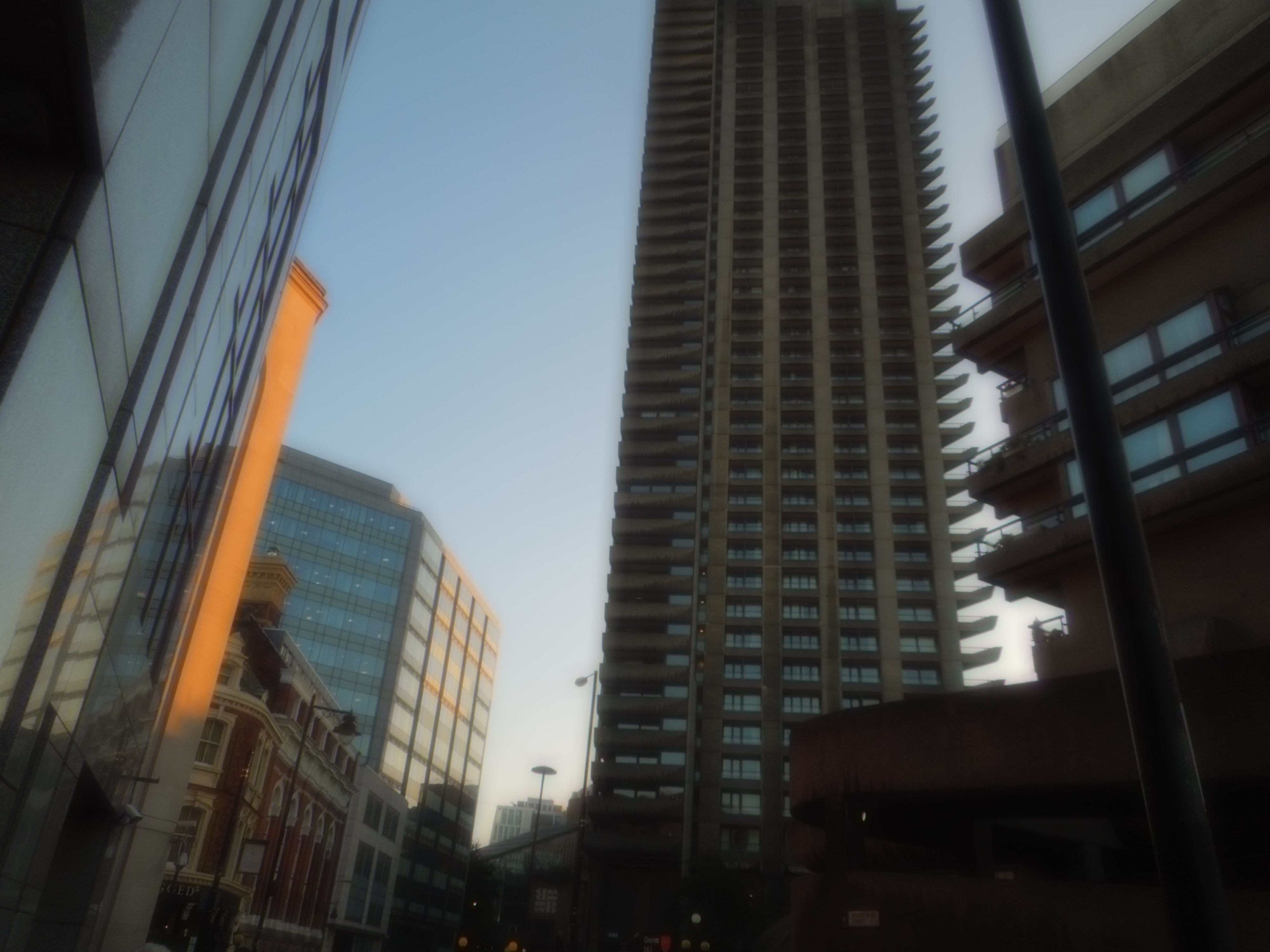
The shops in those days in the area were not very numerous and with the exception of the excellent market in Whitecross Street, getting everything we needed wasn’t easy. There was no supermarket, unlike today where there is a Waitrose in Whitecross Street.
So often on a Saturday, we’d take the boys up the hill to the Angel and shop in the Marks and Spencer and the Woolworths in Liverpool Road opposite the Underground station.
I’ve since found out that the Marks at the Angel is a long-established store and it may have been the one my grandmother spoke about, that she used around the time of the First World War, when she and her family lived just down from the Angel by the Regent’s Canal.
Woollies went a few years ago and much to the regrets of many of the locals is now a Waitrose.
My friends, who knew Celia, and myself often share a laugh over the fact that when I can get it, I drink a Czech gluten-free lager called Celia. A few weeks ago, I heard that the beer will be stocked in Waitrose, so I wrote to them asking where it will be stocked locally. This is an extract from their reply.
I’ve looked into this and I’m pleased to tell you that this should be available at both our Islington and Barbican branches from tomorrow.
As these are two branches, that we would have walked past together in the 1970s, long before they opened, I just can’t help thinking that life is truly strange!
Could anybody, who spots Celia lager in their local Waitrose please let me know?
Thanks!
Gluten-Free Food On The NHS
As a coeliac, I get no food from the NHS.
If you take bread as an example, I get through a couple of slices a day, usually spread with honey, in a sandwich or as something to eat with say hummus.
If I was to get this bread on the NHS, a month’s worth would leave me with no space in the freezer and I’d have to defrost each slice as I needed it.
Also, the bread from Marks and Spencer is far superior to anything available on the NHS.
I probably spend about a fiver on specialist gluten-free food every week, but mainly I eat the sort of food, that is naturally gluten-free, like meat, fish, vegetables and fruit.
A more cost-effective system would be that all coeliacs got a monthly payment to help with food costs. If they spent it on cigarettes, then that is their affair!
So what do I think are the best gluten-free foods?
Bananas – A snack in its own wrapper.
Beans
Black Farmer Sausages – Made for real men
Celia gluten-free beer
EatNakd Bars
Eat Natural Toasted Muesli With Vine Fruit – Not the Buckwheat!
Eggs
Fish – Always skinless and boneless
Goats Milk – It lasts forever in the fridge
Honey
Leeks
Marks & Spencer’s Beefburgers –
Marks & Spencer’s Bread – It’s all excellent
Marks & Spencer’s Calves Liver – All that B12
Marks & Spencer’s Still Lemonade – I use it to clear my throat of catarrh
Marks & Spencer’s Welsh Goats Cheese
New Potatoes – I use them as nibbles too!
Rachel’s Yoghurt with Honey – It doubles as a quick pasta sauce!
Rice
Strawberries
Tea
Tomatoes
Rump Steak – Always top quality
Waitrose Chicken Breast Chunks – So many simple meals start with these!
Waitrose Prepared Mango, Melon and Pineapple
Whisky – Scotch or Irish
I do tend to buy food that doesn’t need preparation, as my knife skills aren’t that good and being on Warfarin, I don’t want to cut myself. I also buy the Waitrose prepared fruit, as to buy a whole mango, melon or pineapple would mean I would waste a lot.
I should say I don’t need to live frugally, but if I had to, I could fund my energy, water, Council Tax, phone and daily food from well within my State Pension. Obviously, I get travel in Greater London free and I don’t have a car
From Walthamstow To Hackney
The space in the East of London up the Lea Valley between Walthamstow and Hackney is all grass, scrub, reservoirs, canals, rivers and railways.
These pictures were taken on a train between Walthamstow James Street and Clapton stations.






It is a very underused area and lies just to the south of the proposed Walthamstow Wetlands. The only development that will happen here is to reinstate the Hall Farm Curve to enable trains from Walthamstow and Chingford to join the Lea Valley Line to Lea Bridge and Stratford. It will probably end up though, ringed by high-rise housing, like you can see along the River Lea.
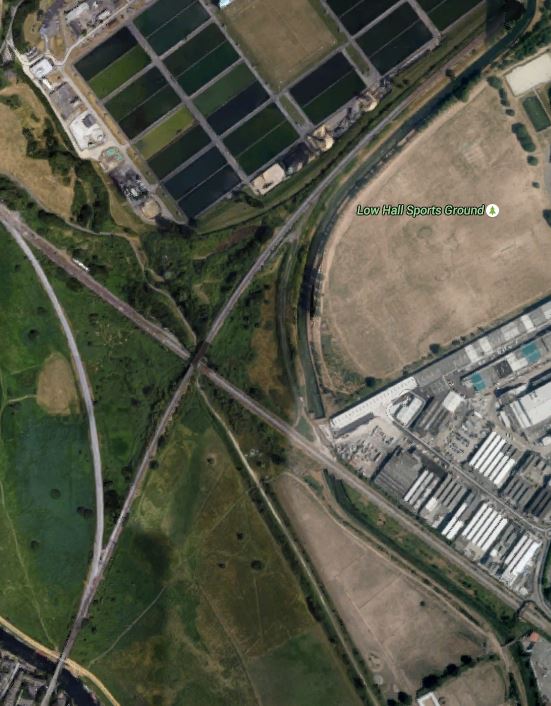
London is a surprising city. Soon it will be a City with a world-class nature reserve just a few minutes from the business heart of the City, This is a Google Map of the area.
Walthamstow To Hackney
Note the two rail lines crossing in the middle. The route of the Hall Farm Curve can be made out, as it hugs the boundary of the unmanaged area.
At the top of the picture you can see the filter beds of Thames Water’s giant water factory, that provide a lot of London with water using the massive reservoirs of the Lea Valley, some of which will form part of the Walthamstow Wetlands.
If you take a train from Liverpool Street to Stansted Airport or Cambridge, you’ll come over the River Lea and then take the curve to join the main line before passing through the Walthamstow Wetlands and stopping at Tottenham Hale.
Electrification Of The GOBlin
I have just found this article on the Gospel Oak to Barking Line on the Railfuture web site.
It explains the way the line will be electrified and other issues very well.
One thing it says is that the line will be electrified in two parts, so that whilst the overhead wires are erected on one part and passengers will be put on the bus, the other part can be used by four-car trains. Provided of course they lengthen the platforms.
The Railfuture article is an interesting read, as it talks about this short stretch of electrification.
1. The Line Connects Electrified Lines
It is joined to electrified lines at each end and several along its route, which will enable through electric passenger and more importantly freight trains to use the route.
It also means that getting electric power to the line shouldn’t be too much of a problem.
2. A Freight By-Pass For The North London Line
At present electric freight trains have to use the North London Line, but using an electrified GOBlin would avoid congested junctions at Stratford, Forest Gate and Camden Road.
3. More Passenger Capacity
Replacing two-car Class 172 diesel trains with new four-car Aventra electric trains, won’t just double the passenger capacity, but because electric trains have faster acceleration, they will do better than that.
4. Extended Passenger Routes
The extension of the GOBlin to a new Barking Riverside station was announced in the 2014 Budget, but the Railfuture article talks about extending services the other way to Willesden Junction, Clapham Junction or even Ealing, which probably means Ealing Broadway.
You can understand why Transport for London might want to do this, but it would need new platforms at Gospel Oak. This Google Map shows the station.
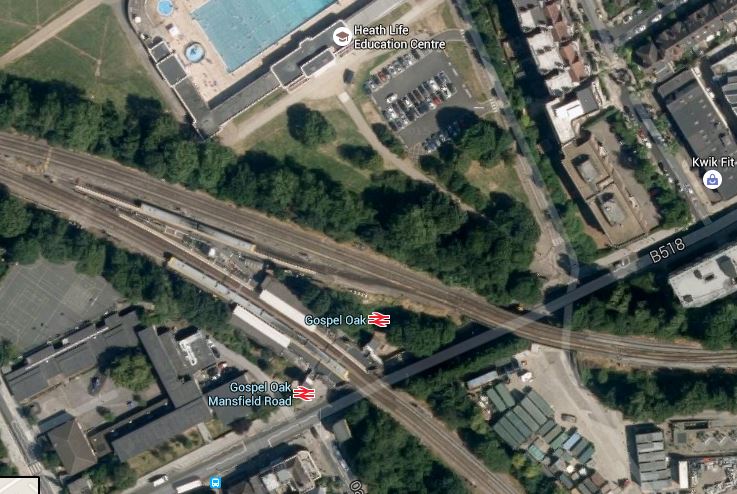
Gospel Oak Station
Note that there is a Class 172 in the platform and it looks like accommodating a train, twice that length might need a platform extension.
I suspect that Transport for London will look at other options, depending on where passengers go from Gospel Oak and the number of freight trains that have to be pathed through the area.
On a personal view, I’d like to see trains on the GOBlin terminating in Ealing, as that would give me an easy route to the area, by getting a 141 bus from outside my house to Harringay Green Lanes.
But I don’t think that is likely. After all when Crossrail opens, I can just take a 141 bus the other way to Liverpool Street/Moorgate and get Crossrail to Ealing.
Greater Electric Freight Capacity and Flexibility
Railfuture reckon that up to thirty freight trains a day will leave London Gateway and many will be electric hauled and need to make their way up the West Coast Main Line. An electrified GOBlin gives them two routes across London.
The second route will also enable services to be maintained, when say one line is blockaded.
Limited passenger services could also be run via Stratford and South Tottenham to Gospel Oak, when work is being undertaken on the North London Line.
Harringay Park Junction
Railfuture also says that this vital junction will be electrified.

Harringay Park Junction
The GOBlin runs across the image, with the junction under the bridge on the left.
It will allow eastbound freight trains to go north on the East Coast Main Line.
Carlton Road Junction
Another junction, that Railfuture believes will be electrified.
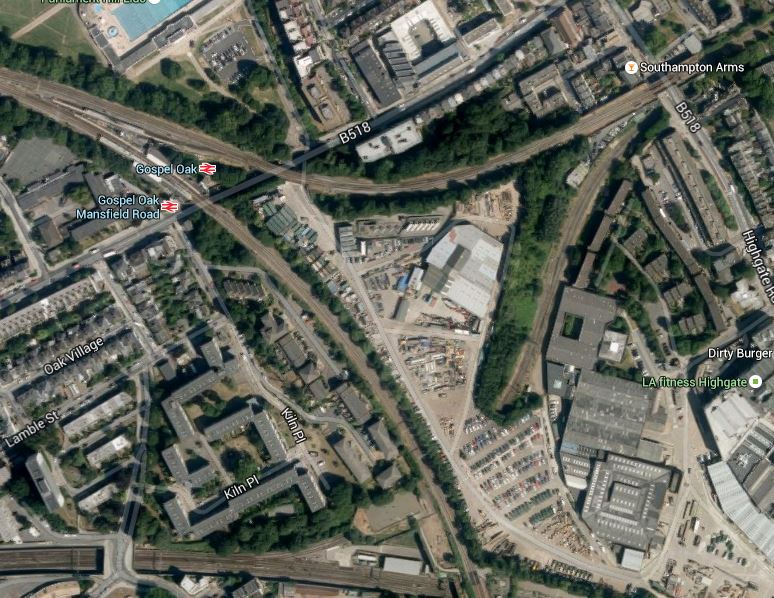
Carlton Road Junction
It will allow westbound trains to go north on the Midland Main Line, which runs across the bottom of this image
A lot will be freight going up towards the Radlett Freight Terminal or the Midlands, but a proportion will take the Dudding Hill Line to go west.
Dudding Hill Line
I think that it will not be long before the Dudding Hill Line is electrified to allow both electrified freight and passenger services to go west, by bypassing the North London Line.
Certainly Transport for London have identified this route as a possible GOBlin extension.
Something To Bragg About!
A few days ago, someone asked me about the overhead wires of a railway and the pantographs, that pick up the 25,000 Volts AC current.
I can’t remember what their question was, but I said it is a difficult problem, as a train like a Virgin Class 390 Pendelino might be travelling at 125 mph in bad weather, so maintaining contact with a constant pressure between the pantograph and the overhead wire isn’t easy.
I was reading something else and found this article on the Rail Engineer web site. Research has been going on at the City University to develop a sensor that monitors the forces at the pantograph head. As you can imagine it is a particularly harsh environment and the engineers have bean using a technology called a Fibre Bragg Grating (FBG) developed in the 1990s, based on the work by the Nobel Prize-winning scientists William Lawrence Bragg and his father; William Henry Bragg.
I won’t paraphrase the article, but it is a must read. Where it will all lead to I don’t know, but I will repeat this last paragraph.
In the long term, the FBG sensor system offers the ability to detect contact forces from the entire service fleet if combined with GPS and suitable telemetry. This offers the potential of continuous real-time monitoring of the entire overhead line network. Then the Braggs’ work on X-ray diffraction of crystals a hundred years ago could well have made overhead line dewirements also a thing of the past.
Just imagine what it would mean to the operators of our increasingly electrified rail network, if delays caused by trains bringing down the overhead wires were to be reduced.
I’ve met people at Cambridge University for whom William Lawrence Bragg was their tutor and they have described him as a quiet man, who was superb in getting brilliant work out of the students, he tutored.
This tale illustrates why we must do more and more research and often that the solution to a difficult problem is unexpected, but brilliant.
An Offer From A Bank Out Of The Disruptive Handbook
Banks don’t often copy the sort of marketing ideas used by the disruptive companies like Zopa and OVO Energy.
Both these companies pay users a bonus for introducing new customers.
Now Nationwide are saying that if you recommend a friend and they switch to the Bank, you’ll both get £100.
Nationwide does all I need from a money-transfer company. I should say that I don’t use any of their other services except for free travel insurance and a credit card, which is one that is recommended by various financial pundits, as it is very good in its use abroad.
This sounds like a good deal all round, for those who have simple banking needs like I do.
So if you’re thinking of changing your bank and Nationwide is on your list, get a friend to recommend you and you’ll both be quids in.
The Piccadilly And Victoria Lines, Manor House Station And Harringay Green Lanes Station
The planners and the politicians created a real dog’s breakfast here, when the Victoria Line was designed and built in the 1960s.
A Few Facts
I’ll start with a few facts, as far as we can trust Wikipedia.
From the Planning and construction section of the entry for the Victoria Line.
A test tunnel from Tottenham to Manor House under Seven Sisters Road had been bored in 1959 and was later incorporated into the running tunnels.
From the entry for Seven Sisters station.
The section of Victoria line between Seven Sisters and Finsbury Park stations is the longest between adjacent stations in deep level tunnels on the London Underground network.
From our own observations.
There is a ventilation station at the junction of Green Lanes and St. Ann’s Road. This was put in, as it’s a long way between Turnpike Lane and Manor House stations. The Cockfosters Extension section of the entry for the Piccadilly Line says this.
It was also planned to build a station between Manor House and Turnpike Lane at the junction of Green Lanes and St Ann’s Road in Harringay, but this was stopped by Frank Pick, who felt that the bus and tram service at this point was adequate. However, a ‘Ventilation station’, in similar architectural style to tube stations of the time was provided at the site, and is visible today. There was also some opposition from the London and North Eastern Railway to the line.
I think we underestimate the influence the LNER had on shaping London’s railways. Much was positive, but some was about protecting their interests.
I had a great uncle, who lived in Harringay and in the 1950s, we’d go and visit him on the 29 bus, as it was a long walk from Turnpike Lane.
What Might Have Been
Here again from various parts of Wikipedia.
From the Victoria Line section of the entry for the Piccadilly Line
During the planning stages of the Victoria line, a proposal was put forward to transfer Manor House station to the Victoria line, and also to build new “direct” tunnels from Finsbury Park to Turnpike Lane station, thereby cutting the journey time in and out of central London. This idea was eventually rejected due to the inconvenience to passengers that would have been caused during rebuilding, as well as the costs of the new tunnels.
From the entry for Seven Sisters station.
During the planning phase of the Victoria line, thought was given to converting Manor House into a Victoria line station and diverting the Piccadilly line in new tunnels directly from Finsbury Park to Turnpike Lane via Harringay Green Lanes, but the idea was abandoned because of the inconvenience this would cause, as well as the cost.
From fifty years and more after construction of the Victoria Line it might seem to be a feasible plan on a cursory look.
- It would speed trains on the Piccadilly Line to Kings Cross and Central London, as the route is shorter.
- There would be an extra station at Harringay Green Lanes on the Piccadilly Line, which would replace Manor House.
- It might also be feasible to turn the ventilation station at Green Lanes into a station.
- There would be an extra station at Manor House on the Victoria Line.
Also affecting these services will be this summer’s upgrade to the Victoria Line which will allow thirty-six trains per hour on that line.
So if you take the two improvements together passengers on both the Victoria and Piccadilly Line would get a better service with extra stations.
Enter Crossrail 2
Crossrail 2 will add another dimension to the planning in this area.
I’ll start with a personal observation from my childhood.
Many times, I travelled from Oakwood to Leicester Square or South Kensington and it’s a long way! It probably still is! And in trains that are a lot more crowded.
The opening of Crossrail 2 will affect the Piccadilly and Victoria Lines.
- Passengers on the Piccadilly Line from Wood Green northward may switch to Crossrail 2 at Turnpike Lane.
- Passengers on the Victoria Line from Walthamstow may switch to Crossrail 2 at Tottenham Hale.
- Many passengers from the London Boroughs of Barnet, Enfield, Harringey and Waltham Forest, will change their route to Central London with the arrival of Crossrail 2. And before that an upgraded Thameslink.
I think overall, we’ll see an easing of the lot of passengers on both the Piccadilly and Victoria Lines, by the end of the next decade. The Piccadilly Line should also have been upgraded with new and larger trains, running to an increased frequency. The Future Upgrades section for the Wikipedia entry for the Piccadilly Line says this.
On current plans, resignalling work on the Piccadilly line will begin in 2019 and new trains should be in service by 2022.
If the Piccadilly Line eases South of Turnpike Lane, then there may be scope for opening more stations on the line at perhaps the ventilation station on Green Lanes and Harringay Green Lanes.
And what about an interchange to the North London Line at Maiden Lane to serve the Kings Cross Central development?
How Could New Stations Be Built?
Doing anything at present to create any new stations on the Piccadilly Line is probably not feasible, as it would be impossible to shut the Piccadilly or Victoria Lines for long enough to do anything substantial. There’s been enough chaos caused by shutting the outer reaches of the Victoria Line this summer.
Transport for London have a similar problem about creating a link between the Central Line and the East London Line at Shoreditch High Street station. Transport for London feel that nothing can be done until Crossrail opens. I discussed that link in Will Shoreditch High Street Be Connected To The Central Line?.
Creating new stations on the Piccadilly Line probably can’t be done, until Crossrail 2 is opened, as how do the passengers get to work, rest and play?
I think that in a few years time actually creating the stations will not be as difficult as it would be today, from a construction point-of-view. The experience gained on building Whitechapel station on Crossrail, where a technique called uphill excavation has been used, might be applicable.
Conclusion On The Piccadilly Line In Harringay
My view is that a sort out of the Piccadilly Line and its stations in Harringay is possible and probably very worthwhile, but only after Crossrail 2 has been opened.
Planned Rail Development At Harringay Green Lanes Station
Over the next few years, there will be two major developments on the GOBlin through Harringay Green Lanes station.
The line is going to be electrified with 25 KVAC overhead lines, which will mean putting up structures to support the cables. The bridge across Green Lanes will probably be replaced, as it doesn’t look to be in the best of condition and to be safe, it will probably be replaced before the wires are erected.
The new electric trains will be four-car and this will probably mean the platforms have to be extended. I suspect that Transport for London may well future-proof the station and extend the platforms for perhaps six or even eight-car trains.
There is definitely space at the eastern end of the station to do the platform extension, but why not extend the platforms over the bridge and perhaps even use glass sides, as they’ve done at Deptford. Extending over the road will also mean that in future a western entrance or link to Harringay station could be created.
As no plans to replace the bridge have been published that I can find, could it be that Network Rail and their architects are working with property developers to design a proper flagship station?
I also think that designing a station to carry the overhead wires in its structure, as I’ve seen at Liege station, may simplify the design and save on the cost of the building.
Property Development And Harringay Green Lanes Station
If you want a profitable development, building car parking is a waste of money, so good access to public transport is essential.
For this reason and especially for housing, property development will be the force that drives the development of London’s transport system.
There is a lot of scope for property development in the area around Harringay Green Lanes station.
This document from the London Borough of Harringey entitled Harringay’s Local Plan lists a large number of development sites around the station.
On Page 92 the document details the St. Ann’s Hospital Site, which lies to the north of the GOBlin. It details how the South West corner of the hospital site will be connected to Green Lanes and the station.
On Page 94 the document goes on to talk about the Arena Retail Park, which adjoins the station.
Both sites have something that developers love. They are both in single ownership; one public and the other private.
So you can have control of the sites without the sort of problems that Tottenham Hotspur have had on building their new stadium, which has delayed the development for some years.
As it will be in the developers’ interest and profitability to have good public transport, I would be very surprised not to see a very good station built at Harringay Green Lanes to serve their developments and also to improve the transport opportunities for locals. This is said in the document.
Access to Harringay Green Lanes Station should be improved by creating a
new entrance on Portland Gardens.
Also, no sane developer would build this station without a secret place, where the escalators and lifts to the Piccadilly Line could be installed. As an example, Tottenham Court Road and perhaps Angel stations, are already ready to accept Crossrail 2.
I believe that given the amount of property development that will take place in the area, a new station at Harringay Green Lanes will be one of the first new buildings to be constructed.
Imagine the advertising potential for your development to see a shiny glass and steel station built over Green Lanes, as you drive or ride a bus through the area. Buiilding the station partly over the road would mean you need to use less valuable land and it would be easier to create a Hackney style link to Harringay station along the railway. If you want to see what can be done, go to Deptford station.
Tailpiece
If you have a flagship station at one end of Green Lanes in Harringay, why not have one at the other by converting the ventilation station into a real one?
I just wonder if that should and could be done before Turnpike Lane is rebuilt for Crossrail 2, so that there is an alternative station, if Turnpike Lane had to be closed.
Crossrail have shown that they like to be good neighbours and converting the ventilation station could be something they’d look at to cool the anger of diverted passengers and local residents. The superb new Pudding Mill station on the DLR was built by Crossrail, as the old station was in their way and had to be demolished. I was very surprised that the new station is so spectacular, but I suspect that through good design, clever use of space and leaving out expensive escalators and various utilities not needed if there are driverless trains and no booking office, that the station wasn’t as expensive as it looks. The property developers and West Ham United won’t be complaining.
 The Anonymous Widower