Has The Queen Ever Ridden In a Battery-Powered Train?
Countryfile this evening had a special program about the Queen’s Scottish house and estate at Balmoral.
One archive film, showed her arriving at Ballater station in a train hauled by a locomotive with a number that looked slightly familiar. Looking it up, it was a B1 Class locomotive, which I must have seen regularly, when I went train-spotting on the West Anglia Main Line in the 1950s.
So I looked up Ballater station in Wikipedia.
The station, which was on the 43 mile long Deeside Railway from Aberdeen, is now closed but there was this paragraph on Wikipedia under Services.
When the battery multiple unit was introduced, services were doubled to six trains a day from 21 April 1958, and Sunday service reinstated. The line was chosen for testing the unit because the stations were well spaced and the 1 in 70 ruling gradients would require substantial discharge rates.
As someone very interested in railways at the time, I’d never heard of British Rail’s use of battery trains.
Remarkably, the battery electric multiple train, is still in existence and is being preserved at the Royal Deeside Railway, not far from Balmoral.
It looks to me. that a lot of engineers at Derby, made sure that this train survived.
So what was it like?
- It was based on the Derby Lightweight diesel multiple unit.
- The North of Scotland Hydro-Electric Board initiated the design and was a joint sponsor.
- The train had an operating speed of 60 mph.
- The train was powered by two 100 kW traction motors.
- Power was provided by 416 lead-acid cells, giving a total of 440 V and 1070 A hour capacity.
- The batteries weighed nine tonnes.
- There were seats for twelve First Class passengers and a hundred and five in Second Class.
It couldn’t been that bad a train, as it ran between Aberdeen and Ballater station from 1958 to 1962.
There’s more about the train here.
Conclusion
But I can’t help wondering, if the Queen ever used the train!
Discontinuous Electrification For Valley Lines?
The title of this post, is the same as that of an article in the May 2018 Edition of Modern Railways.
The Valley Lines in question are the Cardiff Valley Lines, that fan out from Cardiff Central and Cardiff Queen Street stations in various directions.
- Some of the lines into the valleys are quite steep.
- The lines in the Cardiff area seem to be typical coastal lines and fairly flat.
- The lines are a mixture of single and double track.
- There are various plans to extend some of the branches.
According to the article, it would appear that the current diesel system would be replaced with a system, with these characteristics.
- Light rail vehicles
- Discontinuous electrification
- Use of stored energy.
- Street running is expected to be in the specification for the vehicles to be used, to allow extension in the Cardiff Bay area and perhaps other places.
The proposal would save costs against full electrification and heavy rail.
My observations follow.
Batteries
Batteries will be an integral part of the design of the new rail vehicles.
Powering The Trains
The article states that battery power will be used to power the trains on sections that are difficult to electrify, like the mile-long Caerphilly Tunnel.
Battery power could also be used on level and downhill sections of track up to a few miles, but I suspect on steep uphill sections, electrification will be needed.
Handling Regenerative Braking
I believe that regenerative braking will be employed on the rail vehicles and the energy generated will be stored in the batteries.
The main advantage of this is that it simplifies the power supply to the electrification, as it only has to handle power going to the train.
This less complex electrical system, saves construction costs.
Recovering The Train’s Potential Energy
A train travelling from Cardiff to one of the terminal stations at the heads of the valleys, will need to acquire an amount of potential energy, based on the train’s mass and the height involved. This will be provided by the train’s traction system powered by the electrification and the energy in the batteries.
Coming down the hill, the regenerative braking will control the speed of the train and store any energy generated in the batteries.
This will save on the cost of energy to operate the system.
Charging The Batteries
The batteries will be charged from both the overhead electrification and the regenerative braking.
Extensive simulations of the route on computers would be able to calculate the following, for a wide range of scenarios.
- The size of the batteries.
- The power of the traction motors.
- Where the electrification needs to be installed.
- The maximum power output of the electrification system.
These calculations could also lead to an energy-saving operating philosophy, that could be programmed into the train’s computer system.
I suspect the worst case scenario, would be a train full of the heaviest Welshmen after an important rugby match at the Millennium Stadium.
Electrification
My thoughts on how various sections of track would be electrified follow.
Tracks With A Significant Uphill Gradient
These would need to be electrified, as I doubt battery power on the steepest gradients, would be enough to take a fully-loaded train to the top of the hill.
Electrification would be lighter-weight 750 VDC overhead wires.
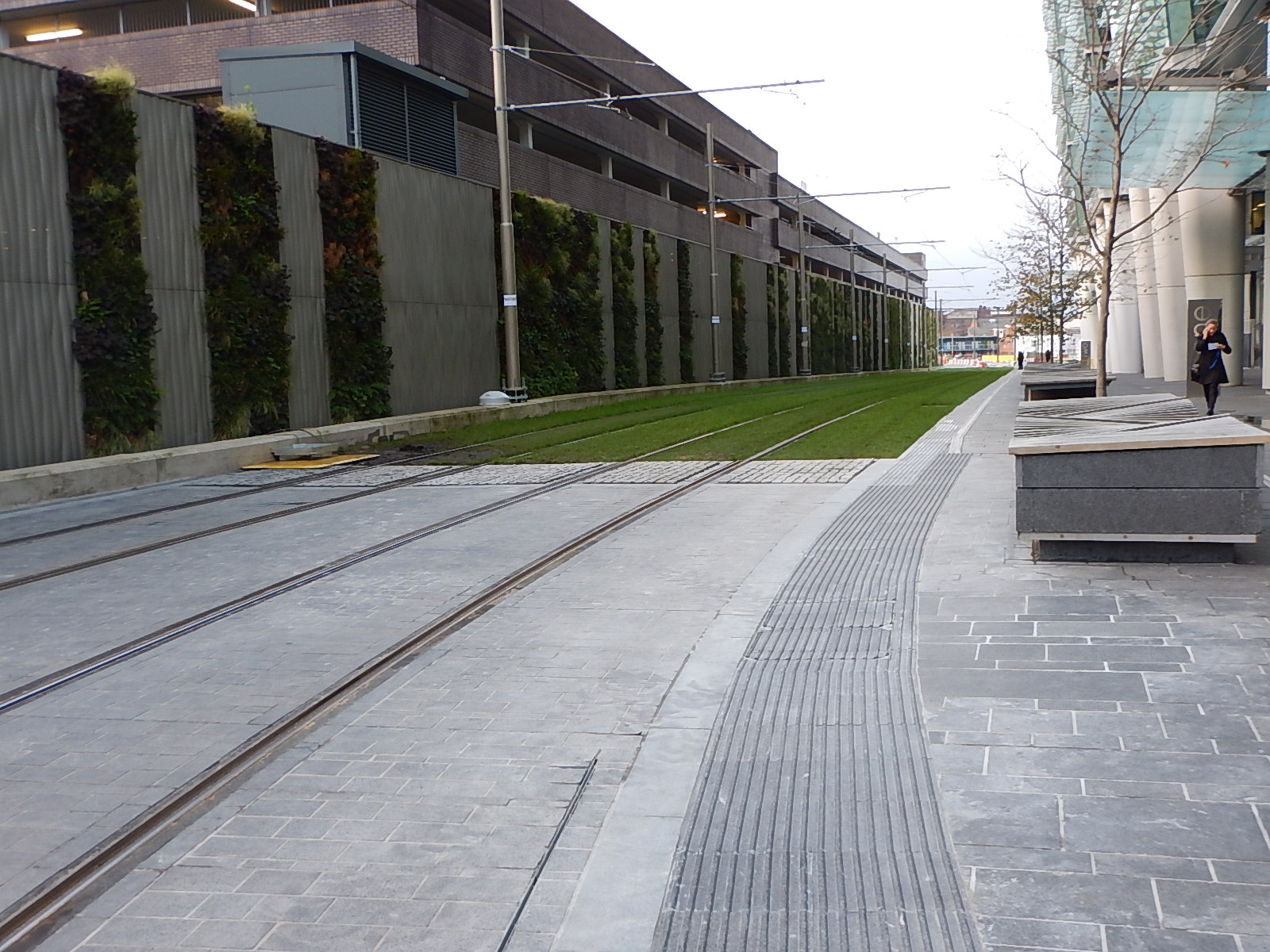
The picture shows some of the overhead wires in Birmingham, that are used by the Midland Metro’s Urbos 3 trams.
Tracks With A Downhill Gradient
These would not need to be electrified, as Newton’s friend gravity would do most of the work.
However, as batteries will be fitted, these can have three important functions on downhill stretches of track.
- Give the tram a nudge if needed.
- Restart the train after a stop at a station.
- Store any energy created by regenerative braking.
Note that we could have the unusual situation on a double-track section of line, where the uphill track was electrified and the downhill track was left without electrification.
Level Tracks
These would not need to be electrified, as battery power would be used to propel the train.
Selected Stations
Some stations could need to be electrified to ensure that the service was reliable. These might include terminal stations or those with tricky gradients on either side.
Tracks With 25 KVAC Electrification
Some of the tracks used by the trains on the Cardiff Valley Lines should be electrified with 25 KVAC, by the end of December 2018.
Class 399 tram-trains, that are used in Sheffield can use either 750 VDC and 25 KVAC overhead electrification.
it would probably be a good idea, if the new vehicles on the Cardiff Valley Lines could also use both voltages.
Automatic Pantographs
The pantographs on the vehicles would be raised and lowered automatically to access the electrification. This could even be GPS-controlled and able to be carried out at line speed.
Tram-Trains?
I very much feel, that tram-trains could be used to advantage.
- Some of the Valley Lines are also used by freight trains, so couldn’t be converted to trams-only.
- Tram-trains like the Class 399 tram-train, under test in Sheffield can work on both 750 VDC and 25 KVAC overhead wires.
- Tram-trains can use conventional railway signalling.
- Tram-trains could work on the South Wales Main Line to Newport.
- Modern tram-trains like the Class 399 tram-train have performance, that is about the same as a Class 142 train, which is a Pacer, that works the Cardiff Valley Lines, in large numbers.
- Tram-trains could run on the streets as trams, as they do in Sheffield.
Several manufacturers make tram-trains, which I believe could be suitablefor the Cardiff Valley Lines.
Stadler’s Class 399 Tram-Trains
Nothing is said about the vehicles, that would be used, but I think they need the following characteristics.
- Ability to climb the steepest section of the routes using 750 VDC overhead electrification.
- Ability to store energy.
- Regenerative braking to charge the batteries coming down the hills into Cardiff.
- A similar capacity to a Class 150 train, which is around 150 seats.
- It would be a bonus if they could use 25 KVAC overhead electrification, which will be available on part of some of the routes.
- Ability to raise and lower the pantograph quickly and automatically.
- Ability to run on the National Rail network.
- Ability to run on the street.
This specification is virtually the same as a Class 399 tram-train with the following additions.
- More seats and possibly an extra car.
- Batteries.
Class 399 tram-trains are a UK version of the Stadler Citylink tram-train. The German version is used in Karlsruhe to climb into the hills surrounding the city, on routes that are as challenging as the Cardiff Valley Lines.
So I have no worries about a version of the Class 399 train handling the Cardiff Valley Lines.
I certainly believe after my experience in Karlsruhe, and looking at other Citylink variants, that Stadler can come up with a tram-train for Cardiff based on the Class 399 tram-train.
And Then There’s CAF!
CAF have provided the Urbos 3 trams for Edinburgh Trams and the Midland Metro.
These are modern trams, that will be doing the following in a few years in the Midlands.
- Running on stored energy in the centre of Birmingham and to Wolverhampton station.
- Sharing the South Staffordshire Line with heavy freight on a new route to Merry Hill Shopping Centre.
This sounds like a tram-train with stored energy.
Wikipedia also lists a version of the Urbos family, called an Urbos TT, which is described like this.
The Urbos TT series is built with tram-train technology, connecting existing heavy rail infrastructure directly to urban tramway systems.
This document on the CAF web site, gives more details of Urbos variants, including the Urbos TT.
Looking at the modular nature of the design, you could have a custom-built tram-train tailored to the rail network.
But surely, the major factor with CAF, is that they have recently opened a factory at Newport.
If CAF get the order for the Cardiff Valley Lines, they could do a substantial part of the train building in a factory connected directly to the lines.
Converting The Valley Lines
I think that there are advantages and cost savings to be had, by good design in this area.
Could The Rail Vehicles Be Designed To Fit The Existing Platforms?
The first thing to do would be to design, build and fully test the rail vehicles.
Could the tram-trains be built, so that they fitted all the existing platforms?
- Class 150 trains are 2.82 metres wide.
- Urbos 3 trams on the Midland Metro are 2.65 wide.
If the tram-trains could run without platform modifications, this would be a big cost saving and still allow diesel units to use the lines, at the same time.
Testing The Trains
If the tram-trains were being given a 25 KVAC capability, they could even be tested on the quadruple-track the South Wales Main Line after the line is electrified through Newport.
Electrifying The Lines
It could be that the only sections of the valley lines that will need electrification, are the steep lines into the hills, as all other sections could use stored power or the 25 KVAC, where it exists.
- It would probably be possible to put up the simpler 750 VDC overhead lines during weekend and perhaps longer possessions.
- The electrification could be designed so that it doesn’t interfere with existing services.
- The lines would be converted one at a time.
- ,Note that tram-trains could share track and platform with the current diesel trains working the lines.
If CAF were to get the order surely the Ebbw Valley Line, which could be connected easily to the factory would be the first to be converted.
Conclusion
Obviously, the devil will be in the detail, but it does look like a viable plan will emerge.
I think that if CAF get the order, that they could be big winners.
The Cardiff Valley Lines could demonstrate the following.
- Running on main lines with 25 KVAC electrification.
- Running on 750 VDC electrification.
- Running on batteries.
- Running on lines with steep hills.
- Street running.
- Sharing tracks with freight trains and other passenger services.
- The tram-trains could also connect to Cardiff Airport.
It is a world-class demonstration and test track for innovative tram-trains, designed to cope with challenging rail networks.
With a factory close by at Newport, the selling of the tram-trains to other operators would be a salesman’s dream.
I think there’s more to CAF coming to Newport, than was apparent, when the deal for the factory was signed.
Auckland Rows Back On Battery Train Plan
The title of this post is the same as this article on the International ailway Journal.
This is said.
Following approval by Auckland Council, the proposal went to the New Zealand Transport Agency (NZTA) for final sign-off. However, in the run-up to New Zealand’s general election on September 23, a political consensus emerged in favour of bringing forward electrification of the Papakura – Pukekohe line, prompting the NZTA to reject the case for battery trains.
Can we assume the reason for the change of order is political?
Certainly, CAF, who are building the trains seem to have the required battery technology. This is also said.
CAF says the contract will include an option to equip the trains with battery packs at a later date if required.
I just wonder if battery trains are just too risky for politicians, who tend to be rather conservative and badly-informed about anything technological.
Japanese Trains With Batteries
If Bombardier in Derby and the Germans in Chemnitz (Karl Marx Stadt to Jeremy and the Corbedians) are addressing battery technology, you could be sure that the Japanese would have ideas and there is this article in Railway Gazette, which is entitled Emergency batteries for Tokyo Metro trains.
This is said.
Nippon Sharyo Series 1000 trainsets operating on Tokyo Metro’s Ginza Line have been fitted with Toshiba onboard emergency batteries so that they can reach the next station under their own power in the event of a traction supply failure.
Toshiba says the SCiB lithium-ion battery is well-suited to emergency use, being resistant to external shock, internal short circuits and thermal runaway. It recharges rapidly, has a long life and a high effective capacity over a wide range of environmental conditions.
The battery draws power from the third rail during normal operation, and can supply the traction system in the event of power outage or other emergency. It can also be used for train movements within depots.
I also said this in Bombardier’s Plug-and-Play Train,
I wouldn’t rule out that all Class 345 trains were fitted with some form of onboard energy storage.
The main reasons are all given in the article about Japanese trains.
Is The Battery Electric Multiple Unit (BEMU) A Big Innovation In Train Design?
By training I am an Electrical Engineer who specialised at Liverpool University and for a few years afterwards in the mathematics of the control of mechanical, electrical and other systems.
Over the last fifty years, I’ve liked to think of myself as scientifically green and in transport, I’ve come to the belief that we need to be as electric as possible, as this can produce a minimum of carbon dioxide and less noxious fumes and noise.
We may have produced a series of battery-electric vehicles for special purposes such as golf buggies, the electric milk floats of my childhood and light taxis and buses for historic city centres.
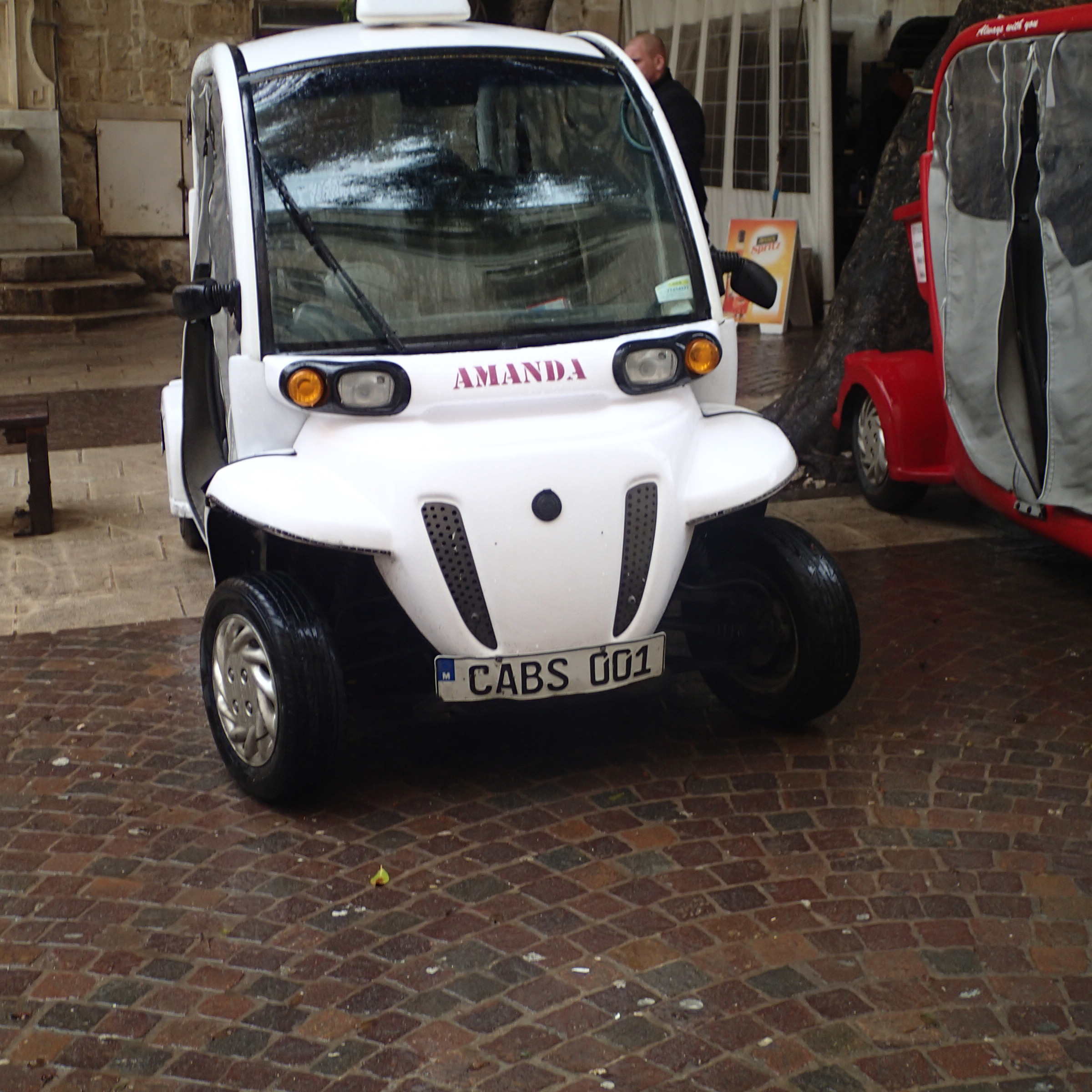
Electric Taxi In Malta
But where are the queues of stylish electric cars waiting for the charging points in my local car park in Dalston?
In my view, electric road vehicles with one or two rare exceptions, don’t really appeal to drivers, owners and users. You read reports that the economics are suspect without large subsidies. That’s as maybe, but having once owned a golf buggy, I can testify that battery life and performance wasn’t acceptable to the special needs on my farm.
So when Bombardier, Network Rail, Greater Anglia and others announced they were going to test a Class 379 4-carriage train as a battery-electric multiple unit (BEMU), I either thought they had more money than sense or there was something I’d missed.
Riding The BEMU
A desire to investigate found me on a cold morning in February boarding what looked to be a outwardly normal Class 379 train at Manningtree.

An Outwardly Normal Class 379 Train
The only visible difference was the Batteries Included sign on the side. Inside nothing appeared to have been changed
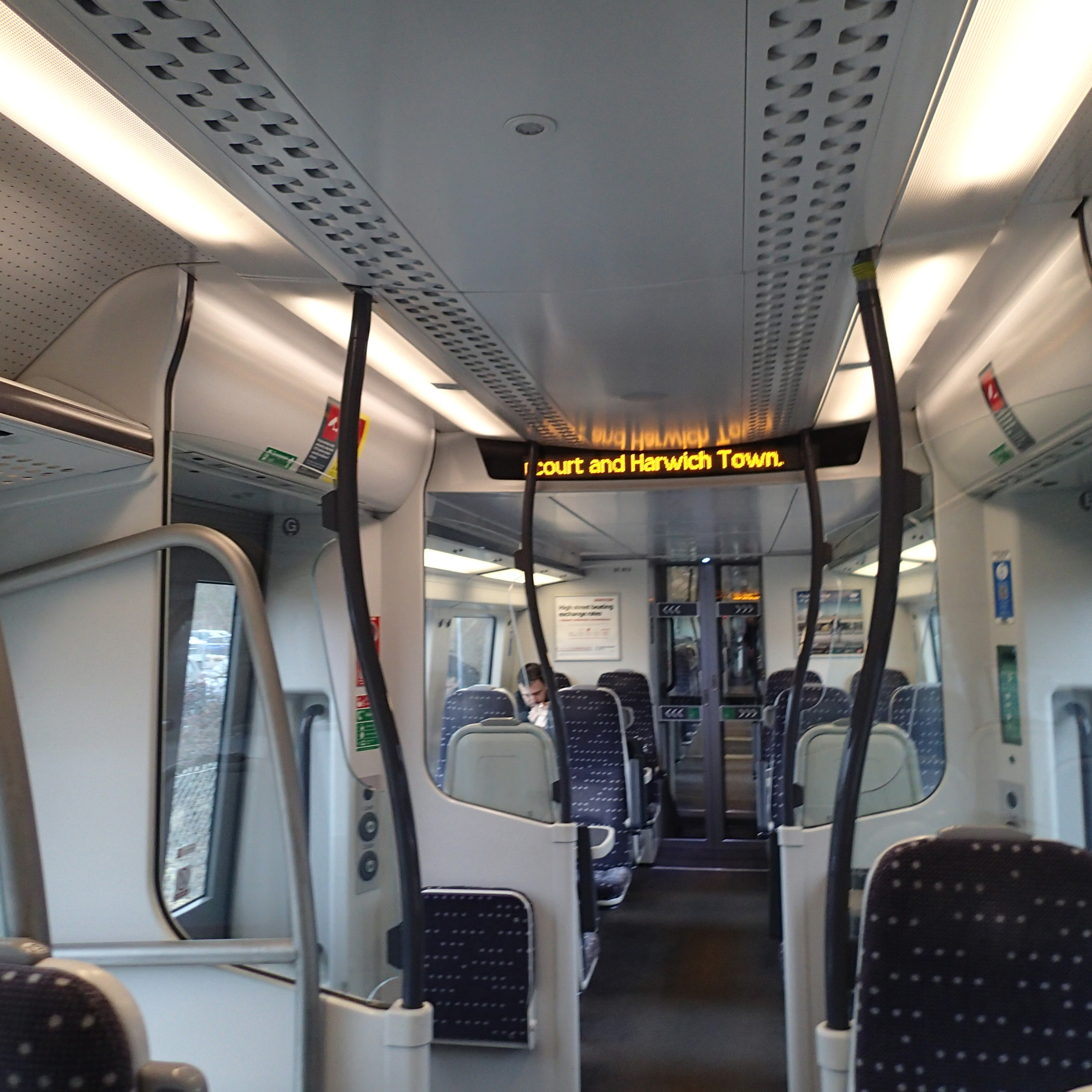
A Very Familiar Interior
Except for the destination display showing we were going the dozen miles to Harwich Town.
As we trundled away and breezed down and back up the Stour Estuary, I could detect no difference between the two runs and between train 379013 and its unmodified siblings, which I use regularly to Cambridge. The conductor assured me that they generally went one way under AC power from the catenary and the other on the batteries.
Returning from Harwich, I travelled with the train’s on-board test engineer, who was monitoring the train performance in battery mode on a laptop. He told me that acceleration in this mode was the same as a standard train, that the range was up to sixty miles and that only minimal instruction was needed to convert a driver familiar to the Class 379 to this battery variant.
It was an impressive demonstration, of how a full-size train could be run in normal service without connection to a power supply. I also suspect that the partners in the project must be very confident about the train and its technology to allow paying passengers to travel on their only test train.
It’s All About The Rolling Resistance
The physics of rolling resistance, explain why I was wrong to be sceptical and had now been so surprised and delighted by the Class 379 BEMU.
Most of us have driven a car with soft tyres and know that you need more power to maintain speed, as soft tyres have a higher rolling resistance.
Generally the rolling resistance of a steel wheel on a steel rail is lower, which helps trains move heavier loads for less power than road vehicles with rubber tyres.
But also if you read about the mathematics of rolling resistance, you will find that if you increase the load on a steel wheel running on a steel rail you lower the rolling resistance, so you can move the train for less power. This helps explain the impressive performance of the BEMU.
You have the paradox, that optimally-located heavy batteries, in a steel-wheel-on-rail vehicle, reduce the rolling resistance and mean it needs less power.
One of the most important rules of life is that you can’t disobey the laws of physics.
A Hybrid Train
In some ways to consider this train a battery electric multiple unit is wrong, as its nearest cousin is probably the hybrid bus, such as the New Routemaster in London. In the bus the battery is charged by a small diesel engine and final drive is all-electric.
In the rest of this article, I will continue to use BEMU, but hybrid electric multiple unit or HEMU might be better. It could be argued that the general public associate hybrid with something good, so there may be sensible public relations reasons for calling the trains HEMUs.
Using a BEMU
One of the main uses of a BEMU would be on a cross-country route that connects two electrified lines. The overcrowded Cambridge to Ipswich route would certainly be possible, as the gap between Haughley Junction and Cambridge is short of thirty miles and well within the capability of a BEMU.
Another use of a BEMU would be to extend an electrified route to an important town that needed a rail link bigger than can be provided by a two-coach diesel train of a certain age. London to Great Yarmouth via Norwich would be a typical route.
Branch lines off an electrified main line, such as the Felixstowe branch would be ideal for a BEMU.
The three East Anglian examples I have given could probably be served without spending a penny on infrastructure.
The Greater Anglia Involvement
Greater Anglia’s involvement in the project is significant as East Anglia has several routes suitable for a BEMU, in addition to those mentioned earlier.
The trains would also give the company the ability to extend some of the Liverpool Street to Cambridge services to perhaps Norwich, Newmarket and Bury St. Edmunds.
Some gaps like Ely to Norwich, might be stretching the range, but the trains could give the soon-to-be-two Cambridge stations much better access to a wider East Anglia from Peterborough and Wisbech in the West, Norwich and Cromer in the North and Yarmouth and Ipswich in the East.
East Anglia seems to suffer more than most from track and overhead wire problems and rebuilding. A BEMU would make a superb blockade buster and could even have been used to get passengers to Peterborough, when all the problems happened on the East Coast Main Line at Christmas, by jumping the gap from Ely.
The rail network in East Anglia also suffers from periodic overcrowding, especially in the summer, so extra carriages on many services would be welcome to Greater Anglia and users alike.
East Anglia for so long a rail backwater would love these trains.
Advantages To Network Rail
Network Rail is an infrastructure company so why is it getting involved in the design of trains?
Network Rail has some problems with electrification due to well-publicised issues and in some cases the large quantity, they are being tasked to install, which puts pressure on manpower and resources.
In some sensitive areas, there may be planning issues with putting up the overhead wires. A simple example in Suffolk illustrates the value of a BEMU. It is unlikely the Gainsborough Line will ever be electrified, as it runs through the Stour Valley and the Nimbys would have a field day if Network Rail decided to put overhead line gantries on the iconic listed Chappel Viaduct, which is the second largest brick structure in England. But as the line is only a dozen miles long, running a BEMU on the line would be a sensible idea.
There are probably a lot of places where using a BEMU, rather than electrifying saves Network Rail a lot of installation costs and lawyers fees. Passengers would get a brand new and probably larger electric train, from the day they can be delivered and after the train crew has been trained.
Electrification of passenger services is a proven revenue generator, but predicting how much electrification will increase traffic, is one of the blackest of black arts. The difficulty is illustrated by the North and East London Lines, which were built to run the three-car trains that were thought to be required for the level of traffic. London Overground is now going through the second train lengthening process to cope, which is also requiring various infrastructure changes. If London can’t get this right with their massive journey databases, how can you predict traffic on a branch line in say Dorset or Norfolk? A shiny modern BEMU could be a valuable tool for assessing the increase in traffic, by trialling one for a period to ascertain what needs to be done to improve a service. The solution could be anything from bringing back the terrible diesel multiple unit, through using a BEMU on the line to full electrification.
I think it is true to say, that Network Rail could probably cut the cost of electrification and line improvements, by better planning of the work.
There are also innumerable lines in the United Kingdom, where the distance is less than sixty or seventy miles and both ends of the line are electrified, which are possibilities for running BEMUs.
- Hurst Green to Lewes via Uckfield and the Marshlink Line in Sussex
- The Tyne Valley Line between Newcastle and Carlisle
- Many lines that link to electrified hubs like Liverpool, Manchester, Birmingham and Leeds.
- Lines in Scotland that link to the current electrification. This could include the new Borders Railway which is only thirty miles long.
- Any branch from an electrified main line.
Unfortunately for everybody concerned, the hundred miles between Salisbury and Exeter is probably just too far to run on batteries at present. But this could be possible in a few years, as the technology develops.
Many routes with minimal partial electrification could accept a BEMU tomorrow, which could be a more affordable alternative to full electrification.
- Full electrification often needs a lot of bridge and tunnel reconstruction to give sufficient clearance to the wires. With a BEMU, this is unnecessary.
- Deployment of BEMUs, could also release much-needed modern diesel trains for use on lines away from electrification.
I would argue it’s better to spend the money on rolling stock, rather than use it to enlarge bridges and tunnels.
The Biggest Advantage To Rail Companies And Users
The biggest advantage of the technology is a truly unusual one, which is akin to putting the cart before the horse.
It’s that the new BEMUs start to run as soon as they are delivered and even before the electrification is complete.
Suppose you are possibly going to electrify a line like Carlisle to Newcastle, where both ends are already wired.
Traditionally, you can’t run any electric trains, until the electrification is complete.
But if you used BEMUs to operate the line, you can actually deliver the trains and bring in the new service pattern before you electrify using the power at both ends to charge the batteries.
After electrification, you might replace the BEMUs with a non-battery sibling and move the BEMUs to another line to repeat the process.
So the passengers benefit earlier from new trains. The train company should also benefit, as hopefully all the publicity of better and possibly longer trains generates extra journeys.
Instead of the speed of the electrification works governing the pace of line modernisation, the limiting factor is how fast trains can be built and any necessary much smaller infrastructure improvements like platform extensions are completed.
A Possible Production BEMU
The partners in this project seem to have come up with some fairly tight performance objectives for the train.
- A sixty plus mile range. This seems to bridge a lot of network electrification gaps and the length of out and return on the average branch line – Achieved
- Performance similar to the standard Class 379 and enough to work the average secondary or branch line – Achieved.
- No change of passenger experience to a standard Class 379 – Achieved
- Identical Driving Characteristics to a standard Class 379 – Achieved
- An overall experience better than a Pacer or a Sprinter – Achieved by a wide margin. I’ve also ridden modern Class 171 and Class 172 diesel multiple units lately and the Class 379 BEMU was certainly better in terms of ambient noise.
Bombardier could just create a Class 379 BEMU, but I suspect that the upcoming Aventra train chosen for Crossrail would be used. After all, why would you use a boring old train, when you could have a sexy new one? Especially one that is lighter and more energy efficient. You could even borrow the use of a small on-board engine to charge the battery from the bus industry.
Probably the most difficult decision in the design is the train length, but why not make them all identical go-anywhere four carriage dual-voltage trains?
Incidentally, that go-anywhere capability will be enhanced when ERTMS becomes standard for all trains.
How Would BEMUs Affect Various Schemes?
The next few sections will look at various proposed schemes and how BEMUs might affect them.
The Felixstowe Branch
I’ve used the Felixstowe branch for over fifty years and the individual train capacity is now smaller than it was in the 1960s. But the frequency has improved and the service has got better since the Bacon Factory Chord was created.
It carries upwards of thirty freight trains each way every day and has long been mooted for electrification. Unless the complete route from
Felixstowe to Nuneaton and inside Felixstowe Port were also electrified, electrification of the branch line is probably a waste of time, as there would need to be a change of locomotive at some point.
I sometimes wonder if you want to have overhead wiring in a port or goods yard, with cranes lifting containers all the time.
I believe that the Class 88 locomotive is a better solution, as this would give electric haulage on electrified lines like the Great Eastern Main Line and diesel haulage on the branch and in the port.
Passengers on the line would like better and larger trains and this could be solved by a BEMU charging every time it returned to the Ipswich end of the branch.
Ipswich To Cambridge And Lowestoft
If you are going to run a BEMU from Ipswich to Felixstowe, then surely it would be a good idea to run the trains on the services from Ipswich to Cambridge and Lowestoft.
The gap between the overhead wires at Cambridge and Haughley Junction is less than thirty miles and would easily be jumped by a BEMU, charging itself at the two ends of the line.
Ipswich to Lowestoft is fifty miles which would certainly be too far for a BEMU going out and back on one filling of electricity at Ipswich. But as I believe a BEMU should be dual voltage, why not put in a shielded length of third-rail away from the platform side of the train in Lowestoft station. This picture shows the platform layout at Lowestoft with the current Norwich and Ipswich Class 156 trains in the platforms.
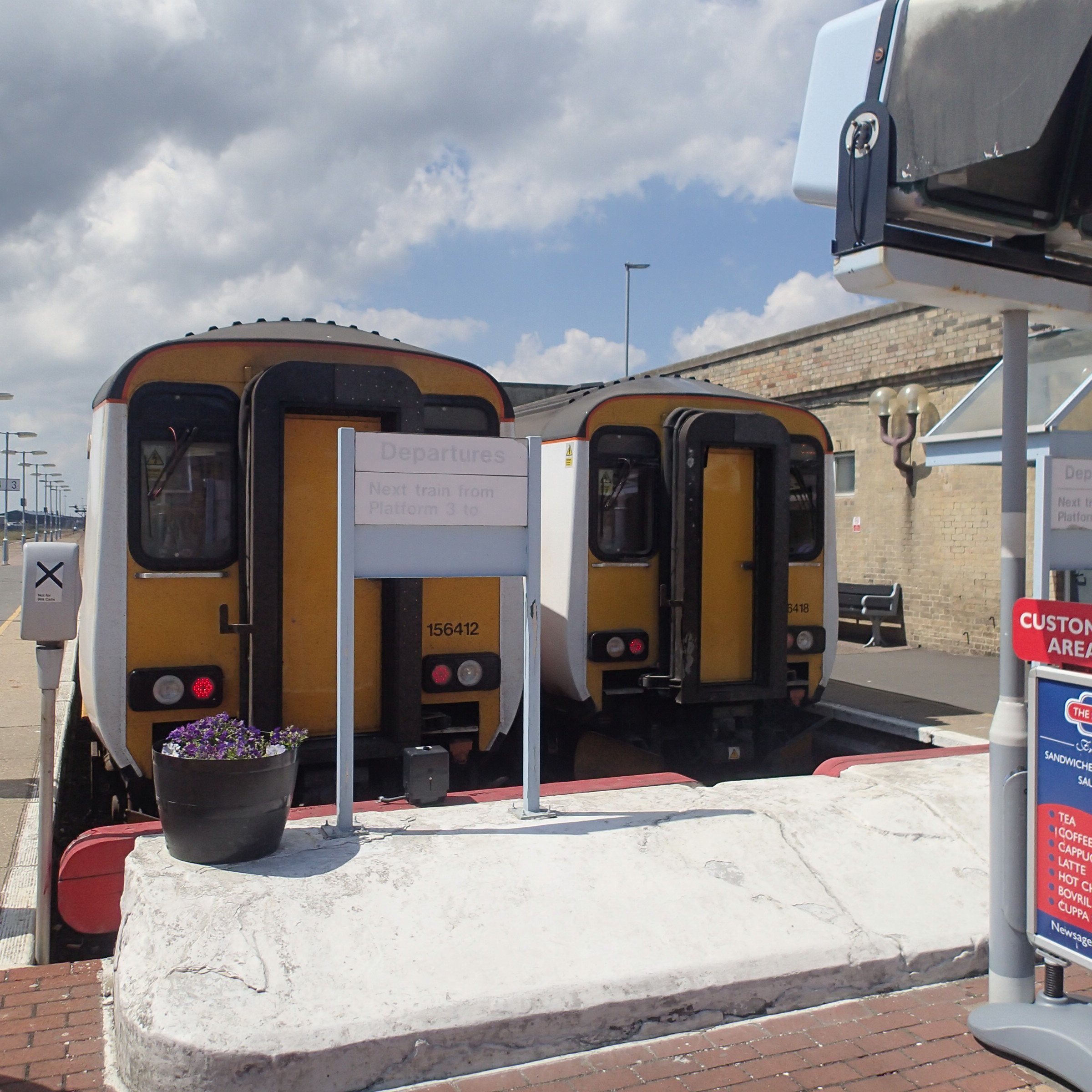
Surely, Network Rail’s engineers can come up with a third-rail system in the station for charging BEMUs, that meets the most draconian Health and Safety regulations.
If BEMUs were to also run the Norwich to Lowestoft services, then you’d have electrified the passenger services to the United Kingdom’s most easterly town.
What would a picture of two Aventra BEMU profiles in Lowestoft station, do for the town?
Completing The East Anglian Electrification Of Passenger Services
If some means of range extending like a third-rail-based charger in some terminal stations, then there is no reason that all unelectrified lines in East Anglia could be run successfully by BEMUs. These would include.
- Cambridge and Ely to Norwich on the Breckland Line
- Norwich to Yarmouth on the Wherry Lines
- Norwich to Cromer and Sheringham on the Bittern Line
- Marks Tey to Sudbury on the Gainsborough Line
The BEMUs would also be an ideal train for the proposed re-opening of Bramley Line between Wisbech and March and the possible creation of the Norfolk Orbital Railway from Sheringham to Wymondham.
Completing The Electrification In East Sussex
East Sussex Council has produced a document called Shaping Rail In East Sussex, and also proposes the electrification of the Marshlink Line and improving and fully electrifying the Wealden Line and Oxted Line.
I believe that BEMUs could be the key to completing the electrification of this important commuter area and releasing sixteen Class 171 diesel multiple units for areas with no electrification at all.
As BEMUs would effectively be a one-for-one replacement for the Class 171 and no infrastructure work would be needed except for the track work at Lewes, as the new trains were delivered, a Class 171 could be released to go and replace a Pacer or Sprinter.
The Borders Railway
I suspect that various Scots and their politicians will be a bit miffed, that a beautiful new railway will be running second-hand trains. I suspect that something like Class 171 or Class 172 will be used, but wouldn’t it be nice if four-coach electric trains were to be used on the route.
As the route is not being electrified, but power is available at the Edinburgh end and the line is only sixty miles out and back, the line would be an ideal candidate for equipping with sexy new BEMUs.
The only problem is that the Scots have just signed a deal with Hitachi to deliver a whole stable of new AT200 electric trains.
However, it should be noted that Abellio Greater Anglia is one of the partners in the testing of the experimental Class 379 BEMU and that Abellio ScotRail is the new Scottish franchise holder.
Incidentally, Abellio’s parent; Nederlandse Spoorwegen still have sa few diesel multiple units, so perhaps they have other motives in being involved with the BEMU.
Glasgow Crossrail And The Airport Rail Link
Glasgow Crossrail is a proposal to improve rail services in Glasgow described like this in Wikipedia.
The proposed Crossrail initiative involves electrifying and reopening the City Union Line for regular passenger use in conjunction with new filler sections of track which will connect the North Clyde, Ayrshire, and Kilmarnock and East Kilbride suburban routes together, therefore allowing through running of services through the centre of Glasgow in a North-South axis.
It has been an on-and-off project over the years, as has the closely-related Glasgow Airport Rail Link.
Perhaps by selectively using BEMUs on the City Union Line, some of the major problems of rail transport in Scotland’s largest city can be alleviated, until the budget allows full electrification across the city.
Replacing Pacers Out Of Electrified Hubs
I asked in the title of this post if a new battery electric multiple unit (BEMU) could be a replacement for the truly-dreadful Pacers.
On some routes out of Liverpool, Manchester, Leeds and other electrified hubs, Pacers perform out and back services, which could probably be replaced by a BEMU.
As electrification progresses more and more, Pacers will find that they operate more of their routes partially under the wires. All of these routes will become candidates for BEMUs.
As the new trains will elsewhere displace some modern diesel multiple units, these could also probably chase a few Pacers to the scrapyard.
So in my view, new BEMUs may not always directly replace the Pacers, but they will certainly hasten their demise.
Should The Gospel Oak To Barking Line Be Electrified?
I know that freight is an important driver of electrification of the Gospel Oak to Barking Line, but how would the availability of a number of BEMUs affect how the work will proceed?
The Gospel Oak to Barking Line is being electrified at a cost of £115million. In addition eight new four carriage trains are being ordered for the line.
Electrification of the line is said to be difficult, as there are numerous bridges and viaducts.
But the line is also desperately short of capacity for passengers and desperately needs the new electric trains.
As the line is partly electrified, why not drop the full electrification for a few years and buy eight new BEMUs?
They would pick up power east of Woodgrange Park station and around South Tottenham, leaving only about twenty miles to run on the batteries.
If the batteries need a top up at Gospel Oak, why not put in a short length of overhead wire at the western end of the line. Or heresy of heresies, a short length of third rail!
As circumstances and funds allowed the rest of the line would be electrified.
All of the flexibility in the schedule would be down to the unique characteristics of the BEMU.
Some residents along the line might be annoyed by the continuing noise and smell of the diesel freight locomotives passing through if the line remains without full electrification, but passengers will get twice as many carriages as at present, in brand new electric trains. Passengers won’t care that they’re powered by batteries, so long as they are reliable, comfortable and punctual
Conclusion
Who’d have thought that such a rather unusual concept of a battery electric multiple unit would have so many possibilities?
I think I’ve seen the future and it just might work!
 The Anonymous Widower