Waterbeach Station To Be Relocated
The title of this post, is the same as that of this article on Railway Gazette.
These three paragraphs, outline the project.
Cambridgeshire County Council has called tenders for an estimated £35m design and build contract for the relocation of Waterbeach station to a new site further to the north.
This would support the Waterbeach New Town development of 4 500 homes. Opening is now envisaged for 2026.
The replacement station would have two platforms, an accessible footbridge, a 200-space car park, taxi and bus drop-off, cycle storage and a new access road from Cody Road. The 24-month scheme would include the demolition of the existing station.
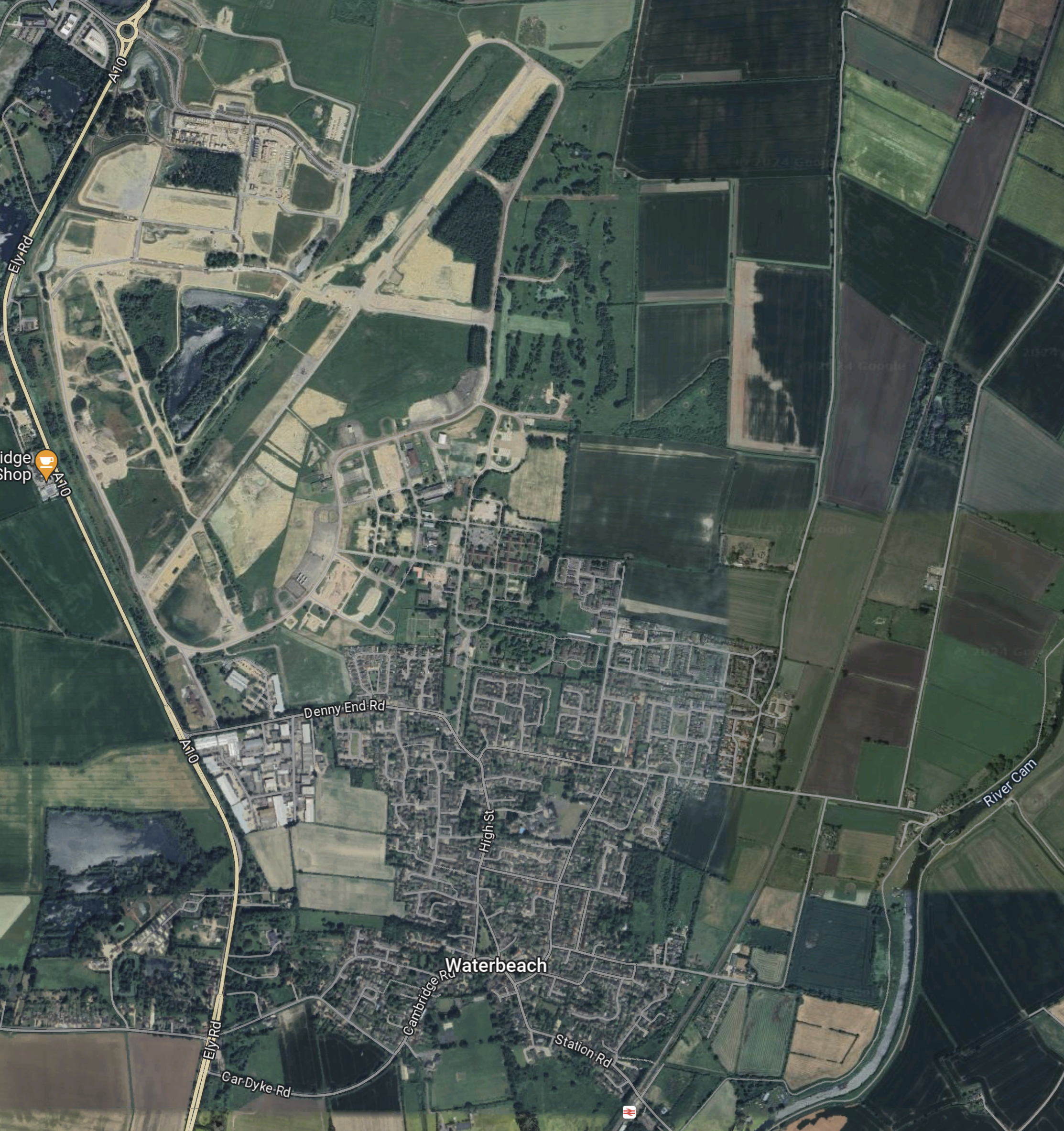
This Google Map shows the current station and the location of Waterbeach New Town.
Note.
Waterbeach station is at the bottom of the map, just to the right of centre.
- The station is on the Breckland Line between Cambridge and Norwich via Ely.
- The Breckland Line continues North-East to the North-East corner of the map.
- The village of Waterbeach is to the North of the station.
- North of Waterbeach is the old Waterbeach Airfield, which will be covered in the housing of the New Town.
Moving the station nearer the New Town would seem to be a sensible action.
I have some further thoughts.
The Remodelling Of Ely
Ely station is a railway bottleneck and in Are The Trains In Ely Finally To Be Sorted?, I discussed what needed to be done.
Would it help, if Waterbeach station were to be rebuilt first?
A Cambridge Metro
Once Waterbeach station has been rebuilt and Cambridge South station has been built, there will be a run of stations through Cambridge.
- Ely
- Waterbeach
- Cambridge North
- Cambridge
- Cambridge South
Perhaps, extra trains could be added to create a frequent rail route across Cambridge.
East West Railway
Will the trains of the East West Railway stop at Waterbeach station?
Conclusion
Waterbeach could be a very useful and busy station.
Appliance Of Science To Boost Stevenage
The title of this post, is the same as that of this article in The Times.
These two paragraphs introduce the article.
Planning permission has been granted for a former TK Maxx outlet and two other stores in the middle of Stevenage to be knocked down and replaced with laboratories.
The £500 million development, funded by UBS Asset Management and designed by Reef Group, is the latest example of how Britain’s town centres can be adapted and brought up to date.
Note.
- We have a laboratory shortage in the UK, which is especially serious in Oxford and Cambridge.
- Canary Wharf is also turning offices into laboratory space.
- There was even an article in The Times yesterday about converting offices to laboratories in Harley Street.
It’s probably a sign of success!
If Stevenage is to become a worldwide centre for life sciences and medical research, it probably needs the town’s excellent rail links to London and Cambridge to be further improved.
- LNER runs two fast trains per hour (tph) to and from London King’s Cross.
- Other fast services call during the day.
- Local services include two tph to Cambridge, London and Peterborough.
Services need to be improved, especially to and from Cambridge.
ERTMS Is Being Installed Through Stevenage
Installation of full digital signalling on the East Coast Main Line could have various effects.
- LNER and other fast services could be faster to places like Doncaster, Leeds and York.
- Fast Cambridge, Ely and King’s Lynn services would have to be run by 125 mph trains to keep out of the way of the expresses.
- 125 mph services to Cambridge would reduce journey times by a few minutes and might allow the Cambridge Cruisers to sneak in a stop at Stevenage, whilst maintaining the current times.
- Will the Thameslink Class 700 trains have to stick to the slow lines?
- As the Hertford Loop Line will also be digitally signalled, it might be possible to divert some trains via Hertford North.
There will be a lot of hard thinking going on to find out the best way to run services on the Southern section of the East Coast Main Line.
High Speed Norfolk
I like the concept of running high speed trains to Ely, Norwich and Kings Lynn.
- It would open up a lot of West Norfolk for laboratory space and commuter towns for Cambridge.
- The Breckland line between Ely and Norwich would be improved for higher speeds. It could even become a 125 mph line.
- High Speed Norfolk trains would have a frequency of two tph and call at Stevenage, Cambridge South, Cambridge, Cambridge North and Ely before alternatively going on to Norwich and King’s Lynn.
- Cambridge and Norwich services would alternate with the Norwich and Stansted Airport service.
Norwich could be the overspill city that Cambridge needs.
Plans For Brandon Rail Station Upgrade Deemed Lawful By Local Council
The title of this post, is the same as that of this article on Rail Advent.
This is the introductory paragraph.
Train operator Greater Anglia has been allowed to press ahead with plans to complete £1m of improvements at Brandon railway station.
Work at Brandon station will include.
- Demolishing of redundant buildings, that are not in the best of condition.
- Install new shelters, LED lights, CCTV cameras and better drainage.
- Increase car parking spaces from six to a hundred.
- It looks like accessible car parking will be provided.
- Provide a new bat roost.
The overall cost will be a million pounds.
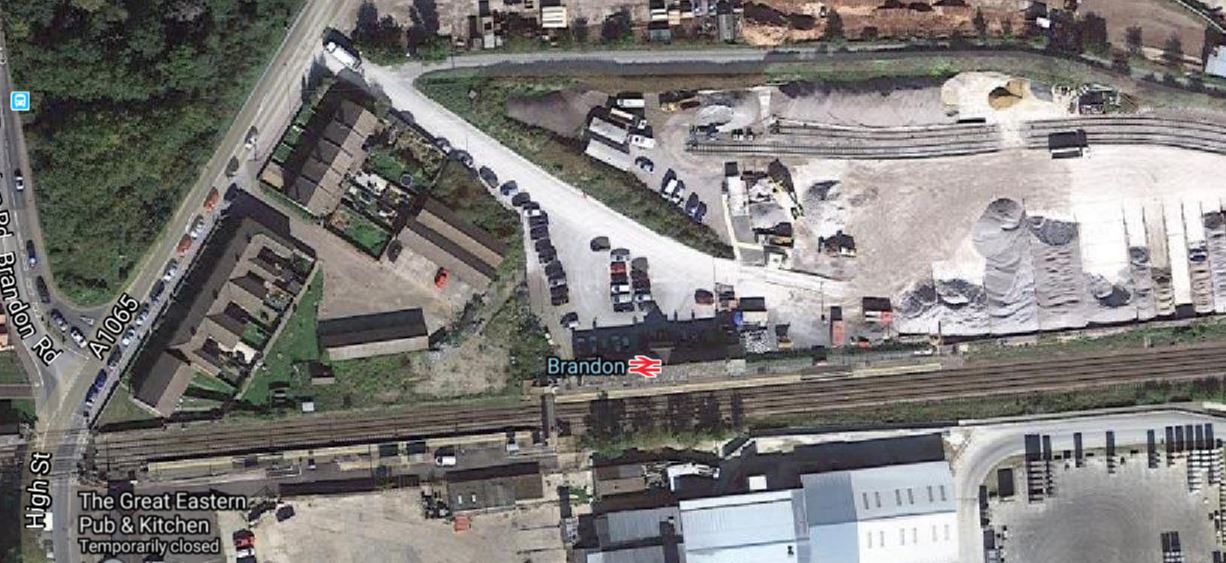
This Google Map shows the station.
Note.
- Cambridge and Ely is to the West and Norwich is to the East.
- The queues at the level crossing at the Western end of the station.
- I seem to remember, that it’s a Council Depot on the North side of the tracks.
At some time in the future the station will need a step-free footbridge.
Greater Anglia’s Norwich And Stansted Service
This is the main passenger service at Brandon station.
- Trains are four-car Class 755 trains.
- The service is hourly.
- Trains take about thirty minutes between Brandon and Cambridge stations.
- Trains take about an hour between Brandon and Stansted Airport stations.
- Trains take forty-five minutes between Brandon and Norwich stations.
Will there be enough car parking spaces?
Could Brandon Station Ever Have A Half-Hourly Service?
If there’s one city that will dominate the economy of East Anglia, it is Cambridge and its need for premises and housing for workers, will mean that there will be increasing numbers of passengers using the trains into Cambridge.
So I wouldn’t be surprised to see a half-hourly service between Norwich and Cambridge.
Could We See More Brandon Stations?
As I travel round the country, I’ve visited several stations like Brandon. Many could be improved by a radical restructuring or a comprehensive refurbishing.
Comparing Ride And Perceived Performance In Class 170 And Class 755 trains
I had intended to go to Norwich and Sheringham today, to take some pictures of Class 755 trains at Sheringham station.
Unfortunately, when I got to Norwich, the Sheringham train was a Class 170 train, so as I was running late, I came back.
But as I had travelled to Norwich in a twenty-year-old Class 170 train and returned in a brand-new Class 755 train, I was able to compare their ride and passenger performance on the well-maintained and straight Breckland Line.
The Class 170 train has a good ride and I’ve never felt to complain, even when travelling at 100 mph on some CrossCountry and Greater Anglia routes.
But I did feel that the Class 755 train had a smoother ride.
I did time the 755 at 90 mph on parts of the route, but at most times it was doing a motr sedate 75 mph.
Could it be that twenty years has enabled train dynamics to have been improved using computer simulation?
Intriguingly, the three-car Class 170 train is twenty percent heavier and has half the power of the four-car Class 755 train, which probably results in more sprightly acceleration for the new train.
Could this acceleration mean that the trains will be faster on a route with lots of stops?
Greater Anglia’s Norwich And Stansted Airport Service Starts On December 15th 2019
The annual December timetable change on December 15th 2019, will see Greater Anglia bringing in their new service between Norwich and Stansted Airport stations start as an hourly service.
The Route
Between Norwich and Ely stations, the route is on the Breckland Line.
- It is not electrified, except for a short section at the Norwich end.
- It is a full double-track, except for the single-track Trowse Bridge, that it shares with the Great Eastern Main Line on the approach to Norwich.
- The operating speed is between 75-90 mph.
- There are intermediate stations at Shippea Hill, Lakenheath, Brandon, Thetford, Attleborough, Spooner Row and Wymondham.
There is potential to increase the line speed, perhaps add some extra stations and remove the antiquated Trowse Bridge.
South from Ely through Cambridge to Stansted Airport, the route is a busy, fully-electrified double-track line.
The New Timetable
The Sunday journeys are as follows
- Journey time appears to be a couple of minutes over two hours both ways.
- Most services seem to leave Stansted at XX:09
- First Northbound train is 08:18
- Last Northbound train is 21:11
- Most services seem to leave Norwich at XX:03
- First Southbound train is 09:03
- Last Southbound train is 20:03
- Calling points appear to be Audley End, Wittlesford Parkway, Cambridge, Cambridge North, Ely, Brandon, Thetford, Attleborough and Wymondham.
Weekday services appear to be more-or-less similar.
- Northbound services take around 6-9 minutes less than two hours.
- Most services seem to leave Stansted at XX:48
- First Northbound train is 05:27
- Last Northbound train is 21:11
- Southbound services take around 3-9 minutes less than two hours.
- Most services seem to leave Norwich at XX:27 or XX:33
- First Southbound train is 08:33
- Last Southbound train is 19:27
- Calling points are the same.
My Observations follow.
Convenience And Capacity
It is currently actually quicker by a few minutes to use the following services.
- East Midland Railway’s service between Norwich and Ely
- CrossCountry’s service between Ely and Stansted Airport.
These two trains can be very overcrowded at times and the new four-car Class 755 trains are much better and have more capacity, than the other services, which are often just two-car Class 158 or Class 170 trains.
Two Trains Per Hour Between Norwich And Stansted Airport
It also appears that the service with the single change at Ely will still be possible after the timetable change.
Thjis means that Norwich and Stansted Airport will have a two trains per hour (tph) service.
Train Timings
It would appear that the times between Cambridge and Norwich are very similar before and after the timetable change.
So it doesn’t appear that Greater Anglia are taking advantage of the superior performance of the new Class 755 trains.
How Many Trains Will Greater Anglia Need For The Norwich And Stansted Airport Service?
The current service between Norwich and Cambridge stations has a three hour round trip, so three trains are needed to provide the hourly service.
It looks like the Norwich and Stansted Airport service has a four hour round trip, so four trains will be needed to provide the hourly service.
Extending the Norwich and Cambridge service to Stansted Airport needs just one extra train.
How many extra passengers will Greater Anglia attract?
Whittlesford Parkway Gets An Extra Hourly Service To And From Cambridge
The extended hourly service between Norwich and Stansted Airport will call at Whittlesford Parkway station, which will increase the frequency on the busy commuter route between the Parkway station and Cambridge City Centre.
When we lived near Newmarket and C was practising as a barrister, she would sometimes go to Norwich up to tyree times a week. I wouldn’t be surprised to find that travellers between Whittlesford Parkway and Norwich stations are rather more numerous than the forecast.
- The train will take about ninety minutes and driving about seventy-five.
- The Class 755 trains have wi-fi.
- There is a lot of parking at Whittlesford Parkway station.
- Will Greater Anglia put a snack trolley on the train?
C would have certainly used the service, as Whittleford Parkway station was around fifteen minutes from where we lived.
What Will Greater Anglia Do With Lakenheath And Shippea Hill Stations?
These two stations are By Request and only get a few services a week.
Consider.
- The modern Class 755 trains with their high performance and short dwell times could probably selectively stop at these stations without degrading the train timings.
- Cambridge needs satellite development to provide housing and commercial development.
- The future of RAF Mildenhall is uncertain and it could be sold for housing.
- It could be argued that Cambridge needs a new Park-and-Ride station to the North to take the pressure off Ely station.
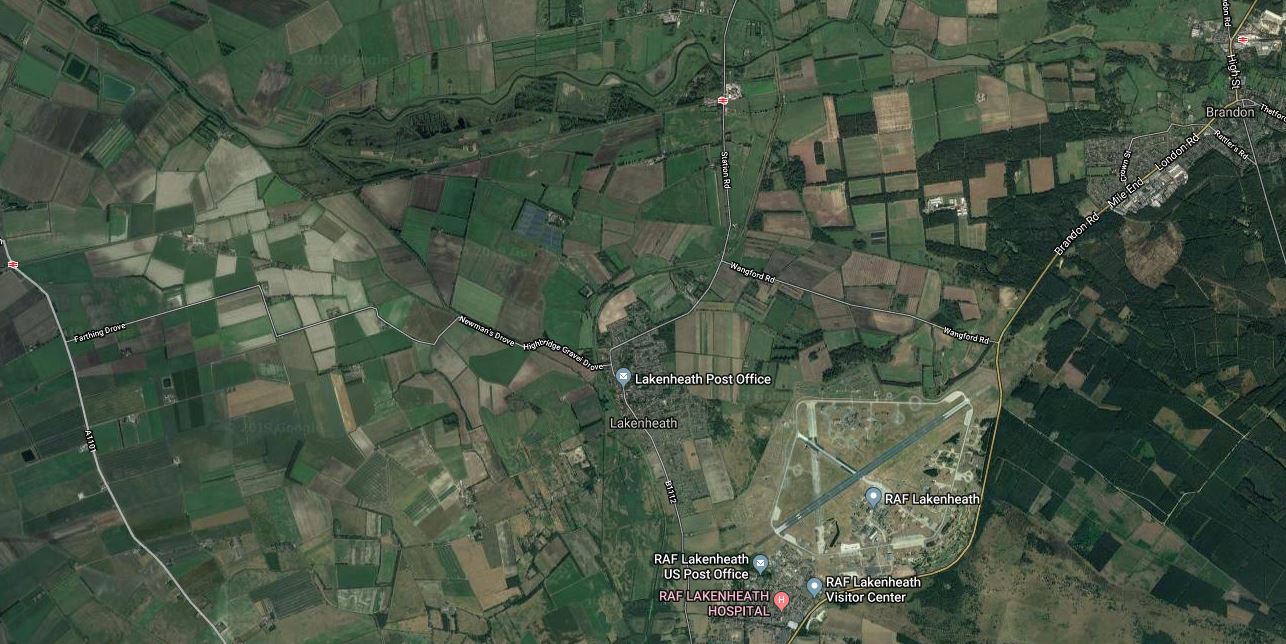
This Google Map shows RAF Lakenheath and the Breckland Line running Easy-West between Ely and Norwich.
Note.
- RAF Mildenhall is to the South-West of RAF Lakenheath.
- The railway going across the North side of the map through Shippea Hill, Lakenheath and Brandon stations.
- Most of the land is aricultural and very flat.
I wouldn’t be surprised to see substantial development of the railway through the area in the next ten or twenty years.
What Will Greater Anglia Do With Spooner Row Station?
Spooner Row station is another By Request station on the Breckland Line bertween Attleborough and Wymondham stations..
Spooner Row is not a busy station, although as this Google Map shows it is just off the main A11 road.
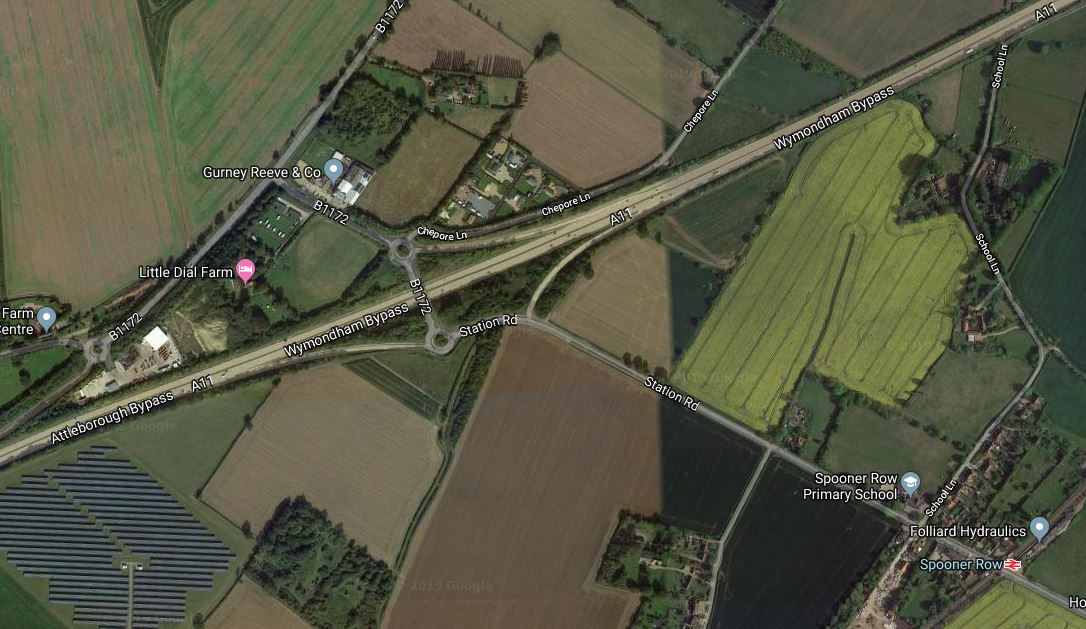
Noyr that Spooner Row station is in the South-East corner of the map.
Perhaps with more services and some increased car parking, it might pick up commuters and shoppers for Cambridge and Norwich it might become a convenient station for local residents travelling to and from Stansted Airport.
Could There Be A Norwich And Dereham Service?
Greater Anglia seems to be working closely with the Mid Norfolk Railway, which runs between Wymondham station on the Breckland Line to the town of Dereham.
- In Aerial Pictures Show New Trains Housed In Mid-Norfolk, I showed how the heritage railway was storing trains for Greater Anglia.
- According to Wikipedia, it would appear that several million pounds were spent to i8mprove the railway and its signalling, so that Greater Anglia’s new trains could be safely stored.
- The line is mainly single track and signalled for an hourly service.
- The yard at Dereham station seems to be regularly used for freight purposes, including loading damaged rolling stock on to road vehicles. It is also used by Network Rail for storage of track plant.
- Train operating companies and heritage railways are increasingly working together for their mutual benefit.
As an InterCity 125 trains has recently been beyond Dereham, I wouldn’t rule out Greater Anglia running a new service between Norwich and Dereham, with a future aim of extension to Fakenham.
Because of the limitations of the track, it could probably only be a limited service.
Can Capacity Be Increased If Needed?
Having lived near Cambridge for nearly thirty years of my life, I believe that there will come a time, when one four-car train between Norwich and Stansted Airport will not be enough.
- Two tph could be run on the route, which is relatively lightly used by other services.
- Longer trains could be created or two three-car trains could be run as a six-car train.
- The current speed limit of 75-90 mph of the Breckland Line, can probably be increased closer to the 100 mph of the Great Eastern Main Line.
Higher speeds would shorten journey times and increase capacity.
Could We See 125 mph Trains From Kings Cross To Kings Lynn And Norwich?
In Call For ETCS On King’s Lynn Route, I talked about putting digital signalling on the Kings Cross and Kings Lynn route and running 125 mph trains via Cambridge.
If the Kings Cross and Kings Lynn route were to be upgraded for faster running, this would also upgrade the proposed Kings Cross and Norwich route as far as Ely.
This would make it very feasible to run the following serrvices using 125 mph trains like Class 800 trains.
- Kings Cross and Kings Lynn
- Kings Cross and Norwich
Because of their speed these trains would help to open up capacity between Hitchin and Kings Cross.
I feel that these 125 mph bi-mode trains could do the trip between Kings Cross and Norwich in ninety minutes, which would match the time via Ipswich.
Do I Have Any Criticism?
My main criticism is that the service between Norwich and Stansted Airport, doesn’t have trains that run early and late enough.
Wil lthe service be timed to better fit the services out of the Airport?
Further Development Of The Breckland Line
This report in the Ely Standard from 2015, is entitled Could Railway Revolution See New Station Built at Ely North?.
These improvements are listed.
- A new four-platform station North of Ely would improve connectivity.
- A service between Kings Cross and Norwich via Cambridge is suggested.
- Improvements in services across East Anglia.
A cost of a billion pounds is mentioned.
125 mph Trains From Kings Cross To Kings Lynn And Norwich
In Call For ETCS On King’s Lynn Route, I talked about putting digital signalling on the Kings Cross and Kings Lynn route and running 125 mph trains via Cambridge.
If the Kings Cross and Kings Lynn route were to be upgraded for faster running, this would also upgrade the proposed Kings Cross and Norwich route as far as Ely.
This would make it very feasible to run the following serrvices using 125 mph trains like five-car Class 800 trains.
- Kings Cross and Kings Lynn
- Kings Cross and Norwich
The two services could even split and join at the proposed Ely North station to make full use of the paths into Kings Cross.
The 125 mph or more operating speed of these trains on the East Coast Main line would help to increase capacity between Hitchin and Kings Cross.
I estimate that these 125 mph bi-mode trains could do the trip between Kings Cross and Norwich in ninety minutes, which would match the time via Ipswich.
Norwich could have the following services.
- Three tph to and from London via Ipswich
- Two tph to and from London via Cambridge
- Two tph to and from Stansted Airport via Cambridge.
It sounds fantastic, but if we are to get travellers out of their cars, they must be given a high quality train service.
Conclusion
The improved Norwich and Stansted Airport service will be the first major improvement brought in by Greater Anglia.
An Analysis Of The Route Between Buxtehude And Cuxhaven
Alstom have chosen the route between Buxtehude and Cuxhaven, as the launch route for their hydrogen-powered Coradia iLint train.
I’ll now look at the route.
Buxtehude Station
Buxtehude station is on the outskirts of Hamburg.
This Google Map shows the station.

Note.
- There is a double-track electrified line through the station.
- There appears to be a West-facing bay platform, which conveniently has what looks to be a train in DB red, in the platform.
Services at Buxtehude include.
- Line S3 of the Hamburg S-Bahn between Pinneberg and Stade. This line appears to be electrified with 15 KVAC overhead wires.
- Service RE 5 between Cuxhaven and Hamburg via Otterndorf, Stade and Buxtehude. This route is only electrified between Hamburg and Stade.
- Service RE 33 between Cuxhaven and Buxtehude via Bremerhaven and Bremervörde. This route is not electrified.
Service three is the one that from yesterday has been run by the Coradia iLint trains.
Between Buxtehude And Bremervörde
I followed this route in my helicopter and it is a single-track line through reasonably open country with in places trees along the line.
If this line was in the UK, it would be something like the Breckland Line or Great Eastern Main Line. through Norfolk, both of which have an operating speed of between 140-160 kph.
So I wouldn’t be surprised that the Coradia iLint could be almost at its maximum speed of 140 kph for long periods between stations.
Bremervörde Station
This Google Map shows Bremervörde station.
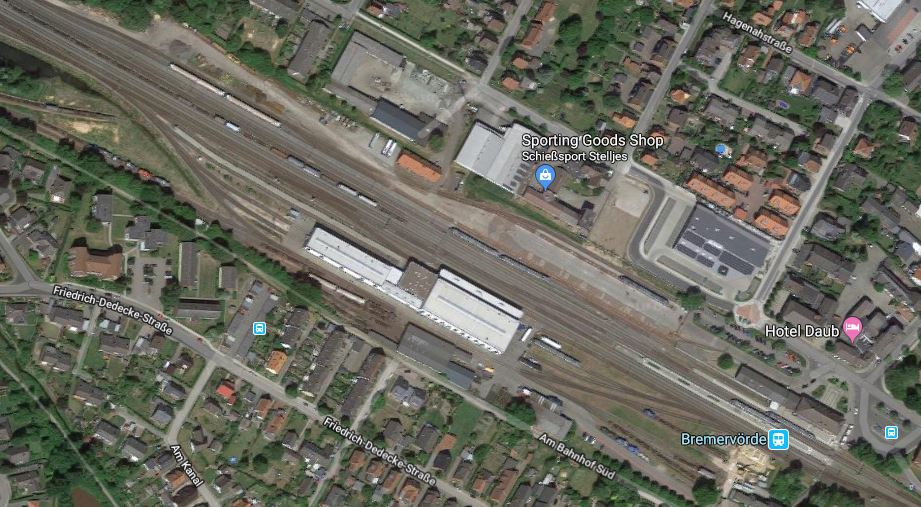
It would appear to be on a large site and there might even be a depot.
There’s certainly space to add a couple of large wind turbines to generate electricity, that could be used to create hydrogen through electrolysis.
Between Bremervörde And Bremerhafen HBf
As with the line to the East of Bremervörde, it is fairly straight across what appears to be fairly flat and through a mixture of open countryside and woodland.
This Google Map shows Bremerhafen Wulfdorf station.
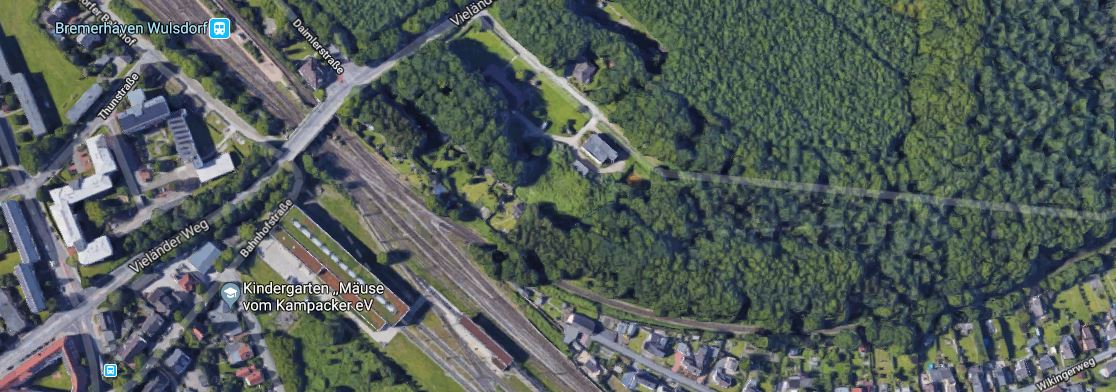
The line from Buxtehude can be seen joining from the East.
The line is electrified to Bremerhafen HBf station.
So will the Coradia iLint trains change to overhead power at Bremerhafen Wulfdorf?
From Bremerhafen HBf To Cuxhaven
This Google Map shows Bremerhaven HBf station.
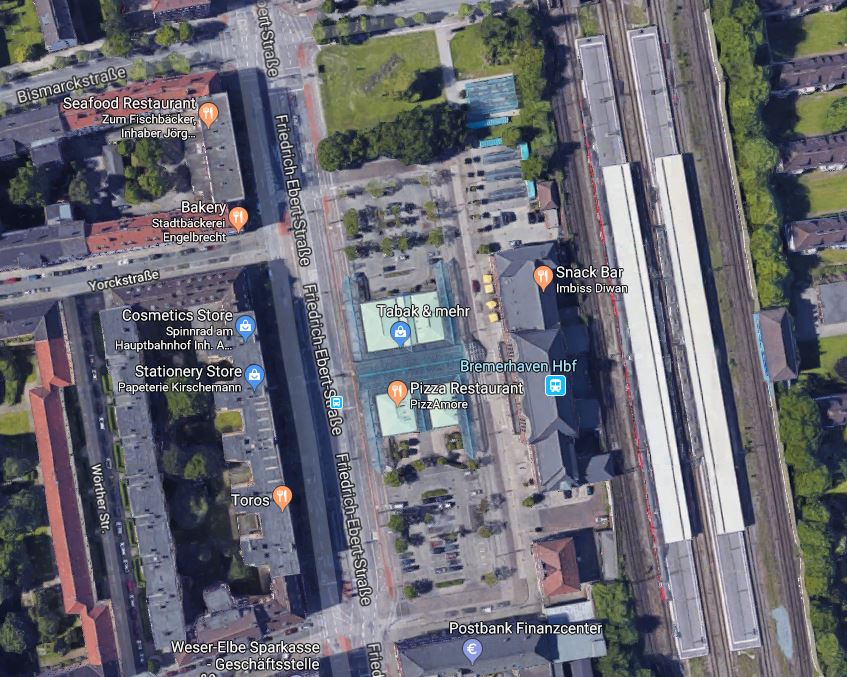
It looks to be a typical functional German station with four platforms, which are all electrified.
The electrification continues Northwards for a few kilometres, but once out of Bremerhaven, the line becomes single track without electrification.
I found this passing loop at the two-platform Dorum station, shown here on a Google Map.
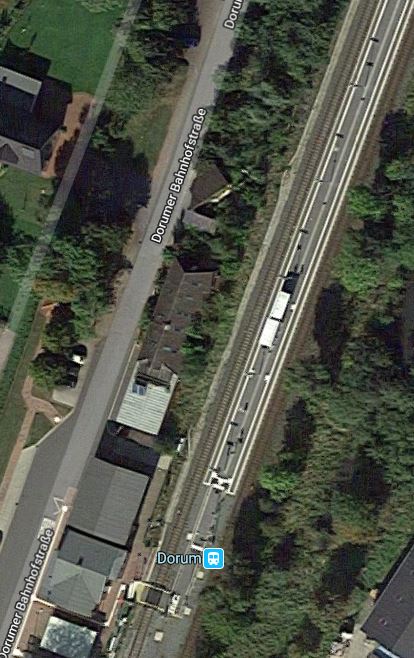
Note how the tracks go either side of an island platform.
I suspect there are other places for trains to pass or they could easily be created.
The route ends at Cuxhaven station, shown in this Google Map.
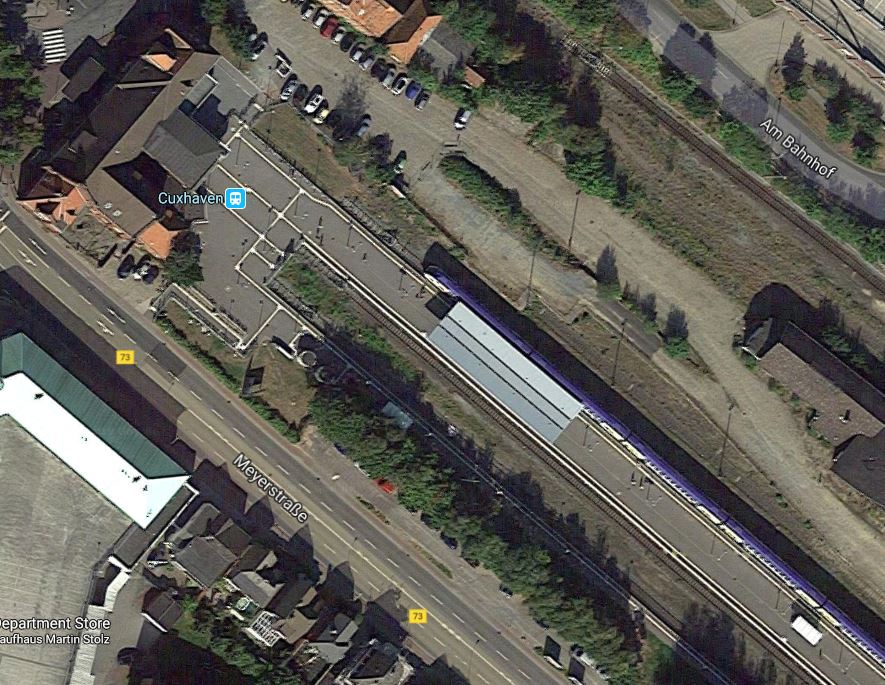
In addition to the service to Buxtehude, there is also a another service on a shorter and more direct route to Hamburg along the estuary of the River Elbe.
Summing up this section of the route.
- It is single-track with at least one passing loop.
- There are just four stations.
- It is electrified for a few miles at the Southern end.
I’ve also never seen a line with so many level crossings.
Services Between Cuxhaven And Buxtehude Via Bremerhaven HBf
The current service is hourly, with what looks to be these timings.
- Buxtehude to Bremerhaven HBf – 1:43 – Incldes 14 stops
- Bremerhaven HBf to Buxtehude – 1:37
- Bremerhaven HBf to Cuxhaven 0:51 – Includes 4 stops
- Cuxhaven to Bremerhaven HBf – 0:44
- Buxtehude to Cuxhaven – 2:34
- Cuxhaven to Buxtehude – 2:21
Turnrounds are the following times.
Buxtehute – 28 minutes
Cuxhaven – 12 minutes
This gives a round trip of five hours and thirty-five minutes.
So it would appear that at least five Coradia Lint 41 trains are needed to provide the service.
Coradia Lint Trains
From what I can find on the Internet, the Coradia Lint trains are diesel-mechanical units, where the wheels are driven directly from the two diesel engines.
I’m not sure, but the engines may be mounted under the cabs!
Coradia iLint Trains
I suspect that the hydrogen-powered iLint trains could be driven by simply replacing the diesel engine, with a suitable traction motor.
What surprises me, is that there appears to be no plans to fit a pantograph to the iLint, so that the intelligent brain on the train can use overhead electrification, when it exists.
This would mean that the range of the train on hydrogen would be increased, if the route was partially electrified.
Coradia iLint Trains Between Buxtehude to Cuxhaven
On the Buxtehude to Cuxhaven route, using electrification could be used to advantage to power the train and charge the batteries through Bremerhaven, where about ten kilometres is electrified using 15 KVAC overhead wires.
Also, in Buxtehude station, which has 15 KVAC electrification on other lines, the bay platform that it appears will be used for the hydrogen-powered trains could be electrified to charge the batteries, during the twenty-eight minutes, that the train is in the station. Perhaps, they could use a system such as I wrote about in Is This The Solution To A Charging Station For Battery Trains?
A similar system could be installed at Cuxhaven.
Surely, it is better to use the turnround times at each end of the route to charge the batteries, as this means less hydrogen will be consumed and the train’s range on a tankful will be increased!
There is an interesting comparison to be made here, with a route, I know well in the UK; Cambridge to Norwich.
- Both routes are around 100 km.
- Both routes are fairly flat and reasonably straight.
- The operating speed of the UK line is 140 kph and I suspect the German line is about the same.
- The UK line has six intermediate stops, whereas the German route has fourteen stops.
- Both lines are run by diesel trains with similar operating speeds.
But the UK route is timed at one hour and nineteen minutes, as opposed to the two hours thirty-four minutes of the German one.
The German route does have twelve more stops, but even if two minutes is allowed for each stop, that doesn’t explain the difference.
The German route must be run at a slower speed than the UK one.
As the Germans improve the speed, journey times will surely reduce.
Conclusion
I am led to the conclusion, that Buxtehude to Cuxhaven route is an ideal route on which to test hydrogen-powered trains, but that as the trains develop, journey times will reduce substantially.
 The Anonymous Widower