Batteries Or Flywheels?
Hybrid buses and IPEMU trains need some form of energy storage.
Typical systems generally use batteries. Mechanical devices are discussed in this article in Transport Engineer.
Read the article.
TPOD or Blockade?
This article on the Rail Engineer web site is entitled Preparing The Way For Bath Electrification.
It is a good read and it brings a new acronym into the English language – TPOD. This is said about the change of wording.
Normally, closing a 20 mile stretch of the main line, from Thingley Junction to Bath Station, for six weeks would be referred to as a ‘blockade’ but, during the consultation process, the word blockade became a very sensitive issue. It implied that Bath was closed for business, which wasn’t the case. Therefore, to ensure that tourists were not put off travelling to the city, it was suggested that Network Rail should use a different description for the closure. As a result the acronym TPOD was created – Temporary Period of Disruption! So the work was carried out during a six week TPOD. You’ll get used to it.
Only time will tell, if this friendlier word TPOD becomes accepted. Or will it have the same connotations as Rail Replacement Bus?
But words are important!
As an example, I object to messages on trains and buses using the word terminate at the end of a journey.
It sounds so final!
At least, it seems to be becoming more common for a message like.
This train finishes its journey here.
To be used. Especially, where train staff are giving an announcement.
Other Train, Tram And Tram-Train Manufacturers And IPEMUs
The Aventra IPEMU is a Bombardier product, but I can’t see anything about using batteries in a train being patentable.
In the future we will see a range of energy storage devices based on all sorts of technology for transport applications. Kinetic Energy Recovery Systems describes the technology in Wikipedia
To deliver energy saving in transport, they need to be installed with regenerative braking and some clever control systems.
They are best generally described as kinetic energy recovery systems or KERS.
Applications will include.
- Passenger Cars – A sexy image would sell top-of-the-range hybrid and electric cars.
- Buses – Hybrid and electric buses in cities are the way forward and they’ll need intelligent energy storage.
- Trucks, Vans and other Commercial Vehicles – Why not, if it makes them more attractive to operators and makes vehicles more environmentally friendly?
- Trams, Trains and Tram-Trains – The Aventra IPEMU is just the first.
Looking at KERS in motor sport and Formula One in particular, in Wikipedia, there are several ideas, some of which are based on batteries and others on mechanical systems like flywheels.
As buses, trams, trains and tram-trains tend to be large vehicles with plenty of available space, where quite a large KERS can be tucked away, it is probably not the demanding weight-sensitive application of say motor sport or passenger cars.
So I don’t see any reason why a train or bus manufacturer like Alstom, Hitachi, Siemens or Wrightbus will not fit KERS.
Wrightbus are mentioned in this press release from Torotrak entitled FUEL SAVING KINETIC RECOVERY SYSTEM PROJECT READY FOR NEXT PHASE. This is the first paragraph.
Wrightbus have confirmed that an innovative Kinetic Recovery System (KERS) project, developed in a collaborative partnership and partially funded by Innovate UK, the UK’s innovation agency, is in full service trials with project partner Arriva.
Overall, this project looks very like the partnership that created the IPEMU demonstrator to prove the technology for trains, as it involves a bus manufacturer, a couple of technology or engineering companies, a transport operator and funding from the Government.
Incidentally, Torotrak is a British company with links to BAe Systems.
According to the press release the prototype bus is in service in Gillingham in Kent.
I can’t believe that the other train manufacturers are not looking seriously at KERS.
It is interesting to look at this article from Bus and Coach, which describes the Wrightbus project.
It is complicated mechanical setup, compared to installing KERS in an all-electric tram, train or tram-train, where it is a matter of designing an intelligent control system to link.
- Overhead electric supply at 25 kVAC or 750 VDC
- Third rail supply at 750 VDC
- Traction motors
- KERS
- On-board electrical systems like air-con, lights and passenger displays
The control system would balance the sources and needs according to route and load.
I think that any train manufacturer that doesn’t offer KERS as standard on a train or tram will be an also-ran!
Manchester’s Metroshuttle
Manchester has a network of three free Metroshuttle buses that you can use in the City Centre.
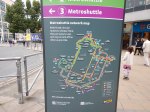

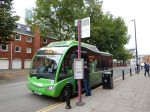
My big complaint about the system is the limited hours. Surely, in a busy City Centre a bus service like this should go on later than 19:00.
I also feel that the stops away from Piccadilly station could be better designed with more information and local maps.
A Mother Of All Traffic Jams
I took this picture from the front on a 19 bus, as I tried to get from Piccadilly to Islington.
The bus was turned round, as it was going nowhere, so I got on a 38, which then promptly overheated, but at least as it was a 38, there was another behind.
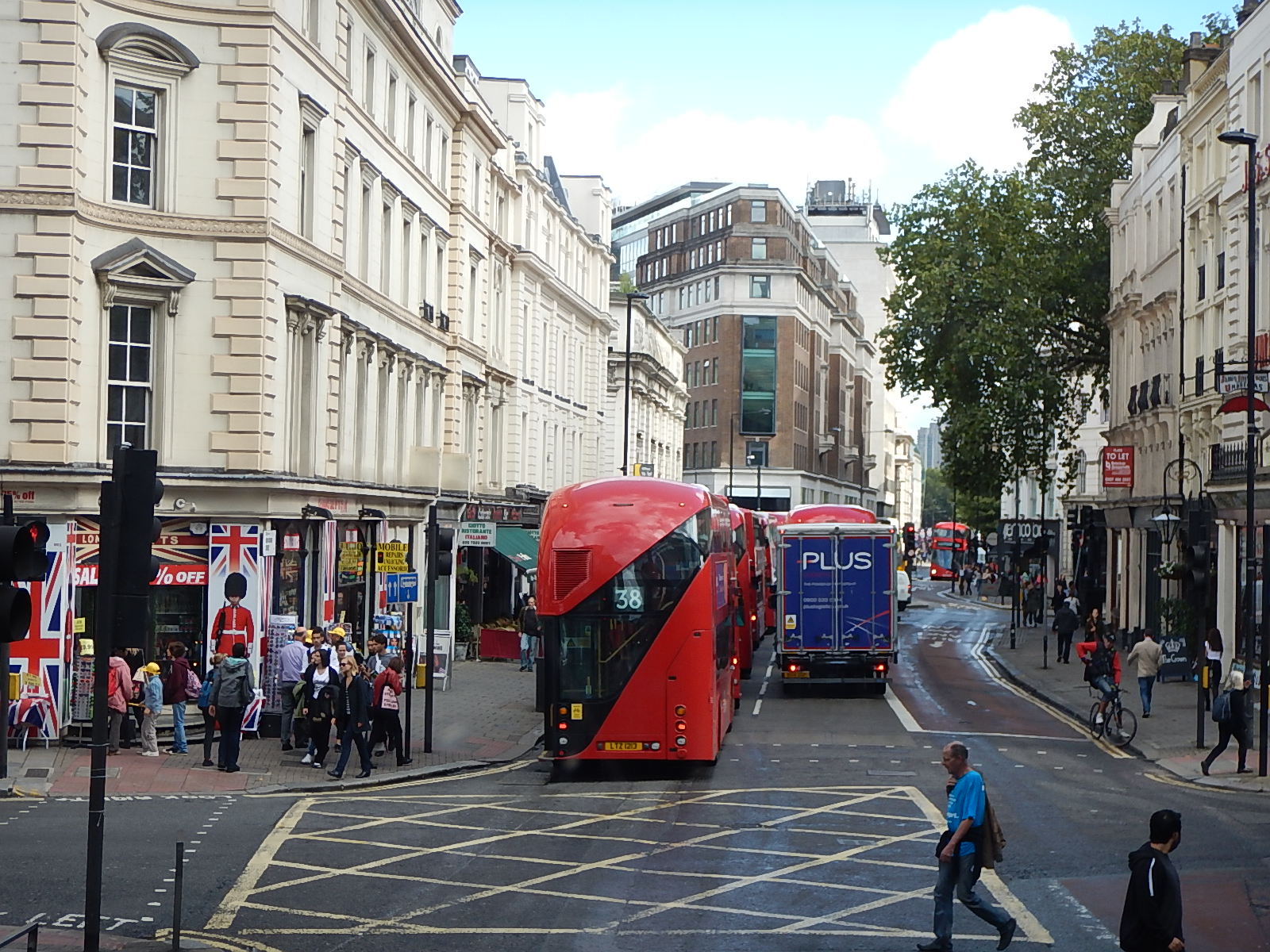
Traffic everywhere and nothing moving.
Traffic everywhere and nothing moving. My bus journey took over an hour.
So what was causing the slow progress? I think it was a mixture of works for services and the Cycle Superhighway.
It was obviously going on all day, as a visitor later in the afternoon complained of similar problems. A friend visiting London also had problems.
You might ask, why I didn’t take the Underground! I needed to get to Angel and as the Victorian designed the Northern and Central Lines so that they didn’t go near Piccadilly. Buses are the only way unless you want to do some tortuous walking in an Underground interchange.
Is Waverley Station Good Enough For Edinburgh?
If you arrive in London Kings Cross station, the experience has been transformed over the last few years. Instead of entering a dark concourse crowded with tired retail outlets in a wood and asbestos shed designed in the 1960s, you now have two choices. You can walk to the front of the train, through the barriers and doors and into a large square with seats, buses and entrances to the Underground. Or if the weather isn’t good, you can take an escalator or a lift to the footbridge that spans all of the platforms and enter the covered Western concourse to make your way to onward transport or to one of many cafes, most of which are upmarket.
Other stations that I know well, like Birmingham New Street, Liverpool Lime Street, Manchester Victoria, Newcastle Central and Nottingham have also been transformed into impressive gateways for their cities. Next in line for substantial upgrading are London Euston and Waterloo, Glasgow Queen Street and Cardiff.
Edinburgh Waverley station has had a bit of a tidy up and it now has a set of escalators to get you up to Princes Street, but it is still a dark, cramped station, with no quality cafes in the station.
If I was to give Kings Cross five stars, Newcastle and Nottingham would get four and Waverley scarcely deserves one.
So to answer my original question. The answer is a definite No!
Waverley And The New Borders Railway
In some ways the new Borders Railway is going to make matters worse, as if it is successful, there will be pressure for more services on the line and there may not be enough terminating platforms at the East end of the station. But at least according to the Layout section in the station’s Wikipedia entry, things are being reorganised. This is said.
Former Platforms 8 and 9, which were substantially shortened for use as a Motorail terminus, the infilled area becoming a car park; since the demise of Motorail services these platforms are used only for locomotive stabling, although the numbers 5/6 were reserved for them in the 2006 renumbering. These are to be extended as full length platforms to accommodate terminating CrossCountry and Virgin Trains East Coast services with the taxi rank closed in June 2014 to make way for these works.
On the other hand, the Borders Railway has removed the need to use one of the worst train/bus connections in the UK.
Currently, if you arrive on a train from London and want to get an express bus to the South or the Borders, this necessitates a climb up flights of steps onto the North Bridge, which with heavy bags is impossible, unless you’re stronger and fitter than most.
Now you walk to the bay platform at the East end of the station and get one of the half-hourly trains to Galahiels, where there is a short walk to the bus station to get a convenient bus to all over the Borders and even to Carlisle.
But it is still a long walk from the bay platforms at the East (3 to 6) to the platforms that go West (12 to 18). And the tram is even further to walk.
Buses And Trams At Waverley
Like many main stations in the UK, no thought has been given at Edinburgh to how to efficiently organise the interface between trains and the buses.
I would have thought that when Edinburgh trams were built that they would have reorganised public transport in the city, so that the trams served the station properly. After all in Manchester, Croydon, Sheffield, Nottingham, Liverpool and Newcastle, local light rail, underground or trams serve the main train stations. Only in Blackpool is a walk needed, but that is being remedied.
In my view there are three places for tram stops at Waverley station.
- At the top of the escalators that take you between the station and Princes Street. But would this get in the way of the posh cars taking people to and from the Balmoral Hotel?
- On Waverley Bridge in front of the station. But where would the tourist buses go to clog up next?
- There also could be a Nottingham-style solution, where the trams cross over the station on a bridge at right angles to the train lines. But this would probably be an impossibly difficult project to design and implement.
The trams do serve Haymarket station and I wonder how many visitors to Edinburgh, use that station instead.
Waverley And Princes Street Gardens
After my trip to the Borders Railway, my friend and I went for lunch in a restaurant by the Royal Scottish Academy facing out onto Princes Street Gardens.
It was not an easy walk from the station as once we’d climbed up the escalators, it took several minutes to get across the busy Waverley Bridge in front of the station to get into the civility of the Gardens. This Google Map shows where we walked.
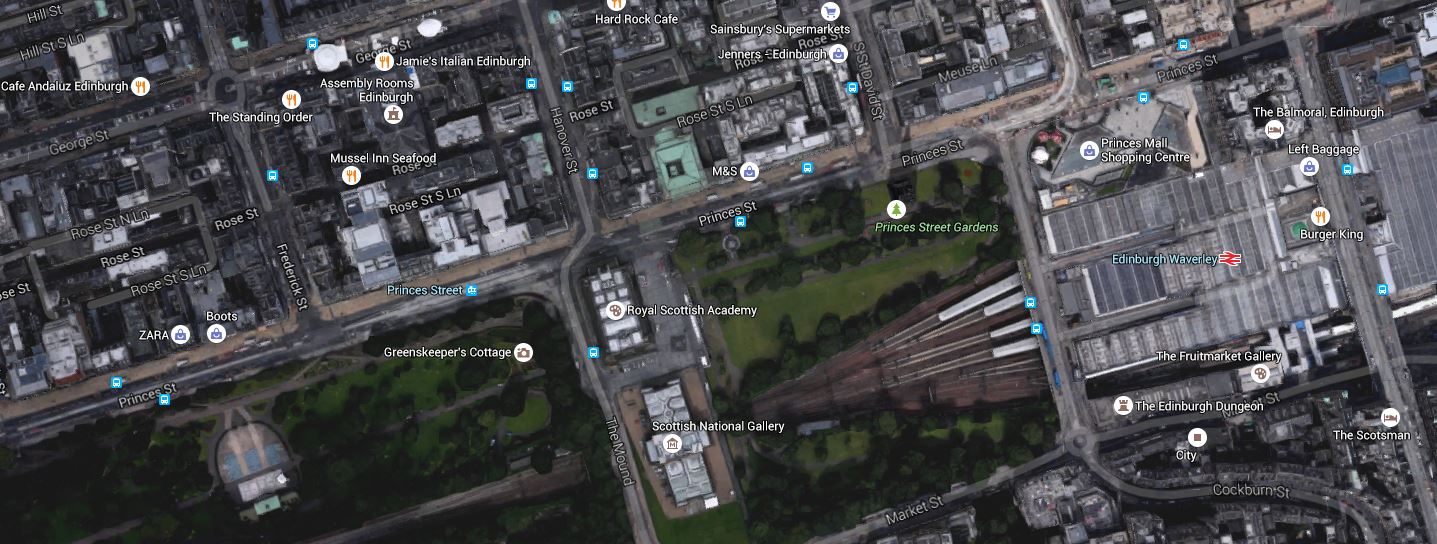
Waverley Station And Princes Street Gardens
Over lunch, I asked my friend, who’d lived in Edinburgh nearly all her life, , why there wasn’t a subway between the gardens and the station. She didn’t know and said there never had been! So as I walked back to the station, I took some pictures.



They show no evidence of a subway that might have been closed.
But they do show that if a subway could be built, then Edinburgh could have a World Class meeting place for when the weather was good.
Sorting The Trams
Seeing the map of Waverley station and the Princes Street Gardens, I have a feeling that if they were designing the Edinburgh trams now, they would be very different.
The difference is that in the last few years, tram-trains have come into general use in Germany. The Germans are getting enthusiastic about their use and large systems are being developed in cities like Karlsruhe, Kassel and Chemnitz.
In the UK, a test line is being added to the Sheffield Supertram, but how could tram-trains help solve the problems of Waverley station?
Trams coming from Edinburgh Airport and the West stop at Murrayfield Stadium tram stop and then move onto the street to call at Haymarket before going down Princes Street. New Class 399 tram-trains, as will be used in Sheffield, would follow the same route as the trams until Murrayfield. Passengers would find the only real difference would be that they had somewhere else on the destination board.
But at Murrayfield they would join the main railway lines and running as trains, they would call at Haymarket and Waverley stations.
The tram-trains could end their journey at Waverley or they could pass through the station and perhaps go on to further destinations like Dunbar or North Berwick. There would be no infrastructure modifications needed East of Waverley station, as the tram-trains would just appear to everything to be just another type of electric train.
If you look at the map in the Proposals for the Edinburgh tram network in Wikipedia, you’ll see this map.
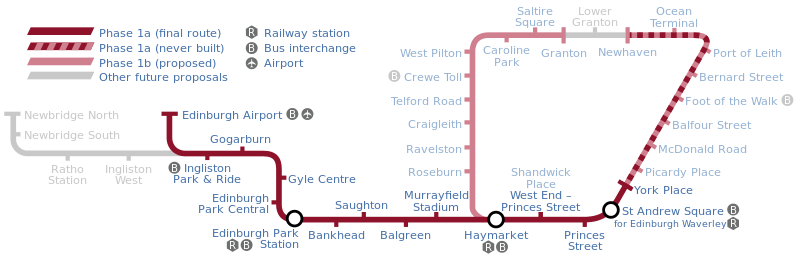
Edinburgh Tram Map
Note there is another Western destinations in addition to the airport and a loop to Newhaven and the Port of Leith. All come together at Haymarket. So services from the West could be run by trams or tram-trains as appropriate and those on the loop would probably be run by trams.
It should also be said, that the tram-trains could go anywhere to the East or West of the City, where there are electrified lines. Even Glasgow!
Edinburgh could have a lot of fun, without digging up the streets too much. Although, they’d probably need to do this, if they were going to extend the tram to Newhaven and the Port of Leith.
Getting To The Falkirk Wheel And The Kelpies
I took a train to Falkirk Grahamstown station and then got a pink bus called The Loop.
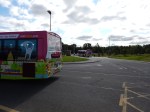
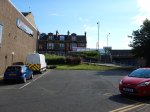

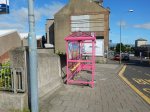
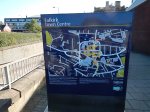
I know it is relatively early days, but information for the bus needs to be improved. You can find the stops easily, but knowing how long to wait is difficult, unless you are psychic. A big poster is needed in every stop, with the times that the buses arrive clearly marked.
The stops should also be clearly marked on the maps on the liths!
This type of tourist bus is crying out for a contactless ticketing system using bank/credit cards. Every time, the bus is used you touch in and at the end of the day your card would be charged appropriately.
In the next few years, this will become the gold standard for small payments and buses like this, that don’t embrace the technology will get lots of complaints.
If the Falkirk Wheel attracts a massive number of visitors, I feel that the area could support a rail station. Look at this Google Map of the lower basin at the wheel.

The Railway Passing The Falkirk Wheel
The railway is the line between Stirling and Glasgow and the bridge across the railway leads to the car park for the Falkirk Wheel.
To actually build a simple station should be fairly easy and visitor numbers and the level of success of the attraction will determine, if the station is ever built.
I think it will be built, as it has so many factors going for it.
Nottingham To Ilkeston And Back
Ilkeston is a town without a railway station and this is said in Wikpedia about the town and its railway links.
Ilkeston has not had a railway station since 1967, despite its substantial population and the fact that the Midland Main Line (formerly part of the Midland Railway, later the LMS) skirts the eastern edge of the town. Due to recent rail reopenings in similarly-sized towns it is now, by some definitions, the largest town in Britain with no station.
So I had to go to the nearest station at Langley Mill and hopefully, I could organise a taxi. I took these pictures on the journey.

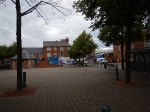
After trying three taxi numbers at Langley Mill and all saying they couldn’t help, I got a bus to Heanor from where I got another bus to Ilkeston. To be fair to the buses, I’ve travelled on much worse services elsewhere in the UK. Cambridge to Haverhill for a start. And I was not issued with a dreaded ticket.
After my meeting, I decide to take the easy route back, so I got an express bus into Nottingham and then use the Nottingham Express Transit to get to the station.
I don’t think that in the twenty-first century, where we’re supposed to use green public transport, that this is the best we can do to get in a reasonable time from Nottingham to Ilkeston.
A related question, is, Is it easier to get to Ilkeston by taking a train to Derby and getting the bus from there?
Crossrail Will Affect The Buses
This article from GetWest London is entitled Improved bus services for Hayes to prepare for Crossrail.
The article talks about how Bus Route 90 is going double-deck and buses through Hayes will be improved as Crossrail, with the new Hayes and Harlington station is constructed
Provision of improved and rerouted bus services will happen at many of the new Crossrail stations.
My nearest Crossrail station will be the double ended giant at Liverpool Street that will serve both the current Liverpool Street and Moorgate stations.
From close to my house I can get a 21 or 141 bus to just outside Liverpool Street station, although coming back I have to walk to Moorgate for a northbound bus.
After Crossrail is opened, I predict that when I use Liverpool Street station, I will get a bus to a stop that will be connected by weather-free subways to any of the existing lines in the area and of course Crossrail. Coming back, these or other subways will connect me to a northbound stop to get a bus home.
I actually suspect to get the bus, it might be best to be at one particular end of a Crossrail train, so that you use an entrance to the station, that is convenient for your bus. Getting the carriage right could save you quite a walk with a two-hundred ,metre long train.
If what is provided, is not better than the current interim arrangement at Liverpool Street/Moorgate, I will be very surprised and will complain like an irate rhinoceros.
Most of the stations on Crossrail are served by London buses, also under the control of Transport for London. So improving the buses, as at Hayes and Harlington will be a matter for Transport for London, with input from the appropriate London Borough.
But what will happen at places like Brentwood, Burnham, Iver, Langley, Maidenhead, Reading, Slough, Shenfield and others,which are outside of Transport for London’s influence.
So that Crossrail has one holistic design from East to West, buses at these outer stations must conform to the rules that apply in the London area.
- Buses must be cashless, with payments either by Oyster, contactless card, concessionary pass or an extension to an orange rail ticket.
- London-style bus spider maps must be provided at all stations.
- A state-of-the-art bus arrival system must be provided in the same manner as in London, either by display or text message.
- All buses must be fully-accessible to match the fully-accessible stations.
- In an ideal world, all buses must display the next stop and be front entrance and centre exit, to help blind and disabled passengers and speed the buses on their way.
Looking at text message bus alerts like TfL’s Countdown, allowing a sixth digit to the text system would probably enable every stop in the South East to be covered.
Incidentally, according to this article in The Guardian, there are less than 500,000 transport stops in the whole UK, so six digits and one text number would cover the whole of the country.
But would the Scots, Mancunians and the Cornish, embrace a system that was designed in and for London?
Crossrail is a rail system, but it is going to affect lots of parts of our lives.
Working Around The Victoria Line Closure
Today, I wanted to go to IKEA and a decent B & Q, so as both are close to Tottenham Hale station, it required a trip to that station or thereabouts.
The problem is that the Victoria Line is closed past Seven Sisters in August, so they can remove the bottleneck at Walthamstow Central that was part of the cheapskate design of the 1960s. Click here for the full story.
So I couldn’t take my usual route of an Undrground train to Tottenham Hale and a 192 bus.
I decided to go to IKEA first, which is just an easy trip all the way on a 341 bus from perhaps a hundred metres from my house. But as I got to the stop, the 341 whizzed past. Luckily it was followed by a 476 bus, which joins up with the 341 at Northumberland Park and hopefully because of the route it takes will get there first.
So I got the 476 and sat upstairs. I was watching to see if the 341 was behind us as we turned off Tottenham High Road and saw the 341 appear behind.
At the next stop I got off the bus to get the 341, only to see that bus go straight past. Luckily, I was able to get back on the 476, so in the end, I went all the way to Northumberland Park, a couple of stops short of IKEA. The bus information saif I’d haveto wait twenty minutes for a 341, so I walked over the level crossing to the Marigold Road stop for the 192. Again my luck was in, as a 192 had just turned up and they were changing drivers.
Coming back, I was carrying a full IKEA bag, and wanted to get to B & Q at Tottenham Hale for a couple of small bits, so I needed a 192 bus. Unfortunately, there was a bit of a gap in the service, but after about twenty minutes, I’d done my hopping and needed to get home.
So I walked back to Tottenham Hale station, hoping that there was a Hackney Downs train due.
Remarkably there was one in a couple of minutes and I just had time to climb over the bridge to catch it.
At Hackney Downs, the train dropped me on Platform 1, so I could either go down into Hackney Downs station and get a 56 or 38 bus, or use the new walkway to Hackney Central, from where I could get a more numerous 38 bus.
As it was a warm day and there was a lift in the walkway, I decided to take the newly-opened route.
I’m glad I did, as it turned out that due to the wire mesh at the top of the sides of the walkway, it was remarkably cool.

I’d surmised it would have been good in wet weather, but I’d never thought I’d be pleased to use it because of the heat.
According to one of the staff to whom I spoke, the walkway is staring to be increasingly well-used as passengers discover it.
I think that we’ll see this type of walkway in other places on the UK rail network.
One thing that helped this morning to get around the Victoria Line closure, which removes a bit chunk of my usual routes to Tottenham and Walthamstow, was London’s superb text message-based bus information system, which like any good system is designed to work on any device that can send and receive text messages.
And it does it all without using any dreaded app.
 The Anonymous Widower