What Will Be The Effects Of Cashless Buses?
When London’s buses go cashless on the sixth of July, London and the passengers on its buses, will submit themselves to a big experiment.
But as I said in this post, nearly all of the staff and passengers seem to be strongly in favour.
The average London bus driver isn’t stupid, as what employer would allow an imbecile to have control of any £200,000 machine. The biggest problem they have with cash, other than the security one, is the inevitable delay, when passengers go searching for small change. London buses are timed to the minute and drivers seem not to like to miss their schedule.
I haven’t found any actual data on what passengers think about going cashless, but I have seen or heard no complaints in the media. I have heard the odd moan though, when a bus is delayed by passengers searching for small change. Although, that seems to have happened less since it was announced buses were going cashless and contactless bank cards could be used.
There will obviously be some troubles on the sixth, but I suspect TfL will put a lot of extra staff on the buses to smooth things through.
Remember though that according to Wikipdeia, London’s buses are used by six million riders a day and that every touch-in is registered on TfL’s ticketing system. That will generate an enormous amount of data.
When it has all settled down, just by examining before and after data will give conclusions, that will help with the planning of London’s transport system.
Will going cashless speed the buses?
Will the buses be carrying more or less passengers?
Will we be seeing a new group of passengers using a bus for the first time?
Would visitors to London, use their bank card or an Oyster?
Will we see a long term decline in the use of Oyster on buses?
I will not speculate, but let the data do the talking!
But the biggest effects will be felt, if the scheme works well and increases the revenue and profitability of London’s buses.
How many cities seeing how the London system works, would decide to go to a similar system? Many bus systems like Manchester, Liverpool, Edinburgh and Glasgow are not very comprehensible to a visitor without a guide, but London’s simple touch-in once with your bank card system, is probably understandable to everybody familiar with a contactless bank card.
I would also see London using the same system on the Underground, Overground and railways within London.
As Oyster now works on train journeys around London and many stations like Cambridge, Watford and Brighton are gated, would we see pressure to allow the Oyster/bankcard ticketing on journeys around the broader South East of England. Yesterday, when I went to Salisbury, I paid £24.60 for my walk-up Off Peak ticket, which was the same price as if I’d bought it earlier in the day on-line. It would have been so much more convenient to have touched-in at Waterloo and touched-out at Salisbury with a contactless bank card. Especially, as I just missed the previous train to Salisbury, so with a contactless bank card ticket, I’d have got there thirty minutes earlier.
So will we see the creeping of Oyster/bank card ticketing out from London? One problem is Railcards, but I’m sure one could be associated with a particular bank card.
Would it increase the resolve of TfL to introduce cashless ticketing all over the Underground, Overground and trains in the London area?
London’s new ticketing regime is going to provide a lot of answers to questions, some of which haven’t even been thought up yet. It is also going to ask a lot of politicians to bury some of their views. A lot of money will have been proven to have been wasted on systems that can never accept contactless bank cards.
Scaremongering Over Cashless Buses
I travel on London buses regularly and probably every other trip, I hear a message broadcast on the bus saying that from the 6th of July, London buses will go cashless.
Yesterday, when the message was played, I started talking to the young lady sitting next to me. We both agreed that we rarely see anybody pay cash on the 38s or 56s we regularly used, although we did think we’d been held up by a passenger scrambling for small chsnge. Transport for London (TfL) say the number paying by cash, has dropped below one percent for those, who use cash on the buses.
Speaking to one of tail-gunners on a 38 last week, she said that staff were looking forward to the cashless buses, as it should further cut the dangers of dealing with the public.
So it would appear from my small survey, that passengers and bus staff are in favour of buses going cashless. I certainly haven’t heard anybody sounding off on the Dalston omnibus about it being a bad idea.
However, there was this story in the Standard last night, which claimed up to two thousand passengers could be stranded every day in London, due to lost Oyster cards. Here’s the first couple of paragraphs.
But notice it is the Green Party complaining.
If this means that 770,000 people are given a free ticket every year at the cash price of a ticket of £2.40, this would cost TfL just under £2,000,000. Compare that with the savings of £24million from going cashless stated in this article on the BBC. The remaining savings would buy a lot of buses or fund other improvements.
You can just hear the rattle in the various canteens in bus garages, as they prepare the teacups for the inevitable storms.
A Telling Statistic
Justin Webb in this article in The Times says the following.
This year under 70 per cent of American 19-year-olds have driving licences, down from 87 per cent two decades ago.
I have heard young people in London, say they are not going to learn to drive, as they have no need. So as [ublic transport and cycling gets better, are we all falling out of love with our cars.
In a thought provoking article he goes on to say this.
Does the hunger for live events in the internet age — concerts, exhibitions, demonstrations — encourage people to meet and talk again?
Certainly here in East London, there are two groups of four seats on the new Routemasters on route 38, where people do seem to congregate to have a chat. If they don’t chat, everybody also interreacts in a very polite way.
So has a good design, made life in the world’s greatest city better and less fraught?
A Well-Designed Transport Interchange
Golders Green is not an area I go to often. Years ago, C and myself used to go there to buy shoes for the children, at a shop I think was called Brians. I wonder if it is still there!
But yesterday, I needed to go there to get some extra keys for my new Banham lock. It is not a difficult journey, as I just got a train up the Northern line from the Angel to Golders Green station.

There are numerous buses to places all over North London from the station as this map shows.
It’s also a stop for a lot of National Express coaches.
We need more well-designed simple interchanges everywhere, so that train passengers can easily get to their ultimate destination.
From the station, it was just a short walk to Banham’s shop.
Tottenham Court Road To Be Transformed
It has been announced and reported here, that the Tottenham Court Road area of London is to be transformed. Here’s the first two paragraphs from the BBC article.
Tottenham Court Road will be reserved for buses and bicycles only during daylight hours from Monday to Saturday.
Camden Council wants to make the central London street safer and boost business ahead of the opening of a new Crossrail station in 2018.
I like the idea, but will everybody else?
I’m sure that it won’t be popular with taxi drivers, as how will they drop well-heeled customers at Heals?
I have a feeling that Crossrail and Thameslink could be the key to making this scheme work? I’ve not seen any figures, but how many people will switch to the trains rather than drive in London, when the two railways open around 2018. If the switch is quite substantial, then cars in London will drop and this will speed up the buses.
We live in interesting times.
Edinburgh’s Poor Bus Information
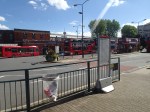
In London the bus information is superb, with route and street maps at any stop with a shelter. Even rudimentary stops have a text number and a small map.
But this is all you get in Edinburgh.
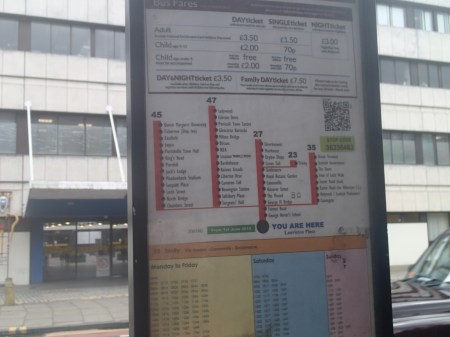
Edinburgh’s Poor Bus Information
If you are not familiar with the city, what possible use is this map, especially as there are no walking maps except for a solitary lith on Princes Street.
As a major tourist city, Edinburgh has to be labelled as Could Do Better.
Especially as the tram stops are a map free zone.
I Track Down An Elusive Night Bus Map
A couple of weeks ago, when I was returning home, I thought I saw a new Transport for London Night Bus Map, drawn like a cross between one of their bus spider maps and the well-known, loved and understood tube map.
As I couldn’t find one either physically or on the Transport for London web site and I was coming round to the conclusion I’d imagined seeing the map.
But I finally found one today, that I could photograph at Walthamstow bus station.
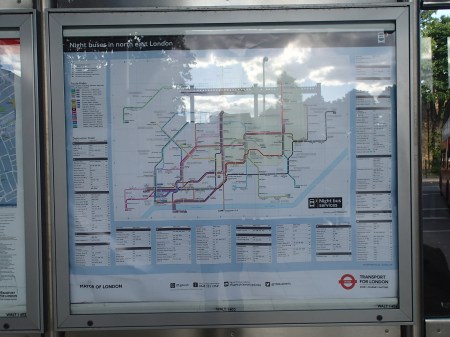
North East London Night Bus Map
This one is for the whole of North East London, whereas mostbus spider maps are for a specfic location like say Kings Cross. It certainly better than the old black and white night ones for a larger area.
Why is it London maps seem to get better and better and much of the rest of the country seems to be stuck in 1950s or even earlier.
God Said All London Buses Must Be Red
London’s buses have always been red in my memory and according to this piece, which is a response to the question of why London’s buses are red, they’ve been predominately red since the creation of the London Passenger Transport Board in 1933. Although buses from the London General Omnibus Company had started using the colour in 1907.
Today though I saw my first New Routemaster in a full black advertising livery.
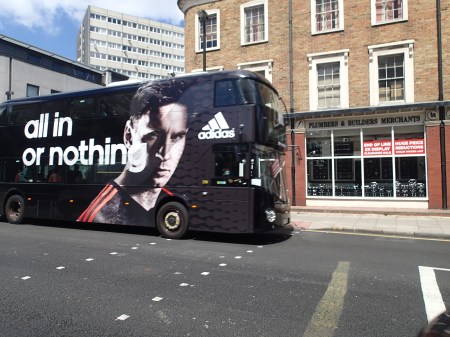
God Said All London Buses Must Be Red
I don’t think the bus suited the livery.
By the way, God or in London Transport’s case; Frank Pick, wouldn’t have liked this bus either, as it would grate with the overall philosophy he laid down for London’s transport system.
Has anybody else ever imposed their design philosophy on a city, as Frank Pick did for London to such a positive effect?
I wonder what he’d have thought of London’s New Routemaster.
One thing he would have liked was the process where Thomas Heatherwick was involved in the design of the bus. Pick in his years as London’s transport supremo, regularly hired the best architects and designers.
He was also prepared to back those, whose designs were unconventional, like Harry Beck‘s tube map, which has evolved to be one of the most recognisable maps in the world.
Hackney Downs Station’s Newly Painted Bridge
Hackney Downs Station has been a pain for me in recent months, as they have been refurbishing the bridge over Dalston Lane and this means that the 56 bus has been diverted and I can’t use it to get to the station for a trip to my son’s house in Walthamstow.
But it looks to be finished now and the 56 and 30 buses are back on their normal routes.
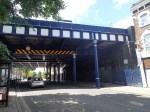
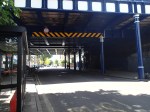
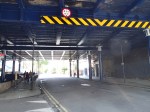

The next phase of the development at the station is completing the lifts and reinstating the walkway to Hackney Central station.
I suspect they’ll be getting the orange paint out for when the station becomes part of the Overground.
London’s Express Buses
Many cities in the UK and elsewhere have express buses to speed you on your way.
With the introduction of a substantial number of New Buses for London on route 38, it seems that London now has express buses, as they are faster than the traditional buses.
Today, I arrived at Dalston Junction station and as I do caught the first bus along the Balls Pond Road. It was an elderly 56 and before it got to the first stop, it had been passed by a following New Bus for London on route 38. The 38 had been able to make a faster getaway at the lights, as their hybrid drive train seems to give better acceleration.
But by the time I got to my stop at Southgate Road, the new bus was on its way to Islington. This is probably because with three doors the cargo gets on and off a lot quicker.
It also helps that only about a third of the passengers need to go past the driver to check in.
As I can get both 38s and 56s to the Angel, it’ll be interesting to see if the 56s get less crowded when route 38 has its full compliment of new buses.
It would also appear than the traditional buses are having their route displays updated for the introduction of cashless buses in July, with nudge messages suggesting you go cashless. They are also saying you can go in and out through either door.
So will the two door buses be fitted with a touch pad at the rear door, just as the new buses do?
It would certainly speed loading and unloading of buses.
All of this shows that good design can make something as mundane as a bus better!

