The Other Side Of The New Bus For London
My Internet trawl picked up this story from the BBC in Northern Ireland, which talks about the jobs being created by Wrightbus in Ballymena. This is second paragraph.
The company is making a total investment of £14m – more than £10m of which will be for research and development projects.
So will the rest of the world be seeing their own New Buses?
All of this shows the value of good design and engineering.
Incidentally, now that the route 38 is now mainly New Buses for London, everybody seems to be very pleased and talks about it on the buses.
So good design and more space puts a smile on peoples’ faces too!
Most of our trains, even the older refurbished ones, are some of the best in the world for passenger comfort, so why shouldn’t we have similar standards on buses everywhere?
Come In Number 38, Your Time Has Come!
I saw several New Buses for London or Routemasters today, as I travelled the other way on a 38 to and through Hackney.
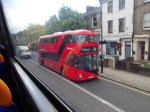
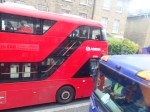
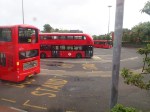
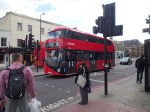
But they weren’t the remnants of the original Hackney Eight, but pristine ones, just off the boat from Northern Ireland.
Coming back from the Angel, I got one of the new buses and the driver said with a big beaming smile on his face, that from Monday all buses on the 38 will be New Routemasters.
So now visitors to the capital and those that live here for that matter, will be able to take their partner, boyfriend or girlfriend to romantic Clapton Pond, as I surmised here.
On a serious note, If you were thinking of opening a cafe, then Clapton Pond surely is the place!
Also if I was Hackney’s Tourism Officer, I’d be making sure everything was ready.
Rumour also has it too, that a well known estate agent has jacked up the prices of all properties near to a 38 bus stop by two percent.
Berlin’s Pseudo-Tourist Buses
Berlin has a short bus route numbered 100 across the centre using double-deck buses, that doubles as both a tourist and a general route. It passes a lot of the main tourist sites in a similar way to London’s route 11.







Use of this route is included in the Berlin Day Transport Ticket. I caught the bus from the Zoological Garden.
Like New Buses for London, they have two staircases.
Burnley To Liverpool Airport On A Sunday
To get to Liverpool Airport from Burnley on a Sunday wasn’t easy.
I first got a train to Preston where I got a train to Ormskirk. There was this unusual end-to-end interchange between one of Northern Rail’s Class 153 scrapyard specials and one of Merseyrail’s smart Class 508s.
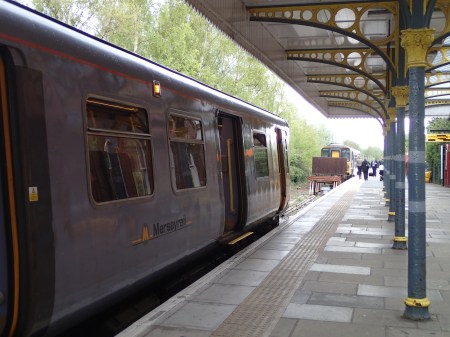
Changing Trains At Ormskirk
Merseyrail has been pushing to electrify all the way from Liverpool to Preston, which would remove this change of train. Wikipedia says this.
Electrification from Ormskirk to Preston has been considered in conjunction with the Burscough Curves reopening. It would re-establish the most direct Liverpool-Preston route and is one of Merseytravel’s long-term aspirations.
This whole corner of Lancashire seems either to be sprouting wires or growing third rails. Many of which lead to Liverpool or Manchester.
Once in Liverpool, I alighted at Moorfields station and walked a hundred yards or so to Carluccio’s, where I had a supper to prepare me for the journey.
I did search for a bus to Liverpool Airport, but even at the main bus station, there was no information or anybody to ask.
When will these people learn, that one of the way to get people to use buses is to provide information everywhere as London does.
So I reluctantly took a taxi!
Open Data Will Improve Public Transport
I was actually looking to see if anybody else had spotted that London buses now have time displays, which I reported here.
But I did find this article entitled, Smart data will only work if the network data is truly open.
The article says that London has one of the biggest real-time passenger information systems in the world. All of the data is available free for developers. The article then says this.
Developers have created more than 100 apps for the city’s buses alone. They offer everything from route planners for the disabled to scalable tube maps, with live updates when lines are disrupted, and apps that let you know where to board a train so you can get off as close to your exit as possible.
So is it right to think that as time goes on, more and better apps will be written to make difficult journeys easier?
You could envisage apps, where you entered your start and destination and the system made suggestions, as to how to get there fastest, when say the local low life had nicked the signal cable or a bus or train had broken down.
The one thing that the article misses, is the data connection from the smart device to the central system.
Surely to cope in the near future, all vehicles will have a wi-fi connection. First Manchester is reported here to be fitting wi-fi to all its buses.
Once you have a fast local connection between vehicles and passengers, other possibilities will become feasible.
As an example, I often catch a 38 bus to the Angel, where to get to Kings Cross, I change to a 73 bus or take the Northern line. If the bus had a rearward facing camera, I could link to this to check for the 73 bus.
One of the great things about this technology is that you don’t need everybody to be using it on a bus, as bus passengers will talk to each other and share their information. I say this because you see people at bus stops texting to find the arrivals and then showing them to other passengers.
None of the apps because of the open data will cost Transport for London a penny. The reverse could be true in that the apps might encourage more passengers to travel and travel on the more lightly-used part of the network. If more people travelled by bus, hopefully this would reduce car traffic, thus allowing more road space for buses.
Such is the power of software!
If You Want To Know The Time Get On A Bus
I was on three big red taxis today and they’ve had a software upgrade on the information display.


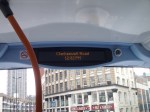
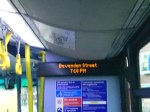
I haven’t noticed the time before, but I was away Tuesday and Wednesday and only took one bus yesterday.
Since I created this post, I’ve been on about six or so buses. All were showing the time! Even a very elderly example! I did see a New Bus for London pass and it looked like this was showing the time as well.
It will be interesting to see the indirect effects of this technology change!
Will people be on time more, as they should spot they are late, even when they’ve left their watch at home?
Will it cut watch thefts, as people might wear them less on public transport?
Will there be a clamour for more clocks on the Underground, the Overground and trains?
This Is Becoming A Habit
I had another letter in The Times yesterday under the heading of Bus Information
The rest of the country is lagging far behind London for maps and timetables — could rivalry be to blame?
Sir, Roger Sexton (letter, Apr 4) says that there are no controls on commercial bus fares outside London.
As a senior citizen living in a Tube-free London borough, I use buses a great deal and I travel a lot around the UK. Outside the capital, I find that buses run in an information-free zone, with no maps and unworkable text systems to check arrivals. As London’s excellent system is software based, surely, it could be applied countrywide. Or perhaps cities like Birmingham, Manchester and Edinburgh are saying that they don’t want any system that has been proven in London.
I doubt that information will improve, although a friend told how there was an item on bus regulation in Newcastle on Radio 4 yesterday.
Could Hebden Bridge Be The UK’s Second City?
This sounds like the sort of idea dreamed up by someone, who really does think that Yorkshire is the centre of the earth.
But the BBC has published a piece entitled The Case For Making Hebden Bridge The UK’s Second City by Evan Davis on their website.
This extract sums up his logic.
The suggestion that it is Britain’s second city came from resident David Fletcher, who was active in the 80s saving the town’s old mills and converting them to modern use.
His point is that Hebden Bridge is an inverted city with a greenbelt centre and suburbs called Manchester, Leeds and Liverpool.
His point was that the real second city of the UK is a northern, trans-Pennine strip that extends the relatively short distance across northern England, joining the built-up areas that lie second, fourth and sixth in the UK ranking.
I think he has a point and treating the area from Liverpool and Blackpool in the West to Leeds and Sheffield in the East, as a megacity, may be a very good idea.
Davis says that it would need a lot of infrastructure, and there would be rivalries and infighting. But there’s enough of that in Manchester already, with one of the worst bus systems in the UK.
To be fair to Network Rail, their plans for the Northern Hub, very much fit the proposal for the Northern megacity and the government, especially in the statements of George Osborne, seem to be backing them.
Is there anything I’d like to see in the North?
I would like to see London’s local transport information systems and ticketing imposed on the North. And probably on everywhere outside London as well.
- I should arrive at any station and be able to find my onward route, by foot, bus or tram without difficulty or bothering any of the station staff.
- If say, I wanted to use a bus where my bus pass is valid, I would just touch in with my pass. Every town or city seems to use a different system.
- If I need to pay for my ticket, then I would just touch in with a contactless bank card.
- All buses would have fully disabled access and at least a separate entrance and exit, like most buses in London.
- I should also be able to find out the next bus, with a simple text-based system, based on five digits for the stop and a short text code. If larger London can do it, why do cities like Leeds have a system that is so difficult.
I shall be watching Evan Davis’s program tonight with interest.
Don’t forget there would be one great argument for making Hebden Bridge the UK’s Second City. It would eventually stop all the arguments.
You also have to ask, whether other megacities could be created.
- Newcastle-Sunderland-Middlesbrough
- Glasgow-Edinburgh
- Wolverhampton-Birmingham-Coventry
- Southampton-Portsmouth-Brighton
Are four that come to mind.
The Connection Between The First Tanks And The Classic Routemaster Bus
At first glance, it would appear that there would be little connection between Little Willie, which was one of the prototypes leading to the first tanks of the Great War and the classic Routemaster bus of the 1950s.
But I’ve just read this article on the BBC’s web site about how the tanks were developed in Lincoln. The article talks about the two designers.
The work needed more than technical experience, it needed two very particular men – William Tritton and Lieutenant Walter Wilson.
“Tritton was a brilliant engineer,” says Mr Pullen. “And he was a brilliant leader. He got things done.
“He turned Foster’s around with new ideas and new markets.
“Couple him with Walter Wilson, who was also a good engineer but a genius with things like gearboxes, and they made a brilliant partnership.”
It goes on to describe how they locked themselves in a hotel room and scribbled designs on envelopes and fag packets.
And the rest as they say is history!
Walter Wilson went on to form a company called Self-Changing Gears, that developed pre-selector gearboxes. I never drove a vehicle with one of these gearboxes, but I’ve sat just behind the driver on many a London Transport RT-bus and watched the driver select the gear and then hit the gear change pedal to engage it. The use of this type of transmission, was to make the effort of the constant stopping and starting easier on the driver.
Routemasters , it would appear had a fully-automatic version of the transmission, linking them back to the original tanks.
Life On A 38 Bus
The 38 Bus in London, is probably the route that I use most. I even used its sister the N38 to get to Victoria for the Gatwick Express in the middle of the night. Yesterday, I used the route twice, once to go to the Angel and the other to go to a lecture near the Royal Academy in Piccadilly. But then the Upwestbound stop is just round the corner from my house.
But I haven’t done what a Timeout journalist has and spent twenty-four hours running up and down the route from the romantic Clapton Pond to crowded Victoria. His article is here. This is a typical paragraph.
But there’s more to the London bus than keeping costs down. It’s fascinating about seeing the city from the top deck. Ever bother looking at the buildings above the shops? I’m not talking about nosing into offices and flats (though you wouldn’t believe how many people walk around naked with the curtains open) – it’s the centuries-old architecture pocked with the scars of history, with Victorian inscriptions and scraps of pre-war adverts. Glimpses of London’s former lives.
The 38 may not be one of the glamour routes, that have got a full compliment of New Buses for London, but as a working lifeline for connecting the people of Hackney to the jobs, shops and attractions of the West End, it is invaluable.

