Rolls-Royce Completes Next Step On Its Journey To Decarbonising Business Aviation
The title of this post, is the same as that of this press release from Rolls-Royce.
This is the sub-heading.
Rolls-Royce today announces the successful completion of a series of tests with 100% Sustainable Aviation Fuel (SAF) on its latest generation of business aviation engines, the Pearl 15 and the Pearl 10X. The Pearl 15, the first member of the Pearl engine family, powers Bombardier’s Global 5500 and 6500 aircraft, while the Pearl 10X will power Dassault’s ultra-long-range flagship aircraft, the Falcon 10X.
These are the websites for the three aircraft, with number of passengers, typical cruise speed and range.
- Bombardier Global 5500 – 16 pax – Mach 0.85 – 5900 nm
- Bombardier Global 6500 – 17 pax – Mach 0.85 – 6600 nm
- Dassault Falcon 10X – 19 pax – Mach 0.925 – 7500 nm
This screenshot from the Dassault Falcon 10X web site shows the range from London.
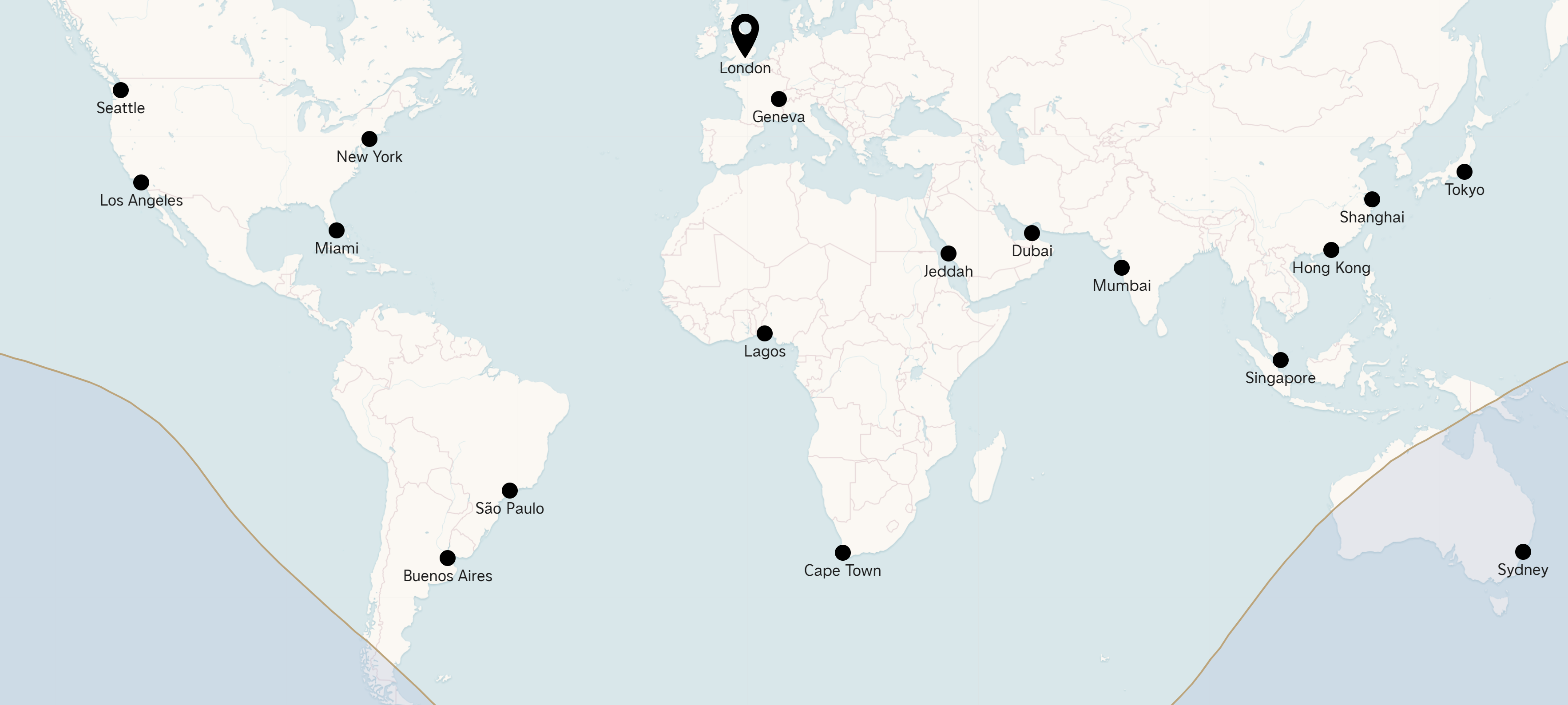
Note that Buenos Aires, the Falkland Islands, Seattle, Seoul and Tokyo are all within range.
I have a few thoughts and observations.
Jet A-1 And 100% SAF
This paragraph from the press release describes how Rolls-Royce are testing the compatibility of Jet A-1 and 100% SAF.
As well as proving compatibility with 100% SAF another target of the test campaign was to run a back-to-back engine test with both Jet A-1 and SAF on the same Pearl 10X engine. The aim was to confirm further improvements in the environmental footprint when switching to SAF. The results from this first back-to-back engine emission test under standard certification conditions provides important correlations for the evaluation of future SAF within our environmental strategy.
Compatibility and back-to-back running is surely very important, as it could be many years before all airports can supply 100 % SAF for visiting jet aircraft.
The Fuels Used In The Tests And The Benefits
These two paragraphs from the press release describes the fuels used and the benefits..
The HEFA (Hydro-processed Esters and Fatty Acids) SAF was produced from waste-based sustainable feedstocks such as used cooking oils and waste fat. This fuel has the potential to significantly reduce net CO2 lifecycle emissions by about 80% compared to conventional jet fuel.
The back-to-back tests conducted with conventional fossil-based fuel and subsequently SAF also confirmed a cleaner combustion of the sustainable fuel, with significantly lower levels of non-volatile particulate matter (nvPM). In combination with the low NOx combustor technology of the Pearl 10X and its additive manufactured combustor tiles a reduction of all emissions was achieved.
Note.
- An eighty percent reduction in lifecycle emissions is not to be sneezed at.
- Cleaner combustion and low NOx emissions are very much bonuses.
- Additive manufacture is better known as 3D-printing and I’m not surprised that Rolls-Royce have embraced the technology.
As an engineer and retired light aircraft pilot, I suspect the tests have met Rolls-Royce’s objectives.
Moving To 100 % SAF
This is the final paragraph of the press release.
The tests demonstrated once again that Rolls-Royce’s current engine portfolio for large civil and business jet applications can operate with 100% SAF, laying the groundwork for moving this type of fuel towards certification. At present, SAF is only certified for blends of up to 50% with conventional jet fuel. By the end of 2023 Rolls-Royce will have proven that all its in-production Trent and business aviation engines are compatible with 100% SAF.
It must be a good selling point for aircraft equipped with Rolls-Royce engines, that the buyer knows that the aircraft can run on 100% SAF.
100 % SAF As An Airline Marketing Tool
It will be interesting to see how airlines use 100% SAF to sell tickets.
As an example, I can see routes like London and Scotland becoming very competitive.
- Avanti West Coast, LNER and Lumo already run all-electric trains to Edinburgh and Glasgow.
- The technology exists to decarbonise trains to Aberdeen and Inverness..
- Other open access operators could well move in to a lucrative market.
- The only way, that the airlines will be able to compete on emissions, would be to move to 100 % SAF.
There must be hundreds of routes like London and Scotland around the world.
100 % SAF And Business Jets
In A Class 319 Train, But Not As We Know It!, I told this tale.
I am reminded of a tale, that I heard from a former GEC manager.
He was involved in selling one of GEC’s Air Traffic Control radars to a Middle Eastern country.
The only working installation of the radar was at Prestwick in Scotland, so he arranged that the dignitaries and the sales team would be flown to Prestwick in GEC’s HS 125 business jet.
As they disembarked at Prestwick and walked to the terminal, the pilot called the GEC Manager over.
The pilot told him “The Scottish Highlands at this time of the year, are one of the most beautiful places in the world! Would you and your guests like a low-level tour on the way back? I can arrange it, if you say so!”
Despite knowing GEC’s draconian attitude to cost control he said yes.
The sale was clinched!
I also remember an article in Flight International about how JCB sold diggers.
- Dealers in a country like Greece would put together a party of prospective customers.
- The customers would then be flown to East Midlands Airport in JCB’s business jet, which is close to the JCB factory at Rocester.
- After a sales demonstration and a tour of the factory they would be flown home.
I once met a lady who had been one of JCB’s cabin staff and she told me it was a very successful sales technique.
I suspect that a business jet running on 100 % SAF would be an even better sales aid.
There are also increasing protests from the greens about business jets, which are seen as producing pollution and are only the toys of the rich and powerful.
Surely, if they were running on 100 % SAF, this would make business jets more acceptable.
100 % SAF And Niche Airlines
In the web site for the Falcon 10X, there is a section called Mission Flexibility, where this is said.
As large as it is, the Falcon 10X can still access typical airports serving business aviation as well as others with challenging approaches. The Falcon 10X will be London City-capable so that it can fly you straight into the heart of global finance. When you’re ready for rest and relaxation, the 10X can whisk you to out-of-the-way corners of the world.
British Airways used to run a service between London City Airport and New York.
- The route used 32-seat Airbus A-318 airliners.
- The flight stopped at Shannon for refuelling.
- It was business class only.
I suspect someone will think about running a similar London City Airport and New York service using a Falcon 10X.
- It has nineteen seats.
- It could do it in one hop.
- It could run on 100 % SAF.
- British Airways must have all the passenger data from the discontinued service.
- A Falcon 10X flies higher than a Boeing 767, Boeing 787 or an Airbus A350.
I have a feeling that flight time would be comparable or better to a flight between Heathrow and New York.
Conclusion
Rolls-Royce would appear to have the right strategy.
If I was going to New York in business class, I’d use it.
Germany ‘A Laughing Stock’ After Minister’s Plane Grounded
The title of this post, is the same as that of this article in The Times.
This is the first paragraph.
Faulty wing flaps on an ageing Airbus have left officials red-faced after Germany’s foreign minister was forced to abandon the plane en route to Australasia.
Germany’s foreign minister is Annalena Baerbock, who is a Green Party politician.
A lot of the comments are asking, what was a Green Party politician doing flying all the way to Australia in a fuel-hungry four-engine Airbus A 340.
The article got me thinking.
Consider.
- Government ministers, diplomats and some business people, will always need to fly around the world for some important face-to-face meetings.
- Perhaps, this won’t happen as much as it did in the past with the development of better communications technology, but there will always be a need in some cases.
- There are over 20,000 business jets in service.
- Most business jets could be run on sustainable aviation fuel.
- Some business jets have a very long-rage.
I can see one of the manufacturers developing sustainable business aircraft to fit various segments.
Lightweight Zero-Carbon Business Aircraft
Aircraft like the Eviation Alice will dominate this field.
- The aircraft is battery-powered.
- It can carry nine passengers.
- It has a range of 440 nautical miles.
- It can operate as either a feeder airliner, business aircraft or small parcel carrier.
- It is planned to be in service in 2027.
The Alice already has a substantial order book.
There are several other aircraft in this segment under development.
Lightweight Hybrid-Electric Business Aircraft
Aircraft like the Faradair BEHA are under development.
- The aircraft is powered by a Honeywell turbo generator running on sustainable aviation fuel.
- It can carry eighteen passengers.
- It has a range of around a thousand miles.
- It is being developed at Duxford Airfield.
- The aircraft has a radical quick-change interior.
- Operational trials are planned to start in 2026.
Like the Alice the Faradair BEHA is different.
Lightweight Business Aircraft Running On Sustainable Aviation Fuel
I can see several of the smaller business aircraft being certified for sustainable aviation fuel.
Cessna sold 8,000 of their Citation jets in 2022 and have delivered around 7,500 according to Wikipedia.
Cessna won’t be giving up that market without a fight.
Certifying the aircraft to run on sustainable aviation fuel would be the interim solution until a hydrogen-powered business aircraft becomes available as it surely will.
The biggest problem will be to make enough sustainable aviation fuel.
Long-Range Business Aircraft Running On Sustainable Aviation Fuel
Long-range business jets like the Gulfstream G800 are true intercontinental transport.
- They can carry nineteen passengers and sleep ten.
- Range is 8,000 nautical miles.
- The jets are powered by Rolls-Royce Pearl 700 engines.
- This press release from Rolls-Royce is entitled Rolls-Royce Conducts First Tests Of 100% Sustainable Aviation Fuel For Use In Business Jets.
I think it is right to assume that long-range business jets like the Gulfstream G800 will be able to fly intercontinental routes on a net-zero basis.
An Airbus A321 XLR Running On Sustainable Aviation Fuel
Airbus and to a certain extent Boeing are the elephants in the room.
Airbus have launched an A321 XLR for long routes.
- The aircraft can carry over 200 passengers.
- It can fly up to 5,400 miles.
- It is selling well.
- Air Canada are thinking of using the plane on transatlantic routes.
The engines are from either CFM or Pratt & Whitney and I would be very surprised if the aircraft couldn’t run on sustainable aviation fuel.
Conclusion
I can see a new pattern of flying developing.
To return to the case of Germany’s foreign minister, I could see her going to Australia in a long-range business jet like the Gulfstream G800 running on sustainable aviation fuel.
- She might take a flight from Berlin or perhaps a more convenient airport with a rail connection.
- The plane would refuel in the Middle East and possibly Singapore.
It would be interesting to see how her green supporters reacted.
I can also see Airbus A321 XLRs running on sustainable aviation fuel across the Atlantic, being marketed as the net-zero way to the USA.
After all, Lumo market themselves as the net-zero way to Scotland against the airlines.
 The Anonymous Widower