Nervous Operators Force Network Rail To Defer King’s Cross Plan
The title of this post is the same as that of this article on Rail Magazine.
King’s Cross station has to be closed for three months, so that tracks, electrification and signalling can be replaced and modernised for about 1.5 miles from the buffer stops at the station.
The original dates of the closure were to have been between December 2019 and March 2020, but now it looks like it could be delayed by up to a year.
The article on the web site, is a shortened version of the article in the magazine, where this is said.
Closure dates have yet to be announced, and NR is still developing a passenger handling strategy which could include long-distance services at Finsbury Park or some services terminating at Peterborough. Some trains could even be rerouted into London Liverpool Street.
I wonder, if Network Rail’s planners are cursing that the around thirty miles between Peterborough and Ely is not electrified.
If it were electrified, it would allow electric trains as well as diesel and bi-mode trains to access Liverpool Street station via the West Anglia Main Line.
What Benefits Would There Be From Electrifying Peterborough To Ely?
I can imagine Oxford-educated civil servants in the Department of Transport and The Treasury dismissing calls for more electrification in the backwater of East Anglia, after the successful electrification to Norwich in the 1980s.
But now Cambridge is powering ahead and East Anglia is on the rise, with the massive Port of Felixstowe needing large numbers of freight trains to other parts of mainland UK.
This East Anglian success gives reasons for the electrification of the Peterborough-Ely Line.
Direct Electric Trains Between Peterborough And Cambridge
I have met Cambridge thinkers, who believe that Peterborough is the ideal place for businesses, who need to expand from Cambridge.
Peterborough has the space that Cambridge lacks.
But the transport links between the two cities are abysmal.
- The A14 is only a two-lane dual-carriageway, although a motorway-standard section is being added around Huntingdon.
- Peterborough station has been improved in recent years.
- The direct train service is an hourly three-car diesel service between Birmingham and Stansted Airport, which doesn’t stop at the increasingly-important Cambridge North station.
The road will get better, but the rail service needs improvement.
- There needs to be at least two direct trains per hour (tph) between Cambridge and Peterborough.
- They would stop at Cambridge North, Waterbeach, Ely and March.
- End-to-end timing would be under an hour.
- Greater Anglia will have the four-car bi-mode Class 755 trains, which would be ideal for the route from next year.
If the Peterborough- Ely Line was electrified, Greater Anglia could use five-car Class 720 trains.
An Electric Diversion Route For The East Coast Main Line
The works at Kings Cross station, and the possible proposal to run some trains into Liverpool Street station, show that an electric diversion route would be useful, when there are closures or problems on the East Coast Main Line.
In the case of the Kings Cross closure, if Peterborough were to be used as the terminal for some trains from the North, then I suspect some high-capacity Class 800 trains could shuttle passengers to Liverpool Street.
If the date of the Kings Cross closure is 2020, then certain things may help.
- Crossrail will be running.
- Extra trains will be running from Finsbury Park to Moorgate.
- Hull Trains will be running bi-mode Class 802 trains.
- There could be more capacity on the West Anglia Main Line.
- There could be more capacity and some longer platforms at Liverpool Street.
What would really help, is the proposed four-tracking of the West Anglia Main Line.
The latter could prove extremely useful, when Network Rail decide to bite the bullet and four-track the Digswell Viaduct.
Extending Greater Anglia’s Network
Greater Anglia have bought new bi-mode Class 755 trains.
This would appear to be more than enough to covering the current services, as they are replacing twenty-six trains with a total of fifty-eight coaches with thirty-eight trains with a total of one hundred and thirty-eight coaches.
That is 46 % more trains and 137 % more coaches.
The new trains are also genuine 100 mph trains on both electricity and diesel.
Obviously, Greater Anglia will be running extra services, but with the explosive growth around Cambridge, coupled with the new Cambridge North station, I feel they will be running extra services on the Peterborough to Cambridge route and perhaps further.
The new Werrington Grade Separation will make a difference.
- It will open in a couple of years.
- Trains between Peterborough and Lincoln won’t block the East Coast Main Line.
- The Leicester route could also be improved.
So services to and from Lincoln and Leicester would probably be easier to run from Cambridge and Stansted Airport.
CrossCountry run a service between Birmingham New Street and Stansted Airport stations.
- The service stops at Coleshill Parlway, Nuneaton, Leicester, Melton Mowbray, Oakham, Stamford, Peterborough, March, Ely and.Cambridge and Audley End stations.
- The service doesn’t stop at Cambridge North station.
- The service is run by an inadequate Class 170 train, which sometimes is only two coaches and totally full.
- Trains take just over three hours ten minutes for the journey.
Will Greater Anglia take over this route? Or possibly run a second train as far as Leicester?
Their Class 755 trains with better performance and specification would offer the following.
- Electric running between Ely and Stansted Airport stations.
- Greater passenger capacity.
- wi-fi, plugs and USB sockets.
- A three hour journey both ways.
- The extra performance would probably allow an extra important stop at Cambridge North station.
The new trains would certainly offer what passengers want.
CrossCountry run an extra train between Birmingham New Street and Leicester, so perhaps at the Western end, the Greater Anglia service need only go as far as Leicester.
At the Stansted end of the route, there will be an hourly train between Stansted Airport and Norwich, so there could be scope for perhaps cutting one the services back to Cambridge.
Obviously, time-tabling would sort it out to the benefit of the train operators and passengers, but I can envisage a set of services like this.
- Norwich and Stansted Airport – Greater Anglia – 1 tph
- Birmingham New Street and Stansted Airport – CrossCountry – 1 tph
- Leicester and Cambridge – Greater Anglia – 1 tph
- Colchester and Peterborough – 1 tph
- Norwich and Nottingham (Currently Liverpool Lime Street) – 1 tph
Adding these up you get.
- Stansted Airport and Cambridge – 2 tph – As now!
- Stansted Airport and Cambridge North – 2 tph – New service!
- Cambridge and Ely – 4 tph – At least!
- Ely and Peterborough – 4 tph – At least!
- Cambridge and Peterborough – 2 tph – Up from 1 tph
- Stansted Airport and Peterbough – 1 tph – As now!
- Cambridge and Leicester – 2 tph = Up from 1 tph.
This pattern or something like it would be much better for all.
If the Ely-Peterborough section of the were to be electrified then it would enable the following.
- A reduced journey time for electric or bi-mode trains.
- If required Greater Anglia could run an extra electric service using Class 720 trains between Stansted Airport and Peterbough.
I said earlier that the Werrington Grade Separation will make it easier to run services between Peterborough and Lincoln.
So why not add an hourly service between Cambridge and Lincoln?
I can envisage, when the West Anglia Main Line is four-tracked at the southern end, that there might be enough capacity for a Liverpool Street to Lincoln service via Cambridge, Cambridge North, Ely, Peterborough, Spalding and Sleaford.
But whatever happens Greater Anglia’s choice of bi-mode Class 755 trains, seems to give them the flexibility to match services to passengers needs.
Electro-Diesel and Battery-Electric Freight Locomotives
The Class 88 locomotive is an electro-diesel freight locomotive, that can use either power from overhead electrification or an pnboard diesel engine.
I believe that locomotives like this will become more common and that eventually, we’ll see a battery-electric heavy freight locomotive.
I wrote about the latter in Thoughts On A Battery/Electric Replacement For A Class 66 Locomotive.
The Peterborough-Ely Line will see increasing numbers of trains hauled by these powerful electric locomotives, with either diesel or battery power to propel them over the gaps in the electrification.
Electrifying the line would speed these hybrid trains through and increase the capacity of the route.
Conclusion
Network Rail have annoyed the train operators with their planning and timing of the upgrade at Kings Cross station.
It looks to me, that the part of the problem, is that there is no viable electrified secondary route to London.
Bi-mode trains can use the Peterborough-Ely Line to go to Liverpool Street via Cambridge.
This line is one of those routes that sits in a sea of electrification, which carries a lot of traffic, that would bring several benefits if it were to be electrified.
- Direct electric trains between Cambridge and Peterborough, would greatly improve the spasmodic service between the two cities, with large economic benefits to the county.
- An electric diversion route would be created from Peterborough to Liverpool Street via Ely and Cambridge.
- It would allow Greater Anglia to develop routes West of Cambridge to places like Lincoln and Leicester using their future fleet of Class 755 trains.
- It would also make it easier for battery-electric freight locomotives to cover the busy freight route between Felixstowe and Peterborough.
I also feel that it wouldn’t be the most difficult route to electrify.
The Fens are flat.
There is no history of mining.
The track is fairly straight and simple.
I suspect that it could become a high-quality 90-100 mph, electrified line.
With
Greater Anglia, The Fen Line And Class 755 Trains
Greater Anglia currently operates two trains per day between King’s Lynn and Liverpool Street stations, in the Morning Peak
- 05:17 – 07:25 – 2 hr. 8 min.
- 06:17 – 08:25 – 2 hr. 8 min.
This is matched by three trains a day between Liverpool Street and King’s Lynn, in the Evening Peak.
- 17:07 – 19:08 – 2 hr. 1 min.
- 18:-07 – 20:10 – 2 hr. 3 min.
- 19:07 – 21:05 – 1 hr 58 min.
Note.
- The two Morning Peak trains stop at Watlington, Downham Market, Littleport, Ely, Cambridge North, Cambridge, Whittesford Parkway, Audley End, Bishops Stortford and Tottenham Hale.
- The three Evening Peak trains call similarly, but miss out Cambridge North.
- Services are run by Class 317 or Class 379 trains.
All the passenger trains on the Fen Line including Great Northern’s Class 387 trains, are four x twenty metre cars, which can run as four, eight or twelve cars.
Maximum Length Of Trains On The Fen Line
This article in the Eastern Daily Press is entitled Plans For Longer Trains Between King’s Lynn And London Could Be Delayed.
Reading it, I get the following impressions.
- The Fen Line can currently accept four-car trains.
- Eight-car trains are needed.
- Plans have been or are being developed to lengthen all platforms to accept eight car trains.
- Network Rail are quoted as saying “The King’s Lynn eight car scheme is amongst the CP5 projects that have funding.”
Extending further might well be out of the question, on grounds of cost and inconvenience to passengers, whilst the work is carried out.
Greater Anglia’s Trains And The Fen Line
There is a problem for Greater Anglia, as both the Class 317 and Class 379 trains are being moved on.
Class 745 Trains
The thirty x four-car Class 379 trains, that work the express West Anglia Main Line services are being replaced with ten x twelve-car Stadler Class 745 trains.
These trains will be too long for the Fen Line.
Class 720 Trains
Five-car Class 720 trains would fit the Fen line and as they are 100 mph trains, like the Class 317 and Class 379 trains, they could handle the current service.
Class 755 Trains
Greater Anglia currently have the equivalent of twenty-eight assorted diesel trains in different lengths, which they are replacing with thirty-eight bi-mode Class 755 trains.
These are.
- 100 mph trains.
- Bi-mode trains with the ability to run on electric or diesel.
- Compatible with the Class 745 trains.
Fourteen will be three-car trains and twenty-four will be four-car trains.
Greater Anglia, have already said they will run services to and from Liverpool Street from Lowestoft, so will they use the extra trains to run services to and from Liverpool Street to important East Anglian towns?
It is worth looking at the capacity of the various trains.
- Class 379 train – four-car – 189 2nd/20 1st
- Class 755 train – three-car – 166 2nd
- Class 755 train – four-car – 224 2nd
- Class 720 train – five-car – 430 2nd
Would a four-car Class 755 train have sufficient capacity for a service between Kings Lynn and Liverpool Street?
I think the answer is probably in the affirmative, but a six or seven car train couple be created, by joining two trains together, if required.
So if the Class 755 trains can provide direct Liverpool Street services for Kings Lynn and Lowestoft, what other towns could get a direct service to London?
- Bury St. Edmunds – Either via Newmarket and Cambridge or Stowmarket and Ipswich
- Cromer/Sheringham via Norwich and Ipswich
- Norwich via Wymondham, Attleborough, Thetford, Ely and Cambridge
- Peterborough via March and Cambridge
- Yarmouth via Via Norwich and either Ipswich or Cambridge.
I can remember, when some of these towns had services to Liverpool Street.
Trains could also split and join at Cambridge and Ipswich to save paths on the main lines to London.
Could trains go up to London in the Morning Peak and return in the Evening Peak?
If there was sufficient demand, they could return in mid-morning and come back to Liverpool Street in mid-afternoon, in time for the Evening Peak.
If so, how many trains would be needed?
- Bury St. Edmunds (35k) – 1
- Cromer (7k)/Sheringham (7k) – 1
- King’s Lynn (43k) – 3
- Lowestoft (70k) – 1
- Norwich via Cambridge – 2
- Peterborough – 1
- Yarmouth (47k) – 1
The figures in brackets are the population
Considering, that my rough calculation, showed there were ten spare trains, these numbers seem feasible.
I have some questions.
- How many Class 755 trains will be able to link together?
- Will platforms needed to be extended at Liverpool Street
- Could Lincoln be reached from London, via a reopened March to Spalding Line via Wisbech?
- Could a Yarmouth and Lowestoft service to London be created by reopening the chord at Reedham?
- Would it be a good idea to have a dozen First Class seats in the Class 755 trains doing the London commute.
I feel that Greater Anglia have ambitious plans.
Conclusion
From this rather crude analysis, it appears that Greater Anglia will be using the Class 755 trains as three and four car electric trains on the electrified lines to Cambridge, Ipswich and Norwich and then using their diesel power to create new direct routes to the capital.
I also suspect, trains will split and join at Cambridge, Ipswich and Norwich to reduce the number of paths needed to and from London. After all one twelve-car train is cheaper to run than three four-car trains!
Could Greater Anglia be bringing forward a timetable, where any town in East Anglia, with a population of over say 10,000, gets at least one fast train to London in the morning and back in the evening?
As the tracks, signals and stations are already there, away from the main lines, there may be little that needs doing.
If not, Greater Anglia have bought too many trains.
How To Build Railway Stations
With all the troubles caused by the failure of Carillion, it is good to report on a company, that is providing new and improved railway infrastructuresubstantially on time and on budget.
This article on Rail Engineer is entitled VolkerFitzpatrick: Upgrading Stations.
This is the first two paragraphs.
With Network Rail’s comprehensive Railway Upgrade Plan well underway and the modernisation of Britain’s railways firmly in the spotlight, there is a growing need and expectation for first-class stations and infrastructure to accommodate growing numbers of passengers nationwide.
One business with a huge role in the modernisation programme has developed a reputation as an exceptional multi-disciplinary contractor, with extensive capabilities in civil engineering, building and rail, meeting the demands of a wide range of clients across multiple disciplines. It is this consolidated approach that has helped VolkerFitzpatrick deliver several high-profile UK railway station schemes in the last 10 years.
The article then goes on to describe how the company tackled the following stations.
- Cambridge North – Described in Cambridge Gets Its Own Mini-Crossrail
- Gatwick Airport – New platform and expansion, that opened in 2014
- Hackney Wick – Complete station rebuild for 2018 – The major work is described in A Tough Way To Spend Easter.
- Imperial Wharf – New station in 2007
- Lea Bridge – Described in The People Of London Welcome Lea Bridge Station
It then goes on to detail the company’s omvolvement in the Lea Valley Improvement Program, which will deliver new stations at Tottenham Hale, Northumberland Park and Meridian Water.
Read the Rail |Engineer article, as it gives a good insight into design and construction.
New Station Collateral Benefits
In Cambridge Gets Its Own Mini-Crossrail, I wrote about the opening of the new Cambridge North station.
This article on Rail Technology Magazine is entitled Great Northern completes refurb of Fen Line Class 387s and it details how Great Northern now runs air-conditioned trains through Cambridge to Cambridge North and Ely stations and then down the Fen Line to Kings Lynn.
It also appears that some of the fast Cambridge trains have now been extended to Ely with a second stop in Cambridge at the new station.
So the opening of Cambridge North station, seems to have given Ely and the Fen Line a better service to London.
Cambridge North is not a run-of-the-mill station.
- It is large with lots of parking.
- It is close to the Cambridge Science Park.
- It is in the middle of a very affluent area, where train travel is used extensively toget to London, Cambridge and Norwich.
But perhaps most importantly, two major train operators; Great Northern and Greater Anglia,provide services to London.
Have Great Northern’s air-conditioned trains fired the first shots in the competition between the two operators?
Passengers will be the main beneficiary in the next few years.
Cambridge Gets Its Own Mini-Crossrail
This morning I went to see the very newly-opened Cambridge North station.

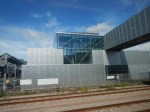
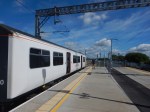
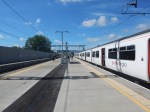
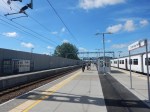


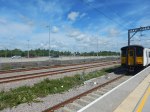
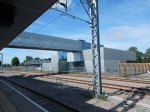

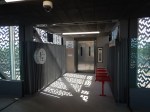
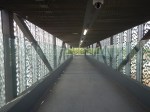

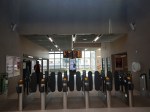



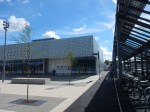
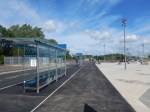


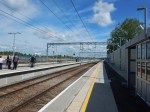
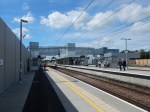
The station is probably best described as a Parkway station close to the Cambridge Science Park and the A14 on the Northern Side of Cambridge.
The station is not short of facilities and service pattern.
- Two through platforms and one bay platform, all capable of taking a 12-car Class 700 train.
- Two avoiding lines for freight trains.
- Full step-free access.
- 450 car park spaces.
- Parking under cover for a thousand bikes.
- Access to the Cambridgeshire Guided Busway.
- Close to the A14.
- Customer toilets.
- A proper ticket office and several ticket machines.
- A square outside to meet people if it’s sunny.
- Retail units and some greenery will be added later.
- Currently, it is planned for about four trains per hour to stop at Cambridge North station in each direction.
According to this article on the BBC, the station cost £44million.
It is all pretty impressive and practical.
Are Cambridge, Cambridge North, Waterbeach and Ely stations the first four stations of a Cambridge Mini-Crossrail or Metro?
Consider.
- Cambridge South station could be built close to Addenbrooke’s Hospital.
- Lines fan out from Ely to Bury St. Edmunds and Ipswich, King’s Lynn, Norwich and Peterborough.
- Lines will fan out to the South of Addenbrooke’s to Bedford, Hitchin and Kings Cross, Stansted and Liverpool Street.
- Cambridge station has more platforms than many terminal stations.
- Cambridge North station has space for extra platforms.
- A lot more trains could stop in the stations.
It will be interesting to see how the system develops in the future.
Reverse Commuting To Cambridge North Station
Cambridge North station opens on the 21st May 2017.
Around 1070, I commuted from London to Welwyn Garden City. It was much more relaxing than sharing the busy trains into London and on early trips to Cambridge in the last few years, I’ve noticed that quite a few people commute from London to Cambridge.
So given the proximity of the new Cambridge North station to the Cambridge Science Park, I wonder how many will use the service to get to and from their place of work?
The Service On Sunday, 21st May 2017
Trains would appear to be every hour at XX:42 taking about ten minutes under two hours.
The Service On Monday, 22nd May 2017
The weekday service would appear to be more comprehensive.
- 06:08 KX 1:02
- 06:44 KX 0:53
- 06:52 KX 1.14
- 07:04 KX 1:32
- 07:28 LS 1:32
- 08:04 KX 1:29
- 08:14 KX 1:00
- 08:28 LS 1:33
Note that KX is Kings Cross and LS is Liverpool Street.
All the trains shown arrive before 10:00 or a few minutes after.
Given that Thameslink will improve this service in May 2018, by adding another two trains per hour, it is certainly a good start.
Passengers At Cambridge Station
I found a reference to the passenger growth at Cambridge station, which is confirmed in Wikipedia.
In 2011/12 passengers at the station were around 9 million and in 2015/16 that had grown to around 11 million.
Consider.
- Cambridge North station opens in May this year.
- Thameslink will start services to Cambridge from all over London in 2018.
- Greater Anglia will be increasing capacity and frequency to Bury St. Edmunds, Colchester, Ipswich, Norwich, Peterborough and Stansted Airport.
So what will be the traffic in say 2020?
Are Greater Anglia Making Ipswich Station A Better Interchange?
Services In A Few Years
By the end of this decade, Greater Anglia will be running the following services through or from/to Ipswich station.
- 3 trains per hour (tph) Norwich to London, taking sixty minutes to London – Platform 2
- 3 tph London to Norwich, taking 30 minutes to Norwich – Platform 3
- 1 tph Peterborough to Colchester – Platform 2
- 1 tph Colchester to Peterborough – Platform 3
- 1 tph Ipswich to/from Cambridge – Platform 4
- 1 tph Ipswich to/from Felixstowe – Platform 0 or Platform 1
- 1 tph Ipswich to/from Lowestoft – Platform 0 or Platform 1
I have assumed a new Platform 0 is built outside of Platform 1, is as I speculated in A Good Look At Platform 1 At Ipswich Station And The Work On The Far Side.
A Service Pattern
As each of these trains has fairly clear routes in and out of Ipswich station, could we see a sequence like this at the station, at a fixed time in every hour?
- Trains from Cambridge, Felixstowe and Lowestoft arrive in their respective platforms.
- London-Norwich and Norwich-London call at the station.
- Trains leave for Cambridge, Felixstowe and Lowestoft.
As the Peterborough-Colchester service provides a second service between Ipswich and Bury St. Edmunds, this would be scheduled thirty minutes after the Cambridge-Ipswich service.
Services To Nearby Towns
It is worth showing a table of frequencies to nearby towns.
- Bury St. Edmunds – 2 tph
- Cambridge – 1 tph
- Colchester – 4 tph
- Felixstowe – 1 tph
- Lowestoft – 1 tph
- Manningtree – 4 tph
- Newmarket 1 tph
- Norwich – 3 tph
- Stowmarket – 5 tph
- Woodbridge – 1 tph
There are also places, that lack a direct service from Ipswich, such as Cambridge North, Aldeburgh, Harwich, Sudbury and Yarmouth
Independently-Powered Trains
Services from Ipswich to stations that are not on the Great Eastern Main Line, will need to use independently-powered trains.
Greater Anglia will have three possible types of independently-powered trains.
- The existing Class 170 trains, some of which may be retained.
- The new bi-mode Flirts.
- The new Aventras, which could be fitted with on-board energy storage.
All are modern trains, with at least a 100 mph capability.
Extra Services From Ipswich
Intriguingly, because the current one tph Ipswich-London service has been extended to Norwich, there is probably space to terminate another service from the South.
To the South, there are only two possibilities for extra services.
- Harwich, which already has a very limited service from Ipswich.
- Sudbury, which will be served from Colchester Town.
Neither is an obvious terminal for services, So I think it likely, that no Southern services would be added at Ipswich.
The only other possibility for extra services South from Ipswich, would be if it was decided to create a second route across East Anglia connecting Ipswich and Colchester to Cambridge and the East West Rail Link, via Sudbury and Haverhill, using the existing Gainsborough Line and a rebuilt Stour Valley Railway.
But if a Suffolk Circular Railway is ever built, it will be a long time coming.
Services along the Ipswich to Ely Line to Cambridge and Peterborough, will be as follows in a couple of years.
- Bury St. Edmunds – 2 tph
- Cambridge – 1 tph
- Ely – 1 tph
- Newmarket 1 tph
- Peterborough – 1 tph
- Stowmarket – 5 tph
It’s certainly better than it was, when I lived in the area, but there is a big new station at Cambridge North, that needs to be adequately served from Bury St. Edmunds, Ipswich and Suffolk.
Passengers from Bury St. Edmunds and Ipswich to Cambridge North will have a choice of three routes.
- Take a Peterborough service and change at Ely.
- Take a Cambridge service and change at Cambridge.
- Take a Cambridge service and change at Cambridge to the Cambridge Guided Busway.
None is ideal and the last can get stuck in Cambridge’s legendary traffic jams.
Greater Anglia’s full plans have not been disclosed, but Wikipedia says this.
- 5tph to Cambridge, with 2tph continuing to London King’s Cross; 1tph continuing to London Liverpool Street and 1tph continuing to Stansted Airport.
- 4tph to Ely, with 1tph continuing to King’s Lynn, 1tph continuing to Birmingham New Street and 1tph continuing to Norwich.
So all stations to Birmingham get a direct service, but Suffolk doesn’t!
Consider.
- Norwich-Cambridge services will be extended to Stansted, releasing a bay Platform 5 at Cambridge station.
- Trains can’t go between Cambridge North and Bury St. Edmunds will have to reverse at Ely station.
- Kennett to Ely could be double-tracked to improve freight routes between Felixstowe and Peterborough.
- Soham station could be reopened.
- This Network Rail document talks of improving connections at Newmarket.
- The East West Rail Link will connect to Cambridge at a proposed Cambridge South station.
I can see a package of work emerging, that would include.
- Dualling from Kennett to Ely.
- Provision for Soham station.
- Improvements to Ely station and the various lines in the area.
- Improvements to the junctions between Newmarket and Kennett.
- Provision for connection to the East West Rail Link.
This would enable more capacity for freight trains.
It would also allow a second Ipswich and Bury St. Edmunds service to Cambridge, via Kennett, Soham, Ely and Cambridge North stations.
- There would be capacity in Platform 4 at Ipswich and Platform 5 at Cambridge for the service.
- Between Ipswich and Bury St. Edmunds there would be three tph.
- The new station at Soham would have excellent connectivity.
- Kennett station has excellent connectivity, is surrounded by space and is close to the A14 and A11. Could it be developed as a Parkway station?
- A chord might be built at Ely to connect the lines to Cambridge and Kennett, which would avoid the reverse at Ely.
- Greater Anglia will have trains for the route.
It will be interesting to see what happens in the next few years, but services to Cambridge will call the tune.
Cambridge North Station
Cambridge North station is being built to serve the North of the city and especially, Cambridge Science Park and other developments in the area.
This Google Map shows the area.
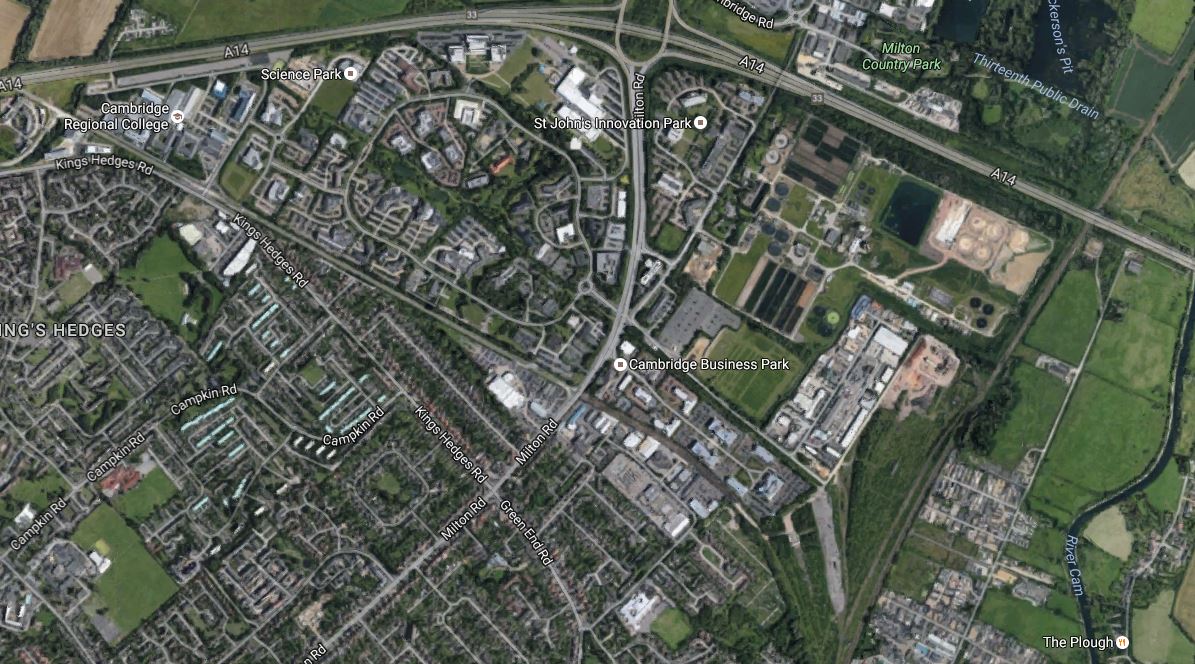
Cambridge Science Park And Cambridge North Station
Note the Breckland Line between Cambridge and Ely, which cuts across the Eastern side of the map, at a right-angle to the main A14 dual carriageway. The rail line appears to split with a loop on the North West side by a green space. The station will go in this area.
These are pictures, I took from passing trains going to and from Ely.

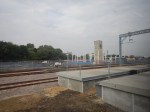


From the pictures, the following seems to be apparent.
A long island platform is being built to the North West side of the tracks.
There is a lift tower by the car and cycle parks outside of all tracks.
There is a double-track loop that by-passes the platforms.
This is the only plan I can find on the Internet.
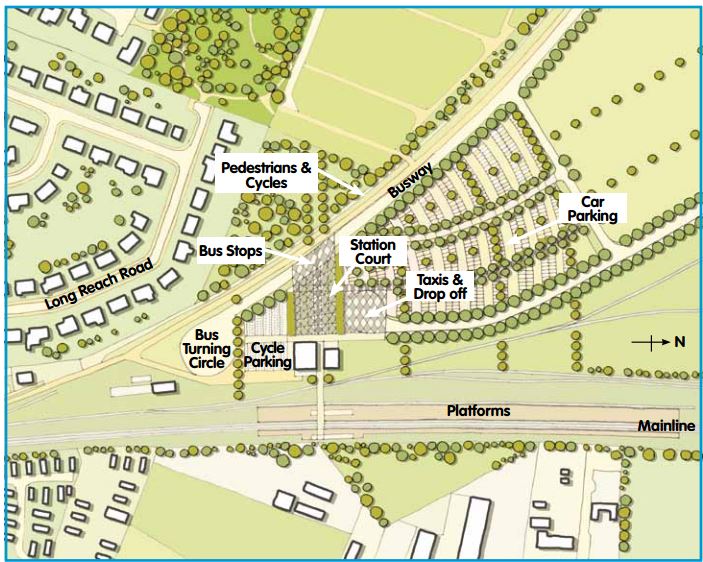
Cambridge North Station Pan
I know this about the station.
- It is proposed to have three platforms according to Wikipedia.
- Thameslink will terminate two trains per hour at the station.
- Most other services will stop at the station as they pass through.
The plan shows the main line going between the platforms, so will the double-platform in the pictures be used as a through platform for Cambridge to Ely trains and the far side as a terminating platform?
Unfortunately, when I returned to Cambridge, there were no seats on the other side of the train.
This article in European Railway Review is entitled New Cambridge North railway station taking shape – set for 2017 launch, has two pictures, which clearly show the second through platform on the South-East side of the tracks.
A few observations.
- It would appear that to go between the car or cycle park and the trains, you always need to use the bridge.
- My pictures show that the platforms are very long and will certainly handle the twelve-car Class 700 trains.
- Passengers from Thameslink needing to go to say Kings Lynn or Norwich, will just walk across the platform to get their onward train.
- Passengers from Kings Lynn and Norwich wanting to go South on Thameslink would probably change at Cambridge to avoid using the bridge.
- On the current service pattern the station would only have a one train per hour service to Peterborough.
- The station has no direct connection to Ipswich or Bury St. Edmunds.
I wonder if there are plans to allow Cambridge North station to act as a terminus for trains from the Ely direction.
Under the new East Anglian Franchise, Abellio are extending their Peterborough to Ipswich service to Colchester and making it hourly.
It is a pity, that this service can’t easily serve Cambridge North station.
This Google Map shows Ely station and the lines going South towards Cambridge.
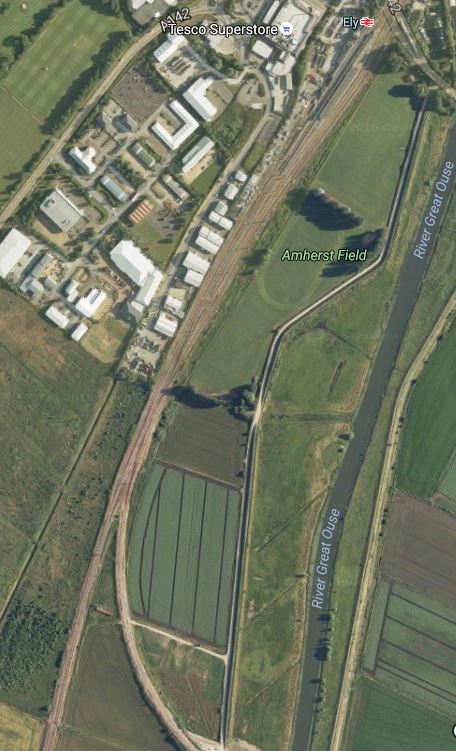
Ely Station And The Lines To Cambridge And Ipswich
Note how the line to Bury St. Edmunds and Ipswich branches off to the South-East.
If a chord were to be built allowing trains to go between Cambridge and Bury St. Edmunds, this would do the following.
- Allow the Peterborough-Ipswich service to call at Cambridge North, with just a reverse at Cambridge North.
- Give Cambridge North station a second train in an hour to and from Peterborough.
- Create a direct hourly service between Cambridge North station and Bury St. Edmunds, Ipswich and Colchester.
- When the East-West Rail Link opens, it would allow freight trains to go between that line and Felixstowe without using the single-tack Ipswich-Cambridge route.
Strangely, it doesn’t appear that this chord has ever existed.
But, I do think it will be seriously considered in the future, with the main reason being the freight route from Felixstowe to the Great Western Railway at Reading.
The Site Of Cambridge Sience Park Station
I passed this new station site on the way to Norwich.








Progress does not seem to have got past site clerance.
 The Anonymous Widower