Northern’s Latest Class 319 Trains
I took these pictures of the interior of a couple of Northern’s latest Class 319 trains.
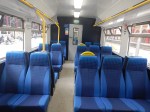
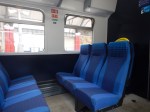
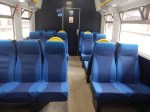

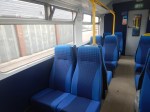
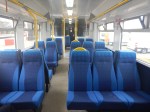
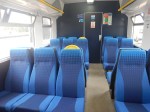

The train companies certainly seem to be improving their refurbishments, as these posts show.
- A Class 321 Renatus
- A Very Smart Class 319 Train
- Is This Really A Pacer In A New Outfit?
- It’s Not A New Train
- What Train Is This?
Personally, I hope I stick around long enough to get a ride in the following trains, that are in the line for substantial rebuilding.
- Alstom/Eversholt’s hydrogen-powered Class 321 train
- South Western Railway’s Class 442 train
- Porterbrook’s Class 769 train
- Vivarail’s Class 230 train
And of course, I want a ride in one of Great Western Railway or ScotRail’s short-formation InterCity 125.
Will We See Any Other Substantial Rebuilds?
It would be unfair not to ask this question.
I think it would be reasonable to say that if refurbishment of the quality that has been applied to Class 319 and Class 321 trains, then train owners and their engineers could probably bring the Networkers and Voyagers, up to scratch.
If nothing else, batteries could be fitted to harness the braking energy and use if for hotel power on the train.
Bombardier have hinted, they will be doing this to Voyagers and I wrote about it in Have Bombardier Got A Cunning Plan For Voyagers?
Class 230 Trains On The Conwy Valley Line
I suspect to some people, the use of Class 230 trains, which are rebuilt London Underground D78 Stock on the Conwy Valley Line is a challenge to far.
Class 230 Trains
I wrote about these trains in First D-Train With Transport for Wales In March 2019, where I stated that the train formation will be.
- DM – Driving Motor with battery
- T – Trailer with four generators
- DM – Driving Motor with battery
As the trains will have regenerative braking, this will be used to help charge the batteries.
Note that batteries and traction motors are only in the Driving Motor cars.
The Conwy Valley Line
The route of the single-track Conwy Valley Line can be summsarised as follows.
- From Llandudno to Llanrwst it is a fairly level route alongside the River Conwy.
- From Llanwrst the line climbs to a 240 metre summit in the Ffestiniog tunnel, with gradients as steep as 1-in-47.
- From the summit, the train descends into Blaenau Ffestiniog with gradients as steep as 1-in-43.
It has some of the characteristics of a roller-coaster.
Class 230 Trains On The Conwy Valley Line
Provided the trains can handle the gradients either side of the summit, they can just roll down the other side. During the descent, the regenerative braking will charge the batteries.
This will have the following effects.
- Trains on the downhill sections will not need to use their diesel engines.
- Trains waiting in Blaenau Ffestiniog station, won’t need to use their diesel engines until they start back to Llandudno.
- I suspect some Northbound services, trains would be able to reach Llandudno without using their diesel engines.
Gravity is being used as an energy store to create an efficient railway!
Energy Of A Class 230 Train On The Conwy Valley Line
I am curious to know how much energy is needed to get a fully-loaded train up the hill from Llandudno to Blaenau Ffestiniog.
Consider the following.
- A D78 Driving Motor car weighs 27.5 tonnes
- A D78 Trailer car weighs 19 tonnes
- Wikipedia says “For the Country layout, each D-train unit is to be a three-car formation, which would accommodate 163 seats along with a total capacity of 291.”
- I assume each passenger weighs 90 Kg with baggage, buggies and bicycles.
- I think it is fair to say that each generator and battery weighs about a tonne.
- The summit of the line in the Ffestiniog Tunnel is 240 metres above sea level.
- I will assume that the coastal end of the route is at sea level.
This means that the empty train weighs eighty tonnes and a full load of passengers weighs twenty-six tonnes.
Using Omni’s Potential Energy Calculator, this gives a potential energy for the train of seventy kWh, at the summit with a full load of passengers.
This figure means that if two 55 kWh batteries from a New Routemaster bus were used on the train and they were fully-charged, then they could power the train to the summit and on to Blaenau Ffestiniog.
It should be noted that Vivarail talk about using 106 kWh battery rafts on the Class 230 train.
A Few Questions
I have these questions.
Are These Class 230 Trains Serial Hybrids?
I ask this question, as it could be key to making the operation of the trains more efficient on this line.
The train would always be powered directly from the batteries.
- The diesel engines would cut in to charge the batteries, when the battery charge level got to a certain low level.
- The diesel engines would cut out, when the battery charge level, got to a certain high level.
As the train has four generator sets, an appropriate number could be used as required.
A well-trained driver or an intelligent control system could make these trains very efficient.
In this article on RAIL Magazine, this is stated.
Shooter told RAIL that the trains will save around 20% on fuel consumption.
Adrian Shooter is Chairman of Vivarail, who are creating the Class 230 trains.
Possible Electrification Of The Ffestiniog Tunnel
The Class 230 trains are created from London Underground D78 Stock and I suspect it would be possible for the Class 230 trains to be powered by third-rail electrification.
The Ffestiniog Tunnel is the summit of the Conwy Valley Line.
- It is a single-track.
- It is 3.5 kilometres long.
- One end of the tunnel is close to Blaenau Ffestiniog.
Would it be a sensible idea to electrify the tunnel either fully or partially, to top up the batteries?
Consider.
- The third-rail electrification would be no intrusion in the landscape.
- The electrification could only be switched on when a train is present.
- I don’t think supplying power would be difficult.
- There could be less need to run on diesel.
The electrification could even be extended to wards Blaenau Ffestiniog station, so that trains leaving the station could have electrical power to climb to the summit.
Will The Class 230 Trains Attract Passengers?
I think that the Class 230 trains have several passenger-friendly features.
- All new interiors.
- Ten percent more seats and almost twice the capacity.
- Lots of space for bicycles
- Large windows
- Wi-fi and power sockets
- Accessible toilet
Hopefully, there will also be step-free access between train and platform.
This package of improvements should encourage more to travel.
I also suspect, that having a decent train with a novelty appeal that connects to the Ffestiniog Railway will tap a new market of travellers.
Conclusion
I have no doubt, that Class 230 trains will be able to provide a successful service on the Conwy Valley Line.
Blaenau Ffestiniog Station
Blaenau Ffestiniog station is the interchange between the Conwy Valley Line and the Ffestiniog Railway.
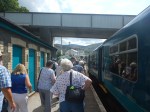
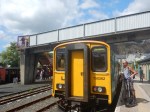
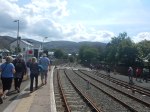
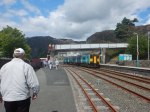
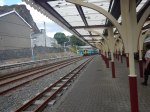
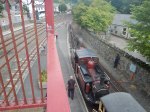
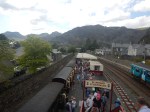
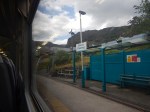
Note that as my train arrived from Llandudno, there was a Ffestiniog Railway train to take travellers to Porthmadog.
This is said in the Wikipedia entry for KeolisAmey Wales under Improvements.
Invest to co-fund new station buildings at Blaenau Ffestiniog
Consider.
- The Conwy Valley Line is scheduled to be run by new Class 230 trains from mid-2019.
- According to Wikipedia, there have been steam workings up the Conwy Valley Line.
- Blaenau Ffestiniog station has a run-around loop to put a locomotive on the other end of a train.
- The Halton Curve will open in December 2018, allowing direct and faster trains between Liverpool and Llandudno.
It would appear Transport for Wales are pulling out all the stops to bring tourists and employment to Blaenau Ffestiniog.
First D-Train With Transport for Wales In March 2019
The title of this post, is the same as that of this article on Rail Magazine.
This is the first paragraph.
The first Class 230 D-Train for Transport for Wales should be ready by March 2019, with all five in traffic from May 2019.
There are also other details.
The Train Formation
More details are given about the formation of the Class 230 trains.
- The trains will be three cars.
- The driving cars will have batteries.
- The centre car will have four generators.
When the trains were D78 Stock on the London Underground, they ran as a six-car train formed of two half-trains containing.
- DM – Driving Motor
- T – Trailer
- UNDM – Uncoupling Non-Driving Motor
The two UNDM cars were coupled together, to form the six-car train.
So is the formation of a Class 230 train as follows?
- DM – Driving Motor with battery
- T – Trailer with four generators
- DM – Driving Motor with battery
I would suspect that the DM cars are identical.
Regenerative Braking
The trains will have regenerative braking, where the energy recovered will be stored in the batteries.
In the D78 Stock, the Trailer car wasn’t motored, so unless motors are fitted in this application, the two Driving Motor cars can almost be considered two identical battery locomotives with regenerative braking, that are solely responsible for moving the train.
The Trailer Car With Power
The Trailer Car in the middle of the train contains the four generators.
The Wikipedia entry for the Ford Duratorq engine, has a section for a 3.2 litre diesel engine, where this is said.
The 3.2 is an I5 engine used in the Ford Transit, the Ford Ranger, Ford Everest, Mazda BT-50 and the Vivarail D-Train.
The standard engine has a rating of 200 hp or 150 kW.
The Class 230 train would appear to have an installed power of 600 kW.
Interiors
The article says that everything the passenger will see inside the train is new!
Performance
This is a quote from Tristan Guyard of Transport for Wales.
On the Conwy Valley and Wrexham – Bidston routes, ‘230s’ will be quicker than most other new trains built in the UK at the moment. This is because of the high proportion of motored wheels and the use of batteries to provide additional power. When these trains come into service, we will be able to improve journey times and have a more flexible timetable as soon as 2019.
The Conwy Valley Line seems a stiff route, which might get a better service with a more powerful train.
The Wrexham-Bidston route currently takes 56 minutes to go South and 58 minutes to go North, which probably makes timetabling a half-hourly service a difficult job.
Will the Class 230 trains offer enough extra performance for these services?
Perhaps this is why they have four diesel power packs.
We will find out next year, what is the toughness of these remanufactured London Underground trains!
Thoughts On The Traction System
How Does The Power Compare To Other Trains?
How powerful is the 600 kW in the Class 230 train?
By comparison. a two-car Class 156 train, has 860 kW of diesel power.
On the other hand the three-car Class 230 train has regenerative braking using batteries.
Is The Class 230 Train A Serial Hybrid?
In a serial hybrid vehicle, a power source like a diesel engine charges the battery and the battery drives the vehicle and powers internal systems.
The classic serial hybrid vehicle is a New Routemaster bus, which is powered by a 138 kW diesel engine.
In this bus., the engine starts and stops to keep the energy in the battery within a particular range.
It is a very simple control system and is regularly used in many applications, where water or temperature levels are to be kept within range.
The layout of the Class 230 train with a central power car could easily provide power to the batteries in the two Driving cars.
The train’s control system would switch the engines on and off automatically as required.
If two diesel generators supplied the battery in each Driving Car, the train could even be considered a double serial hybrid.
So this should make the train reliable, as most components of the drive-train are duplicated.
Conclusion
I sometimes feel that the Class 230 train could end up as a heroic design failure.
But then the oldest trains in service on the UK’s rail network are the London Underground 1938 Stock on the Island Line.
London Underground rolling stock seems to have a longevity, that other trains seem to have been built without!
Or is it that as the elderly fleets of the Glasgow Subway, Merseyrail and the Northern City Line seem to keep soldiering on, that spending a large proportion of your working life underground, is good for trains?
What Is It With The Welsh And Batteries?
If ordering two fleets of rail vehicles with batteries, that I wrote about in The Greening Of The Valleys, KeolisAmey Wales have now gone and ordered a third fleet for North Wales.
This article in the Railway Gazette is entitled Vivarail D-Trains For Wales & Borders.
This is the first paragraph.
Incoming Wales & Borders franchisee KeolisAmey is to take delivery of five three-car Class 230 D-Train diesel-battery multiple-units from Vivarail, which is to produce them using the bogies and aluminium bodyshells of withdrawn London Underground D78 metro trains.
Note that they are described as diesel-battery trains.
The article says the Class 230 trains will be used on these lines.
- The Borderlands Line between Wrexham and Bidston.
- The Conwy Valley Line.
- Between Chester and Crewe stations.
Five trains have been ordered, but I suspect it will eventually be more.
I believe that this picture shows a property of the Class 230 train, that would be ideal for Welsh routes or any other scenic lines.
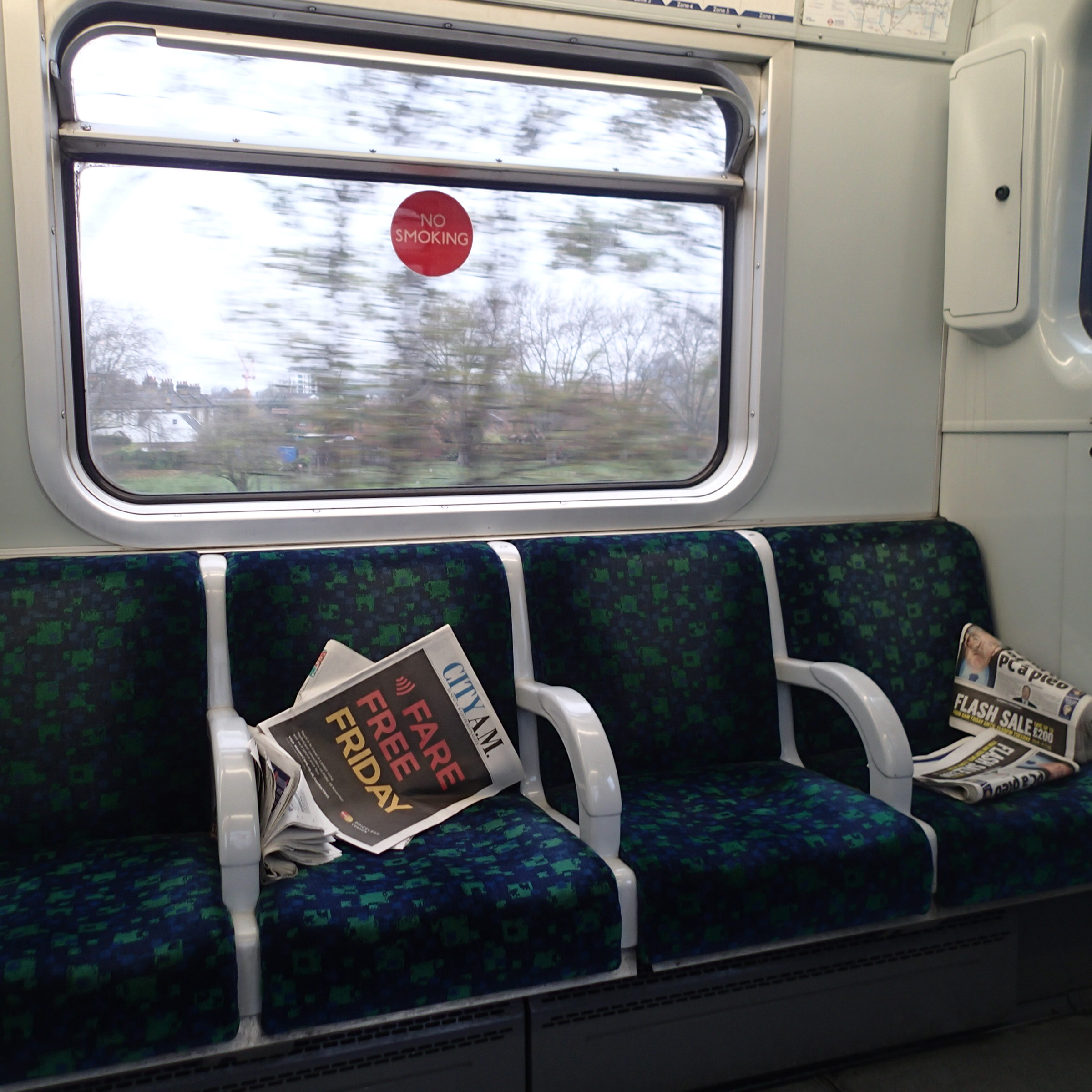
They have large windows and get the interior design right and they could become an iconic way to fill a difficult niche market.
- A reliable hourly or half-hourly service on a remote line.
- A quality interior with everything customers expect like a fully-accessible toilet, wi-fi and power sockets.
- Space for bikes, buggies, babies and wheel-chairs.
- Step-free entry between train and platform was possible at some stations on the District Line and I suspect that many stations could be made, so that wheelchairs and buggies could just roll across.
- The ability to be serviced remotely.
Note that the train is fitted with toilets from Cwmbran in South Wales.
Did Transport for Wales say, that if you fitted Welsh toilets, we’ll buy a few trains?
I suspect though, that they are much better toilets, than those I saw as a child in castles like Caernarfon, Conway and Harlech, where the inhabitants in the Middle Ages must have been quick on the job to avoid the getting shot with arrows, where it would hurt!
I suspect constipation was rare in those days!
Seriously though, here’s a video of the Class 230 trains for Wales.
This video comes from this article in this article on Wrexham.com.
How Do The Trains Work?
I obviously don’t know exactly, but I suspect the method of operation is very similar to that of some of the advanced hybrid buses, like a new Routemaster.
Each of the diesel engines have a generator, which produces electricity. This can either be fed directly to the traction motors to power the train or stored in the onboard battery.
The train’s control system manages the power and chooses, whether traction power comes from the diesel engine or the battery.
This means that the diesel engines don’t have to work all the time.
D-Train Order For Marston Vale Confirmed
The title of this post, is the same as the title of an article in the April 2018 Edition of Modern Railways.
It gives a few more details on the order from West Midlands Trains for three Class 230 trains to provide the service on the Marston Vale Line.
- The trains will be in operation in December 2018
- Two trains will operate the daily service.
- The trains will be diesel-powered.
When the trains come into operation, extra early morning and late-night services will be added from Monday to Saturday.
Battery Prototype
The article also gives more details of the battery prototype.
- The train has four battery rafts, each with a capacity of 106 kWh
- Range is up to fifty miles with a ten minute charge at each end of the journey.
- Range will increase as battery technology improves.
- The train is charged using a patented automatic charging point.
- The batteries will have a seven-year lifespan, backed by a full warranty.
- Battery rafts would appear to be interchangeable with the diesel generators.
- Hydrogen power will be used within the next few years.
The specification seems comprehensive and it would appear there is a high degree of innovative automation and well-thought-out electrical engineering.
Train Energy Consumption
The train has the following characteristics.
- Two cars
- 424 kWh of battery capacity.
- 50 mile range
This gives a consumption 4.24 kWh/per car/per mile.
In an article in the October 2017 Edition of Modern Railways, which is entitled Celling England By The Pound, Ian Walmsley says this in relation to trains running on the Uckfield Branch, which is probably not much more taxing than the Marston Vale Line.
A modern EMU needs between 3 and 5 kWh per vehicle mile for this sort of service.
I am surprised that the Class 230 train lies in the 3-5 kWh range, but then I’m not sure of the weights of the two trains.
I estimate two-car units to weigh as follows.
- Class 230 train plus batteries – Around 50 tonnes.
- Electrostar – Around 90 tonnes
- Aventra – Around 80 tonnes
I shall get some better figures, when I actually see the trains, as the weight is on the side.
The Pop-Up Train
The article talks of the concept of a low-cost pop-up train as a solution for a regional or commuter train.
Export To America?
This pop-up train could be designed to be used to demonstrate rail services in America.
Henry Posner, who is promoting the train in America is quoted as saying cities could use the train to test possible services with passengers on board ‘for less than the cost of a consultant’s study into a possible service’.
These demonstrations will be on freight lines, where for reasons of safety, the passengers trains would run during the day and freight trains at night.
Is America ready for an invasion of remanufactured forty-year-old London Underground D78 Stock trains?
Commitment To West London Orbital Rail Line
The title of this post, is the same as that of this article in Global Rail News.
This is the first three paragraphs of the article.
A new West London Orbital rail line has been included in a revised 25-year Transport Strategy for the city.
Its addition follows a public consultation. The document describes an extension of the Overground network connecting Hounslow with Cricklewood and Hendon via Old Oak, Neasden and Brent Cross.
The line would reinstate a regular passenger service on the Dudding Hill line, which links Acton and Cricklewood.
I like this proposal and I wrote about the railway in New Railway Line For West London Proposed.
In the related post, I said this about building the line.
This is no Crossrail or HS2, where billions need to be spent.
The three largest sub-projects would be.
Electrification of the Dudding Hill Line, if it is to be done.
Resignalling of the Dudding Hill Line.
Necessary track replacement and updating.
In addition, there are around ten station projects.There will also be a need for up to perhaps sixteen Class 710 trains. This could be around £90-100 million.
Since, I wrote that, things have moved on.
Trains
The first order for Class 230 trains has been placed, giving them credibility.
They could do the short routes on batteries.
But if these trains can do it on batteries, why can’t Class 710 trains?
So that means no new electrification!
Stations
Some of the stations, that will need to be built or modified, like Harlesden or Neasden, sit on sizeable brownfield sites.
Surely, property developers can be persuaded to build a station underneath much-needed housing.
It’s all about good design and very much in the Mayor’s thinking and the property developers’ interests!
Project Management
Get this right and, the line could be built simply and reasonably quickly.
The West London Orbital could be built to the following specification.
- No full electrification.
- Battery trains.
- Platforms long enough for four-car Class 710 trains.
- Bay platforms with possible charging at West Hampstead, Hendon, Hounslow and Kew Bridge stations.
- Four tph on both routes.
It lends itself to a very efficient way of building the railway.
- Update the tracks and signalling as required on the route.
- Build a platform on the freight line through West Hampstead Thameslink station.
- Build a bay platform that will accept a four-car train at Hounslow station.
- Establish a four tph shuttle service between West Hampstead Thameslink and Hounslow stations calling at Acton Central, South Acton, Brentford, Syon Lane and Isleworth.
- Stations could be built at Neasden, Harlesden and Old Oak Common, where there is a generous amount of brownfield land, with lots of space for housing above the tracks and platforms.
- Add a bay platform at Hendon and Kew Bridge stations.
- Establish a second four tph shuttle service between Hendon and Kew Bridge stations calling at Neasden, Harlesden, Old Oak Common, Acton Central and South Acton.
Note.
- Batteries would be charged South of Acton Central using the existing third-rail electrification.
- About five miles of the route would not be electrified.
- Housing developments on top of a station are a property developers dream.
The service could be started using Class 230 trains, with the option to switch to four-car Class 710 trains, powered by batteries, when more capacity is needed and Bombardier have fully developed the battery Aventra.
Will London Overground Procure Some Class 230 Trains?
Transport for London has a cash flow problem caused by various factors.
- The reduction in grant from Central Government.
- A fall in bus revenue caused by traffic congestion.
- The freeze of fares by the Mayor.
- The need to add services to stimulate much-needed housing.
This article in Rail Magazine is entitled Vivarail’s D-Trains Confirmed For Bedford-Bletchley.
As West Midlands Trains have now confirmed the order for the Class 230 trains, does this mean that buying Vivarail’s innovative refurbished London Underground D78 Stock, is now a less-risky train purchase?
Battery Or Diesel Class 230 Trains?
Would Transport for London buy a diesel or battery version of the Class 230 train?
Transport for London will have an exclusively electric fleet in a few months, when they have passed the Class 172 trains to West Midlands Trains.
I can’t believe they’d want to buy a small number of diesel trains, so I suspect they’ll go for battery versions.
Advantages Of Class 230 Trains For Transport for London
The trains must have advantages for Transport for London.
- They are simple trains, built for remote servicing.
- In some applications, their short length of just two cars must help, in that expensive platform extensions will not be needed.
- I would suspect that one two-car train is designed to rescue another.
- Capacity can be increased by adding a third-car.
- Transport for London must also have a lot of expertise on how to get the most out of these trains.
Possible Routes
There are a handful of possible routes.
Greenford Branch Line
The Greenford Branch Line must be a prime candidate for running with two-car battery version of a Class 230 train.
Consider.
- Using a four-car train, like a Class 710 train would require the platform at Greenford to be lengthened.
- A Class 230 train would only need some form of simple electrification at Greenford and/or West Ealing stations.
- Class 230 trains, would probably fit all platforms easily and give level access for wheelchairs and buggies.
- Could London Overground’s third-rail engineers add suitable electrification to charge the batteries at Greenford station?
- The branch is only four kilometres long.
- The branch only has the two tph passenger service and the occasional freight train.
- All trains use the new bay platform at West Ealing station.
One train could obviously work the current two trains per hour (tph) timetable, but could two trains and a possible spare run a four tph service on the branch?
The advantages of using Class 230 trains over a more conventional approach using perhaps Class 710 trains would include.
- No electrification of the branch.
- No platform lengthening and possibly little platform modification.
- Only a short length of third-rail electrification would be needed to charge the batteries.
- A four tph service might be possible.
The big advantage would be that it would be a low-cost project.
Romford To Upminster Line
The Romford To Upminster Line is currently run by a single four-car Class 315 train, which was to be replaced by a new Class 710 train.
In the March 2018 Edition of Modern Railways, whilst discussing nine more Class 71 trains for the London Overground, it is said, that a Class 315 train will be retained for the Romford To Upminster Line.
Why not procure another Class 230 train and use that to shuttle along the branch?
Consider.
- The electrification can be removed from the line, to save maintenance costs.
- A short length of third-rail electrification can be used to charge the batteries at Upminster station.
- The trains could be stabled at Upminster Depot.
The line used to have a short passing loop between Romford and Emerson Park station, that could be long enough for a two-car Class 230 train. If this loop were to be reinstated without electrification, if might allow a four tph service.
It would be another low-cost project.
Bromley North Line
The Bromley North Line is currently served by Southeastern.
Reading Wikipedia for the line, I get the impression, that the line isn’t a major problem, but there are little annoyances.
- Services are not frequent enough at some times of the day and week.
- Connection to services to and from London aren’t always convenient.
- It is not the easiest branch to provide with trains and drivers.
In addition, Southeastern would appear to be amenable to pass the line to Transport for London.
The track layout for the line has the following characteristics.
- Double-track throughout.
- There is a single platform at Grove Park station.
- There are two platforms at Bromley North station.
- The intermediate station; Sundridge Park has two platforms.
It looks like the line was designed so that two trains can operate simultaneously.
- Two Class 230 trains could run a four tph service.
- Stabling and servicing could be in Bromley North station.
- Trains could be third-rail or battery.
- A spare train could be held ready if it was felt needed.
It would be a self-contained low-cost solution.
Epping To Ongar
The Epping to Ongar service on the Central Line is no more, but would it be viable now with a Class 230 train?
Brentford Branch Line
The Brentford Branch Line has been proposed for reopening.
Class 230 trains powered by batteries would be ideal rolling stock.
The trains would be charged in Southall station.
West London Orbital
This article on Global Rail News is entitled Commitment To West London Orbital rail line.
This is said.
A press release distributed by the office of London Mayor Sadiq Khan said: “This new line, delivered through TfL, the West London Alliance, boroughs and Network Rail, could potentially support the delivery of an additional 20,000 homes, as well as employment growth in west London.”
In this article on Ian Visits, this is said about the service on the proposed West London Orbital line.
Phase 1: 4 trains per hour from West Hampstead to Hounslow, calling at West Hampstead, Cricklewood, Neasden, Harlesden, OOC, Acton Central, South Acton, Brentford, Syon Lane, Isleworth, Hounslow.
Phase 2: additional 4 trains per hour from Hendon to Kew Bridge, calling at Hendon, Brent Cross/Staples Corner, Neasden, Harlesden, OOC, Acton Central, South Acton, Kew Bridge.
The track is all in place and with a new bay platform at Hounslow, Class 230 trains could work Phase 1 on batteries with ease.
The key to the intermediate stations is property development. At Neasden, Harlesden and Old Oak Common, there is a lot of spare land around the Dudding Hill Line, where the trains will run. Developers will be told to build an appropriate amount of housing with a new station underneath.
The West London Orbital could be built to the following specification.
- No full electrification.
- Battery trains.
- Platforms long enough for four-car Class 710 trains.
- Bay platforms with possible charging at West Hampstead, Hendon, Hounslow and Key Bridge stations.
- Four tph on both routes.
It lends itself to a very efficient way of building the railway.
- Build a platform on the freight line through West Hampstead Thameslink station.
- Build a bay platform that will accept a four-car train at Hounslow station.
- Establish a four tph shuttle service between West Hampstead Thameslink and Hounslow stations calling at Acton Central, South Acton, Brentford, Syon Lane and Isleworth.
- Stations could be built at Neasden, Harlesden and Old Oak Common, where there is a generous amount of brownfield land, with lots of space for housing above the tracks and platforms.
Note.
- Batteries would be charged between Acton Central and Hounslow using the existing third-rail electrification.
- About five miles of the route would not be electrified.
- Housing developments on top of a station are a property developers dream.
The service could be started using Class 230 trains, with the option to switch to four-car Class 710 trains, powered by batteries, when more capacity is needed and Bombardier have fully developed the battery Aventra.
Phase two of the project would need development of platforms at Hendon and Kew Bridge stations.
The beauty of the West London Orbital, is that the only costs for Transport for London are four new platforms, some track-work and a fleet of new trains.
Hopefully, the development of the intermediate stations would be down to property developers, as they will make a fortune out of the housing!
Conclusion
I think the answer to my original question posed in the title of this post is Yes!
Vivarail To Supply Three D-Trains To West Midlands Trains
The title of this post is the same as this article on Rail Technology Magazine.
This order has been a long time coming and the three Class 230 trains will be used by West Midlands Trains on the Marston Vale Line, from December 2018.
Whether they will be diesel or battery versions of the Class 230 trains is not stated.
Enlightening Facts On Battery Trains
This article In Rail Magazine is entitled Vivarail Targets Summer Running For New Battery Unit.
The article says some enlightening things about the battery version of the Class 230 train.
- Four batteries are provided on the two-car train.
- The total battery capacity is 106 kWh. (Note: It has since been disclosed that the total battery capacity is 424 kWh!)
- An eight minute recharge is needed at the end of each run.
- A ten minute recharge gives a range of fifty miles.
Nothing is said of the speed and acceleration of the train on battery power.
How would these figures fit Vivarail’s order for three trains from West Midlands Trains to serve the Marston Vale Line?
- The route is approximately twenty-five miles long.
- Trains currently take forty-three minutes with ten stops.
- Overhead electrification could be available at both ends of the line, as both Bedford and Bletchley station are on 25 KVAC main lines.
Do the sums!
 The Anonymous Widower