Screening For Coeliac Disease
People ask me if they should be screened for coeliac disease.
This page on Coeliac UK is entitled Screening For Coeliac Disease.
They quote this advice from NICE.
NICE has advised that people with close relatives (for example father, mother, son, daughter, brother, sister) are at increased risk of coeliac disease and so should be considered for screening. This would involve having a blood test in the first instance.
That sounds fairly sensible to me.
Coronavirus: Can I Be Infected By Touching Surfaces?
The title of this post is the same as that of an article on The Sunday Times.
The article is worth reading.
These two paragraphs some up the latest thoughts on infection from surfaces.
Monica Gandhi, a professor of medicine at the University of California, San Francisco, told the US science website Nautilus that there had been “a lot of fear” at the beginning of the pandemic about transmission of the virus if people touched their faces after contact with metal, plastic or other contaminated surfaces, collectively known to scientists as fomites.
Yet the evidence suggests that the virus on most surfaces is not strong enough to make people ill. “It’s not through surfaces,” she added. “It’s from being close to someone spewing virus from their nose and mouth, without in most cases knowing they are doing so.”
I travel around the Underground a lot and I’m always masked, when I enter stations and usually use the hand-sanitisers, at least once on a trip. Most in London, seem to be acting similarly.
There has been no scares about using the Underground because of high-rates of the covids in recent months, that I can find.
More importantly, under a sub-title of Why Are Young Women The Targets Now?, this is the first paragraph.
The disease that ravaged care homes and turned the elderly into hermits for much of the spring has taken aim at different targets this autumn. Public Health England’s most recent statistics show that the 20-29 age group has had the most new cases since the end of June, followed closely by the 30-39 age group. In both those groups, more women are being infected than men.
This is paragraph is from the NHS web site.
Reported cases of coeliac disease are around 3 times higher in women than men. It can develop at any age, although symptoms are most likely to develop: during early childhood – between 8 and 12 months old, although it may take several years before a correct diagnosis is made.
Could this paragraph partly explain, the fact that women in their twenties and thirties are suffering from the covids?
Coeliac disease affects one in fifty of the population.
As a coeliac, it’s no hard task to stick to a gluten-free diet.
And I get the bonus of being 25 % less likely to suffer from cancer, according to peer-reviewed research from Nottingham University.
The Small Sign That Means So Much To A Coeliac
I’ve bought Marks & Spencer’s mackerel pate for any years.
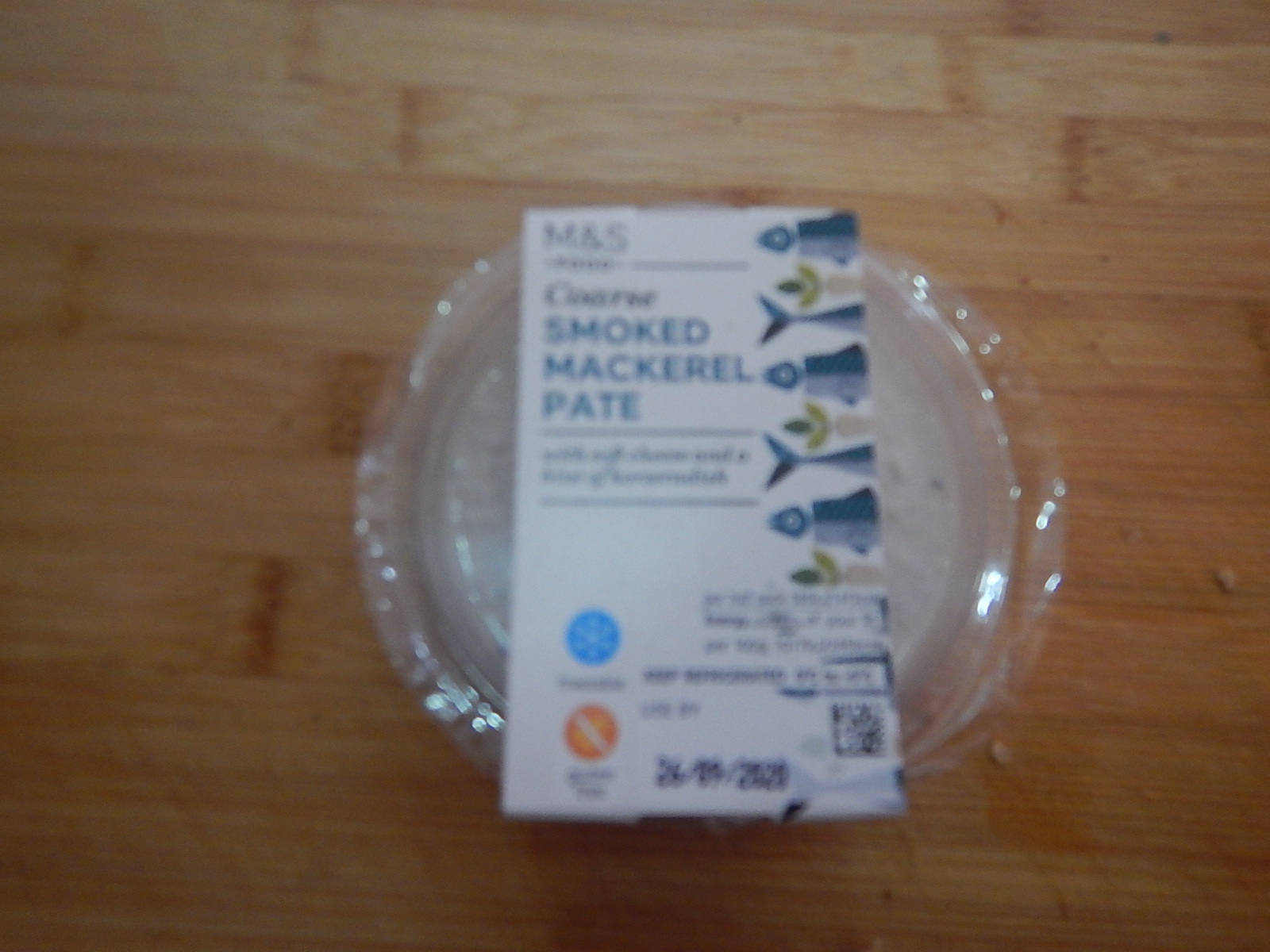
It’s the first time, I’ve noticed the packaging has the gluten-free symbol.
More please! My eyesight needs glasses to read the allergies!
Thoughts On COVID-19 On Merseyside
Merseyside is in trouble with the covids.
These are the number of lab confirmed cases per 100,000 population for local authorities in the area, as of the 1st October 2020.
- Halton – 1108.1
- Knowsley – 1388
- Liverpool – 1244.5
- Sefton – 1037.6
- St. Helens – 1230.4
- Wirral – 1185.5
My London Borough of Hackney, which is demographically, a bit like poorer parts of Liverpool, has a rate of 524.3.
But the gold standard to my mind is Cambridge, which has a rate of only 380.6.
Oxford, which is a very similar city to Cambridge has a much higher rate of 799.5,
Why Is Cambridge Doing So Well?
I was diagnosed as a coeliac at Addenbrooke’s Hospital in Cambridge, twenty-three years ago.
According to my consultant in the City at the time, Cambridge has a VERY high level of diagnosed coeliacs.
He told me, that he had more coeliac patients, than any other gastroenterologist in the UK.
So why is the number of coeliacs so high in Cambridge?
I feel it is because Cambridge had a Whack-a-Coeliac policy in the 1990s, where they attempted to diagnose as many coeliacs as they could find.
I was certainly diagnosed at that time and judging by the speed they did the initial diagnosis, I suspect, they were using one of the first genetic tests. They were also doing endoscopies without anaesthetic to increase throughput!
Coeliacs, Cancer And The Covids
Diagnosed coeliacs on a gluten-free diet have a strong immune system, which helps protect them from cancer, as has been shown by Joe West at Nottingham University.
I should also add, that none of my coeliac acquaintances have had a severe dose of the covids.
So does our stronger immune systems give us protection from the covids?
This could explain, why an area like Cambridge has a lower level of the covids than Oxford.
Why Is Merseyside In Trouble?
The Irish, because of historic famine, have higher levels of coeliac disease.
Comedians from the City have joked about Liverpool being the capital of Ireland for decades.
Could it be that there is a high percentage of undiagnosed coeliacs on Merseyside?
If this is true, could these undiagnosed coeliacs, with poorer immune systems, be easy pickings for the covids?
Conclusion
These actions should be taken.
- Merseyside needs a Whack-a-Coeliac policy, if it doesn’t have one! It would certainly, improve cancer rates!
- Every in-patient with the covids, should be given a quick blood test for coeliac disease.
- Other research needs to be done to find out the any link between coeliac disease and the covids!
Not for nothing is coeliac disease regularly called the Many-Headed Hydra by some doctors and researchers.
Suzie’s Cup Of Joy
It must be very difficult for small cafes in this pandemic, but Suzie’s Cup of Joy in Cleethorpes seemed to be managing. They were certainly doing all the right things.




I had a gluten-free breakfast there on Wednesday.
I would have sat outside, but it was rather breezy.
Lunch At Cafe Piazza In The Hays Galleria
I had a gluten-free lunch in Caffe Piazza in the Hays Galleria near to London Bridge station.

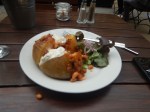


I only had a baked potato and chilli con carne with a glass of wine, but that was all I needed.
I’ll definitely go back again.
Care Homes In England Had Greatest Increase In Excess Deaths At Height Of The COVID-19 Pandemic
The title of this post, is the same as that of this article on the University of Stirling web site.
This is the introductory paragraph.
Care homes in England experienced the highest increase in excess deaths at the height of the COVID-19 pandemic compared to those in the rest of the UK, according to new research.
The actual figures are as follows.
- England – 79 %
- Northern Ireland – 46 %
- Scotland – 62 %
- Wales – 66 %
So why are the three Celtic nations, doing better than England?
In A Thought On Deaths Of The Elderly From Covid-19, I said this.
How many undiagnosed coeliacs are there in those over seventy, who because they are coeliacs, have a compromised immune system?
I would be undiagnosed but for that elderly locum!
How many other coeliacs are there in the UK population?
-
- Age UK has a figure of twelve million who are over 65 in the UK.
- If 1-in-100, as stated by Coeliac UK, in the UK are coeliac, that is 120,000 undiagnosed coeliacs over 65.
Will these 120,000 people have a compromised immune system, that makes them more susceptible to Covid-19?
It has been said, that a good immune system helps you fight Covid-19!
If those 120,000 elderly undiagnosed coeliacs have a compromised immune system, how many are in poor health with cancer, arthritis and general poor health and have decided that a care home is best.
Coeliac Disease And The Celts
The Irish have a history of coeliac disease, which I have heard suggested goes back to the potato famine.
Certainly, the whole island of Ireland is a coeliac friendly place compared to some parts of England. Although, Liverpool with its strong Irish heritage is an exception.
Conclusion
I do wonder, if understanding of coeliac disease in the three Celtic nations is better than it is in England and a higher proportion of elderly coeliacs have been diagnosed.
Any younger coeliac born after about 1980, has probably been picked up, for the simple reason, that most GPs these days take regular blood tests and do seem to be more knowledgeable about the disease than GPs were before about 1980.
According to my GP, to test a child, is normally just a simple blood test and an analysis at a lab. Only a few cases, will need an endoscopy.
So do we have this population of undiagnosed coeliacs with compromised immune systems in English care homes?
Perhaps, everybody in a care home, should be tested for coeliac disease?
If nothing else, it may save money on cancer care, as diagnosed coeliacs on a gluten-free diet are 25 % less likely to suffer from cancer.
Pancreatic Cancer Deaths Around The World
This data is from a web site called World Life Expectancy.
My son died at just 37 and if I can save one person’s family, from the same anguish, that I have suffered, it would have been worth it.
The data is World Health Organisation data from 2018, and the figures shown are as follows.
- Age adjusted death rate per 100,000 of the population
- World ranking
- Rating in the country of pancreatic cancer amongst all deaths.
The country name links to the data.
- Argentina – 7.78 – 31 – 16
- Armenia – 10.34 – 3 – 15
- Australia – 6.25 – 50 – 13
- Austria – 9.13 – 10 – 12
- Bangladesh – 0.77 – 176 – >50
- Barbados – 7.99 – 22 – 22
- Belgium – 7.34 – 38 – 12
- Bulgaria – 7.91 – 25 – 15
- Cambodia – 1.79 – 139 – 48
- Canada – 6.40 – 47 – 13
- China – 4.07 – 85 – 22
- Cote d’Ivoire – 3.81 – 88 – 48
- Croatia – 8.05 – 18 – 15
- Cyprus – 6.50 – 45 – 15
- Czech Republic – 9.89 – 5 – 14
- Denmark – 8.51 – 16 – 12
- Estonia – 9.26 – 6 – 15
- Ethiopia – 1.16 – 165 – >50
- Finland – 8.78 – 11 – 11
- France – 7.92 – 24 – 10
- Germany – 8.68 – 14 – 13
- Greece – 7.36 – 37 – 10
- Haiti – 2.99 – 107 – 42
- Hungary – 11.35 – 1 – 13
- Iceland – 9.21 – 7 – 10
- India – 1.63 – 146 – >50
- Iran – 2.28 – 128 – 27
- Iraq – 1.39 – 99 – 37
- Ireland – 6.83 – 40 – 14
- Israel – 9.18 – 8 – 12
- Italy – 7.41 – 36 – 10
- Japan – 8.74 – 12 – 10
- Laos – 1.15 – 167 – >50
- Latvia – 6.72 – 13 – 14
- Lithuania – 8.21 – 19 – 15
- Luxembourg – 8.15 – 20 – 12
- Malta – 10.01 – 4 – 11
- Netherlands – 8.38 – 17 – 11
- New Zealand – 5.69 – 53 – 15
- Niger – 1.77 – 142 – 50
- Nigeria – 2.30 – 120 – >50
- Norway – 7.78 – 30 – 11
- Pakistan – 0.51 – 182 – >50
- Russia – 7.86 – 29 – 20
- Slovakia – 9.17 – 9 – 14
- Slovenia – 8.55 – 15 – 12
- South Africa – 4.89 – 71 – 33
- South Korea – 6.75 – 42 – 15
- Spain – 6.32 – 49 – 11
- Sweden – 8.15 – 21 – 12
- Switzerland – 7.49 – 34 – 11
- United Kingdom – 6.55 – 44 – 14
- United States – 7.96 – 23 – 17
- Uruquay – 10.72 – 2 – 15
- Vietnam – 0.75 – 178 – 50
These are a few of my thoughts.
The Top Ten Countries
These are the top ten countries.
- Hungary
- Uruguay
- Armemia
- Malta
- Czech Republic
- Estonia
- Iceland
- Israel
- Slovakia
- Austria
The full list is on the World Life Expectancy web site.
From the top ten, it looks to me, that pancreatic cancer seems to be common in the old Austro-Hungarian Empire.
I also think there could be a Jewish connection.
In the history of Jews in the Austro-Hungarian Empire on Wikipedia, this is an extract, that talks about Jews around 1900.
In that period, the majority of Jews in Austria-Hungary lived in small towns (shtetls) in Galicia and rural areas in Hungary and Bohemia; however, they had large communities and even local majorities in the downtown districts of Vienna, Budapest and Prague. Of the pre-World War I military forces of the major European powers, the Austro-Hungarian army was almost alone in its regular promotion of Jews to positions of command. While the Jewish population of the lands of the Dual Monarchy was about five percent, Jews made up nearly eighteen percent of the reserve officer corps. Thanks to the modernity of the constitution and to the benevolence of emperor Franz Joseph, the Austrian Jews came to regard the era of Austria-Hungary as a golden era of their history.
That doesn’t sound like they were suffering large amounts of anti-semitism, as they had for a long time in the Baltic States and East Prussia, where my ancestor emigrated to England around 1800.
I need some help here from a Jewish historian.
But the statistics and geography are indicating to me, that Jews from the Austro-Hungarian Empire could have chosen to emigate through the Balkans to Palestine, when they saw the way the tide was turning after World War One.
I know a bit about life in Palestine in the 1930s, because at one period of my life, my next-door neighbour was a retired British Officer, who was stationed in the country. He was actually in the King David Hotel, when it was blown up. Charles is long-dead now, but I wished I’d recorded his memories, as in today’s Middle East climate, they would be an unusual insight.
But why Iceland, Malta and Uruguay?
Ireland And The United Kingdom
As could be expected, Ireland and the United Kingdom are fairly close together in the table; at 40 and 44 respectively.
- Just men and the positions are 49 and 51.
- Just women and it’s 37 and 42.
In the tables, Canada and Australia are just below the United Kingdom, with New Zealand a few places further down.
Cambodia, Laos And Vietnam
To a coeliac like me, Cambodia is interesting, as they are reckoned to have the most gluten-free cuisine in the world.
But these three countries, are all in the bottom third of the table, along with some other major countries, whose food has a lot of rice; Bangladesh, India, Myanmar, Pakistan and Thailand.
I know gluten affects my health, but if your diet contains little gluten, does that lower, your chance of getting pancreatic cancer?
Coulsdon South Station Has Gone Step-Free
Coulsdon South station went step-free a couple of months ago, so I went to take a look.
















These are my thoughts.
The Bridge
Mechanically, the bridge is typical of many in the UK, but someone has taken care over the design, by the use of well-chosen colours and bricks.
The Café
We need more station cafes like Jaconelli’s Espresso Bar.
- Full range of proper coffee and other drinks.
- Cakes and snacks.
- Gluten-free options.
- Wude selection of alternative milks
- Knowledgeable and friendly staff.
I suspect it is also owner-managed, as most cafes of this type would be in Italy.
It’s one of the best cafes of its type, that I’ve found in a long time.
The Old Bridge
According to one of the guys in the café the old bridge needed replacing.
But leaving it intact, gives the young, fit or agile a second route across the tracks.
Local Walks And Attractions
There are walks nearby in the Surrey Hills and on the London Loop.
I was also told, that you can get a bus to the Lavender Fields.
Zone Six Station On Thameslink
The station is in Zone Six, which puts it in Freedom Pass territory.
It also has two Thameslink and two Southern trains per hour, so it is easily reached.
Car Parking And A Taxi Service
This Google Map shows the station.
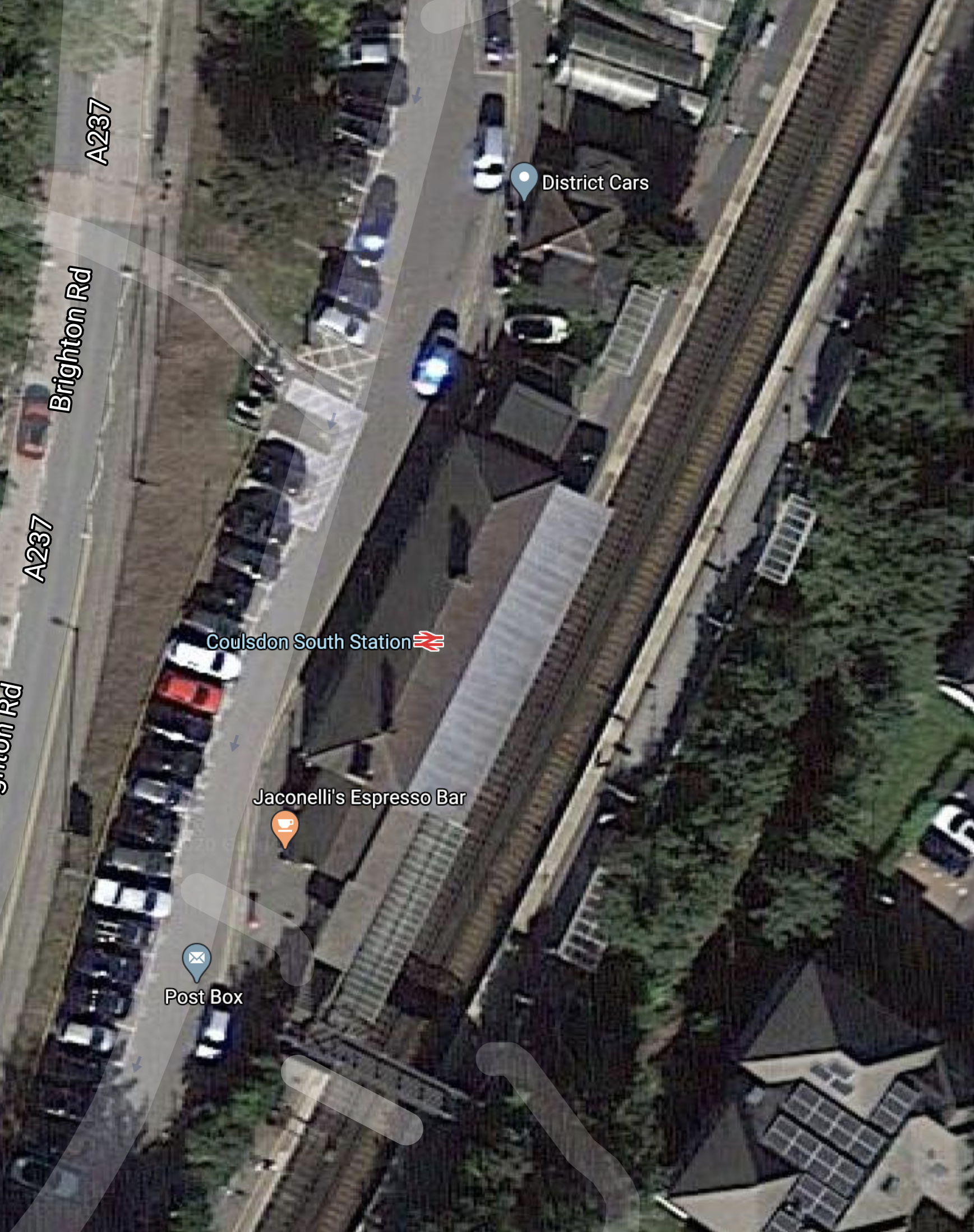
Note the car parking and a taxi service, which is called District Cars.
Conclusion
Coulsdon South is now a very well-equipped station and it must be an ideal place to meet a friend, family member or work colleague to either have a chat or a serious discussion.
Surely, with more people continuing to work from home, the need for meetings between those in the office and those at home will grow! Zoom etc. can only do so much and the cpncept doesn’t suit everybody!
So perhaps we’ll see more community-managed meeting rooms, like the one I described in The Newly-Decorated White Horse Room In Westbury Is Open For Bookings.
Coeliac Disease And Sex Of The Sufferer
This page on the NHS web site is an overview of coeliac disease.
Under Who’s Affected, this is said.
Coeliac disease is a condition that affects at least 1 in every 100 people in the UK.
But some experts think this may be underestimated because milder cases may go undiagnosed or be misdiagnosed as other digestive conditions, such as irritable bowel syndrome (IBS).
Reported cases of coeliac disease are around 3 times higher in women than men.
It can develop at any age, although symptoms are most likely to develop:
during early childhood – between 8 and 12 months old, although it may take several years before a correct diagnosis is made
in later adulthood – between 40 and 60 years of age
People with certain conditions, including type 1 diabetes, autoimmune thyroid disease, Down’s syndrome and Turner syndrome, have an increased risk of getting coeliac disease.First-degree relatives (parents, brothers, sisters and children) of people with coeliac disease are also at increased risk of developing the condition.
The page is fairly definite, that women are three times more likely to be coeliac than men!
 The Anonymous Widower